
Last updated: October 1, 2026
The Zayed Sustainability Prize, the UAE's flagship global sustainability award based in Abu Dhabi, announced on 28 September 2026 the names of its 33 finalists for the 2027 edition, following a record-breaking cycle that drew 10,233 submissions from 177 countries — a 32% increase over the previous round and the highest participation in the prize's history since its founding in 2008. Winners will be revealed on 12 January 2027 during the Abu Dhabi Sustainability Week awards ceremony, where each winning organisation takes home US$1 million and each winning school US$150,000.
A record 10,233 entries from 177 countries
The headline number of this cycle is not the finalist count but the sheer scale of global demand. The prize received 10,233 submissions from 177 countries, up 32% year on year — the highest participation ever recorded. In practical terms, that pushes the odds of reaching the shortlist to roughly 0.3% of all entrants, making a finalist seat statistically harder to win than admission to most Ivy League universities.
These are not ceremonial statistics. Named after the founding father of the UAE, Sheikh Zayed bin Sultan Al Nahyan, the prize says its funded projects have positively impacted more than 411 million lives worldwide — a figure that has quietly turned this annual competition into one of the planet's largest financing platforms for grassroots sustainability solutions.
The prize's own trajectory explains much of that growth. It launched in 2008 as the Zayed Future Energy Prize, focused exclusively on clean energy, and was re-established in 2019 under its current name with categories spanning health, food, water and global high schools, before climate action completed the current six-category format. Each added category opened the door to an entire industry of small organisations that previously had no global competition offering financing at this scale — which is precisely why a single cycle can now grow submissions by 32%.
Read the 177-country figure correctly and it says something more radical: small island and developing states — Mauritius, Fiji, Bhutan — compete on equal footing with the world's largest economies. The jury awards no geographic priority; documented impact counts, wherever it happens. That is why the shortlist holds a school from the villages of the Democratic Republic of the Congo and another from the Pacific islands alongside American and European institutions.
How the 33 seats are distributed across six categories
The 2027 shortlist spans six categories: five organisational ones — Health, Food, Energy, Water, and Climate Action — each featuring three finalists from small and medium enterprises (SMEs) and non-profit organisations, plus the Global High Schools category, which fields 18 finalist schools, three from each of six world regions.
More consequential than the distribution is the funding rule introduced with the 2026 cycle and retained this year: every finalist is guaranteed money. Each organisational finalist receives US$100,000 regardless of the final outcome, and each finalist school receives US$25,000. Winners then take US$1 million per organisation and US$150,000 per school. Reaching the shortlist has, in effect, become a financial achievement in its own right.
The Arab story of this cycle: three Arab schools in the finals
In the Global High Schools category for the Middle East and North Africa, all three finalist seats are held by Arab schools:
- Applied Technology Schools, Ajman (UAE) — the emirate's sole representative in the schools category this year, competing with a student-led sustainability project.
- Inkhil Secondary School (Syria) — a Syrian school reaching the finals of a global competition of this scale is exceptional by any measure, and a reminder that Syrian students can compete internationally against enormous odds.
- Rachaya High School (Lebanon) — completing a clean Arab sweep of the MENA region's three seats.
This triple presence guarantees that at least one Arab school will bank US$25,000 as a guaranteed finalist, with a live shot at converting it into US$150,000 on 12 January 2027. Arab participation is not confined to schools, either: the organisational categories pit Nigerian, Indian, Bolivian and Bangladeshi entities against one another — a genuinely Global South-heavy finale.
The global contenders to watch: from water robots to cellulose batteries
The 2027 shortlist reads like a preview of the next decade of climate technology:
- Health: US-based Elythea uses AI to predict pregnancy complications six to eight months in advance, with more than 63,000 beneficiaries so far; the Netherlands' GOAL 3 has reached 157,000 people across 48 hospitals; and Spain's Marsi Bionics builds exoskeletons that have restored mobility for more than 3,000 children through 67 devices.
- Energy: Singapore's Flint has developed a cellulose battery — a biodegradable unit made from wood fibre — with production capacity of up to 400,000 units a month; Nigeria's Energy Assured has reached 4.6 million people, including 1.3 million farmers; and India's Sustain Plus has deployed more than 34,000 clean-energy solutions.
- Water: India's Solinas builds robots that detect leaks and save up to 600,000 litres of water per day for every kilometre of pipeline, competing against Fundación Aguatuya (Bolivia) and Rupantar (Bangladesh).
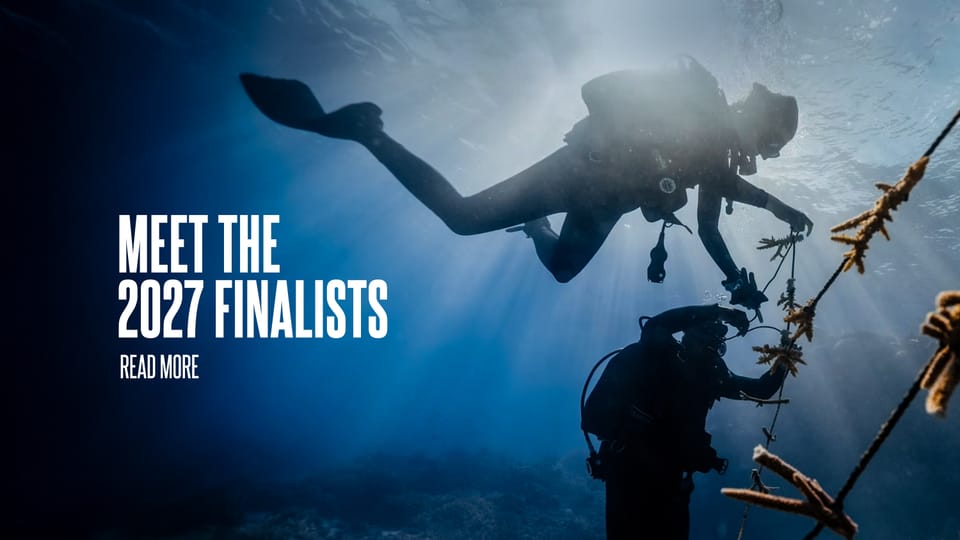
- Climate Action: French Polynesia's Coral Gardeners has planted more than 221,000 coral fragments across 25,100 square metres of reef, while India's String Bio makes CleanRise, a product that cuts methane emissions by up to 50% while raising yields by 39%.
- Food: an American SME raised crop yields by 30–200% across 13 million acres; a Japanese finalist restored 50,000 hectares with biochar; and a Colombian company protected billions of litres of water by recovering whey.
A lesson from the last cycle: what winners did with the money
For anyone tempted to dismiss the prize as a press event that ends the moment winners are announced, the 2026 cycle offers a counter-example. At the January 2026 ceremony, Nepal's Build up Nepal won the Climate Action category for its low-carbon earth-brick construction model — completing the full institutional arc in one cycle: submission, assessment, shortlist, then a US$1 million win channelled into field expansion. That completed loop — from entry to scale — is exactly what the prize repeats every January, and it answers the practical question of "what happens after the gala?": the money goes into production lines, jobs and additional beneficiaries who are tracked in annual impact reporting.
That is also why the 12 January 2027 ceremony is a beginning rather than an end. The six winners join a prize alumni network that now spans dozens of organisations across six continents, and they present on the main stage of Abu Dhabi Sustainability Week in front of policymakers, investors and industry leaders.
What exactly is Abu Dhabi Sustainability Week?
Abu Dhabi Sustainability Week (ADSW) is a global platform hosted every January in the UAE capital by Masdar, the Emirati clean-energy company, since 2008. It gathers heads of government, corporate leaders, academics and youth under one roof for days of ministerial summits, youth forums and energy dialogues. The prize is not the only highlight crowned during the week, which explains the September-to-January rhythm: the months between the finalists' announcement and the ceremony are used for final assessment, presentation commitments and media preparation before the shortlist takes the final stage.
How entries are judged: a two-round process
The ten thousand submissions pass through a two-stage funnel before the shortlist is finalised: an initial review weighing the strength and novelty of the technical or social model, then a deeper jury examination demanding the numbers and documentation that prove field impact — actual beneficiaries served, audited units of measurement, independent reports where they exist — plus the solution's ability to scale and replicate in other contexts. The difference between an entry rejected in round one and a finalist with guaranteed funding is therefore not a moving story but an auditable impact file: the figures quoted for each finalist above (157,000 patients across 48 hospitals, 221,000 coral fragments, 600,000 litres of water saved per kilometre per day) are not marketing copy; they are the substance that earned the seat, and the same standard will decide the six winners in January.
Who runs the prize?
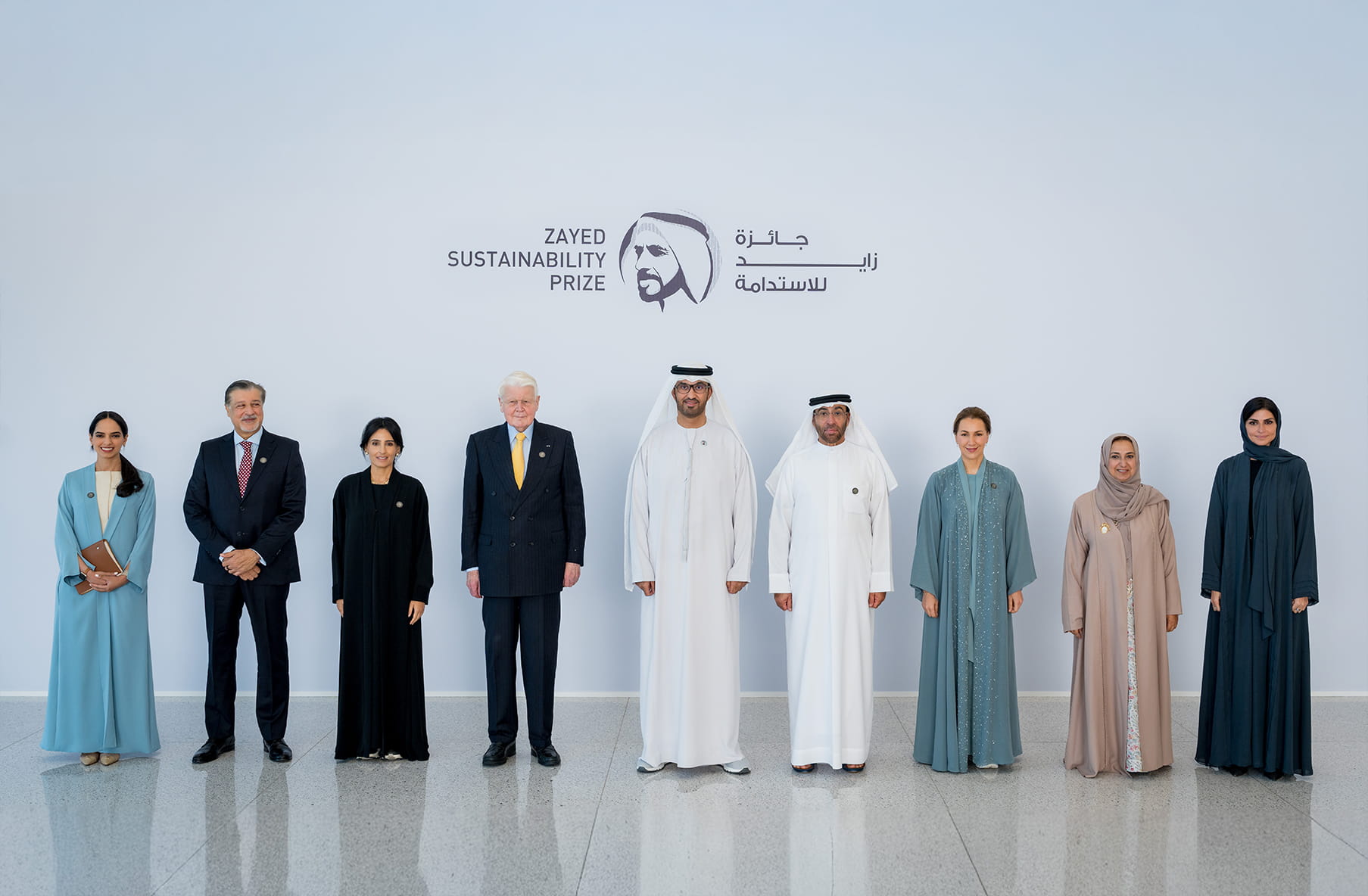
The Zayed Sustainability Prize is led by H.E. Dr. Sultan Ahmed Al Jaber, UAE Minister of Industry and Advanced Technology and Director General of the prize, with the jury chaired by former President of Iceland Ólafur Ragnar Grímsson. Jurors from across the continents assess entries in two rounds before the shortlist is finalised and the six winners are announced at the closing ceremony.
What this means for you in practice
If you run a startup or non-profit working in health, food, energy, water or climate action — or you are part of a secondary-school team with a student-led project — this announcement matters to you for three reasons:
- The guaranteed funding rule means a finalist seat alone unlocks US$100,000 for organisations and US$25,000 for schools — enough to turn a pilot into a real product without bank loans or equity dilution.
- The next cycle is around the corner: submissions for the 2027 edition opened in January 2026, and the 2028 call is accordingly expected to open in early 2027 through the prize's official website. Early preparation — documented impact, verifiable numbers, independent reporting — is what separates a passing entry from a finalist.
- The prize rewards impact, not slogans: every 2027 finalist presented auditable figures (beneficiaries served, litres saved, hectares restored). That is the working standard to build your file against from day one.
And because the ceremony sits inside Abu Dhabi Sustainability Week, the run-up to January 2027 is rich with parallel opportunities in the UAE capital — notably the fully funded IRENA Youth Forum 2027 at Masdar City, which brings young people into the same week of events, alongside the current list of fully funded open scholarships and the guide to the UAE's five fully funded university scholarships for anyone aiming to study sustainability in the Emirates themselves.
Frequently asked questions about the Zayed Sustainability Prize 2027 finalists
When will the 2027 winners be announced?
On 12 January 2027, at the awards ceremony held during Abu Dhabi Sustainability Week in Abu Dhabi, UAE.
How many finalists are there in the 2027 edition?
Thirty-three: 15 organisations (three in each of the five organisational categories) and 18 secondary schools from six world regions.
Do finalists receive funding even if they lose?
Yes. Since the 2026 cycle, every organisational finalist receives US$100,000 and every finalist school US$25,000, while winners receive US$1 million and US$150,000 respectively.
What are the six categories?
Health, Food, Energy, Water and Climate Action for SMEs and non-profits, plus the Global High Schools category for student-led projects.
How can I enter the 2028 edition?
Submissions are expected to open in early 2027 via the official prize website, mirroring the January 2026 opening of the 2027 call. Organisations need a documented-impact solution in one of the five categories; schools need an existing student-led project.