
WhatsApp Business API Now Charges for Service Messages: What Merchants Actually Pay Since October 1, 2026
Last updated: October 2026
Since October 1, 2026, businesses on the WhatsApp Business Platform — the API product — pay for service messages, the customer-initiated chats that had carried no charge since November 2024, and for non-template utility messages. Merchants on the free WhatsApp Business app pay nothing. Every business number gets 1,000 free service messages a month; beyond that, official per-message rates apply.

Source: WhatsApp Business
Most coverage of this change has been one scary headline deep, and a fair amount of it is confused about what is actually new. Per-message billing itself is not the news: template messages moved to per-message pricing back on July 1, 2025. What changed on October 1, 2026 is narrower and, for support-heavy businesses, more meaningful. This article separates the two, lists the verified rates market by market, works through a real monthly bill, and shows where the money actually goes — because in most small-merchant bills, the service-message line is the smallest one on the page.
What actually changed on October 1, 2026 — and what did not
Meta's own developer documentation states it plainly: "Effective October 1, 2026, Meta will charge for service messages, which have not been charged since November 2024." Three concrete changes follow from that date.
First, service messages — the replies your business sends inside customer-initiated conversations — are now metered beyond the free tier. Between November 2024 and October 1, 2026, these carried no charge at all; before that, they lived under the old conversation-based pricing model. Second, non-template utility messages, the practical replies businesses send to solve order and logistics questions without a pre-approved template, are billed as well. Third, the quarterly rate card was refreshed: utility and authentication rates rose in Kuwait, Oman, Morocco, Kazakhstan, and Ukraine, while rates were reduced in Bangladesh, Iraq, Nepal, and Sri Lanka.
Two structural rules govern everything else. Rate cards change only at the start of a quarter, at most four times a year, and final prices for the October change were published before September 1, 2026 — so the next possible movement is January 1, 2027, and merchants planning budgets have a fixed calendar to plan against. Meta has also said there are no volume tiers for service messages: unlike the old conversation pricing, you cannot discount your way down the rate card by sending more.
One more piece of context belongs here because it keeps getting reported backwards. WhatsApp usernames, which Meta rolled out officially during 2026, and the platform's broader product push are part of why message volume keeps climbing — but the October billing change is a pricing decision, not a product one, and it applies whether or not your business uses the newer features.
Who is affected and who is not
The single most common confusion in merchant groups and comment threads is between two products with nearly identical names. The WhatsApp Business app — the free download from the app store — is not affected. The WhatsApp Business Platform, the API that mid-size and larger businesses connect through a Business Solution Provider or directly with Meta, is what bills per message. If you log into WhatsApp on a phone and answer customers yourself, you pay Meta nothing per message. If a bot, a CRM, or a dashboard sends messages on your behalf, you are on the platform and this article is your price list.
Source: WhatsApp official YouTube channel
| WhatsApp Business app | WhatsApp Business Platform (API) | |
|---|---|---|
| Price to Meta | Free | Per-message fees from the official rate card |
| Who runs it | An owner or small team on a phone | Businesses connecting via a provider or Meta directly |
| Access model | One number on mobile and linked devices | Many agents, bots, and systems on one number |
| Automation | Quick replies, catalogs, labels | AI agents, CRM sync, automated order notifications |
| Broadcasting | Limited list messaging | Large template campaigns, charged per message |
| Service messages | Not billed by Meta | 1,000 free per number each month, then metered |
The boundary is not permanent, and that is the point of the table. Plenty of merchants start on the app, hit its limits the day order volume triples, and move to the platform for automation — at which point the October pricing becomes their problem. The honest framing: the free app covers a solo operation comfortably; the platform is what you buy when customers outnumber your thumbs.
The four message categories and what each costs
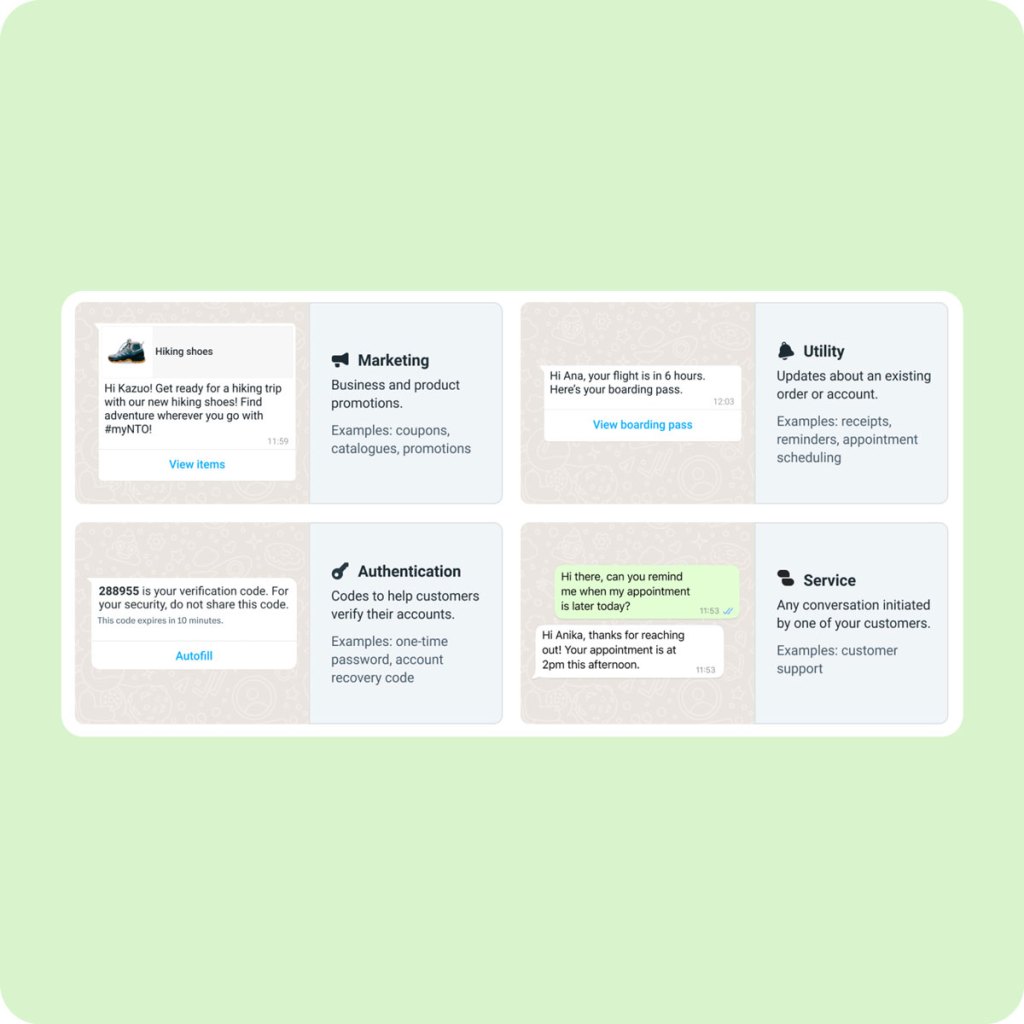
Everything the platform bills falls into four buckets, and knowing which bucket a message lands in is most of the billing literacy you need.
Marketing messages are the ones you initiate to promote something: a sale announcement, a new collection, a re-engagement nudge. They are pre-approved templates, sent to opted-in contacts, and they are the most expensive category by a wide margin. Utility messages are transactional: order confirmations, delivery updates, payment receipts, appointment reminders. Authentication messages are one-time passcodes and verification codes. Service messages are everything your business replies with inside a customer-initiated conversation — the support side of the house, and the category that was free until this month.

Source: WhatsApp Business
Service messages are priced off each market's utility and authentication rates rather than a separate schedule, which is why the country table in the next section doubles as a service price list. There are no volume discounts on them, and the first 1,000 each month per business phone number are free — an allowance Meta's documentation and providers consistently confirm, and one that pure-support businesses with modest volume will never exceed.
Source: WhatsApp Business
The official rate card: what 10,000 service messages cost by market
The figures below are the widely republished rate-card numbers first relayed by RT on September 27, 2026 and carried across Arabic and international outlets, including Masrawy's much-shared table, cross-checked where possible against Meta's pricing documentation. Rates move quarterly, so treat this as the October 1, 2026 snapshot and confirm your market in the Business Manager rate card before locking a budget.
| Market | Per service message | Per 10,000 service messages | Note |
|---|---|---|---|
| Morocco | $0.0230 | $230 | Utility and authentication rates rose again on October 1 |
| United Arab Emirates | $0.0157 | $157 | The steepest rate among the Gulf markets listed |
| Saudi Arabia | $0.0107 | $107 | Mid-range for the Gulf |
| Jordan | $0.0091 | $91 | Among the higher Levant rates |
| Iraq | $0.0079 | $79 | Reduced on October 1, 2026 |
| Algeria | $0.0040 | $40 | Among the lowest rates in this table |
| Kenya | $0.0040 | $40 | Kenya's utility rate, now the service baseline |
| Egypt | $0.0036 | About $36 | Roughly 278 messages per US dollar |
| India | ₹0.115 | ₹1,150 | Confirmed by major Indian outlets covering the change |
Read the spread carefully, because it is wider than most merchants expect: a support message to a Moroccan customer costs more than six times the same message to an Egyptian one, and the UAE sits at more than four times Egypt's rate. A merchant serving the Gulf from a Cairo or Amman back office pays Gulf rates for Gulf numbers, not home-market rates — the pricing follows the recipient's market, which makes your customer mix, not your headquarters, the driver of this line item.
For the markets not in the table, the mechanism is the same even where the number differs: pull the current utility rate for the recipient's country from Meta's rate card, and that is effectively your service rate. Kenya's $0.0040 utility rate, reported by Techweez, is the working example for East African merchants.
A worked example: what a small store's monthly bill actually looks like
Take a hypothetical online fashion store in Cairo with 2,500 opted-in customers on WhatsApp. In a typical month it handles about 3,000 customer-initiated support messages — sizing questions, order status, returns — and runs one marketing broadcast to the full list announcing a seasonal sale. Using Egypt's verified rates, here is the full bill.
Source: WhatsApp official YouTube channel
| Cost line | Volume | Rate | Monthly cost |
|---|---|---|---|
| Service messages | 3,000 sent, 1,000 free, 2,000 billable | $0.0036 | $7.20 |
| Marketing template broadcast | 2,500 recipients | $0.0644 | $161.00 |
| Monthly total | $168.20 |
The composition is the story. The service-message change that generated weeks of headlines contributes $7.20 to this bill — about four percent of it. The marketing broadcast, unchanged in principle since July 2025, contributes $161.00. In Egypt, a marketing message costs nearly 18 times a service message, and that ratio holds, with local variations, across most markets. If the store skipped the broadcast entirely and only did support, its new monthly line item since October 1 would be $7.20 — the price of two coffees for a business moving thousands of messages.
Scale the same arithmetic to Gulf rates and the picture changes: 2,000 billable service messages to UAE customers would cost $31.40 a month, and to Moroccan customers $46. Still modest, but no longer invisible, and for businesses running high-volume support desks — telecom agents, delivery platforms, travel desks — the metered tier is where attention belongs. AI-driven support shifts the arithmetic again: Meta's Business Agent pricing, at $2.00 per million tokens since August 1, 2026, works out to roughly four to five cents per AI-generated reply, which can exceed the message fee itself. Merchants who added AI assistance inside WhatsApp during the year should now price both layers, tokens and messages, not just one.
Where the money goes: cutting the bill without cutting the channel
Because the bill is dominated by marketing and inflated support volume, the fixes are mechanical rather than heroic.
Live inside the 1,000 free tier. The allowance resets monthly per business phone number. Most single-location merchants and professional practices will never cross it; support desks that do should treat the crossing as a signal to fix deflection, not just a cost to absorb.
Move repeat questions out of paid replies. Sizing charts, return policies, opening hours, and shipping timelines answer themselves in a WhatsApp Channel, a status update, or a pinned note in the catalog. Every question a customer never needs to ask is a service message never sent — and unlike a reply, the channel post costs nothing per reader.
Consolidate conversations instead of sprinkling replies. Three one-line answers in a support chat can often be one complete answer. Every message beyond the free tier is metered, so support scripts and bot flows should be audited for message count, not just politeness.
Prune the broadcast list before the next campaign. Marketing is the expensive category, and it is priced per recipient. Segmenting the 2,500-name list down to the 1,400 customers who opened the last campaign cuts the $161 line to about $90 with, in most merchants' experience, little revenue loss. The AI-assisted product-ad workflow for WhatsApp-first stores covers exactly this kind of list hygiene.
Match the tool stack to the volume. If monthly message counts sit in the low hundreds, the free app plus the right store-management tools may cover everything, and the API question can wait. The guide to starting an online business from scratch walks through that sizing decision at setup time, when it is cheapest to make.
Sort the plumbing before the quarter turns. Bills arrive in US dollars or one of sixteen approved billing currencies — the Egyptian pound is not among them, so Egyptian businesses settle across a currency conversion — and failed payments are not a paperwork matter: delivery of paid messages stops until the balance is cleared. Pairing the billing setup with a modern account that trims international transfer fees quietly saves a further slice every month.
If you are rebuilding the budget for a store that sells through WhatsApp, Truescho's opportunities hub rounds up programs, tools, and partnerships for online merchants worth a look once the messaging math is done.
Source: WhatsApp official YouTube channel
The success stories Meta itself publishes — small Nigerian shops in the video above are a running example — make the underlying point: for merchants in Lagos, Cairo, Nairobi, or Karachi, WhatsApp converts better than almost any channel at almost any plausible metered price, which is why the rational response to October 1 is budgeting discipline, not channel flight.
Frequently asked questions before the first WhatsApp bill
Are WhatsApp service messages still free?
Up to a point. Each business phone number receives 1,000 free service messages per month. Beyond that allowance, messages are billed at the market rate — about $0.0036 each in Egypt, $0.0157 in the UAE, or ₹0.115 in India. Between November 2024 and October 1, 2026, service messages carried no charge at all.
When did WhatsApp start charging per message?
Template messages — marketing, utility, and authentication — moved to per-message billing on July 1, 2025, replacing the earlier conversation-based model. What began on October 1, 2026 is different: service messages and non-template utility messages, which had been free since November 2024, are now metered as well.
How much does one service message cost in India?
Indian businesses pay ₹0.115 per service message once the monthly allowance of 1,000 free messages is used, a figure confirmed across major Indian outlets covering the change. That works out to ₹1,150 for every 10,000 service messages beyond the free tier, quoted in rupees in Indian coverage.
What happens if a business does not pay its WhatsApp bill?
Paid message delivery stops. Indian coverage of the October change and Meta's own billing documentation both describe suspension of message delivery when payment fails and the balance remains unpaid, which is why a valid payment method and low-balance alerts belong on every merchant's pre-quarter checklist.
Does the free WhatsApp Business app also charge per message?
No. The smartphone app remains free, with no per-message fees to Meta and no monthly subscription. The charges apply to the WhatsApp Business Platform — the API product that businesses connect through a provider or directly through Meta for automation, multiple agents, and large-scale broadcasting.
Which countries saw rates change on October 1, 2026?
Utility and authentication rates rose in Kuwait, Oman, Morocco, Kazakhstan, and Ukraine, and were reduced in Bangladesh, Iraq, Nepal, and Sri Lanka. Meta adjusts rate cards only at the start of a quarter, at most four times a year, and it published the final October prices before September 1, 2026 — so the next possible change is January 1, 2027.
Which currency is my WhatsApp business billed in?
Meta bills in US dollars or one of sixteen approved billing currencies, and the Egyptian pound is not among them, so Egyptian businesses settle in dollars or another approved currency. Pricing itself always follows the recipient's market, not the sender's headquarters, which is why customer mix drives the bill.
Two calendar dates anchor the quarter ahead: the current rates are locked until January 1, 2027, and the free 1,000-message allowance resets on the first of each month, so a support-desk audit timed to the reset costs nothing to trial. The merchants who come out of this change best will not be the ones who abandoned the channel over a $7 line item — they will be the ones who read the rate card once, moved their FAQs somewhere free, pruned a broadcast list, and put a valid card on file before the next quarter turns; if you want that review done alongside a wider store budget, the Truescho opportunities hub is a sensible place to start.
Sources
- WhatsApp Business Platform pricing documentation — Meta for Developers — the official rate card, message categories, and the non-template message billing policy effective October 1, 2026.
- WhatsApp Business official site — official product pages for the free app and the Business Platform.
- WhatsApp official YouTube channel — official product walkthroughs and small-business success stories.