
The World Economic Forum's Future of Jobs Report 2025, published in January 2025 and built on a survey of more than 1,000 of the world's largest employers representing 22 industry clusters and over 14 million workers, projects that 170 million new jobs will be created between 2025 and 2030 while 92 million existing roles are displaced — a net gain of 78 million jobs, or 7% of today's total employment. For students and early-career professionals, the most consequential number is different: 39% of the core skills required in current jobs will be transformed or become outdated by 2030.
The headline numbers behind the report
Before the job lists, these are the figures the entire report rests on, taken directly from the official edition published by the World Economic Forum:
- 170 million new jobs: equivalent to 14% of today's global employment, created between 2025 and 2030 according to the surveyed employers.
- 92 million displaced jobs: equivalent to 8% of current jobs — roles the same employers expect to shrink or disappear over the same period as structural labour-market transformation accelerates.
- A net gain of 78 million jobs: 7% of total employment today. Positive in aggregate, but the headline hides a complete redistribution of which jobs exist at all.
- 22% of today's jobs will be touched by creation or displacement within just five years.
- 39% of core skills will change: employers expect roughly two-fifths of their workforce's existing skill sets to be transformed or rendered outdated by 2030.
There is also a quietly encouraging finding buried in the skills chapter: this "skill instability" rate has actually fallen compared with previous editions — from 44% in the 2023 report and a peak of 57% in 2020 at the height of the pandemic. The report partly credits the fact that 50% of workers have now completed training, reskilling or upskilling programmes, up from 41% in the 2023 edition.
The 10 fastest-growing jobs until 2030
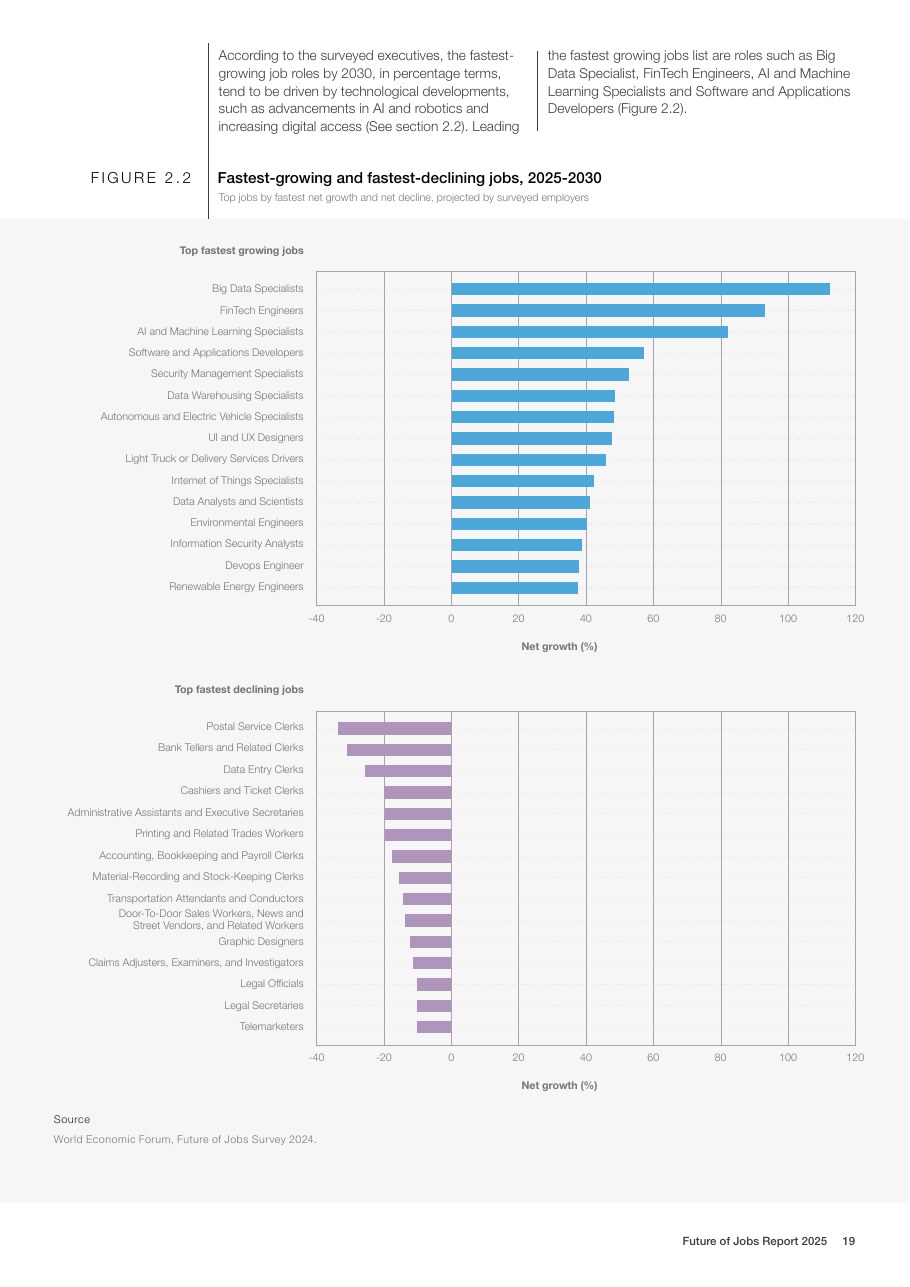
The employer survey ranked roles by expected net growth, and this is the official top-ten list as it appears in Figure 2.2 of the report:
- Big Data Specialists — top of the global list, unsurprising as nearly every industry shifts to decision-making built on data.
- FinTech Engineers — the expansion of digital payments and digital-first banking, especially across emerging markets, lifts this role to second place.
- AI and Machine Learning Specialists — the defining technology wave of the decade, intersecting with every sector from healthcare to energy.
- Software and Applications Developers — persistent demand rather than a passing trend; the role holds fourth position.
- Security Management Specialists — as every organisation faces escalating cyber threats, the role ranks fifth.
- Data Warehousing Specialists — the infrastructure layer that makes big data usable in the first place.
- Autonomous and Electric Vehicle Specialists — the green transition in transport is creating an entirely new profession.
- UI and UX Designers — the competition for user attention keeps raising the value of whoever designs the experience.
- Light Truck or Delivery Services Drivers — e-commerce has made delivery one of the fastest-growing jobs by absolute numbers, not just percentages.
- Internet of Things Specialists — connecting factories, cities and homes opens a broad career track.
One essential nuance the report itself highlights: when growth is measured in absolute numbers rather than percentages, farmworkers top the table of the largest growing jobs, followed by care economy roles — healthcare, social work and education. Demographic change is injecting enormous demand for people who look after other people, not only screens.
The fastest-declining jobs until 2030
On the opposite side, routine clerical work is contracting fastest. The report's official list of fastest-declining roles:
- Postal Service Clerks
- Bank Tellers and Related Clerks
- Data Entry Clerks
- Cashiers and Ticket Clerks
- Administrative Assistants and Executive Secretaries
- Printing and Related Trades Workers
- Accounting, Bookkeeping and Payroll Clerks
- Material-Recording and Stock-Keeping Clerks
- Transportation Attendants and Conductors
- Door-To-Door Sales Workers, News and Street Vendors, and Related Workers
The common thread is unmistakable: every one of these jobs is built on routine, rule-based tasks that can be partially or fully automated. The job does not disappear because the person in it is neglectful — it disappears because the tasks themselves migrate into systems.
Why is this transformation happening so fast?
The report identifies three large forces reshaping labour markets simultaneously:
First, technology. Artificial intelligence and data analytics are not a new "sector" — they are a transformation layer inside every sector, from medical diagnosis to supply-chain management. Any role with a sizeable routine, model-able component is being redefined.
Second, the green transition. The move toward renewable energy and a low-carbon economy is creating entire job families — renewable energy engineering, energy efficiency, electric vehicles — and their footprint is visible directly in the fastest-growing list above.
Third, demographic change. Ageing populations in advanced economies and youthful populations in emerging economies are redistributing demand: care and education jobs expand where societies grow older, while technology jobs expand where economies grow faster.
What this means for you: a practical reading
Whether you are choosing a degree or planning the first five years of your career, these are the practical takeaways from the data:
If you are choosing a degree: the three lists — fastest-growing jobs, fastest-declining jobs, fastest-growing skills — carry one consistent message. The exact major matters less than the system you enter. A degree that places you at the intersection of data, technology and a transforming sector (digital health, smart energy, financial technology) multiplies your options.
If you are a recent graduate: do not wait for displacement to retrain. The report states plainly that 39% of your skills will change within five years — roughly 8% per year. Anyone who adds one genuinely technical capability each year (data analysis, cybersecurity fundamentals, AI tooling specific to their field) stays on top of the wave instead of beneath it.
If you are hunting funded study options: the fastest-growing skills in the report — big data, AI, cybersecurity, fintech — are precisely the fields where fully funded scholarships and graduate programmes are expanding worldwide. You can browse currently open opportunities on the Truescho opportunities platform and match them against the lists above before applying.
How to read the report correctly: do not treat the list as destiny. The job titled "FinTech Engineer" today may carry a different name in five years, but the substance — understanding money plus understanding technology — will remain in demand. Careers survive by learning their underlying skills, not their titles.
The fastest-growing skills (which are not the same as jobs)
The distinction matters: the report ranks jobs and skills on separate lists. The fastest-growing skills until 2030 are led by:
- AI and big data — the single fastest-growing skill, without contest.
- Networks and cybersecurity — the second-fastest growing.
- Technology literacy — working deeply with digital tools, not merely using them.
- Creative thinking — the human capability systems replicate least easily.
- Resilience, flexibility and agility.
- Curiosity and lifelong learning — transformed from a virtue into a survival requirement.
Among the core skills employers seek right now, analytical thinking remains the most sought-after, with seven in ten companies considering it essential in 2025, followed by resilience, flexibility and agility, then leadership and social influence.
A regional note for international readers
The report is global, but two regional dynamics deserve attention. Gulf economies are investing heavily in diversifying beyond oil, and their national strategies — Saudi Vision 2030, the UAE's technology ambitions, Qatar's regional fintech leadership — target precisely the sectors topping the fastest-growing jobs list: data, AI, financial technology and renewable energy. Regional demand for these specialisations is likely to run ahead of the global average over the coming years.
The second dynamic: funded graduate programmes in these same fields are expanding in parallel. Fully funded master's and PhD tracks in data science, AI and cybersecurity have become among the most widely available categories on opportunity platforms. A student who aligns their academic choice with the report's lists today compounds the value of that degree in tomorrow's job market. Compare the currently open options on the Truescho opportunities page against the top-ten list above.
Frequently asked questions
Does the report mean AI will take our jobs?
Not in the simplistic sense. The full picture: 170 million jobs created, 92 million displaced, a net positive of 78 million. AI displaces routine tasks — data entry, traditional teller work, filing — while expanding roles for the people who build, operate and govern these systems.
What is the difference between "fastest-growing" and "largest-growing" jobs?
Fastest-growing is measured in percentages (a small job base doubling quickly), while largest-growing is measured in absolute headcount. That is why Big Data Specialists top the percentage table while farmworkers and care workers top the absolute-numbers table.
I am a first-year student — what should I study based on this report?
Choose a major that sits at the intersection of technology and a real sector (health, energy, finance, education), and add a data or cybersecurity credential as a minor or professional certificate. The official top-ten list above is your map.
Will clerical jobs disappear overnight?
No. "Declining" means gradual contraction over five years, not overnight elimination. But the trajectory for routine roles is clearly downward, and anyone working in one today has a window to reskill rather than resist the trend.
Where can I read the full report myself?
The official edition is freely available on the World Economic Forum's Future of Jobs Report 2025 publication page, covering the complete methodology, regional breakdowns and full job tables. Official sources are linked below.
The bottom line: five years to reposition
The Future of Jobs Report 2025 is neither a doom prophecy nor a celebration. It is a field survey of hiring intentions at the world's largest employers — the same employers who will create 170 million jobs and eliminate 92 million within five years. The difference between landing on the first side or the second is not luck; it is a decision taken in 2025 or 2026: a degree aligned with the wave, a skill built every year, and curiosity that does not switch off. The official lists above are the most accurate map available to anyone choosing a direction now.
Sources
- World Economic Forum, official full edition of the Future of Jobs Report 2025: https://www3.weforum.org/docs/WEF_Future_of_Jobs_Report_2025.pdf
- World Economic Forum editorial explainer of the report (January 2025): https://www.weforum.org/stories/2025/01/future-of-jobs-report-2025-jobs-of-the-future-and-the-skills-you-need-to-get-them/