
Google WeatherNext 3: Hourly AI Forecasts at 5 km Resolution
Last updated: September 2026
Google's newest weather model, WeatherNext 3, delivers forecasts every hour instead of every six, at 5 km resolution instead of 25, with rain-forecast skill improvements of up to 60% over NASA's IMERG reference data. Announced on September 3, 2026, and built by Google DeepMind and Google Research, it is already live inside Google Search, Gemini, Maps, Google Maps Platform, and Cloud — the first global model that learns weather directly from live satellite observations rather than from traditional six-hourly physics simulations.
The announcement is a week old, but its significance outlasts the news cycle: hourly, high-resolution, globally uniform forecasts are now a consumer product, not a supercomputing privilege. For the data-sparse regions of Africa, Latin America, and Asia-Pacific that Google explicitly built this for — and for energy operators, farmers, and event planners everywhere — the shift is structural.
Source: Google's official blog
Where the numbers come from
Traditional numerical weather prediction (NWP) solves physics equations on supercomputers, producing atmospheric fields roughly every six hours. By the time a run publishes, the freshest observations are already hours old. WeatherNext 3 inverts that pipeline.
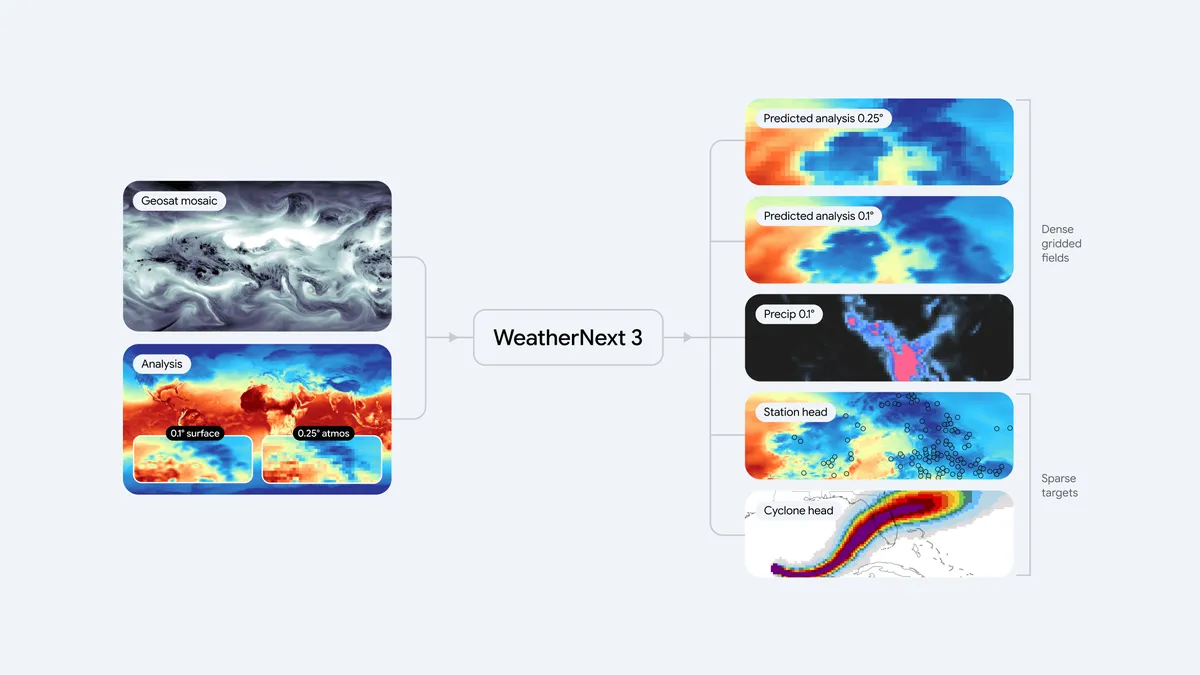
Its architecture is an FGN mesh transformer, and it learns from direct live observation: hourly mosaics from geostationary satellites and the output of ground weather stations themselves. Google describes the result as its "most advanced and accurate global weather model to date" — a claim backed not by internal benchmarks alone but by independent live evaluations from Brightband, an outside assessor that continuously scores global weather models.
The resolution story comes in tiers, and the tiers matter:
| Variable tier | Resolution |
|---|---|
| Surface temperature and humidity | 5 km |
| Other surface variables | 10 km |
| Upper-air variables (winds) | 25 km |
Outputs arrive in three forms: gridded fields, separate tropical cyclone tracks, and sparse station-point forecasts — so the model serves both a map view and a specific airport or farm.
The 60% rain improvement, examined
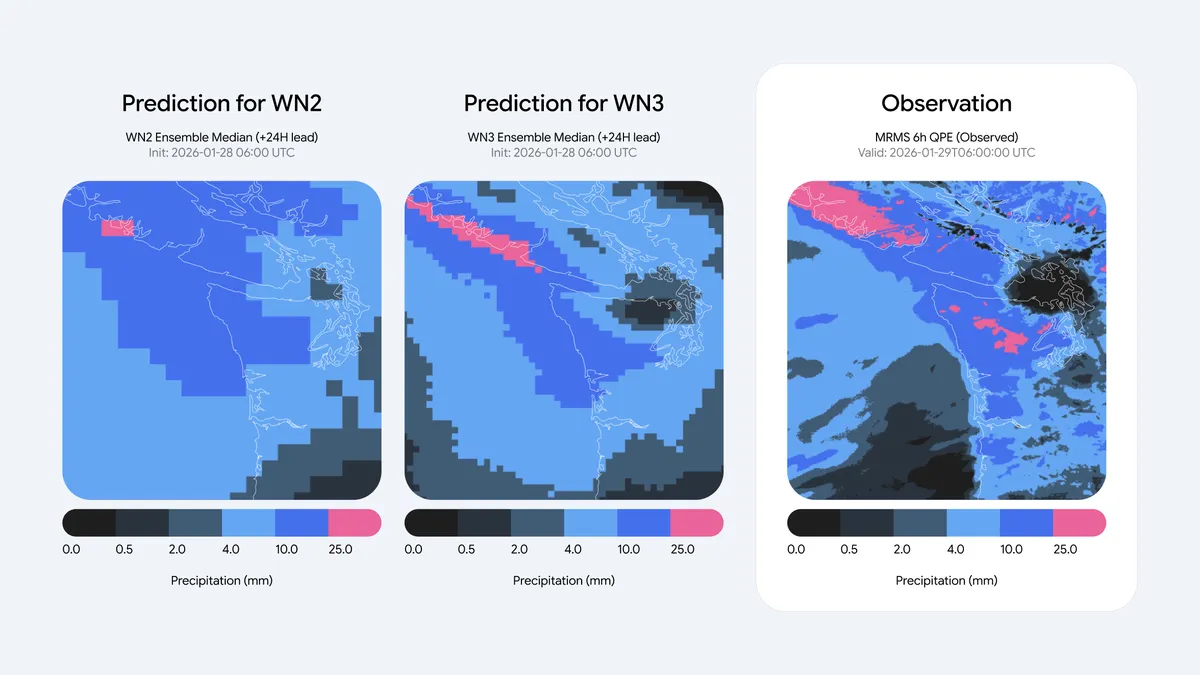
The rain number deserves scrutiny because it is the most quoted and least explained. Google trained the model on NASA IMERG satellite precipitation data and radar reanalysis, then evaluated with the CRPS metric — the standard probabilistic forecasting score, where lower means better. The published improvements:
- Up to 60% better CRPS versus IMERG reference data.
- Up to 30% versus MRMS radar over the United States.
- 10% versus early rain-gauge baselines at short range.
Reading between the lines: the model is strongest where reference data is satellite-based (globally available), which is precisely why the biggest gains land in regions without dense radar networks. 9to5Google's coverage framed it as "50% more accurate rain forecasts"; the underlying claim is the CRPS improvement above, and the honest framing is "up to," not uniform.
Source: Google's official blog
What hourly-at-5-km actually changes
Resolution numbers are abstract until you map them onto decisions. Five kilometers and one hour versus twenty-five kilometers and six hours is the difference between:
- Flash-flood warning lead time. A convective cell that dumps rain on one district for 40 minutes simply does not exist in a six-hour, 25 km product. Hourly 5 km fields can show it forming.
- Solar farm output forecasting. The model predicts cloud cover and surface solar radiation at hourly cadence. Grid operators balancing gigawatt-scale solar portfolios lose money on both over-forecast (unsold commitments) and under-forecast (penalty purchases).
- Wind energy at the right height. WeatherNext 3 forecasts winds at 100 meters — the actual hub height of modern turbines — rather than the 10 m standard weather-station height that requires error-prone extrapolation.
- Agriculture and logistics. Spraying, harvesting, and drone delivery windows all operate on hourly decisions.
The regions that gain the most
Google's announcement centers the equity angle explicitly: the model matters most for Africa, Latin America, and Asia-Pacific, where high-resolution national models simply do not exist the way they do over the US, Europe, or East Asia. A farmer in the Sahel, a port operator in Southeast Asia, or a city planner in the Andes has historically had access only to coarse global models.
A globally uniform 5 km hourly model flattens that hierarchy. It will not outperform a dense national radar network in the countries that have one — but most countries do not have one.
A short history of the AI weather race
The significance of "learning from live observation" lands harder with a minute of context. Since the 1950s, weather forecasting has been the domain of numerical weather prediction: physics equations solved iteratively on supercomputers, with each run taking hours and producing fields on a coarse grid. The European Centre for Medium-Range Weather Forecasts (ECMWF) compressed accuracy and speed for decades, but the structure held — a six-hourly cadence with unavoidable lag between the latest observations and the newest output.
Machine learning broke the compute barrier first. Google's own GraphCast — published in Science in 2023 — and NVIDIA's FourCastNet demonstrated that transformer models trained on reanalysis archives (chiefly ERA5) could produce full atmospheric fields in under a minute on a single processor. ECMWF followed with its own experimental AI models. But that first wave of AI forecasting kept the old publication rhythm and much of the old resolution: it made the physics run cheap, not more current.
WeatherNext 3 moves the battle to genuinely new ground: training on live observation instead of archives, and publishing hourly instead of six-hourly. That is not an incremental accuracy gain — it is a change in what the model can know at the moment it speaks.
Four decisions hourly forecasts actually change
Abstractions become concrete in daily operations. Consider a Thursday anywhere in the tropics:
- A contractor pouring a tower foundation. Fresh concrete is vulnerable to heavy rain in its first hours. "Chance of light rain today" from a six-hourly product cannot justify delaying a pour worth hundreds of thousands of dollars. An hourly 5 km field saying rain starts at 15:00 and ends by 17:00 makes the call obvious: pour in the morning.
- A drone delivery fleet operator. Winds above a threshold ground every flight. A two-hour calm window between two windy periods is the difference between a full operating day and a lost one.
- An outdoor event organizer. Localized convective activity is the danger a 25 km grid physically cannot see, because the entire storm can be born and can die inside a single grid cell. An hourly model that shows a cell forming after sunset changes the travel plan before anyone is standing in it.
- A grid engineer balancing utility-scale solar. Incoming clouds over the array mean a generation dip that gas turbines must cover. One extra hour of warning means less spinning reserve burned — real fuel, real money.
In all four cases the value is not "more accuracy" in the academic sense. The decision was impossible at the old cadence, whatever its accuracy.
How to read probabilistic forecasts without fooling yourself
Models like WeatherNext 3 output probability distributions, not certainties. When you see "40% chance of rain," the precise meaning is typically that 40% of ensemble members or grid points expect rain — not that there is a 40% chance you personally get wet. Three habits keep you honest:
- Do not be surprised when two consecutive hourly updates disagree. The model re-learns against fresh satellite data every hour; updating is the feature, not a bug.
- For big decisions — travel, outdoor events, harvest timing — track the trend across three or four updates rather than trusting a single snapshot.
- When an hourly forecast diverges from an official warning from your national met service, the official warning wins. Probabilistic guidance never overrides emergency protocol.
Where you can use it today
Five surfaces, most already running the model silently:
- Google Search: type "weather" plus any city — the hourly panel draws from WeatherNext 3.
- Gemini: ask about rain this weekend and it answers from the new model.
- Google Maps: the weather layer.
- Google Maps Platform: APIs for developers embedding weather into apps.
- Google Cloud: raw access for enterprises and energy companies.
For context on Google's broader AI push this season, our coverage of Gemini 3.8 Flash's cybersecurity results traces the same pattern: specialized models aimed at concrete industrial problems.
Honest limitations
- Resolution is tiered, not uniform. Winds aloft — aviation-relevant — remain at 25 km.
- Not an official warning system. Google states plainly that official warnings remain the responsibility of national meteorological agencies. WeatherNext 3 informs; it does not replace your local met service.
- Independent peer review is still early. Brightband's live evaluation is continuous and external, but formal peer-reviewed publication of the third generation has not appeared yet.
- Developers pay for depth. Consumer surfaces are free; the Cloud and Maps Platform tiers for raw enterprise access are commercial products.
We previously examined Google's cyclone forecasting work in our DeepMind cyclone model analysis and its follow-up update — the third generation builds directly on that lineage.
Frequently asked questions
What is Google WeatherNext 3?
A global AI weather model from Google DeepMind and Google Research announced September 3, 2026. It produces hourly forecasts at up to 5 km resolution for surface temperature and humidity, learns directly from live geostationary satellite imagery and station data, and is available in Search, Gemini, Maps, Maps Platform, and Cloud.
How accurate is WeatherNext 3 for rain?
Google reports CRPS improvements of up to 60% versus NASA IMERG satellite precipitation data, 30% versus US MRMS radar, and 10% versus early rain-gauge baselines. Independent live evaluation by Brightband rates it the most accurate global weather model to date.
Where is WeatherNext 3 available?
Worldwide, through Google Search, Gemini, Google Maps, Google Maps Platform, and Google Cloud. It is a single global model, so coverage in Africa, Latin America, and Asia-Pacific matches the rest of the planet — a first for consumers in data-sparse regions.
How is WeatherNext 3 different from WeatherNext 2?
WeatherNext 2 produced forecasts every 6 hours on a 25 km grid. WeatherNext 3 delivers hourly forecasts, 5 km resolution for surface temperature and humidity, training directly on station observations, renewable-energy variables including 100 m winds and solar radiation, and separate cyclone track outputs.
Does WeatherNext 3 cover Africa and Asia?
Yes — explicitly. Google highlights Africa, Latin America, and Asia-Pacific as the primary beneficiaries, since these regions historically lacked access to any high-resolution model. The global 5 km hourly grid applies everywhere uniformly.
Is WeatherNext 3 free to use?
Consumer access through Search, Gemini, and Maps is free. Enterprise and developer access through Google Maps Platform and Google Cloud is a paid commercial product with raw data feeds.
What the next twelve months look like
The trajectory Google has followed across three generations — 25 km/6-hourly, then cyclone specialists, now 5 km/hourly — points to the obvious next steps: sub-kilometer urban nowcasting, tighter energy-sector products on Cloud, and cyclone track skill competing with dedicated hurricane models. The deeper shift is institutional: forecasting is becoming a continuously learning cloud service rather than a twice-daily supercomputer run, and every meteorological agency on earth now has to decide what its role is when a free consumer product carries the most accurate global model.
Google also recently shipped sign-language dictation in Gboard — see our Google Sign Language to Text explainer — part of the same pattern of research models becoming everyday tools. For students and professionals planning study or work abroad, weather intelligence of this caliber is one more input worth having: a campus in a monsoon belt and one in a desert climate demand very different preparation, and hourly-grade forecasting makes reconnoitering a place from abroad meaningfully more accurate than it was even two years ago.
Sources
- Official WeatherNext 3 announcement — full details, methodology, and figures
- Google DeepMind — research home of the WeatherNext family
- NASA IMERG — the precipitation reference dataset used in training
- Brightband — independent live evaluation of global weather models
Start Your Journey with Truescho
Whether you're searching for a scholarship or planning to study abroad, truescho.com gives you everything you need for study and career planning.
Get Started Free →