
Last updated: August 2026
Converting USD to Syrian pounds seems straightforward — multiply by the rate. But anyone dealing with real amounts discovers that "the rate" is not a single number. There's a buy rate and a sell rate, an official rate and a parallel market rate, a remittance rate and a cash rate — all different. Picking the wrong one costs you thousands of pounds on a moderate transaction. This guide provides ready-made conversion tables for every scenario, a precise manual formula, and an explanation of every spread.
⚠️ All figures are observational for August 2026 and change continuously. Not a binding offer. Always distinguish new Syrian pounds (1 new = 100 old), and use the rate that matches your transaction direction (buy rate if you're selling dollars, sell rate if you're buying dollars).
How Much Is One Dollar in Syrian Pounds Today?
For accurate conversion, you need to know which rate applies to your situation. Three primary rates exist in August 2026:
| Rate | USD Value in New SYP | Source / Use Case |
|---|---|---|
| Parallel market — buy | 130.10 | You sell dollars and receive pounds (source: sp-today monitoring) |
| Parallel market — sell | 130.60 | You buy dollars and pay pounds |
| Official — CBS | 122.00 | Central Bank of Syria bulletin, 6 Aug 2026 (cb.gov.sy) |
The spread (difference between buy and sell) = 0.50 new SYP per dollar. It may seem small, but that's 50 pounds on $100 and 500 on $1,000 — before any additional commission.
Comprehensive Conversion Table: From $1 to $10,000
For convenience, here are ready-made conversion tables at all three rates. Pick the column that matches your situation:
In New Syrian Pounds (parallel market rate):
| USD | Buy (New SYP) | Sell (New SYP) | Official (New SYP) |
|---|---|---|---|
| 1 | 130.10 | 130.60 | 122.00 |
| 5 | 650.50 | 653.00 | 610.00 |
| 10 | 1,301 | 1,306 | 1,220 |
| 20 | 2,602 | 2,612 | 2,440 |
| 50 | 6,505 | 6,530 | 6,100 |
| 100 | 13,010 | 13,060 | 12,200 |
| 200 | 26,020 | 26,120 | 24,400 |
| 500 | 65,050 | 65,300 | 61,000 |
| 1,000 | 130,100 | 130,600 | 122,000 |
| 2,000 | 260,200 | 261,200 | 244,000 |
| 5,000 | 650,500 | 653,000 | 610,000 |
| 10,000 | 1,301,000 | 1,306,000 | 1,220,000 |
In Old Syrian Pounds (for those using the legacy unit):
| USD | Buy (Old SYP) | Sell (Old SYP) |
|---|---|---|
| 100 | 1,301,000 | 1,306,000 |
| 1,000 | 13,010,000 | 13,060,000 |
| 10,000 | 130,100,000 | 130,600,000 |
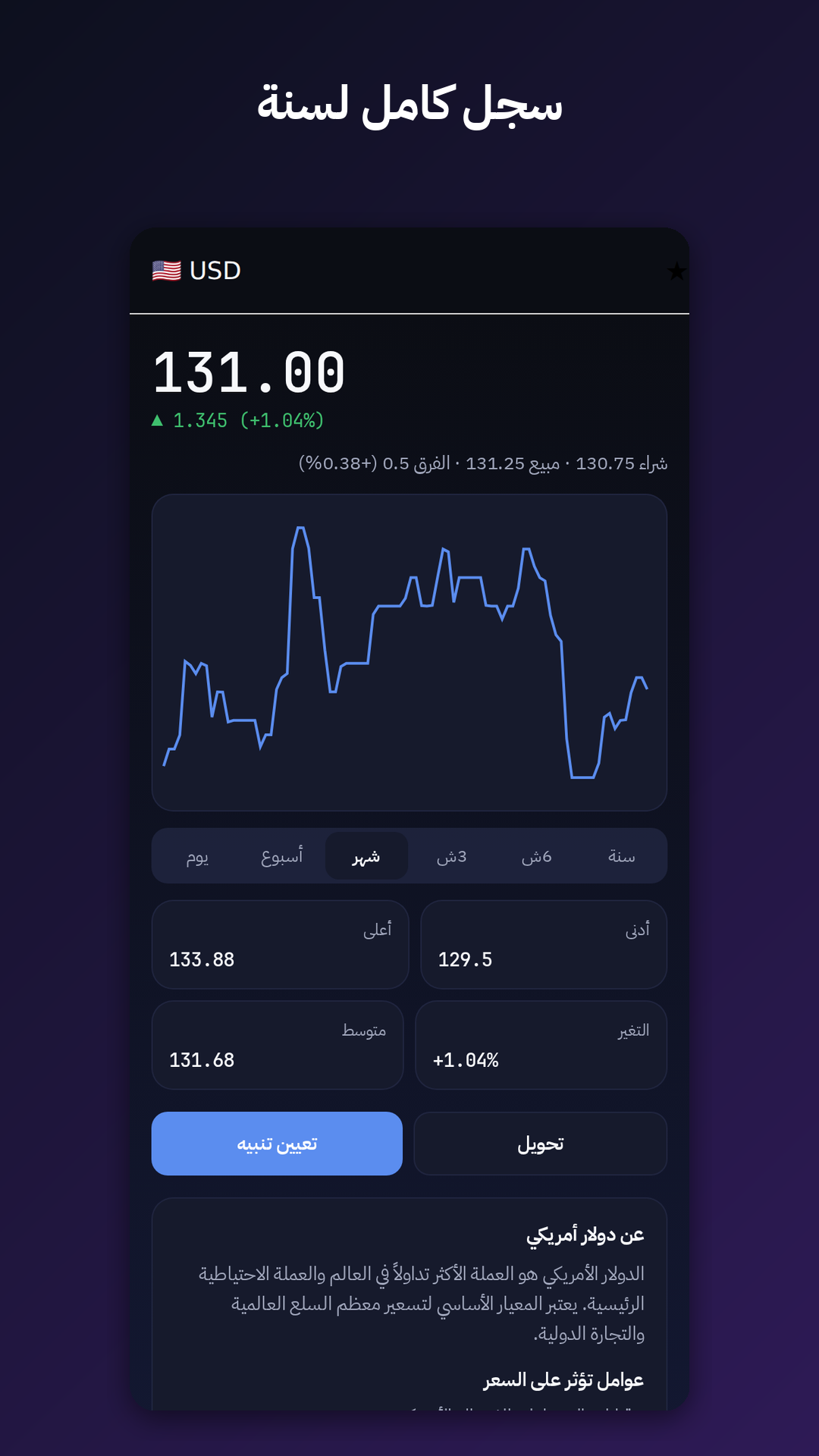
Source: SYPNow on Google Play
How to Convert USD to Syrian Pounds Manually: Step by Step
Online calculators are fast but don't teach you the logic. Here's the manual method:
Case 1: You have dollars and want pounds (selling dollars)
Use the buy rate (because the exchange office buys from you):
Amount in SYP = Number of dollars × 130.10
Example: $250 × 130.10 = 32,525 new SYP (3,252,500 old SYP).
Case 2: You have pounds and want dollars (buying dollars)
Use the sell rate (because the exchange office sells to you):
Amount in USD = Number of SYP ÷ 130.60
Example: 50,000 new SYP ÷ 130.60 = $382.85.
Or, to find out how many pounds you need to pay for a specific dollar amount:
Amount in SYP = Number of dollars × 130.60
Example: $300 × 130.60 = 39,180 new SYP.
Case 3: Converting at the official rate
Used in accounting or government contexts:
Amount in SYP = Number of dollars × 122.00
Example: $1,000 × 122.00 = 122,000 new SYP.
Reverse Formula: How Many Dollars Are Your Pounds Worth?
To convert from Syrian pounds to dollars, divide by the appropriate rate:
| Operation | Formula | Example |
|---|---|---|
| SYP → USD (selling dollars to the market) | SYP ÷ 130.10 | 100,000 new ÷ 130.10 = $768.42 |
| SYP → USD (buying dollars from the market) | SYP ÷ 130.60 | 100,000 new ÷ 130.60 = $765.62 |
| SYP → USD (at official rate) | SYP ÷ 122.00 | 100,000 new ÷ 122.00 = $819.67 |
Practical Conversion Examples
Real-world examples solidify the concepts better than tables:
Example 1: Expatriate sends $500 to family in Damascus
A father in the Gulf wants to send $500 to his wife. Two options:
Option A — Bank transfer at official rate:
500 × 122.00 = 61,000 new SYP
Option B — Exchange office (parallel market buy rate):
500 × 130.10 = 65,050 new SYP − commission (say 1% = 325 SYP) = 64,725 new SYP
Difference: 3,725 new SYP in favor of Option B. On $5,000, that becomes 37,250 SYP.
Example 2: Merchant needs $2,000 for imports
The merchant has Syrian pounds and needs dollars. How much to pay?
Sell rate (buying dollars from the market):
2,000 × 130.60 = 261,200 new SYP
If they could buy at the official rate (difficult for most individuals):
2,000 × 122.00 = 244,000 new SYP
Difference: 17,200 new SYP. This is the "invisible tax" of a dual-rate environment.
Example 3: Employee calculating salary in local currency
An employee earns $800/month. What's the equivalent in SYP?
At parallel market rate:
800 × 130.10 = 104,080 new SYP
At official rate:
800 × 122.00 = 97,600 new SYP
Difference: 6,480 new SYP monthly = 77,760 annually. This explains why many prefer converting through the parallel market despite logistical challenges.
Why the Official Rate Differs from the Market Rate
The gap between the official rate (122.00) and the parallel market (130.10) isn't merely academic. It has direct effects on anyone converting between the two currencies:
When converting USD to SYP: Converting at the official rate yields fewer pounds (122 per dollar) compared to the market (130 per dollar). The difference is approximately 6.6%.
When converting SYP to USD: Converting at the official rate requires more pounds to obtain the same dollars, because dollars are "cheaper" in pounds at the official rate (122 vs 130).
International remittances: Some incoming transfers to Syria are partially priced at the official rate (e.g., official bank transfers), meaning the recipient receives fewer pounds than they would in the open market. This is a common source of frustration: "the remittance arrived lower than expected."
Accounting and invoices: Some official transactions and government invoices are calculated at the official rate, while actual market prices are based on the parallel rate. This mismatch creates significant gaps when dealing with imported goods or dollar-denominated contracts.
For deeper understanding of these dynamics, see Dollar Rate in Syria Today and Syrian Pound Exchange Rate Today.
Remittance Conversion: Why Net Differs from the Headline Rate
One of the most confusing situations: you hear the dollar rate in the news (say 130 pounds), expect that a $1,000 transfer will yield 130,000 pounds, but receive less. Why?
Commission: The exchange office or intermediary deducts a commission (percentage or flat fee). It may be 0.5–2% depending on the provider and amount.
Spread: Even without an explicit commission, the executing party applies the buy/sell spread. You're selling dollars to them, so you get the buy rate (lower), not the mid-rate published in the news.
Lock period: Between the transfer initiation and execution moments, the rate may change. Some providers lock the rate at initiation; others use the execution-day rate. The difference can be significant on a volatile day.
Transfer fees: Some companies charge additional transfer fees on top of the commission.
Practical example: $1,000 transfer, headline rate 130, but you receive 127,000 pounds instead of 130,000. The 3,000-pound gap comes from: 1.5% commission (~1,950 SYP) + spread applied on the net amount. The key: ask for the net amount before accepting.

Historical Context: USD/SYP Exchange Rate Evolution
Understanding the current reality benefits from seeing the historical trajectory:
Pre-2011 — The dollar traded around 46–50 Syrian pounds (in the legacy unit). Relative stability made currency conversion straightforward with minimal spreads.
2011–2019 — The pound began a gradual decline, reaching approximately 500 SYP/USD (legacy) by end of 2019. The gap between official and parallel rates started widening.
2020–2023 — Accelerated depreciation pushed the rate into thousands of units per dollar. At peak volatility, the figures reached extreme levels in the legacy unit. The official-to-parallel gap became a defining feature of the market.
2024–2026 — Currency restructuring (1 new = 100 old), and relative stabilization in the 122–130 new SYP/USD range. The parallel market settled into a narrower band compared to peak years, but the official-parallel gap persists.
This context explains why every Syrian dealing with currency conversion needs to understand the pricing mechanics — what was trivial a decade ago no longer is.
Common Mistakes in USD/SYP Conversion
Mistake 1: Using the wrong rate — A person abroad converts using the mid-rate they heard on the news, while the exchange office applies the buy rate. Result: always less than expected.
Mistake 2: Confusing new and old pounds — You're told "the rate is 13,010" and assume it's in new pounds, but it's in old pounds. Result: you multiply or divide by 100 incorrectly. Rule: the current daily reference rate in new pounds is ~130 (130.10 buy). If you see a figure in the thousands, it's in old pounds.
Mistake 3: Ignoring commission and spread — You multiply the amount by the headline rate directly and are surprised by a lower net. Calculate: amount × buy rate − commission.
Mistake 4: Using a stale rate — Exchange rates change daily and sometimes intraday. Using last week's rate may differ by thousands of pounds on a $1,000 conversion.
Mistake 5: Comparing transfers across different rate environments — Don't compare today's transfer net with last month's. The exchange rate changed; the comparison is misleading.
Safety When Converting Large Amounts
Converting large sums between USD and SYP requires practical precautions:
Use licensed providers — Deal with licensed, known exchange offices or official banks. Unlicensed parties sometimes offer a slightly better rate but carry legal and financial risks.
Receipts and documentation — Request a receipt noting the amount, applied rate, and net. For large transfers, keep all correspondence and records.
Verify the rate — Before execution, check the rate from at least two independent sources. Some providers may quote an attractive rate then deduct unmentioned "fees."
Avoid large cash quantities — Physical conversion of huge amounts carries security and logistical risks. Consider electronic transfers or splitting into batches for large sums.
Be aware of fraud risks — Don't rely on anonymous screenshots as a rate source. Don't deal with anyone pressuring immediate execution. Don't send funds to unverified social media contacts promising "special rates."
Tax planning — Large transfer amounts may have accounting or tax implications. Consult an accountant for significant sums.
Converting Other Currencies to Syrian Pounds
The dollar isn't the only currency converted to SYP. Other major currencies:
Euro (EUR) — EU currency, common in transfers from Europe. The approximate rate in new SYP depends on the EUR/USD rate globally, multiplied by the local USD rate. See Euro rate in Syria for details.
Turkish Lira (TRY) — Particularly relevant in northern areas. Its value fluctuates against both the dollar and the Syrian pound, creating a more complex conversion dynamic.
Saudi Riyal and Gulf currencies — Transfers from Syrian expatriates in the Gulf often flow through these currencies. Some offices convert directly from riyal to SYP without passing through USD.
For converting any non-USD currency to SYP, the most accurate method:
1. Convert the foreign currency to USD at the global rate
2. Then convert USD to SYP at the appropriate local rate
This avoids double-spread markups that some providers may apply.
Tools for USD/SYP Conversion
SYPNow app — Available on Google Play, displays real-time exchange rates for USD, EUR, and other currencies against the Syrian pound, with historical price tracking. Useful for verifying rates before any transfer or exchange transaction.
Central Bank of Syria bulletin — The official reference for legal rates. Updated daily at cb.gov.sy. Required for government and official accounting transactions.
Parallel market monitoring — Platforms like sp-today monitor parallel market exchange rates. Note: sp-today is a commercial competitor — use their data for knowledge, don't link to them.
Manual calculator — The best tool for those who want understanding, not just a number. Multiply or divide manually using the formulas above and verify yourself.
Broader Context: Gold and Other Currencies in Syria
USD/SYP conversion isn't isolated from other markets. Those interested in conversion may also want to check the Euro and Turkish Lira rates in Syria, especially those dealing with European transfers or Turkish trade.
On the savings front, some may consider gold prices in Syria as an alternative to holding dollars. Gold offers similar protection against pound volatility with additional divisibility flexibility.
For those planning larger projects in Syria, foreign investment, opening a bank account, and establishing a company all require a close understanding of exchange rates and available conversion tools.
Frequently Asked Questions
How much is $100 in Syrian pounds today?
At parallel market buy rate: 100 × 130.10 = 13,010 new SYP (1,301,000 old). At official rate: 100 × 122.00 = 12,200 new SYP.
How do I convert Syrian pounds to dollars?
Divide the number of new SYP by the appropriate rate. To sell SYP and buy USD: ÷ 130.60 (sell rate). To buy SYP and sell USD: ÷ 130.10 (buy rate).
What's the difference between new and old Syrian pounds?
New pound = old pound ÷ 100. All figures in this guide are "new." To convert to old, multiply by 100. (Example: 13,010 new = 1,301,000 old.)
Why do I receive fewer pounds than expected from a transfer?
Because the exchange office applies the buy rate (lower than the published mid-rate) and deducts a commission. Ask for the net amount before accepting the transfer.
Which rate should I use to convert my dollars to pounds?
Use the buy rate (130.10 new SYP currently), because you're selling dollars to the market. If you're buying dollars with pounds, use the sell rate (130.60).
Do conversion rates differ between Syrian cities?
Yes, typically by small margins (1–3%). Damascus is the media benchmark, but other cities may show local differentials reflecting liquidity and demand.
How do I verify the current rate before converting?
Check the SYPNow app or parallel market monitoring, then confirm the rate directly with the executing party before transacting. Rates change and what the news publishes may differ from what's actually applied.
Can I convert USD to SYP electronically?
Some local electronic platforms allow conversion at rates close to the parallel market, but the legal and operational framework varies. Verify the platform's reliability and consider local payment tools if available.