
The F-1 student visa interview at a US embassy usually lasts only a few minutes, yet those minutes decide the fate of a file built over months: language tests, a university admission, and hundreds of dollars in fees. Arab applicants walk into them under a particular weight — the officer behind the glass must be persuaded, in a very short conversation, that you are a genuine student, that your funding is real, and that you intend to go home afterwards; every question is an instrument measuring one of those three and nothing else. This guide gathers thirty real F-1 and J-1 interview questions in four groups with a model answer for each, the eight-document file to carry, what actually changed in the rules for 2025 and 2026 from official sources, and what to do after a 214(b) refusal. If you are still at the paperwork stage, start with our complete F-1 visa guide covering I-20, SEVIS, and DS-160 — this article begins where that one ends, at the embassy door.
What the interview actually measures
Behind every consular question stand three pillars fixed by US law itself, and knowing them in advance converts the interview from an interrogation into a conversation. Pillar one: you are a real student — an admission from an accredited school, an academically logical choice of major, a clear study plan. Pillar two: your funding is sufficient and documented — who pays, how much, and why they can. Pillar three, the heaviest in refusal statistics: you plan to return home after the programme — your family, professional, and financial ties there outweigh the pull of staying.
This is exactly why an innocent-sounding question such as "Who will meet you at the airport?" works as a precision test: if your claimed student life is real, your answers flow consistently; if the file was assembled from documents without a story, contradictions surface by the second sentence. The golden rule before anything else in this guide: do not memorize full scripted answers. Officers interrupt and reorder questions, and memorized text collapses at the first interruption, while a true story resumes from wherever it was cut.
Watch this full official briefing from EducationUSA, the US Department of State's advisory network — it explains the logic of the process in the sponsor's own voice:
Source: EducationUSA official YouTube channel
The eight-document file to carry
The interview is spoken, but your file speaks before you do. These documents should be printed and ordered in a transparent folder in the order they are likely to be requested:
| Document | Source | Practical note |
|---|---|---|
| Passport | Valid at least 6 months beyond expected travel | Include old passports if any |
| Form I-20 | Your university, after admission and seat deposit | Signed by you and the DSO |
| SEVIS I-901 receipt | The official payment site, after paying $350 for F-1 ($220 for J-1) | Printed immediately; the visa cannot issue until the fee reaches the system |
| DS-160 confirmation page | After completing the online form | The number must match the one used to book |
| MRV fee receipt | After paying the $185 application fee | Valid for one application within 12 months |
| 5×5 cm photo | White background, embassy specifications | Taken within the last six months |
| Proof of funding | Bank statement, sponsor letter, income evidence | Covering one full academic year of study and living costs |
| Academic records | Transcripts, certificates, English test | English versions; TOEFL/IELTS if taken |
Two organizational notes where Arab-region files commonly slip. First, the bank statement must show capacity, not a transaction — a large sum deposited a week before the interview invites a question about its origin more than it reassures; a stable balance across months is stronger. Second, a sponsorship letter from a father or uncle must be backed by proof of the relationship and evidence of the sponsor's income, or it is a page with no evidentiary value.
If your goal is not a degree but a short programme — an academic conference, funded volunteering, or professional training as in exchange visits — the file is radically different from the academic F-1 stack, and the organizing body's invitation letter is its cornerstone. For precisely that type of short-stay file, Truescho's program visa pack builds the checklist around the host's invitation, the programme schedule, and return documentation, because one missing page in a short-stay file is read faster than in a full university file. A broader generic list sits in the complete student visa documents checklist.
Window one: study and major talk — eight measuring points
This group tests pillar one: a genuine student with a logical plan.
1. Why do you want to study in the United States? — The model answer ties a specific feature of American education to your field: "The programme offers a concentration in renewable energy engineering with lab access from the first year, which is rare in my country's universities." The weak answer: "America is the best country in the world" — nothing in it about you or your programme.
2. Why did you choose this university? — Name two specifics from the programme page: a particular elective, a lab, a professor working in your area. "It offered the exact combination of data science and health informatics I need, and its tuition fits my family's budget after the scholarship I received."
3. Why this major? — A short story with a source: "I worked two years in my father's logistics company and saw how much loss came from poor routing, so I chose supply chain management to solve exactly that." Avoid "it has many job opportunities" alone.
4. Why not study this in your own country? — An officer favourite and an applicant trap. Do not disparage your country; name a specific gap: "The specialization in actuarial science is not offered as a degree in Yemen, and the professional exam preparation is built into this programme."
5. How did you find this university? — Honest and simple: rankings research, a professor's recommendation, an education fair. Overly elaborate narratives here suggest manufactured preparation.
6. What is your academic background? — Two sentences: latest degree, major, and GPA if strong, linked to the new programme. Figures exactly as in your documents — any inflation surfaces when the officer matches the paperwork.
7. What will you do after you graduate? — Handled fully in the plans group below; here it is enough to know the question will return in different phrasings and be cross-checked later in the same conversation.
8. Do you plan to work while studying? — The legally clear answer: on-campus work up to 20 hours weekly is permitted during the first year, and "I have no plans to work outside campus; my funding covers everything" is the safe direction. Any hint of off-campus work as a funding source destroys the file instantly.
Window two: money talk — six measuring points
9. Who is funding your studies? — A specific name and relationship: "My father, a general contractor, covers my tuition and living costs." A bare "the government" or "a sponsor" is not enough unless substantiated by name and knowledge of their work.
10. What does your sponsor do? — The sponsor's profession and approximate annual income source. It must match the sponsorship letter and income evidence in the file — officers do match them.
11. How much will your studies cost? — Memorize two figures exactly: the academic-year cost as printed on the I-20, and the estimated living expenses. "Around 42,000 dollars a year including living expenses, as stated on my I-20" signals full command of the file.
12. How much does your sponsor earn? — An approximate figure close to the income evidence, in a clear currency. "I don't know exactly" about your declared funding source reads as disengagement from your own case.
13. Did you receive a scholarship? — If yes, type and share; the only risk in this question is claiming a scholarship that appears nowhere in the university's records, which reach the embassy.
14. Why would your sponsor spend this much on you? — The family-logic question: "I am the first in the family to study engineering abroad, and my father's business needs a qualified engineer it can trust — me" combines the family dimension with the future one.
Window three: home ties and return — the seven hardest measuring points
This group decides most 214(b) refusals, because the legal presumption is that every applicant intends to immigrate until proven otherwise. Notice the pattern in the seven questions below: they map your network — here and there — and the officer's sharpness is not hostility but an attempt to weigh which side of the map is heavier.
15. What will you do after you graduate? — The golden answer is specific and rooted at home: "I will return to Jordan to work with my father's firm expanding its solar installations; this degree is the qualification the local market lacks." "I will see the options" or "find a job in the US" closes the file almost automatically.
16. Do you have family in the United States? — Complete honesty: relatives in the US mean ties there, and concealing them is discoverable in the immigration systems — and one discovered concealment discredits everything said before it. US family does not mean automatic refusal; lying about it does.
17. Do you have family here at home? — Parents, siblings, the grandmother who lives with you — the pull-back network.
18. What ties do you have to your home country? — Summarize into three: a property or expected role in the family business, a professional link to a locally scarce field, and the family you return to. "All my life is here" is weaker than names and facts.
19. Will you come back during vacations? — Yes with a reason: "Yes, my programme has a long summer break and my sister's wedding is in August." A human detail like this breaks the rhythm of rehearsed answers.
20. Why would you come back if you could stay? — Do not argue the premise; present the plan: "Because the plan I built this degree for is in my country — the market gap I described exists there, not here."
21. Have you applied for a visa before? — This includes Schengen, UK, and Canada refusals; a prior refusal does not kill a file, hiding one does, because the systems are linked and the record appears on the officer's screen.
A quick volley: ten short moments that measure composure
22. What do your parents do? — Two simple, accurate professions matching the paperwork.
23. Where will you live? — "On campus for the first year — my I-20 includes the housing estimate."
24. How long is your programme? — Exactly as on the I-20: "Four years for the bachelor's degree."
25. Why is your TOEFL score low? (if it is) — "I am enrolled in the university's conditional English support course alongside my first semester" — a clear plan beats a long apology.
26. What subjects will you study? — Three first-year course names. Someone entering a real university knows the timetable.
27. Did anyone help you prepare this application? — Comfortable honesty: "Yes, my school's counsellor reviewed my essays." Help is not the sin; claiming lone genius is the suspicious part.
28. Are you working now? — If employed, name the job and your documented study-leave plan; if a student, say so plainly.
29. What is your sponsor's monthly income approximately? — One figure close to the documents, without long hesitation.
30. Do you have anything to add? — Your last word in one sentence: "Only that my complete documents are organized here, and I'm happy to clarify anything." No speeches.
For interview logic applied across destinations — the UK and Schengen as well as the US — the guide to ten student visa interview questions with strong answers re-runs the same thinking in a general form; read it after this one to settle the patterns.
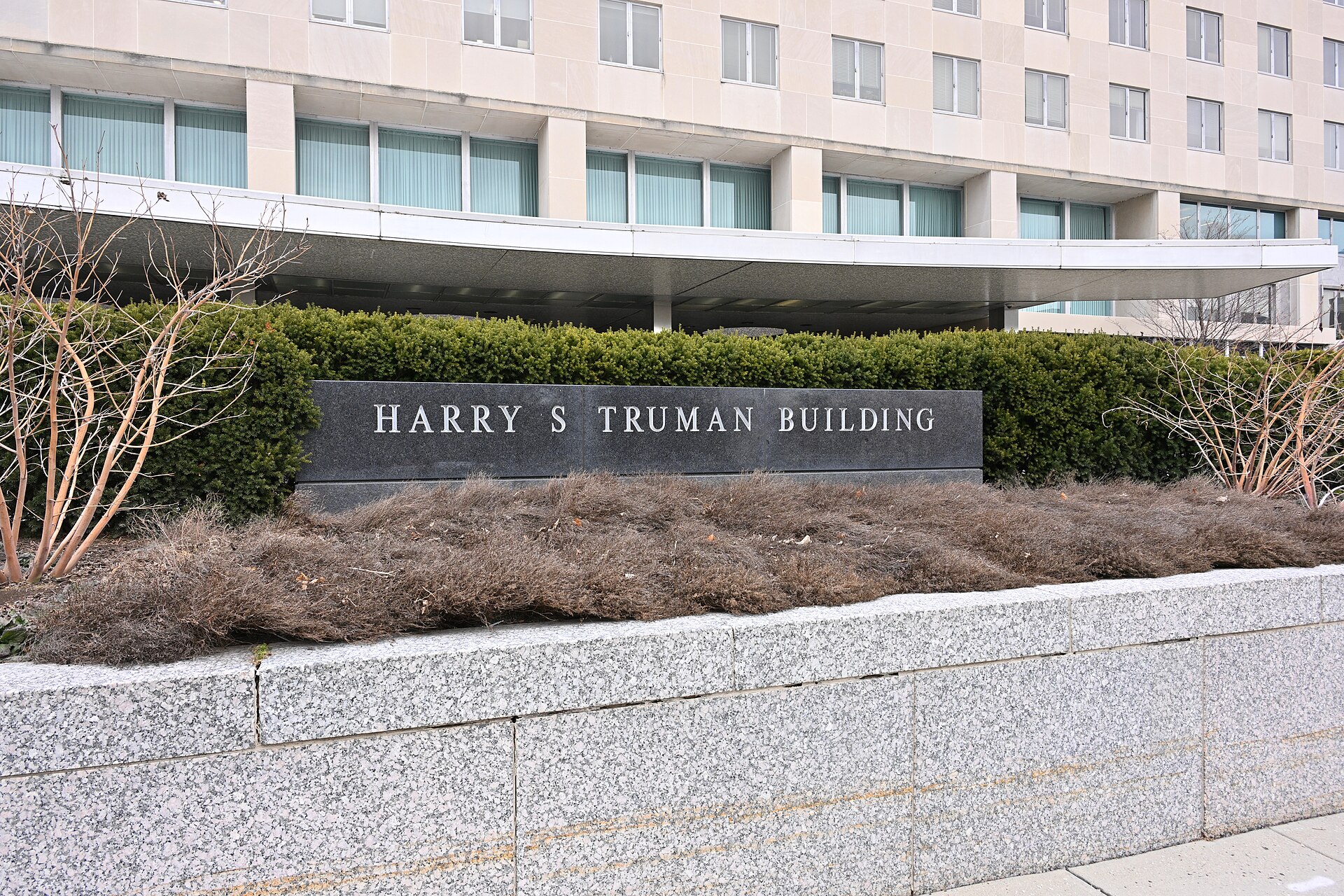
The Harry S Truman Building, headquarters of the US Department of State in Washington — the office that issues interview instructions to every embassy (image: Wikimedia Commons, CC BY 4.0)
What actually changed in the rules for 2025 and 2026
This section is why recycled older articles are a hazard: the rules moved and the embassies enforce the movement. Three documented changes from their official sources:
First: a fixed admission period replaces "duration of status". On 17 July 2026 the Department of Homeland Security published a final rule in the Federal Register changing F-1 and J-1 admission from duration of status to a fixed period of up to four years, extendable through a separate application, effective September 15, 2026, and shortening the departure window after programme completion from 60 to 30 days. The practical effect on a new applicant: your expected graduation must sit logically inside the admission window, and your post-study plan must be budgeted on a tighter clock than before the rule.
Second: expanded social media screening. Since summer 2025 the State Department has enforced enhanced vetting of social media accounts for F, M, and J applicants under its visa integrity programme. Practically: public accounts under your real name may be reviewed, so clean what you would not want an American officer reading — posts about unauthorized work inside the US or openly declared immigration intent are real refusal material.
Third: narrowed interview waivers and applying from your country of residence. In September 2025 the Department re-tightened its interview waiver policy, so most first-time student applicants now require an in-person interview, and the Department directs students to apply from their country of residence or nationality wherever possible. The practical step: book very early — interview queues at Arab-region embassies lengthened after these restrictions, and the appointment should follow your I-20 immediately, not a week before travel.
The fees remain as fixed in the Federal Register: an MRV application fee of $185 for non-petition-based visa categories including F-1 and J-1, and the one-time SEVIS I-901 fee of $350 for F-1 students ($220 for J-1) paid before the interview.
Refusal under 214(b): what happens and what to do
The most common F-1 refusal carries the code 214(b) — the section of immigration law presuming every applicant an intending immigrant until proven otherwise. It is neither the end of the file nor a personal accusation; it is a finding that the evidence presented in that specific interview did not persuade the officer on the three pillars: genuine student, sufficient funds, expected return.
What to do afterwards, practically. First, request and read the refusal sheet — sometimes it names the weak pillar. Second, do not reapply with the same file and the same answers; reapplication is allowed at any time with fresh fees, but success comes from changed facts, not luck: clearer funding documents, a documented scholarship, or a more detailed return plan (a written future job offer from the family firm, for example). Third, if the refusal was for a paperwork defect (mismatched DS-160, expired I-20), fix it immediately and rebook. What you cannot do: appeal a 214(b) — no legal appeal exists for this category, only a better reapplication.
On timing, do not rush a reapplication the following week no matter how close your programme start is; the new officer sees the prior refusal and its date, and a file resubmitted within weeks with cosmetic polish says nothing new happened. A sensible range between a refusal and a serious reapplication is one to three months, spent building the real addition — an additional balance in your own name rather than your sponsor's, a letter from a local employer awaiting your degree, or even a stronger university admission with a scholarship or a switch to a programme more visibly tied to your home market. A second refusal on the same grounds is a blunt message: the structure itself (borderline funding, a major disconnected from your path) needs rebuilding, not a third patch. The same intent test reaches applicants on other tracks even earlier — European volunteering candidates face it through the ESC volunteering motivation letter before any consulate conversation happens.
Want someone to prepare your short-programme file for you? The Truescho team builds the program visa pack (conference, volunteering, training) with a full document checklist — request the service now.
The twenty hours before the interview
The last night is for consolidation and sleep, not new learning. Structure it: sleep early, then review in the morning the three big figures of your file (yearly cost, programme length, sponsor income); read your "what will you do after graduation" answer aloud three times until it sounds natural rather than memorized; lay out modest semi-formal clothes; place the eight documents in order in a transparent folder with small extra copies in another pocket; and plan to reach the embassy thirty minutes before your slot, no earlier — the gate does not open before it, and long outdoor waiting only steadies the hand you will hand your passport with. And the parting advice from everyone who has passed the window: if the officer interrupts your answer with a new question, that is a sign of sufficiency, not attack — answer the new one briefly and follow where they take the conversation.
Frequently asked questions
What questions are asked at a US student visa interview?
The questions circle three pillars fixed by US law: genuineness as a student (why this university, this major, your study plan), sufficiency of funding and its source, and clarity of intent to return after graduation. This guide covers thirty real questions distributed across those pillars with a model answer for each.
Is the interview always in English?
Yes for F-1 applicants, because completing a degree programme in English is a condition of the admission itself, and your level during the interview is part of verifying the language file. If a word escapes you, ask for it calmly — "Could you rephrase that?" is an allowed and respected sentence, unlike silence or an off-topic answer.
How long does a student visa interview last?
Usually between two and five minutes for a prepared file; it is short because the officer has read the written file before you reach the window, and the interview confirms the fit between the paper story and the spoken one. Consistency with the documents matters more than eloquence.
What if my visa is refused under 214(b)?
It means the evidence did not persuade the officer on student genuineness, funding, or return intent. There is no appeal for this category, but you may reapply at any time with fresh fees; success depends on materially changed facts — clearer funding, a documented scholarship, stronger ties evidence — not the same file with the same answers.
What documents are required for an F-1 interview?
A valid passport, the signed I-20, the SEVIS I-901 receipt ($350 for F-1), the DS-160 confirmation, the $185 MRV fee receipt, a recent embassy-specification photo, proof of funding covering a full year, and your academic records with English test scores — ordered in a transparent folder by likelihood of request.
Can I work in the US while studying?
Within limits: on-campus work up to 20 hours weekly during term and full-time during breaks is permitted for F-1 students with the university's approval, while off-campus work requires specific authorization (CPT or OPT) tied to programme conditions. Presenting off-campus work as a funding strategy in the interview weakens the file immediately.
What are the new US student visa rules for 2026?
Effective September 15, 2026, F-1 and J-1 admission shifts from duration of status to a fixed period of up to four years, extendable by separate application, with the post-completion departure window shortened to 30 days, under a DHS final rule published in the Federal Register. Earlier, in 2025, came enhanced social media screening for F, M, and J applicants and a narrowing of interview waivers.
How do I book a US embassy interview appointment?
After receiving the I-20, paying the SEVIS fee, and completing the DS-160, enter your country's appointment portal with your passport number and DS-160 number, pay the $185 MRV fee, and select the earliest available slot. Appointments at most Arab-region embassies have been congested since the 2025 waiver tightening, so book immediately upon receiving the I-20 and keep the slot even if distant — most portals allow switching to an earlier slot later.