
US Small Business Health Insurance Premiums Set to Jump 14% in 2027 — What Business Owners Should Do Now
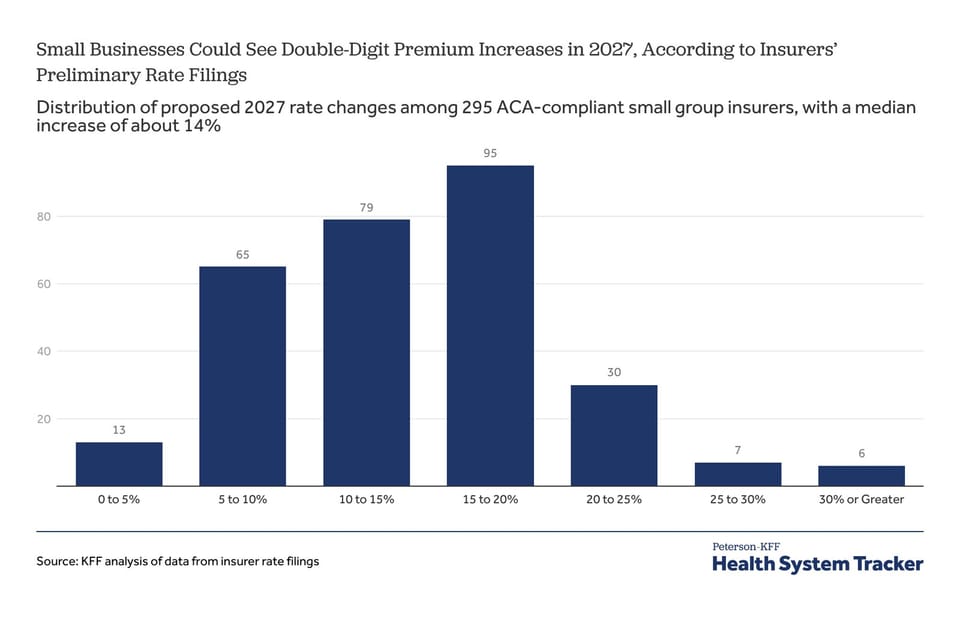
Small businesses across the United States are staring down a median 14 percent small business health insurance premium increase for 2027, according to KFF's analysis of 295 insurer rate filings across all 50 states and Washington, D.C. The analysis, published on 6 August 2026, is not a forecast or a lobbying estimate — it is a tally of what insurance carriers have formally asked state regulators to approve for small group plans next year.
Last updated: September 2026
For owners of restaurants, clinics, law offices, construction firms, and startups that sponsor coverage, that single number decides budgets, hiring plans, and sometimes whether benefits survive at all. This guide breaks down where the 14 percent figure comes from, what it means in actual dollars for a typical small firm, why insurers say they need it, and — most importantly — the concrete moves you can still make before your renewal date, from the 50 percent small business health care tax credit to level-funded plans and network redesign.
Where the 14 Percent Figure Comes From
Insurers in the small group market have requested a median premium increase of 14 percent for 2027, based on 295 rate filings from roughly 300 companies across all 50 states and Washington, D.C. These are initial requests, not final rates: state regulators can still modify them before plans take effect for 2027.
The figure was published on 6 August 2026 by KFF, with a companion brief on the Peterson-KFF Health System Tracker, and it was built the only way a number like this can be built honestly: by reading the actual rate filings carriers submitted in every state. Trade press including MedCity News and Healthcare Dive covered it within days, but most coverage stopped at the headline. For a business owner, two words in that sentence matter most: "requested" and "median."
"Requested" means these are opening positions in a regulated negotiation. Every state runs a rate review process, and regulators can push carriers to justify or trim increases before plans go on sale. Final 2027 rates are expected in the autumn of 2026. "Median" means half of the filings asked for more than 14 percent — and some asked for far more.
Source: KFF
The Distribution of Requests: Your Renewal Letter Could Be Worse — or Milder
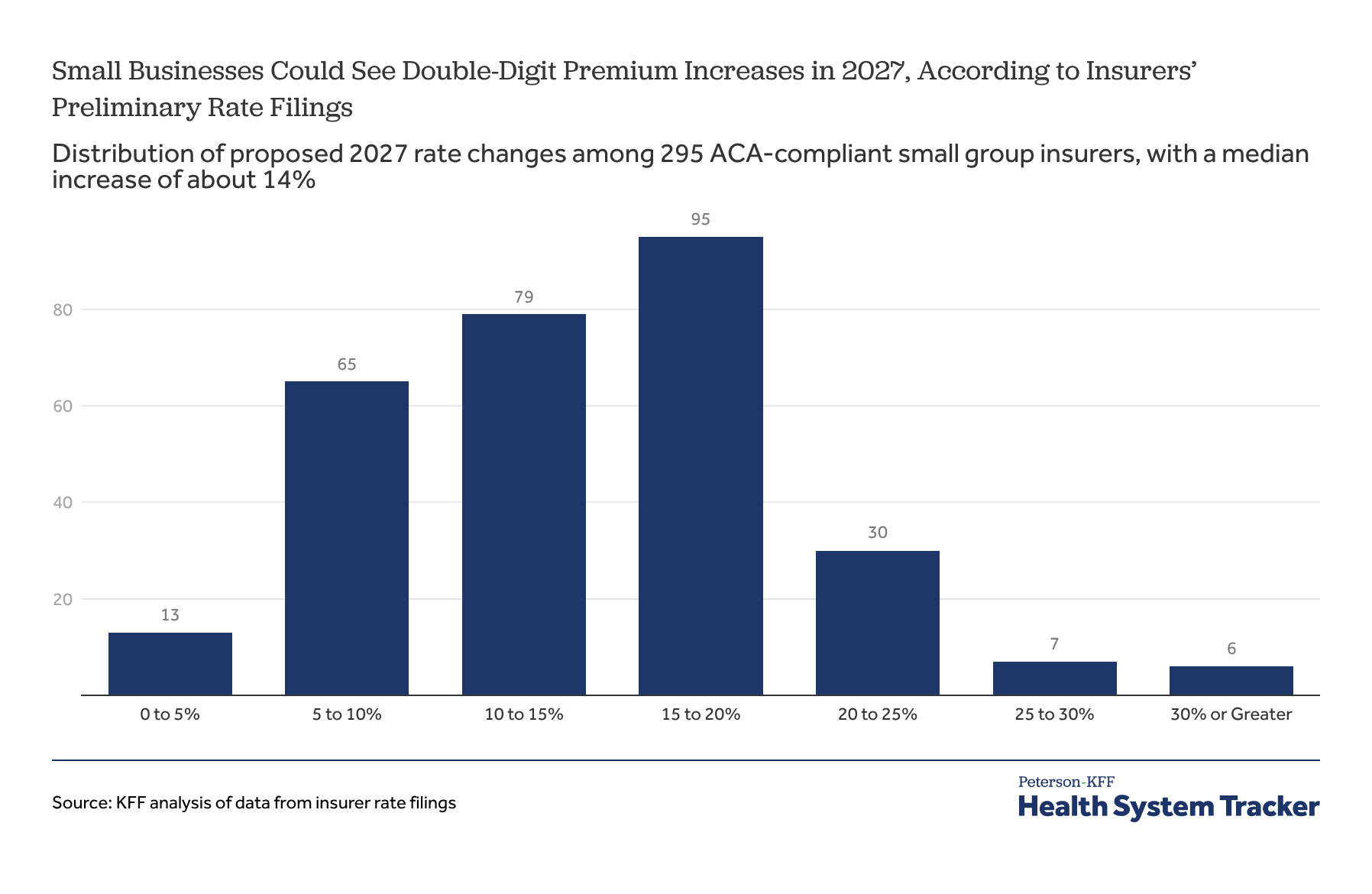
A median hides the spread, and the spread here is wide. MedCity News analyzed the filings and found that the majority of carriers clustered in the double-digit range, with a meaningful minority going even higher.
| Rate filing measure | Value | What it means for your business |
|---|---|---|
| Share of filings requesting 10–20% increases | 59% | The most likely scenario on your renewal letter |
| Share of filings requesting more than 20% | ~15% | Roughly one in seven carriers is asking for even more |
| Share of filings requesting less than 10% | 26% | A quarter of carriers are holding increases to single digits |
| Median requested increase across 295 filings | 14% | The planning baseline for 2027 budgets |
| Median expected growth in claims costs for 2027 | 10.8% | What insurers say care itself will cost next year |
Read that last row carefully, because it carries a lesson. Insurers expect the underlying cost of care to grow by a median of 10.8 percent in 2027 — yet the median premium request is 14 percent. Part of that gap is the risk pool problem we cover below, and part of it is carriers pricing in uncertainty. Either way, a 14 percent small business health insurance premium increase is the number to build your 2027 budget around, not the 10.8 percent cost-growth figure.
The filings themselves are unusually candid. Blue Cross Blue Shield of Massachusetts, in its HMO Blue filing, told regulators that cost is growing at the fastest pace in more than a decade. Moda Health in Oregon explained that the groups leaving the market tend to be the cheaper ones — as healthier employers exit to self-insured arrangements or drop coverage entirely, the employers left behind carry a sicker, more expensive risk pool.
Why Insurers Are Asking for 14 Percent: Six Pressure Points
The KFF analysis and the MedCity review of 82 unredacted filings across 14 states plus Washington, D.C. — including Connecticut, New York, Massachusetts, Oregon, Washington, Michigan, and Illinois — point to six drivers appearing again and again in insurers' own justifications.
- Rising medical prices. Hospitals, physicians, and drugmakers are charging more, and insurers pass those prices through. This is the largest single driver cited across the filings.
- Higher utilization. More claims per member — more visits, more procedures, more prescriptions — layered on top of higher prices.
- A shrinking small group risk pool. As enrollment in small group plans declines, with healthier employers moving to self-insured arrangements or dropping coverage, the employers who remain file claims at a higher average cost. This is the structural trap Moda Health described.
- Specialty drugs, including GLP-1 medications. Weight-loss and diabetes drugs are among the most expensive prescriptions in the system, and filings name them directly.
- Mental health and addiction care. Expanded access and rising demand for behavioral health services increase claims volume.
- No Surprises Act disputes. The billing-dispute process created to protect patients has generated substantial administrative cost; the filings analysis found providers filed most disputes and won most of them, at inflated amounts — costs that flow back into premiums.
None of these six pressures looks temporary.
What Coverage Actually Costs Today: The 2025 Benchmarks
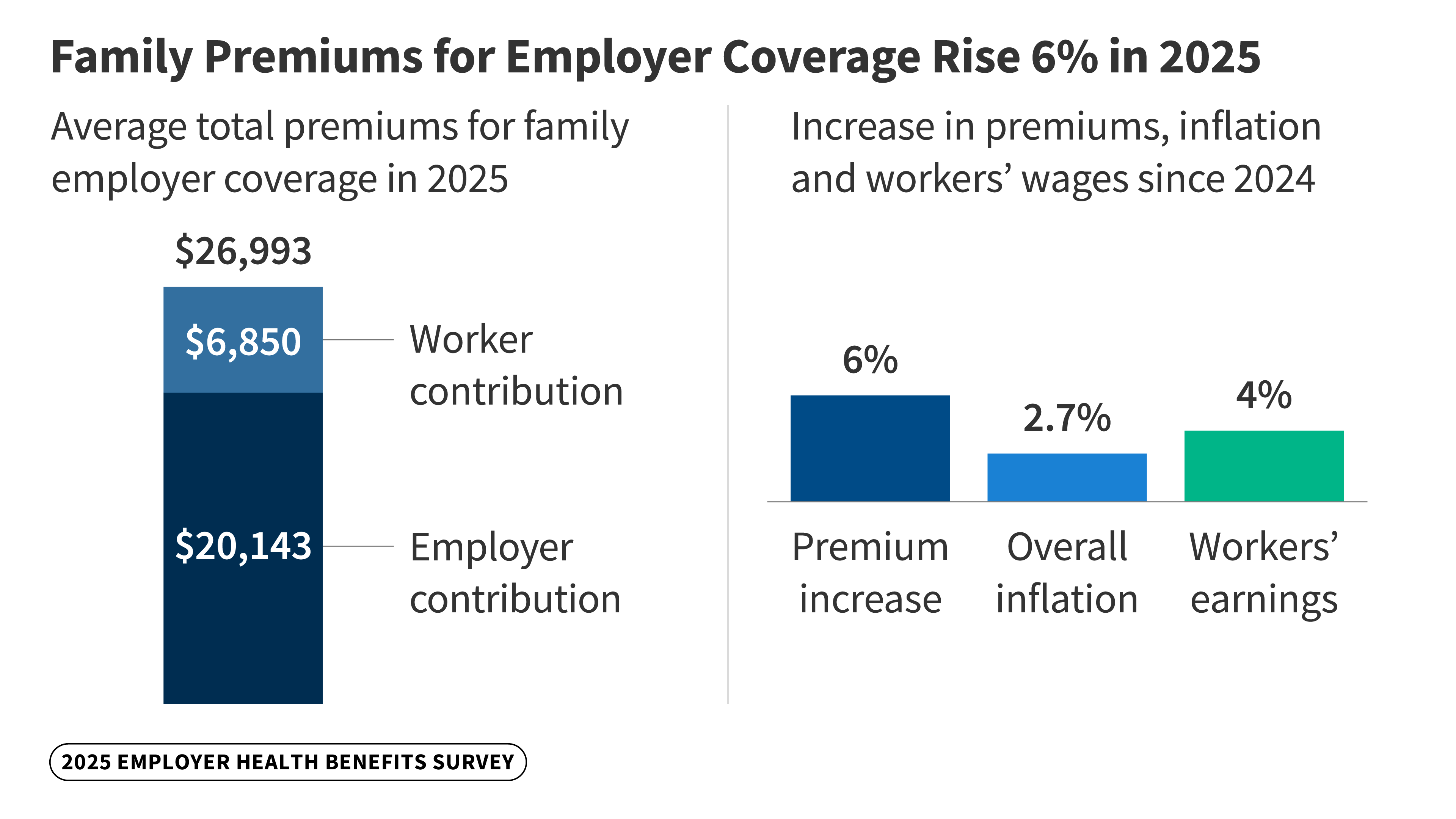
To understand what a 14 percent increase means, you first need today's baseline. KFF's 2025 Employer Health Benefits Survey, released on 22 October 2025, is the standard reference, and its numbers are the ones your 2027 renewal will be built on.
Source: KFF
| Premium measure (2025, annual) | All firms | Small firms (10–199 employees) | Large firms |
|---|---|---|---|
| Single coverage premium | $9,325 (up 5%) | $9,211 | Higher than small firms |
| Family coverage premium | $26,993 (up 6%, or +$1,408) | $26,054 | Higher than small firms |
| Worker contribution, single coverage | $1,440 (16% of premium) | — | — |
| Worker contribution, family coverage | $6,850 (26% of premium) | $8,889 | $6,227 |
| Workers in fully employer-paid single plans | — | 29% | 7% |
| Average single deductible | — | $2,631 | $1,670 |
| Workers with a deductible of $2,000 or more | — | 53% | — |
Two patterns stand out for small employers. First, small-firm family premiums ($26,054) run slightly below the all-firm average ($26,993), but small-firm employees pay far more of them out of pocket — $8,889 a year versus $6,227 at large firms. Second, small-firm workers carry materially higher deductibles: $2,631 on average versus $1,670 at large firms, with more than half facing at least $2,000 before insurance pays anything.
If you want to see how other systems price the same risk, our guides to health insurance for expats in the UAE in 2026 and health insurance for foreigners in Turkey show how mandatory-coverage markets handle cost pressure differently.
The Worker's Share: Why Your Team Feels This Increase Too
Premium increases never land only on the employer. How you split the increase shapes whether your plan stays affordable for the people it exists to protect.
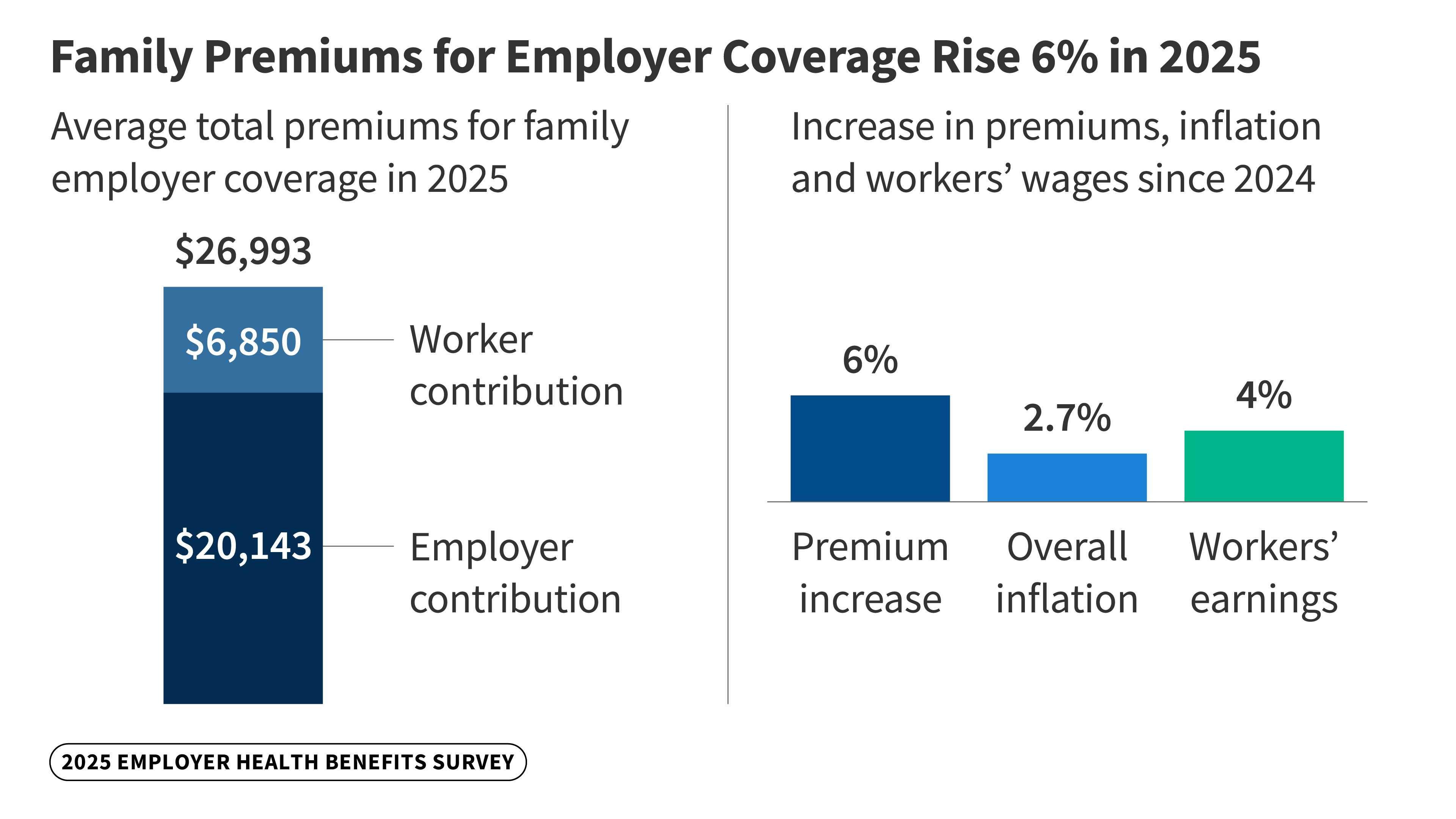
The 2025 survey found that workers across all firms contribute $6,850 a year toward family coverage — about 26 percent of the premium — and $1,440 toward single coverage. At small firms, the family contribution jumps to $8,889, more than $2,600 above the large-firm average. That is already a serious retention problem before any increase: an employee weighing a job offer compares take-home pay, and a family plan at a 50-person firm costs that family thousands more per year than the same plan at a 5,000-person employer.
One countervailing bright spot: 29 percent of workers at small firms are in fully employer-paid single-coverage plans, versus just 7 percent at large firms. Many small business owners have chosen to absorb the full single premium as a recruiting tool. A 14 percent increase forces a hard conversation about whether that generosity survives.
Source: KFF 2025 Employer Health Benefits Survey
The Dollar Calculator: What a 14 Percent Increase Means at Renewal
Percentages are abstract; invoices are not. The table below applies the requested median 14 percent small business health insurance premium increase for 2027 to the verified 2025 benchmarks, so you can see the stakes in dollars. Treat these as planning scenarios, not predictions — final rates may come in lower where regulators intervene.
| Annual cost scenario | 2025 average | If the full 14% request is approved | Added cost per year |
|---|---|---|---|
| Single coverage, all firms | $9,325 | $10,630 | +$1,306 |
| Family coverage, all firms | $26,993 | $30,772 | +$3,779 |
| Single coverage, small firms | $9,211 | $10,501 | +$1,290 |
| Family coverage, small firms | $26,054 | $29,702 | +$3,648 |
| Worker share of family premium, small firms | $8,889 | $10,133 | +$1,244 |
| Employer share of family premium, small firms | $17,165 | $19,568 | +$2,403 |
The bottom row is the one to circle. A small firm sponsoring one typical family plan would see its employer-side cost rise by roughly $2,400 a year — for a single employee. A ten-person firm where half the staff enroll families could be looking at a five-figure annual increase before anyone gets a raise. And if the increase passes through proportionally, each enrolled family would pay about $1,244 more from their own paychecks.
Planning tools like this calculator are exactly the kind of resource Truescho builds into its free global platform for professionals and business owners — practical cost analysis you can act on, alongside opportunity listings from the US to the Gulf.
Seven Moves to Make Before Your Renewal Date
Waiting for the renewal letter to arrive means negotiating from a standing start. Here is the action map, ordered roughly by impact.
- Put your broker to work early. Ask your broker to market your account to multiple carriers well before renewal, not just to re-quote your incumbent. The 26 percent of filings with single-digit increases show the market is not uniform — but you only find those carriers if someone goes looking.
- Run the SHOP and tax credit math. If you have fewer than 25 full-time-equivalent employees and average wages around $65,000 or less, the small business health care tax credit can cover up to half of your premium contributions — but only if you enroll through the SHOP marketplace. Details below.
- Model level-funded and self-funded plans. Because healthier groups are fleeing the small group pool, leaving it yourself may be rational. Level-funded plans cap your downside while giving you a refund if claims run low. The warning: you take on claims risk that fully insured plans absorb, so model worst-case scenarios, not just the happy path.
- Stress-test HDHP-plus-HSA designs. Higher-deductible plans with health savings accounts trade premium for out-of-pocket exposure. With small-firm deductibles already averaging $2,631, the design conversation is really about who carries the risk — you, or your employees.
- Re-examine the provider network. Premium is largely a function of which hospitals and doctors a plan pays. A narrower-network plan can meaningfully change the price if your team's doctors are inside it.
- Interrogate GLP-1 coverage deliberately. Decide on weight-loss drug coverage as a policy, not an accident of your plan document. The cost data below explains why.
- Track your state's rate review. Final 2027 rates land in autumn 2026. Watch your state insurance department's announcements so you are quoting real numbers, not filings, when you budget.
The 50 Percent Tax Credit and SHOP: Who Actually Qualifies
The single most underused tool in small business benefits is the small business health care tax credit, worth up to 50 percent of the premiums you contribute for employees — or 35 percent for tax-exempt organizations. Healthcare.gov, whose pages we verified directly in September 2026, sets four conditions:
- You have fewer than 25 full-time-equivalent employees
- Average annual wages of about $65,000 or less
- You pay at least 50 percent of your employees' premium costs
- You enroll through the SHOP marketplace — generally the only route to the credit
A firm paying $4,000 a year toward each of ten single-coverage employees could recover up to $20,000 a year — $2,000 per employee. The credit phases with size and wage levels, so the math is specific to your payroll, but for businesses at the smaller end of the small group market it can effectively cut the 14 percent increase to a fraction of its face value.
Small Group or the ACA Marketplace? Both Are Getting Pricier
Some owners will be tempted to drop the group plan and send employees to the ACA marketplace. The 2027 numbers explain why that escape hatch is closing too. KFF's preliminary analysis of ACA marketplace filings — first published on 8 July 2026 covering 16 states and the District of Columbia, then updated on 3 August across 276 insurers — found insurers proposing a median increase of roughly 15 percent for 2027, on top of a final 2026 median increase of 20 percent. Taken together, ACA marketplace premiums are set to jump by more than a third between 2025 and 2027.
In other words, the small group market's 14 percent and the marketplace's roughly 15 percent are symptoms of the same medical-cost inflation. Switching markets does not switch diseases, drug prices, or hospital contracts.
GLP-1 Drugs: The Budget Line Nobody Planned For
The KFF 2025 survey quantifies why GLP-1 weight-loss medications keep appearing in rate filings. Nineteen percent of large firms now cover GLP-1 drugs for weight loss. Among firms with 5,000 or more employees, coverage jumps to 43 percent — up from 28 percent — and 59 percent of the largest firms say the drugs' cost has exceeded their expectations.
For a small business owner, the GLP-1 question is doubly loaded. Cover the drugs and you absorb one of the fastest-growing cost lines in the filings. Exclude them and you may face pressure from employees and recruitment disadvantages against large employers. Either way, make the choice explicitly at renewal rather than discovering it in the claims runout.
What State Regulators Can — and Cannot — Do About It
Rate review is real. New York's regulators have already trimmed insurers' requested increases, though small group rates in the state continue to climb. Minnesota's regulators, meanwhile, are bracing for another rise in 2027. History says regulators moderate the worst requests but rarely reverse the direction: the drivers — prices, utilization, and risk-pool shrinkage — sit outside their authority.
The practical takeaway: budget for the full requested increase, treat any regulator-imposed trim as upside, and revisit your numbers when final rates are published in the autumn of 2026. And if you are an international founder deciding between a US and a Gulf base, our guide to the Dubai 5-year multiple-entry tourist visa walks through the other side of that calculation.
Frequently Asked Questions
How much will small business health insurance premiums increase in 2027?
The small business health insurance premium increase for 2027 stands at a requested median of 14 percent, according to KFF's review of 295 rate filings across all 50 states and Washington, D.C. Most requests clustered between 10 and 20 percent. State regulators can still adjust the figures before final rates take effect.
Why are small group premiums rising 14 percent for 2027?
Insurers cite rising medical prices, higher utilization, specialty drugs including GLP-1s, mental health and addiction care, and costly No Surprises Act disputes. A shrinking risk pool — as healthier groups self-insure or drop coverage — concentrates costs on the businesses that remain, pushing requested rates higher.
What is the average employer-sponsored health insurance premium in 2025–2026?
KFF's 2025 survey found average annual premiums of $9,325 for single coverage and $26,993 for family coverage across all firm sizes. At small firms, the averages were $9,211 single and $26,054 family. Family premiums rose 6 percent — an extra $1,408 — in 2025 alone.
What is the small business health care tax credit and who qualifies?
It covers up to 50 percent of an employer's premium contributions, or 35 percent for nonprofits. Qualifying businesses have fewer than 25 full-time-equivalent employees, pay average annual wages of roughly $65,000 or less, contribute at least half of employee premiums, and generally must enroll through the SHOP marketplace.
How many employees do you need for the SHOP marketplace?
The tax credit that makes SHOP especially valuable is limited to employers with fewer than 25 full-time-equivalent employees meeting the wage test. Enrolling through SHOP is generally the only route to claim the credit, so confirm eligibility and timing with your broker before renewal.
How much do employees contribute to family coverage at small firms?
Workers at small firms contributed an average of $8,889 toward family premiums in 2025, versus $6,227 at large firms. Across all firms, the average worker share was $6,850 — 26 percent of the premium. Small-firm employees also carry higher deductibles, averaging $2,631.
Are GLP-1 drugs driving up employer health premiums?
Rate filings explicitly cite specialty drugs, including GLP-1s. In KFF's 2025 survey, 19 percent of large firms covered GLP-1s for weight loss, rising to 43 percent among firms with 5,000 or more employees, and 59 percent of the largest firms said costs exceeded expectations.
Can state regulators block the proposed 14 percent rate increase?
Regulators review every filing and can demand justification or reductions — New York has already trimmed insurers' requests. But small group rates keep climbing regardless, and Minnesota expects further increases in 2027. Treat 14 percent as your planning baseline, not a worst case.
The Bottom Line: Start Before the Renewal Letter Arrives
The small business health insurance premium increase on the table for 2027 — 14 percent at the median — is a request, not a verdict. But the six forces behind it are structural, and the dollar math is unforgiving: roughly $3,600 more per family plan, per year, at a typical small firm. The owners who come through 2027 in the best shape will be the ones who acted in the autumn of 2026, while final rates were still being set: marketing their account to multiple carriers, running the SHOP tax credit math, modeling level-funded alternatives, and making a deliberate GLP-1 coverage decision.
Source: KFF
Health costs are only one line in the bigger financial picture of living and doing business across borders — for households planning a US move, our US F-1 visa guide covers another major expense category. Truescho's free global platform exists to put tools, verified cost guides, and opportunities for professionals and businesses in one place, so decisions like this rest on numbers instead of headlines.
Sources
- KFF — How Much and Why Premiums Are Going Up for Small Businesses in 2027
- Peterson-KFF Health System Tracker — Small Business Premium Brief
- KFF — 2025 Employer Health Benefits Survey
- Healthcare.gov — SHOP Coverage and the Small Business Health Care Tax Credit
- MedCity News — Small Businesses Could Face Double-Digit Premium Hikes in 2027