

How to Get an ITIN in 2026: Processing Times, Costs and Every Step for Non-Residents, Straight from the IRS
Last updated: September 2026
Getting an ITIN as a non-resident in 2026 costs $0 in government fees and takes 7 weeks for a status notice — or 9 to 11 weeks if you file during tax season (January 15 – April 30) or from outside the United States. The process is entirely paper-based: complete Form W-7, attach your federal tax return in the same envelope, include identity documents (a passport alone satisfies all requirements), and mail the package to the IRS processing address. There is no online application through the IRS itself — every "apply online" service is a private intermediary printing and mailing paperwork on your behalf.
That is the whole answer in one paragraph. The rest of this guide is for the reader who needs each step verified before acting: whether you actually need the number, which documents survive IRS scrutiny, how the three-year expiry rule works with real dates, what happens when you later receive an SSN, and the five mistakes that return applications unprocessed. Every figure below comes from the IRS's own published pages — not from intermediary sites recycling processing times from earlier years.
What an ITIN Is — and What It Is Not
An Individual Taxpayer Identification Number is a nine-digit tax processing number, beginning with the digit 9, issued by the Internal Revenue Service to anyone who needs a U.S. federal tax identification but is not eligible for a Social Security number. The published purpose is exactly one thing: federal tax administration.
That single-purpose framing matters because the market around ITINs is full of inflated promises. The IRS states plainly that an ITIN does not authorize Social Security benefits, does not qualify you for the Earned Income Tax Credit, and does not provide work authorization or change immigration status. Anyone selling the number as a step toward residency is selling a fiction.
It is also not an EIN — the employer identification number issued to business entities. A single-member LLC owner may genuinely need both: an EIN for the entity and an ITIN for the personal return that reports the LLC's income. Confusing the two is the most common error in ITIN mail, and it slows down every downstream step: bank onboarding, payment platforms, and the return itself all ask for the number matching the exact relationship type.
Why does your bank or payment platform ask for it before the IRS ever does? U.S. financial institutions file information returns (the 1099 family) on accounts held by non-residents, and those reports require a valid taxpayer number. Without one, account openings stall and payouts freeze — usually at the most inconvenient moment, after the store is built and the sales are flowing. This is why our guide to forming a US LLC as a non-resident recommends starting the ITIN file early and in parallel with formation, not after it.
One boundary rule deserves its own emphasis: a return showing all zeros does not count as a valid federal tax purpose for the application. You cannot obtain an ITIN "in preparation for a future that may come." You need either a genuine filing obligation or one of the documented exceptions — treaty benefits, U.S.-source dividends, partnership interests, or status as a spouse or dependent listed on a U.S. return.
Do You Actually Need One? The Decision Sequence
Answer these in order before buying an envelope:
- Do you hold a valid SSN? Yes → you do not need an ITIN, and using both numbers together later is prohibited. No → continue.
- Do you have a U.S. federal filing obligation or a documented exception? U.S.-source taxable income, a single-member LLC generating reportable income, a spouse you elect to treat as a resident, dividend income, a treaty claim. Yes → you need the number. No → wait until a real obligation exists; a speculative application will be returned.
- Which exception code fits your situation? The W-7 instructions list a code for each qualifying purpose. The wrong code in the right box stops processing until the IRS asks — get this right from the instructions themselves, not from memory.
- When is your filing deadline? Optimal plan: submit before tax season opens (before January 15) to compress the wait from 9–11 weeks toward 7, landing your number comfortably before the April 15 return deadline.
A final positioning check before the paperwork: your own tax residence. The substantial presence test — generally 183 weighted days of U.S. presence — typically makes a person a resident alien for tax purposes, which changes the entire filing picture. Most readers of this guide operate from their home countries and sit outside that zone; if you spend long stretches inside the U.S., settle your status first. Our comparison of US LLC vs UK Ltd for non-residents touches these calculations from the entity-choice side.
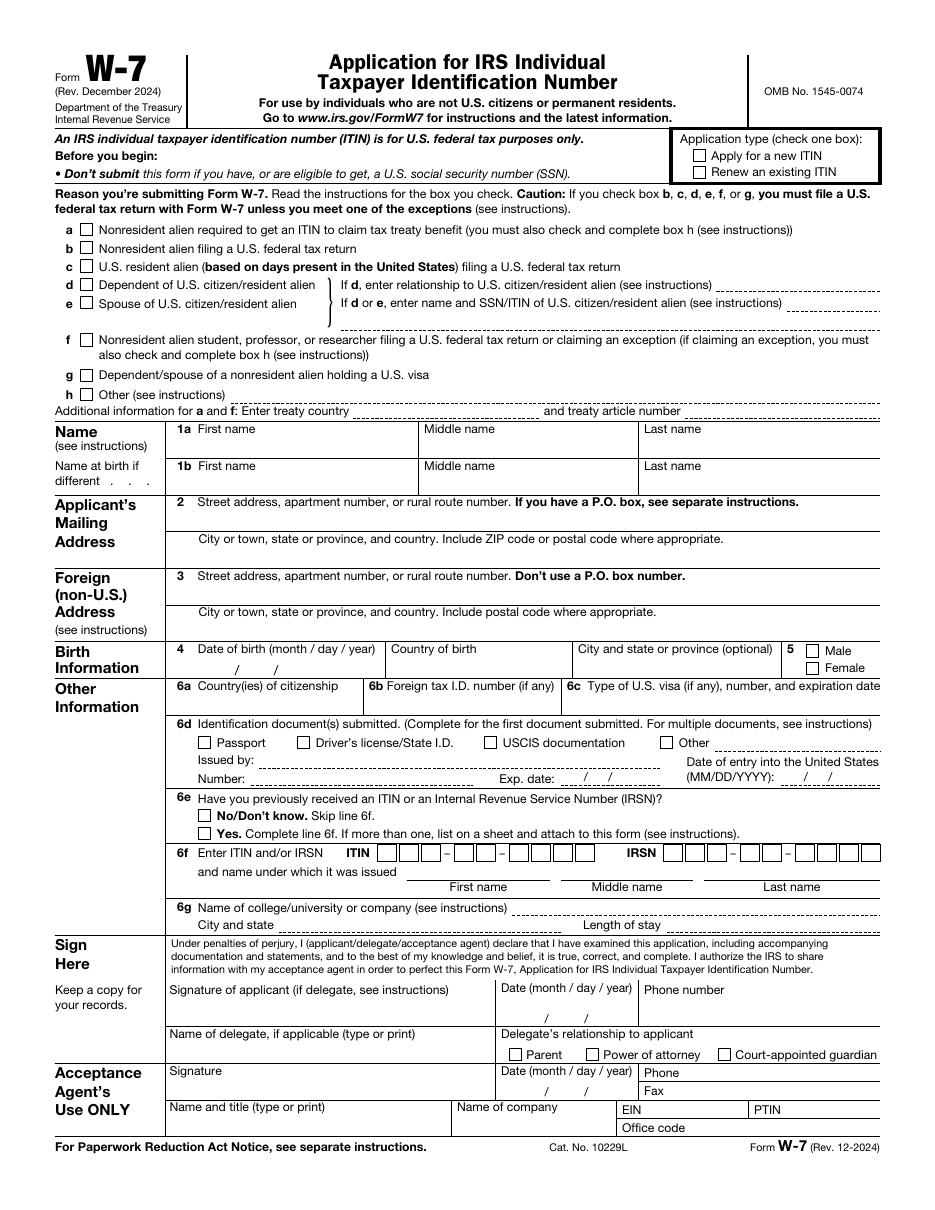
Source: IRS — Form W-7
The Application, Step by Step
Step 1: Download Form W-7 and choose the reason for applying
The official form is free on IRS.gov. The critical field is the reason: first-time request, renewal of an expired number, or a data change. Each tax purpose carries a published code from the instructions — enter it exactly, and leave nothing to interpretation. Renewals use the same form with the "Renew an existing ITIN" checkbox and a stated reason; there is no separate renewal form, contrary to what many intermediary sites imply.
Step 2: Prepare your federal return in the same envelope
The IRS instruction is stated in bold terms: include the tax return in your ITIN application package — do not file it separately. A W-7 mailed without its return is the single most common reason applications come back unprocessed. The documented exceptions (treaty benefits, dividend income) replace the return with their own supporting evidence instead.
Step 3: Prove identity and foreign status
Original documents, or certified copies from approved sources. A passport is the one document that stands alone, covering all requirements at once. Alternatives — national ID cards, driver's licenses, civil birth records, foreign residency documents, voting cards — are accepted in combination. Originals are returned within 60 days of processing, a published commitment the service generally meets.
For applicants unwilling to mail an original passport internationally, the instructions name the official alternative: Certified Acceptance Agents (CAAs) — IRS-authorized agents who verify documents in person and certify copies, so the originals never travel. This is the one point in the process where paying a third party makes structural sense: you are paying for verification and courier work, not a government fee.
Step 4: Mail the package or file in person
Copy the current mailing address from the IRS W-7 page at the time of sending — processing addresses change between form years, and blogs copy old ones. If you can, file before January 15 or after April 30: outside the season window, the wait shortens from 9–11 weeks toward 7. Use registered, tracked mail and keep the proof — during the silent weeks it will be your only evidence the package exists.
Step 5: Handle the filing deadline before the number arrives
If April 15 approaches with no ITIN in hand, do not delay your obligations. The published procedure: file Form 4868 for an extension (to October 15) and pay any estimated amount via 1040-ES before the ITIN arrives, writing "ITIN TO BE REQUESTED" in the SSN field. The return waits for the number; your compliance with deadlines does not.
Step 6: Follow up after the processing window
The IRS offers a phone status service once the published processing time has passed. Have your mailing proof and a copy of the form ready. If a deficiency notice arrives, respond within the stated window — an unanswered notice closes the file, returns your documents, and resets the clock to zero.
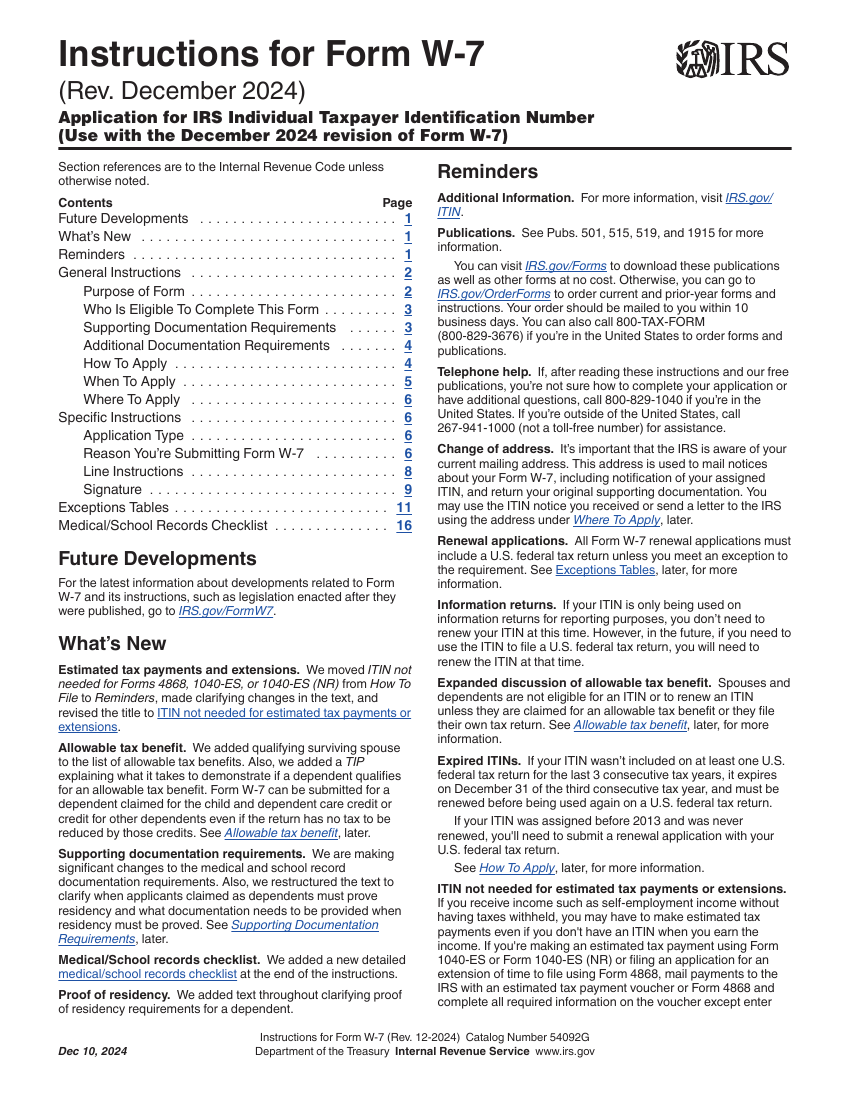
Source: IRS — Form W-7 Instructions
The Real Timeline for Non-Residents
These figures are published on the IRS's current pages, and the difference from intermediary sites is that these have not been copied from earlier years:
| Situation | Official processing time | Practical note |
|---|---|---|
| Filing outside tax season | 7 weeks to status notice | The optimal window: April 30 – January 14 |
| Filing during tax season (Jan 15 – Apr 30) | 9–11 weeks | The annual filing wave multiplies the queue |
| Filing from outside the United States | 9–11 weeks | International mail adds days in both directions |
| Return of your original documents | within 60 days | Whether the application is approved or returned |
| Phone status service | after the processing window | Have proof of mailing ready |
The planning conclusion: to hold your number before the April 15 return deadline, your package needs to be in IRS mail before mid-January. If that window has already passed for this year, the May–September window is the sensible fallback — shorter queues, less pressure, and a number in hand before the next season starts.
The Three-Year Rule: A Number That Expires If Ignored
Here is the trap the intermediary services never warn about — because warning you reduces their renewal business. The official rule published on the IRS renewal page: if your ITIN goes unused on a federal tax return for three consecutive tax years, it expires on December 31 of the year following the third unused year.
A worked example with real dates: your number last appeared on your 2024 return (filed in 2025), then on no return in 2025, 2026 or 2027 → the number expires on December 31, 2028. The LLC owner who filed once at application time, then "postponed compliance" for a few cycles, eventually discovers a frozen payout and no valid number — and repeats the seven-week wait from zero, this time under deadline pressure.
One documented exception worth remembering: use on informational returns only (such as being listed on a Form 1099) does not count as use that keeps the number alive — renewal is unnecessary for someone who files no returns and needs the number only for informational forms, because an expired ITIN remains valid for that purpose. But anyone filing an annual return keeps the number alive automatically, which is one of the quiet advantages of consistent annual filing — a discipline our Stripe account guide for non-residents treats as an operating requirement, not paperwork ritual, since a valid taxpayer number is what keeps the payment rails open.
Renewal itself: the same Form W-7, the renewal checkbox, a stated reason, and evidence of the need — at zero cost, same as the original.
When You Later Qualify for an SSN
If you later receive a Social Security number — through marriage, work authorization, or a change of status — a precise legal moment arrives: using both numbers together is prohibited from the moment the SSN exists. The published procedure: stop using the ITIN immediately and notify the IRS to merge your records, by sending your name, address, and copies of both the SSN card and the ITIN assignment notice to the IRS address in Austin, TX 73301-0057, or delivering it to a local IRS office. Skipping this leaves two parallel files under your name — scattered tax payments, suspended refunds, and avoidable reviews that one mailed letter would have prevented.
Most readers are outside this scenario today. But an ITIN lives in your file for years, and immigration or work paths can open unexpectedly — keep this section in your tax file and act on it from the official source if the day comes.
The Five Mistakes That Return Applications Unprocessed
- Mailing the W-7 without the tax return in the same envelope — the number-one rejection cause; the instruction is explicit.
- Guessing the reason code — the codes are published in the instructions; a wrong code halts processing pending clarification.
- Documents certified by an unrecognized party — certification has defined routes (CAAs and listed authorities); a generic "lawyer's stamp" is not one of them.
- Filing at peak season, then resenting the wait — filing between January 15 and April 30 is a voluntary choice of the 9–11 week queue.
- Letting the number expire through silence — three cycles without a return and the number retires itself; annual filers are structurally immune.
Frequently Asked Questions
What is an ITIN number?
A nine-digit federal tax processing number, beginning with 9, issued by the IRS to people who need a U.S. taxpayer identification for filing purposes but are not eligible for a Social Security number. Its only purpose is federal tax administration: it does not grant work authorization, residency, Social Security benefits, or the Earned Income Tax Credit, and it does not change immigration status in any way.
How do I get an ITIN as a foreigner or non-US citizen?
Complete Form W-7, attach your U.S. federal tax return in the same package, include identity and foreign-status documents (a passport alone suffices), and mail everything to the IRS processing address — or work through a Certified Acceptance Agent who verifies documents in person. From outside the U.S., expect 9–11 weeks of processing and up to 60 days for original documents to come back. There is no direct online application through the IRS.
Is there an ITIN application fee?
No government fee exists — issuance, renewal and replacement are all free through the IRS, which publishes no charge for the service. What you may legitimately pay for: registered mail, and optionally a Certified Acceptance Agent's fee for in-person document verification. Any business quoting a specific "IRS fee" amount is describing its own service price, not a government charge.
What is the ITIN processing time in 2026?
Seven weeks for a status notice when filing outside tax season; nine to eleven weeks when filing between January 15 and April 30, or from anywhere outside the United States. Original identity documents are returned within 60 days of processing. Submit before mid-January or after April 30 to land in the faster queue.
How do I check my ITIN application status?
By phone through the IRS ITIN status line, available once the published processing time for your situation has fully elapsed. Before calling, have your proof of mailing, a copy of your submitted W-7, and your identifying details at hand. If a deficiency notice arrives, respond within its stated deadline to keep the file open.
What documents do I need for an ITIN?
A valid passport alone satisfies both identity and foreign-status requirements. Without a passport, you combine documents from the accepted list — national ID card, driver's license, civil birth record, foreign residency or voter documents — per the IRS supporting-documents page. Originals or certified copies from approved certifiers; originals are mailed back within 60 days.
Do I need an ITIN for my US LLC?
The LLC formation itself and obtaining an EIN do not require an ITIN. The number becomes necessary for your personal federal return reporting the LLC's income — mandatory for single-member LLC owners with reportable activity — and frequently earlier at payment platforms and banks that require a personal taxpayer number. The practical sequence our US LLC formation guide recommends: form the entity and get the EIN first, then apply for the ITIN with the first genuine filing obligation.
ITIN vs SSN — what is the difference?
An SSN is issued to citizens and authorized residents and serves employment, benefits and tax identification. An ITIN is issued solely for federal tax processing to people ineligible for an SSN. Once you obtain an SSN, you must stop using the ITIN and notify the IRS (Austin, TX 73301-0057) so your records merge — using both together is prohibited.
Your First Week After the Number Arrives
Update the taxpayer identification records on your U.S. bank and payment platforms immediately — Stripe, Payoneer and equivalents lift restrictions once the number is on file. Archive the assignment notice (CP565) permanently: institutions ask for it as primary proof far more often than they ask for the number itself. Place the number in the SSN field of your next return, and put two recurring reminders in your calendar — the filing deadline that keeps the number alive, and the three-year expiry check. If your U.S. activity is bigger than one return — an LLC across states, processor payouts layered on processor payouts — the structure matters more than any single fact: our Delaware LLC formation guide assembles the entity side of the file, and our guide to PayPal alternatives for freelancers covers the cash-flow rails the number unlocks. And where the file crosses into multi-jurisdiction territory, a structured review with someone who has handled these cases live — start at Truescho consulting — is cheaper than a second trip through the seven-week queue.
Sources
- IRS — Individual Taxpayer Identification Number (ITIN) — definition, purpose and processing times
- IRS — How to renew an ITIN — the three-year expiry rule and renewal procedure
- IRS — ITIN supporting documents — accepted identity and foreign-status documents
- IRS — About Form W-7 — the official application form and instructions