
2 ===
Last updated: September 2026
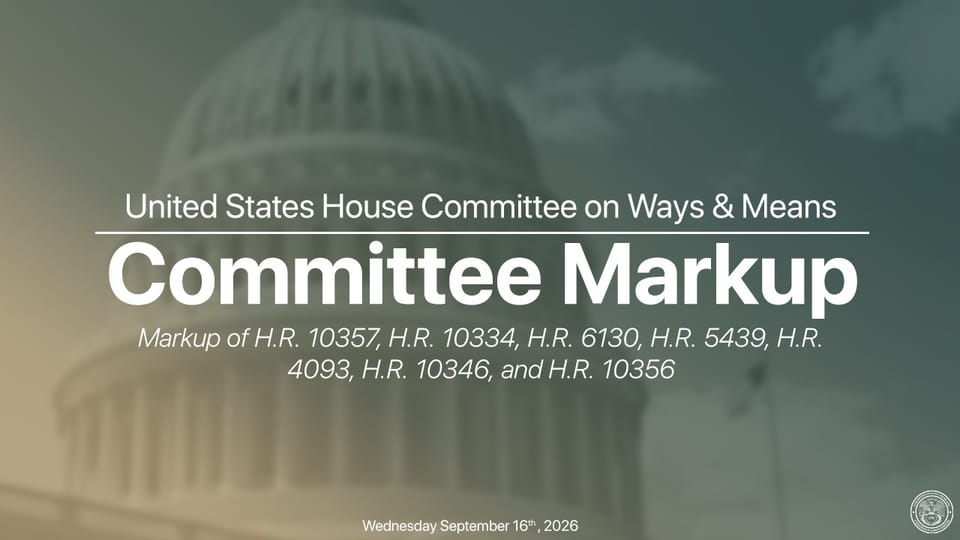
No, the crypto tax bill 2026 does not exempt every small crypto purchase. The Digital Asset Tax Certainty Act, H.R. 10357, exempts gains and losses on regulated US-dollar stablecoins and on network and transaction fees under $10 only, with the fee exclusion taking effect in 2028. It simultaneously extends wash-sale rules to digital assets for the first time. The House Ways and Means Committee approved it 38 to 5 on September 16, 2026, and it now heads to the full House.
That correction matters because half the internet is currently describing this bill as "no tax on purchases under $10." The official one-pager from the committee says something narrower and more important, and getting it wrong could cost you real money at filing time. Here is exactly what the bill does, who it touches, and what changes if it becomes law.
Source: Wikimedia Commons
Who This Bill Applies To
It applies to anyone with US tax obligations touching digital assets, which is a far larger group than active traders. Committee Chairman Jason Smith, citing his own figures, says 1 in 4 Americans, more than 67 million people, now own digital assets, in an economy he values at $2 trillion.
Concretely, that includes long-term holders who occasionally swap coins, people paid in stablecoins, stakers and miners receiving rewards, US-based users of foreign exchanges, and non-residents who trigger US filing duties through American platforms or income sources. If you have ever received a Form 1099-DA from a broker, this bill is about you.
It is also still only a bill: passed committee, not yet passed by the House, not yet law. Nothing in it applies to your 2026 tax return yet unless and until it is enacted.
What the Committee Actually Voted On
On September 16, 2026, the House Ways and Means Committee marked up and approved H.R. 10357 by a vote of 38 to 5, with PYMNTS reporting, citing the Wall Street Journal, that all five opponents were Democrats. The committee describes it as the first-ever federal framework for the substantive tax treatment of digital assets.
Chairman Smith, a Missouri Republican who introduced the bill, credited a bipartisan group of members at the markup: Representatives Yakym, Kustoff, Kelly, Bean, Arrington, Carey, and Horsford. Representative Rudy Yakym announced the committee's passage in a post on X, according to PYMNTS, which also carried quotes from Smith calling the legislation essential to keeping America the crypto capital of the world.
The markup itself is public record, and the committee published the full session on its official channel.
Source: Ways and Means Committee Republicans, YouTube
The Legislative Backdrop: June Hearing, September Vote
The bill did not appear from nowhere. The committee held a full legislative hearing on digital asset taxation on June 9, 2026, taking testimony on how the current property-based treatment fails both taxpayers and the IRS. That hearing shaped the seven titles that reached the markup.
Source: Ways and Means Committee Republicans, YouTube
One day before the vote, the political ground shifted: the Clarity Act, the market-structure bill that would have created a comprehensive regulatory regime for crypto, failed in the Senate on September 15, 2026. Decrypt and PYMNTS both report that the tax bill's advancement came in the wake of that loss, and that the SEC and CFTC pledged to act under their existing authorities instead.
There is also organized opposition: the Americans for Tax Fairness coalition sent a letter opposing the bill on September 16, 2026. That fight now moves to the House floor.
What Each of the Seven Titles Does
The one-pager published by the committee breaks the bill into seven titles. This table summarizes each one faithfully, and the sections below unpack the ones holders ask about most.
| Title | Subject | What it does |
|---|---|---|
| Title I | Digital assets as a medium of exchange | Excludes gain/loss on regulated US-dollar stablecoins; excludes gain/loss on network and transaction fees under $10; adds an election for simplified accounting |
| Title II | Parity with traditional assets | Extends two existing safe harbors to digital assets; allows mark-to-market for traders and dealers; simplified rules for charitable donations of common coins |
| Title III | Anti-abuse | Applies wash-sale and constructive-sale rules to digital assets; derivatives rules; provisions on US territories and foreign corporations |
| Title IV | Mining and staking | Sourcing and character rules; rewards taxed as ordinary income; staking facilitation for ETFs consistent with IRS guidance |
| Title V | Compliance | Simplified broker reporting; a dedicated voluntary disclosure program for digital assets with reduced penalties |
| Title VI | Authority | Regulatory powers for the Secretary of the Treasury |
| Title VII | FULL HOUSE Act | Restores the full deduction for gambling losses, reversing a Senate cut to 90 percent |
Title I is the headline. Per the official one-pager, it removes gain or loss from two specific things: sales of regulated US-dollar stablecoins, and the disposition of digital assets used to pay network or transaction fees under $10. It also creates an election for a simplified accounting method for digital assets. It does not exempt buying coffee with Bitcoin, does not exempt trading altcoins under $10, and does not create a general de minimis exemption. The effective date for the fee exclusion is 2028, per the Joint Committee on Taxation as reported by Decrypt.
Title III is the counterweight. The wash-sale rule would extend to digital assets with a window of 30 days before and after the sale, per the Joint Committee on Taxation as reported by Decrypt. Constructive-sale rules would also apply, closing the exotic-hedge workarounds sophisticated traders use.
Title IV settles the staking and mining argument, mostly against holders. Mining and staking rewards would be taxed as ordinary income, not capital gains, with new sourcing and character rules removing ambiguity. Decrypt also reports the bill drops an earlier proposal that would have deferred tax on some rewards, while making it easier for ETFs to stake in line with existing IRS guidance.
Title V is the amnesty carrot. A dedicated voluntary disclosure program for digital assets, with reduced penalties and what the one-pager calls a clean slate, would be directed to the Treasury. Paired with simplified broker reporting, it is clearly aimed at the millions of holders who have years of unreported activity.
Current Law vs the Bill: Before and After
The cleanest way to see what changes is a side-by-side. Under current law, crypto is property, the wash-sale statute in Section 1091 mentions only stocks and securities, and there is no de minimis exemption of any size at the federal level.
| Question | Current law | Under H.R. 10357 |
|---|---|---|
| Wash sales | Section 1091 covers stocks and securities only; crypto trades are outside the 61-day rule | Wash-sale and constructive-sale rules apply to digital assets, 30 days before and after |
| Stablecoin gains | Every disposal of a stablecoin is a taxable event, even cents of gain | Gains and losses on regulated US-dollar stablecoins excluded |
| Fees paid in crypto | Spending ETH or BTC on a network fee is a taxable disposal of that fee amount | Network and transaction fees under $10 excluded, from 2028 |
| Small purchases | No federal de minimis exemption exists at any threshold | Still no exemption; buying goods with crypto remains taxable |
| Staking and mining | Contested treatment, frequent audits and ambiguity | Rewards are ordinary income, with defined sourcing rules |
| Broker reporting | Form 1099-DA regime live since 2025 | Simplified reporting plus a dedicated voluntary disclosure program |
| Accounting | Specific identification, with disputes | Optional simplified accounting election |
The before picture is genuinely harsher than most holders realize. Because crypto is property and no de minimis exemption exists, every disposal is technically reportable, down to the fraction of a coin consumed by a network fee. The IRS received hundreds of millions of Form 1099-DA documents in 2025 alone, the committee's statement notes, many of them covering transactions under $10. That volume is the administrative argument driving Title I.

Source: IRS
Case Study: One $4.50 Network Fee, Taxed Two Ways
Consider a holder, call her Amara, who moves USDC on Ethereum and pays a $4.50 network fee in ETH. Under current law, that single action creates two obligations. First, the ETH she spent on the fee is a disposal, and if her ETH cost basis for that slice was $3.80, she has a $0.70 capital gain to report. Second, her records must substantiate that basis years later if audited.
Multiply that across dozens of transactions a year and you see why the IRS drowned in 1099-DA paperwork, and why holders drown in tracking. Now layer in the stablecoin leg: under current law, converting volatile crypto into USDC to escape volatility is itself a taxable disposal of the volatile coin.
Under Title I, from 2028, the $4.50 fee leg simply disappears from her return, and her regulated stablecoin dispositions are excluded entirely. But if Amara had instead bought $4.50 of goods with Bitcoin, that purchase would remain a taxable disposal, because the exemption covers fees and regulated stablecoins, not small purchases. The same bill that relieves her of fee-tracking also stops her from tax-loss harvesting her bags: sell ETH at a loss and rebuy it within the 30-day window, and under Title III the loss is disallowed, exactly as it would be with stocks today.
FAQ About the Crypto Tax Bill 2026
Does the 2026 crypto tax bill exempt transactions under $10?
No, and this is the most common error in early coverage. Only network and transaction fees under $10 are excluded, alongside gains and losses on regulated US-dollar stablecoins. Buying goods or trading coins under $10 remains taxable. The fee exclusion starts in 2028.
Are stablecoin gains taxable after H.R. 10357?
Not if the bill passes as written and the stablecoin is a regulated US-dollar stablecoin. Title I excludes gain or loss on their sale. Stablecoins outside the regulated US-dollar definition, and non-stablecoin tokens, keep normal property treatment.
Are wash sale rules coming to crypto in 2026?
The bill applies wash-sale and constructive-sale rules to digital assets, with a 30-day window before and after the sale, per the Joint Committee on Taxation as reported by Decrypt. It cleared committee 38-5 on September 16, 2026, but is not law until the full House and Senate pass it.
How are staking and mining rewards taxed under the bill?
As ordinary income under Title IV, not capital gains, with new sourcing and character rules intended to remove ambiguity. An earlier idea to defer tax on some rewards was dropped. ETF staking facilitation would align with existing IRS guidance.
What is Form 1099-DA and why did the IRS get millions?
It is the digital asset broker information return live since 2025. The IRS received hundreds of millions of 1099-DA forms in 2025 alone, many covering transactions under $10, per the committee's own statement, which is the core argument for the bill's simplified reporting.
Is crypto currently exempt from wash sale rules?
Yes, in practice. Section 1091 of the tax code applies to stocks and securities only, so selling crypto at a loss and rebuying it immediately is currently permitted. Title III of the bill would end that, matching the 61-day-style rule equities face.
When do the crypto tax bill provisions take effect?
The under-$10 fee exclusion begins in 2028, per the Joint Committee on Taxation as reported by Decrypt. Committee sources have not published a full effective-date schedule for every title, and nothing takes effect at all unless the bill passes both chambers.
What happens next after the committee approved the crypto tax bill?
It goes to the full House, where timing is uncertain. The Wall Street Journal, via PYMNTS, suggests floor action may come after the elections, and the House has already deferred contested files to November. A Senate version has not been scheduled.
What Happens Next: The Political Path
The crypto tax bill 2026 now sits with the full House, and the calendar is the obstacle. PYMNTS, citing the Wall Street Journal, reports the floor vote may wait until after the November elections, while Politico describes the bill's future as uncertain and the House has pushed its most contested files into November.
The opposition letter from the Americans for Tax Fairness coalition adds an organized tax-policy flank to the Democratic "no" votes in committee. On the other side, the industry quoted in PYMNTS coverage, including the Chamber of Digital Commerce, frames the bill as basic fairness: equal treatment with stocks, minus the paperwork that currently buries small holders.
What This Means If You Are Not a US Resident
Plenty of digital asset holders outside the United States still touch this system. Non-residents with US-source income or American brokerage accounts often need an Individual Taxpayer Identification Number to file, a process we explain in our guide to the US ITIN tax number for non-residents. Payment platforms, including crypto brokers, trigger their own reporting thresholds, which we broke down when the IRS set the new 1099-K reporting rules. Visa holders should also be aware of related enforcement shifts, like the H1B 60-day grace period elimination we covered, since tax compliance increasingly intersects with immigration status. And if you are weighing a move to a regulated crypto hub, our analysis of Dubai crypto license costs under VARA shows what compliant offshore operations actually cost. None of them are governed by this bill, but all of them increasingly interact with US reporting, which is why holders who fit any of these profiles keep a US tax filing checklist close at hand.
Three Things to Do While the Bill Waits for a Floor Vote
None of the steps below depend on the bill passing, which is exactly the point of them.
First, reconstruct your disposal history for 2025 and 2026 now, while exchange records are still easy to export. The hundreds of millions of Form 1099-DA documents the IRS received in 2025 mean the agency already holds a version of many traders' transaction histories; your own records should be at least as complete as what the IRS can see. Second, log the cost basis of every stablecoin conversion you have made, because under current law those disposals are fully taxable today and only stop being taxable if Title I survives into enacted law. Third, if past years went unreported, treat Title V's promised voluntary disclosure program with reduced penalties as a proposal, not an amnesty you can rely on today; until something is actually enacted, the disclosure options that currently exist are the only ones that apply.
For now, treat H.R. 10357 as a preview of the rules you will likely live under rather than current law: keep paying tax on every disposal including fees, keep your basis records for stablecoin trades, and know that both the stablecoin exclusion and the fee exemption arrive only if and when this bill crosses the finish line, with the fee exclusion not starting until 2028, while the wash-sale extension would end tax-loss harvesting as crypto holders have known it.
Sources
- Ways and Means Committee — statement on H.R. 10357 advancing
- Ways and Means Committee — official one-pager on the Digital Asset Tax Certainty Act
- PYMNTS — House committee advances first-ever crypto tax bill
- Decrypt — Crypto tax bill clears House committee
- Cornell Law School — 26 U.S.C. §1091, wash sales
Keep Following the Bill With Truescho
The Truescho editorial team tracks tax, visa, and work-abroad rule changes as they happen, so the floor vote and what it actually changes will be covered on truescho.com.
Explore Free →