

Last updated: October 2026
uni-assist is Germany's centralized application screening service. You open one account, upload your certificates once, pay EUR 75 for your first course of study plus EUR 30 for every additional course, and the platform either forwards a complete application to your university or issues a VPD pre-screening certificate that you submit yourself. VPD processing takes 4 to 6 weeks, every certificate stays valid for one year, and there are no portal-wide deadlines: each participating university sets its own.
That is the whole machine in four sentences. The rest of this guide covers the details international applicants actually get wrong: a tour of the My assist portal, the exact 2026 fee logic, the three official payment routes that work from Lagos, Karachi or Jakarta, a reverse countdown to your university's deadline, and the seven mistakes that stall files every single semester. If you are still shortlisting programs, open the funded opportunities board in another tab first, then come back and build your timeline around it.

Source: Study in Germany (DAAD)
When This Guide Applies to You
This guide is for you when your target German university routes international applications through the platform, whether for a degree program, a Studienkolleg foundation year, or a VPD certificate. It is not for you if your university screens foreign certificates itself, or if you are moving inside European exchange agreements.
Bachelor applicants from most national curricula use the pre-check to learn whether they qualify for direct subject entry or a foundation year first. Master and PhD applicants run through the same portal with heavier document sets; the wider planning path is covered in master and PhD admission steps 2026. Funding is a separate track with its own calendar, so pair this guide with the DAAD scholarship 2027 guide and the fully funded scholarships roadmap if money is part of your plan.
What the Platform Actually Does, and What It Never Does
It evaluates whether your school and university certificates qualify you for direct entry to a subject, a Studienkolleg place, or only conditional admission, then converts your grades into an assessment that German admissions offices trust. It never decides who gets admitted. The university always makes the final call, every time.
How large is the network? The official homepage says the service evaluates applications for around 180 German universities, while the built-in university tool answers "around 160" yet lists roughly 198 entries, because branches and faculties each get their own row. Treat 160 to 180 as the honest range and always confirm your specific program inside the tool before paying anything.
One more boundary worth knowing: for nationally restricted subjects such as medicine, some applications run through hochschulstart's DoSV coordination instead of, or alongside, this portal. That is a different system with different rules, and confusing the two is one of the seven mistakes at the end of this guide.
How Priya from Hyderabad Ordered Her VPD Ten Weeks Early
Priya, 23, finished her mechanical engineering degree in Hyderabad and wanted a winter-semester master's place at two German public universities. Both asked international applicants for a VPD certificate, so she built her plan backwards from the earlier university deadline and opened her account ten weeks before it.
She uploaded her degree certificate and transcripts with certified translations, her language proof, and the APS certificate she had ordered months earlier because Indian applicants are typically asked for one. Her two course selections came to EUR 105 in fees: EUR 75 for the first course and EUR 30 for the second. Her first two card payments failed on her bank's 3D-Secure limits, so she switched to the IBAN transfer route, quoting her applicant number and choosing the OUR instruction so the full amount arrived.
The status flipped to "in processing" the week her payment matched, and the VPD landed in her My Inbox as a PDF exactly five weeks later, right inside the official 4-to-6-week window. That left her five weeks of buffer to submit both university applications with the certificate attached. Her numbers are the template: a ten-week head start, a five-week processing assumption, and fees calculated before you click submit.
A Tour of My assist, From Registration to Certificate
The portal is called My assist, and it walks you through eight predictable stations. Here is the route from a fresh email address to a certificate in your inbox.
- Register with your email and create a password. You receive an applicant number; quote it in every message, payment reference and envelope from that moment on.
- Log in and use the university tool to search for your programs. Each program you add becomes a "course of study" row in your application.
- Fill in the personal data form. The "name affix" field confuses almost everyone: it exists for name components that are neither your first name nor your surname, such as suffixes like Jr. or III, or particles like bin or binti printed in your passport. Copy your name exactly as the passport shows it, and leave the field empty if there is nothing to enter.
- Enter your education history, including your grading scale. The system compares your certificates against the German scale, so accuracy here decides your assessment.
- Upload the documents from the official checklist for your route: the standard procedure checklist (PDF) or the VPD procedure checklist (PDF).
- Submit the online application and watch your status. Only after submission, and only if your route requires it, mail the certified copies by post.
- Pay through one of the three official routes in the next section. Processing starts when your payment is matched to your applicant number.
- Track the status until the result appears in My Inbox. VPD certificates arrive as a PDF you download yourself; if a university also wants a posted copy, dispatch it the same week.
Source: Study in Germany official YouTube channel (DAAD)
Three Paths: VPD, Direct Application, or No uni-assist at All
Almost every applicant fits exactly one of three paths: the university wants a pre-screening certificate from you, the university is a member and wants the full application forwarded, or the university is not a member at all. Work out which path you are on before you open an account, because it changes what you pay for and what you mail.
| Path | Choose it when | What the platform does | What you still do |
|---|---|---|---|
| VPD | Your university asks all international applicants for a pre-screening certificate | Checks your certificates and issues the VPD PDF | Apply to the university yourself, attaching the certificate |
| Direct application | Your university is a member and processes full applications | Evaluates and forwards your complete file to the university | Wait for the university's own admission decision |
| Neither | Your university does not appear in the tool | Nothing | Apply directly on the university's own portal |
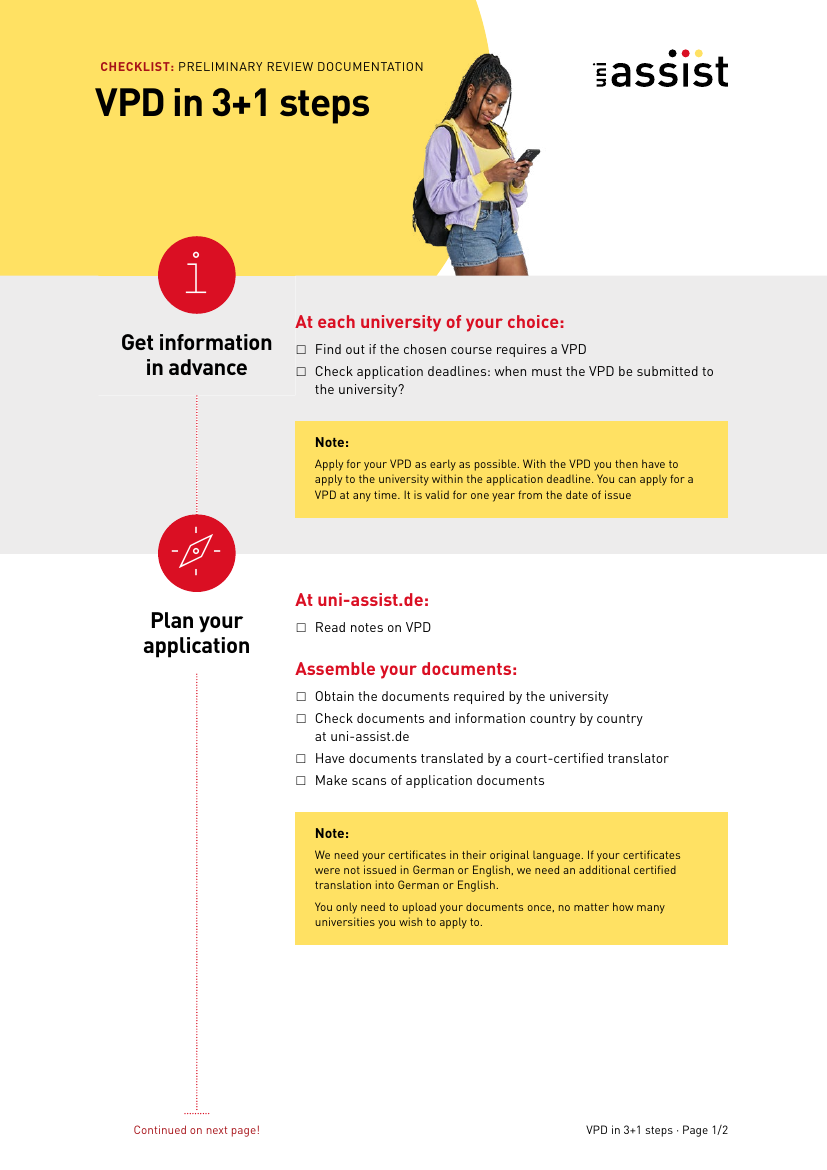
Source: uni-assist.de — official checklists
The practical difference between the first two paths is who receives what. On the VPD path you receive an assessment and then apply yourself, which suits universities that want their own forms plus the certificate. On the direct path your whole file moves to the university without you touching it again.
Order one certificate per university, because it is produced for the institution you name when requesting it. But each certificate stays valid for a full year from its issue date, so ordering early never wastes money, even if your plans shift a semester.
The 2026 Fee Structure, to the Last Euro
The first course of study in your application costs EUR 75.00, and every additional course in the same semester costs EUR 30.00. The official payment page states the costs are identical for all forms of application, standard or VPD, so the certificate route saves you nothing and costs you nothing extra.
| Scenario | What you pay |
|---|---|
| First course of study | EUR 75.00 |
| Each additional course, same semester | EUR 30.00 |
| Two courses at one university plus one at another, same semester | EUR 135.00 total |
| VPD procedure instead of a standard application | Same: EUR 75.00 plus EUR 30.00 per additional course |
That third row is the official worked example from the payment page, and it teaches the key rule: the counter is courses, not universities. Choosing two programs at one university and a third at a second university in the same semester still totals EUR 135, because each additional course of study adds EUR 30 regardless of which campus it sits on.
Paying from Outside Europe: The Three Official Routes
Three payment routes appear on the official payment page, and from outside Europe exactly two of them are realistic for most applicants. Knowing which one fits your banking situation saves the most common kind of delay: a payment that cannot be matched to your file.
The first route is a Visa or Mastercard with 3D-Secure, paid directly inside the portal. Your bank must support 3D-Secure authentication, and when this route fails it is almost always a bank-side limit or an authentication setting, not the portal. Call your bank before your deadline, not after a failed attempt.
The second route is an online bank transfer, available from accounts in Germany and twelve other European countries named inside the portal. If you have a trusted contact with a European account, this route avoids international transfer charges entirely, and the reference still has to carry your applicant data.
The third route is a classic bank transfer to an IBAN issued by the payment provider. The transfer must include your applicant number, your name and your date of birth, or the money cannot be matched to your application. Choose the OUR instruction so bank charges do not eat into the amount, because underpaid applications sit unmatched while the clock runs.
Deadlines: No Single Date, So Build a Reverse Countdown
There is no unified deadline anywhere in the system. Each member university defines its own application periods per program and per semester, and the only reliable sources are the university's entry in the official tool and the university's own admissions page. Build your plan backwards from that date, in weeks, like the table below.
| Time before your university's deadline | What you should be doing |
|---|---|
| 10 to 12 weeks | Create the account, collect certificates, order certified translations and any APS or language test still missing |
| 8 weeks or more | Submit the online VPD request, the officially recommended minimum lead time |
| 6 to 4 weeks | Normal processing window of 4 to 6 weeks; check the status weekly and keep documents ready |
| 3 weeks | If the status has not moved, contact applicant services quoting your applicant number |
| 2 weeks | Mail any certified copies your route requires; hold the finished VPD PDF in hand |
| Deadline week | Submit the university's own application with the certificate attached, before their date, not on it |
If juggling five universities, three deadlines and a VPD queue is the point where you would rather hand the file to someone else, Truescho's international university admission service does exactly this job: packages from one university at EUR 89 up to eight universities at EUR 399 with 21-day delivery, including a motivation letter tailored to each program, a university list with deadlines and fees for your approval, requirement matching, account creation on portals such as UCAS, uni-assist and university portals, plus submission and tracking of every application. The application fees themselves and language exams are paid directly and are not included, no admission is guaranteed, and a consultant replies within 24 hours.
APS, TestAS and Other Country-Specific Extras
Applicants from India, China and Vietnam are typically asked for an APS certificate: an authentication of academic documents issued by a separate authority in your home country, not by this portal. Applicants from Nigeria, Indonesia, Bangladesh, Egypt, Vietnam's neighbors and most other countries do not need APS at all.
If APS applies to you, treat it as its own project with its own weeks-long timeline, because without it your file is incomplete no matter how early you paid. TestAS is different: it is not a portal requirement at all, and only some universities ask for the test for specific bachelor programs, so check your program's entry in the university tool before booking anything. Language proofs follow the same logic: the portal accepts the certificate, but the program decides which test and which score.
Seven Mistakes That Stall International Applications
- Uploading uncertified translations. Documents not in German or English generally need certified translation, and the cheap quick route fails at exactly this check. The full rules are in certified translation for academic documents.
- Mailing the envelope before payment is matched. Post that arrives while your status still shows an unpaid application cannot be processed, so submit, pay, and only then dispatch paper.
- Choosing the wrong semester. Winter and summer semester applications are different products with different deadlines, and one wrong click reorders your entire countdown.
- Confusing VPD with DoSV. The first is a pre-screening certificate from this platform; the second is hochschulstart's coordination procedure for restricted subjects. They solve different problems and are not interchangeable.
- Mishandling the name affix field. Names that differ between your passport and your application by a single particle cause identity mismatches, one of the slowest problems to fix.
- Reusing an expired VPD. The certificate is valid for one year from issue, not forever, and universities reject stale copies silently.
- Ignoring requirements that live outside the portal. Some universities want extra forms, tests or mailed documents that never appear in your online account, and the university's own page is the only place they are listed.
Once an admission letter lands, the next machine starts: the national visa. The student visa documents checklist covers that file from bank statements to insurance.
Frequently Asked Questions
Is the platform mandatory for every German university?
No, only for member universities. The network sits somewhere between the roughly 160 institutions named by the official tool and the around 180 quoted on the homepage. Search your specific university in the tool; if it is absent, you apply directly and this guide does not apply to you.
How long does VPD processing take?
The official answer is 4 to 6 weeks after you submit the online application, which is why the recommendation is to order at least 8 weeks before your university's deadline. The finished certificate is then valid for one full year from its issue date, so an early order is never wasted work.
Can I use one VPD for several universities?
No, each certificate is produced for the specific university you name when ordering it, so a second university needs its own request. The saving grace is validity: every certificate lasts a full year from issue, so ordering for one university now does not lock you out of others later.
What is the name affix field?
It collects name components that are neither your first name nor your surname, such as suffixes like Jr. or III, or particles like bin and binti printed in your passport. Copy everything exactly as the passport shows it and leave the field empty if your passport shows nothing of the kind.
Is the service free?
No. Every application costs EUR 75 for the first course of study and EUR 30 for each additional course in the same semester, and the VPD procedure costs exactly the same. Build your course list first, multiply the fees, and budget before you submit anything.
Do I need APS or TestAS?
APS applies to applicants from India, China and Vietnam, and is issued by a separate authority in your country before you can complete your file. TestAS is not a portal requirement; only some universities request it for specific programs, so confirm in the university tool before booking a test date.
Want someone to take this step off your plate? Truescho's international university admission service pairs you with a consultant within 24 hours, then builds your university list, writes each motivation letter, and submits and tracks every application for you.