
UAE VAT Changes from 1 October 2026: What Cabinet Decision 149 Means for Your Business
Last updated: September 2026
Eight days of September 2026 separate two dates that every UAE finance function should have on its wall: 8 September, when the Ministry of Finance announced Cabinet Decision No. 149 of 2026, and 1 October, when its amendments to the VAT Executive Regulation take effect. That is the entire compliance window. Six amendments are coming into force, five of them clarifications that reduce interpretive risk, and one — the block on input VAT recovery for large cash payments — a behavioural change aimed squarely at how your business pays its suppliers. The rate stays at 5%, the registration thresholds stay where they are, and the Federal Tax Authority remains the regulator. What changes is the paperwork logic underneath: recoverable input tax will increasingly depend on traceable payment rails.

Source: UAE Ministry of Finance
This briefing reads the decision the way an operator has to read it: dates first, then each amendment in plain terms, then a worked example showing what a lost recovery actually does to procurement cost, then a free-zone note, then a seven-point action list sized for the remaining days before the rules bite. It draws on the Ministry of Finance announcement, Federal Tax Authority references, and the wave of advisory alerts published by major firms through September 2026 — Alvarez & Marsal on 9 September, Deloitte on 10 September, KPMG on 12 September, and Crowe UAE on 21 September — cited here as names, with official sources linked directly.
The data first: six amendments, one effective date
Cabinet Decision 149/2026 amends specific provisions of the Executive Regulation of Federal Decree-Law No. 8 of 2017 on Value Added Tax — the same regulation originally issued by Cabinet Decision 52/2017. The six changes, effective 1 October 2026:
| # | Amendment | Nature | Who feels it |
|---|---|---|---|
| 1 | Input VAT deduction blocked on cash payments above thresholds set by a future Minister of Finance decision | Restrictive | Any business paying suppliers large amounts in cash: trading, contracting, hospitality |
| 2 | Medical products supply and import rules aligned with updated UAE healthcare legislation | Alignment | Hospitals, clinics, pharmacies, device suppliers |
| 3 | Employee housing input-tax treatment clarified | Clarification | Companies paying staff accommodation rents |
| 4 | Capital Assets Scheme application clarified for consistency with the VAT law | Clarification | Businesses using assets partly for taxable, partly for exempt activities |
| 5 | Input tax apportionment method refined; existing method retained for government entities and charities | Refinement | Partially exempt businesses with mixed activities |
| 6 | New single composite supply provisions based on the economic substance of the transaction | New rules | Real estate, hospitality, bundled services |
Read the table twice and a pattern emerges: five of six amendments are about removing ambiguity that generated FTA queries and audit disputes. The Ministry of Finance framed the package exactly that way in its 8 September announcement — greater clarity for taxable persons, support for voluntary compliance, fewer tax disputes, and consistency with international best practice. The sixth amendment, the cash restriction, is the only one that takes away an existing entitlement, and it is the reason this article leads with dates rather than definitions.
Who the changes bind — and who can ignore them
The amendments apply to every person registered or required to register for VAT in the UAE. The mandatory registration threshold remains AED 375,000 in annual taxable supplies, with a reduced threshold of AED 187,500 for certain cases defined in the law. Late registration continues to expose a business to an administrative penalty of AED 10,000, a figure the FTA has applied consistently since the tax's introduction on 1 January 2018.
If your business banks digitally, issues compliant tax invoices, and receives compliant tax invoices from registered suppliers, the practical impact on you is close to zero — the clarifications work in your favour by shrinking the area auditors can argue about. The businesses that need to move are the ones whose procurement model runs partly on cash: wholesale purchases settled in banknotes, site materials paid on delivery, informal supplier networks. For that group, the next section is the whole story.
Unregistered businesses below the threshold have no new obligation, but the direction of travel matters for their planning: the entire fiscal environment is tilting toward documented, banked, traceable transactions. Anyone modelling future voluntary registration — or growth that will cross the threshold — should assume this tilt is permanent. For related reading on the wider UAE compliance stack, see our guides on UAE corporate tax compliance and UAE corporate tax for freelancers.
The cash-payment restriction: the amendment that changes behaviour
Before 1 October, the recovery logic was payment-agnostic: purchases made for taxable business purposes, supported by a valid tax invoice from a registered supplier, generated recoverable input VAT regardless of whether you paid by transfer, card, or cash. Cabinet Decision 149 breaks that symmetry. Cash payments exceeding thresholds still to be set by a Minister of Finance decision will no longer generate deductible input tax.
Two points deserve precision. First, the thresholds do not exist yet as published numbers — the decision delegates them to a forthcoming ministerial decision, and any figure circulating on forums or messaging groups ahead of that publication is speculation, not law. Second, the Ministry's stated intent is compliance and reducing evasion risk: large cash transactions are hard to trace, and traceability is exactly what input tax recovery will now be anchored to. The economic logic is unambiguous — the UAE has spent years pushing digital payments across its economy, and this amendment extends that policy into tax recovery rights.
The defensible operating assumption is therefore conservative: treat any material cash purchase as non-recoverable from 1 October onwards, and move supplier payments of size onto bank transfers or corporate cards now. There is also a competitive fairness dividend worth naming: businesses that ran undocumented cash deals historically competed on an artificially lower visible cost base. Requiring the same documentation from everyone narrows that gap.
Worked example: what a lost recovery does to procurement cost
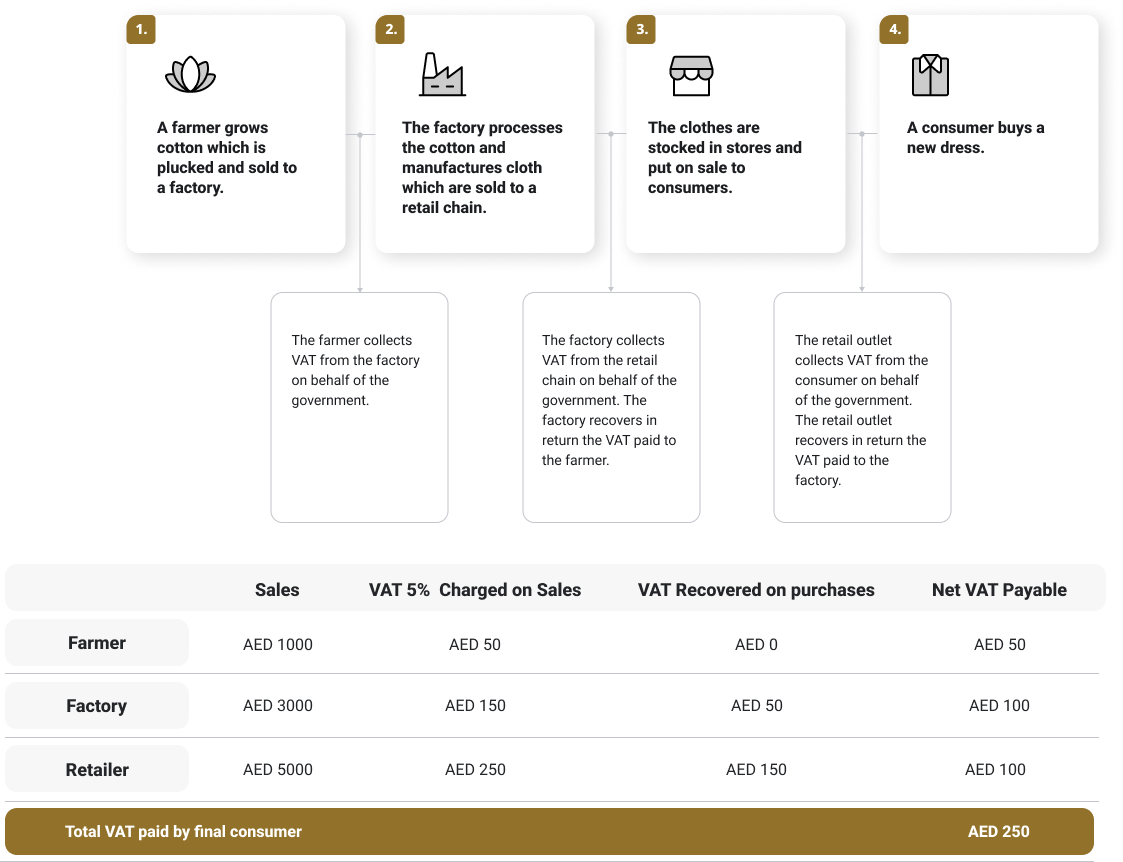
Consider a Dubai trading company buying AED 500,000 of inventory a year from wholesale suppliers. At 5%, the input VAT embedded in those invoices is AED 25,000 — money the company currently recovers by deducting it against output VAT in its periodic returns.
Now assume the company keeps paying those invoices in physical cash, and the forthcoming ministerial decision sets a threshold below the value of the larger invoices. Part or all of the AED 25,000 becomes permanently non-deductible, depending on how each invoice sits against the threshold. The effect lands directly on gross margin: procurement cost rises by the lost recovery with zero operational change, purely because of the payment channel.
Flip the scenario: the same company pays by transfer. Recovery is preserved in full, and the company picks up a secondary benefit — a clean bank record that strengthens its file when negotiating trade finance or supplier credit limits. The difference between the two scenarios is not really a tax difference; it is a documentation quality difference, and documentation quality is what protects a business in any future audit. Businesses that want a structured home for multi-currency supplier payments can read our Wise Business account review; the wider regional pattern is covered in our Saudi VAT registration and compliance guide and the Qatar VAT implementation guide.
Medical products and employee housing: two files closed
Healthcare has been a recurring source of committee questions because UAE healthcare legislation was updated in recent years while the VAT Executive Regulation still pointed at older references. Amendment 2 rewrites the supply and import rules for medical products so they track the current healthcare framework. The practical effect for private hospitals, clinics, pharmacies, and device suppliers is a shrinkage of interpretive conflict between two federal texts — a regulatory tidy-up rather than a new burden.
Employee housing is the quieter but more widespread file. Companies paying accommodation rents for staff have long asked the same question: is the input VAT on that rent recoverable? Answers historically varied case by case. Amendment 3 states the deduction position explicitly, which serves both sides — the company knows its position in advance, and the FTA examiner has a single reference instead of case-by-case judgement. Companies running broader expatriate compliance files will find our expat health insurance in the UAE guide useful, since housing, insurance, and visa compliance usually travel together through the same HR budget.
Capital Assets Scheme and composite supplies: the technical amendments explained
The Capital Assets Scheme is the mechanism that governs recovery when a major asset — machinery, property, a software system — serves taxable activity at purchase but later drifts into exempt use, or vice versa. Full recovery up front, followed by periodic adjustments as the use mix changes, is the scheme's core. Amendment 4 clarifies how the scheme applies so its details sit consistently with the parent VAT law, which should reduce disputes on large asset transactions where adjustment periods span years.
Single composite supply is the amendment that sounds academic until you sell bundles. A furnished unit sold with maintenance and management services; a hotel stay with breakfast and airport transfers; a software licence with hosting and training — each raises the same question: one supply taking the treatment of its dominant element, or multiple supplies each with its own treatment? Amendment 6 resolves this by reference to the economic substance of the transaction — what the customer is genuinely paying for — rather than the paperwork form of the contract. Any business renewing bundled contracts in the fourth quarter should put those contracts in front of an adviser before signature, because pricing structures built on the old interpretation may need rebalancing.
Input tax apportionment: a fairer method, same obligations
Partially exempt businesses — those with both taxable and exempt activities — must apportion recoverable input tax on shared costs using a fair and reasonable method. The historical complaint from auditors was that crude apportionment keys did not reflect actual economic activity, producing recovery percentages that invited challenge. Amendment 5 refines the methodology so it reflects the taxable person's economic activities more accurately, while explicitly retaining the existing method for government entities and charities, recognising both their different nature and their limited capacity to build sophisticated accounting systems.
The practical instruction for your finance team: review the apportionment key you have been using. If it is an approximation inherited from years ago, you now have a regulatory reason to update it to reflect the real shape of your activity — and updating it voluntarily before your first post-October return is a far better position than adjusting it under audit scrutiny later.
Free zones: do the changes reach you?
A question the advisory alerts handled unevenly, so it deserves a direct answer here. Federal VAT law applies to every person registered with the Federal Tax Authority, including entities in free zones. Designated zones carry special rules for the movement of goods, but services supplied from free zone entities follow the general place-of-supply rules. The amendments made no free-zone carve-outs: a registered free zone entity paying large cash invoices for taxable purposes faces the same recovery restriction as a mainland entity, and benefits from the same clarifications on housing, medical products, and composite supplies. If your registration posture is unusual — a Qualifying Free Zone Person under corporate tax, for example, which our UAE free zone corporate tax guide explains — the VAT position and the corporate tax position are separate conversations with your adviser.
What the advisory alerts covered — and what they skipped
The September alert wave from the major advisory firms was technically solid: accurate recitals of the six amendments, good legal framing, and consistent confirmation of the 1 October effective date. What they uniformly skipped, because their audience is tax directors rather than operators, is the mundane logistics of compliance: which supplier payments to re-route first, how to renegotiate cash discounts into instant transfers, and what a mid-size procurement operation should physically do in the final week of September. That gap is the reason this article exists. The recital of law you can get anywhere; the sequence of operational moves is what protects your recovery percentage.
Seven actions before 1 October
Book time with your accountant this week and work the list top-down — it is ordered by impact:
- Map your payment channels. Pull your thirty largest purchases of the past six months and classify them by payment method. Every large cash item needs an immediate transition plan to transfer or corporate card.
- Renegotiate cash discounts into instant transfers. Most wholesale suppliers will accept an immediate transfer at the cash price — instant settlement carries no cash-handling risk for them, and it may help their own tax file.
- Audit your tax invoices. Every registered supplier must issue an invoice carrying their TRN and your correct details. An incomplete invoice is a lost recovery even when the payment is banked.
- Update your apportionment key if your activities are mixed, so it reflects real taxable-versus-exempt proportions before your first post-October return.
- Inventory your capital assets. If a major asset's use has shifted between taxable and exempt purposes, model the scheme adjustments with your accountant now.
- Re-read your bundled contracts. If you sell composite offers, have an adviser classify them under the new substance-based rules before Q4 renewals.
- Write down an internal cash ceiling. A one-page policy on the maximum cash payment any employee may make or accept, circulated to everyone who handles money, is the cheapest compliance document you will produce this year.

Source: Federal Tax Authority
Compliance has stopped being a single form and become a system, and systems deserve a adviser who understands your specific setup — the Truescho consultant centre lets you choose specialist advisers for business, compliance, and study files directly.
UAE VAT FAQ
What are the UAE VAT changes from 1 October 2026?
Cabinet Decision 149/2026 amends the VAT Executive Regulation in six areas: input VAT recovery is blocked on cash payments above thresholds to be set by ministerial decision; medical products rules align with updated healthcare legislation; employee housing deduction treatment is clarified; the Capital Assets Scheme is clarified; input tax apportionment is refined with government entities and charities keeping the existing method; and new single composite supply rules based on economic substance apply.
What is Cabinet Decision 149 of 2026?
It is a Cabinet-level decision amending specific provisions of the Executive Regulation of Federal Decree-Law No. 8 of 2017, the UAE's VAT law. The Ministry of Finance announced it on 8 September 2026, and its amendments take effect on 1 October 2026.
Can I still reclaim input VAT on cash payments in the UAE?
Yes, for cash payments within the thresholds that a forthcoming Minister of Finance decision will set. Cash payments above those thresholds will not generate deductible input tax, which is why moving large supplier payments to bank transfers or corporate cards before October protects your recovery.
Does the UAE VAT amendment affect free zone businesses?
Federal VAT rules, including these amendments, apply to every entity registered with the Federal Tax Authority, including free zone entities. Designated zones keep their special rules for goods, but no free-zone carve-out was introduced for the cash-payment restriction.
What is the input tax apportionment change?
The apportionment method for businesses with mixed taxable and exempt activities is refined to reflect economic activities more accurately. Government entities and charities explicitly retain their existing method.
How does the Capital Assets Scheme change?
Its application is clarified for consistency with the VAT law's provisions, reducing disputes over adjustment periods when major assets serve a changing mix of taxable and exempt use.
Do the UAE VAT changes apply to medical products?
Yes — the supply and import rules for medical products are realigned with the UAE's updated healthcare legislation, closing interpretive gaps between the two federal frameworks for hospitals, clinics, pharmacies, and suppliers.
What should UAE businesses do before the October 2026 VAT changes?
Re-map payment channels for large purchases, convert cash settlement to instant transfers at negotiated prices, audit invoice completeness, update apportionment keys, inventory capital assets, review composite contracts, and adopt a written internal cash ceiling.
Sources
- UAE Ministry of Finance — Value Added Tax — official VAT page and amendment announcements
- Federal Tax Authority — VAT overview — official reference for rules and procedures
- Federal Tax Authority — VAT guides and references — official guidance for taxable persons
- Ministry of Finance announcement via Emirates News Agency (WAM), 8 September 2026
- Khaleej Times coverage of the amendment announcement, 8 September 2026
- Advisory alerts published September 2026 by Alvarez & Marsal, KPMG, Deloitte, and Crowe UAE (cited by name)
The question in front of your business is no longer whether the amendments apply to you, but what state your six files are in the day the new rules become accounting reality. Between now and 1 October there is enough room for one honest procurement audit and a handful of small decisions that protect your recovery — and the businesses that start this week will spend the next quarter explaining to everyone else how they did it.