
TypeSafe's Jev and System One Models: AI Decisions in Milliseconds, at 1/200th the Cost
A two-year-old stealth company founded by a former OpenAI researcher behind ChatGPT's core instruction-following work has just shipped something the model race didn't expect. On September 15, 2026, TypeSafe AI emerged from stealth with $40 million in funding and introduced System One Models — a new class of frontier models built not to write, chat, or reason at length, but to make fast, structured decisions that software can consume directly. Its first public model, Jev, answers in 70–500 milliseconds, a speed its makers say is 40 to 200 times faster than frontier LLMs on the same tasks, at an input price of $0.042 per million tokens with free output.
The announcement rocketed to the top of Hacker News with over 1,400 points and 400 technical comments within a day — the strongest reception a new AI lab's launch has received this quarter.
The idea: stop using System 2 for System 1 jobs
The name comes from Daniel Kahneman's famous mental model in Thinking, Fast and Slow. System 2 is slow, deliberate reasoning; System 1 is the instant, intuitive judgment that handles thousands of micro-decisions per day. Today's LLMs force everything through a System 2 pipeline — generate tokens, deliberate, produce prose — even when the task is a split-second classification or risk score.
System One Models invert that. TypeSafe's stack pairs a new model architecture with a parallel sampler and a training method called RLCD (Reinforcement Learning for Calibrated Decisions), and the result behaves less like a chatbot and more like a function call with intelligence inside:
- No text generation. Outputs are type-safe structured values conforming to a schema you define upfront — an integer, an enum, a score — which is why the company claims its models "can't hallucinate": there is no free-form text to drift from the truth.
- Calibrated probabilities and confidence scores with every answer. The model doesn't just say "suspicious transaction" — it says suspicious at 0.87, letting your system route high- and low-confidence cases differently.
- Parallel sampling in a single query, with support for up to 255-way classification.

Source: TypeSafe official blog — Introducing System One Models and Jev
The economics that made developers take notice
Speed records are fun; unit economics are what ship products. TypeSafe published a pricing comparison that, if it holds in production, changes how AI-first products get architected:
| Cost factor | Jev (TypeSafe) | Frontier LLMs |
|---|---|---|
| Input price | $0.042 / M tokens | $0.20 – $10 / M tokens |
| Output price | Free ("too cheap to meter") | ~5x the input price |
| End-to-end latency | 70 – 500 ms | 3 – 329 seconds |
| Output shape | Structured values + probabilities | Free-form text |
On internal workflow evaluations, the company reports its pipelines ran up to 193.6x faster and 444.6x cheaper than the same workflows executed through LLMs — while candidly labeling those numbers "the higher end of real-world gains" rather than typical results.
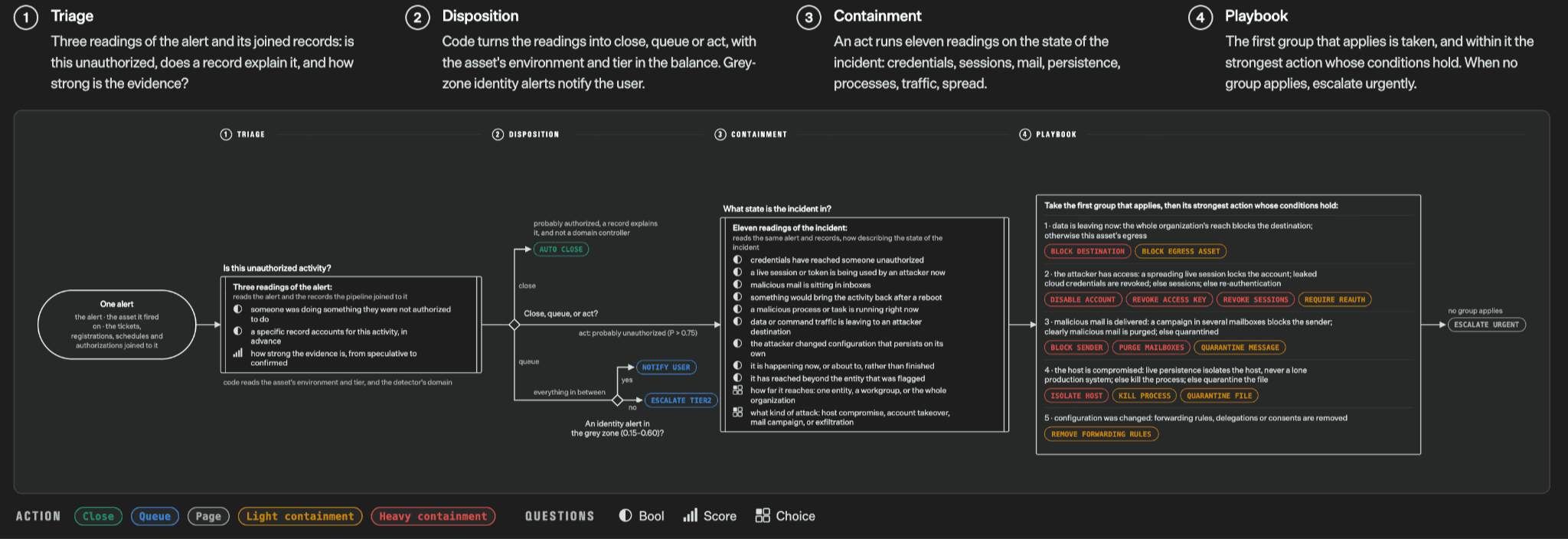
Source: TypeSafe official blog — Introducing System One Models and Jev
The demo that captured press attention puts those numbers in perspective: Jev running as the decision brain inside the classic game Doom, executing roughly 10 queries per second at a cost of about $7 per hour. A frontier LLM in that control loop would be economically absurd. A decision model at two-thousandths of a cent per call is not.
Who is behind it — and why that matters
TypeSafe was founded by Diogo Almeida, whose research at OpenAI on instruction-following underpins how ChatGPT interprets user requests. That pedigree matters for a specific reason: the hardest part of structured decision models is not architecture but alignment — making the model reliably honor the schema and intent it was given. It is precisely the problem Almeida's research career attacked. The $40 million raise, announced via Business Wire the same evening, gives the lab runway to chase what it calls "composable AI": systems where cheap decision models orchestrate expensive language models, not the other way around.
For builders, this slots neatly into the emerging agent stack. If you followed our practical guide to Gemini's managed agents and background tasks, you already know the pattern: agents need thousands of small judgments (route this, verify that, score this) for every one long-form generation. That ratio is Jev's home turf.
What it means for international builders and buyers
Three practical implications stand out for teams outside Silicon Valley. First, cost barriers to "AI-everywhere" products just collapsed: when a decision costs $0.000042, you can embed intelligence in every row, every event, every click — think grading engines for edtech platforms in Lagos or Karachi, fraud triage for fintechs in Jakarta, or eligibility screening for scholarship and job-matching services handling millions of applications. Second, latency budgets open up: sub-500ms responses make AI usable inside interactive loops, checkout flows, and live moderation where a 10-second LLM call was never an option. Third, architectures get cleaner: probability-scored structured outputs are exactly what auditors and regulators increasingly demand from automated decision systems — far easier to document and defend than a chat transcript.
It also sharpens the industry-wide efficiency race we have tracked all year — from DeepSeek's aggressively priced V4.1 Flash to the public debate about scaling limits that OpenAI's agent-swarm proof of Navier–Stokes reignited. TypeSafe's bet is the sharpest expression of the counter-thesis yet: don't wait for a smarter giant; change the category of model you use.
Questions developers are actually asking
What exactly is Jev?
It is the first public System One Model: a decision-only model that returns type-safe structured values with calibrated probabilities in 70–500 ms, trained via RLCD. It does not generate text, images, or code.
Can it replace ChatGPT or Gemini?
No — by design. Long-form writing, multi-step explanation, and open conversation remain language-model work. Jev targets the high-frequency decision layer: classification, scoring, ranking, routing, and verification. Mature stacks will use both.
How much does the Jev API cost?
$0.042 per million input tokens (about $42 per billion), with output currently free, per the official announcement. Practical translation: a million simple decision calls cost cents, not tens of dollars.
How do you get access?
Early access is open through the playground at console.typesafe.ai, and the company says it is clearing the waitlist in waves. The strongest first use case is a well-defined decision in your product — support-ticket triage, duplicate detection, risk scoring — where the speed and cost delta is immediately measurable.
Is "no hallucination" literally true?
It is true in the narrow, technical sense: outputs are constrained to a typed schema, so the model cannot produce free-form fabricated text. It does not guarantee decision accuracy — a calibrated 0.9 confidence can still be wrong. Calibrated probabilities reduce and expose risk; they do not eliminate it.
Honest limitations
The workflow-eval numbers are TypeSafe's own, on tasks it selected, and the company itself flags them as best-case. Independent benchmarks don't exist yet. Explanations are out of scope — if you need a human-readable "why," you'll pair Jev with a language model. It's early access, so capacity limits and API churn are likely. And "no hallucination" is a claim about output structure, not about the model being right — treat it as a better error model, not an absence of error.
Sources
- TypeSafe official blog — Introducing System One Models and Jev — architecture, pricing, and benchmarks
- Business Wire — TypeSafe AI Emerges From Stealth With $40M in Funding — funding details
- The Register — TypeSafe AI debuts model for machines that plays Doom — independent coverage
- Hacker News discussion of the launch — 1,400+ points of technical commentary
If you're building with AI and want premium tools without premium pricing, browse the Truescho digital shop for shared subscription plans — and explore Truescho's global scholarship platform while you plan your next build.