
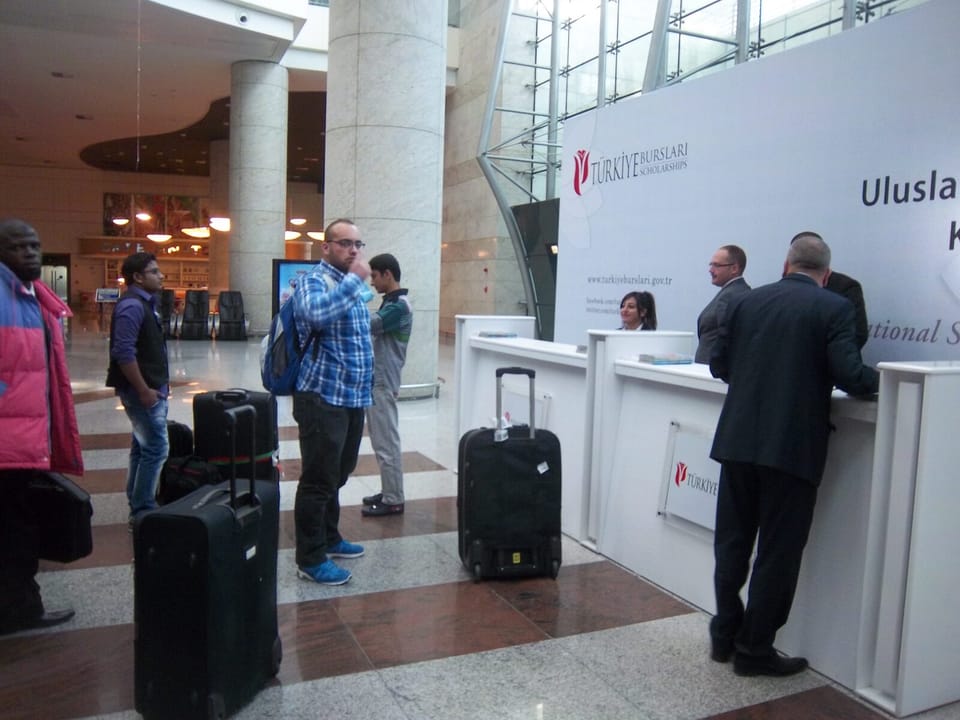
Turkiye Burslari Motivation Letter 2027: Format, Questions, and a Rewritten Sample
Last updated: October 2026
The Turkiye Burslari motivation letter — officially the Letter of Intent inside the Türkiye Scholarships application system — is the one section of your application written in your own voice, and it is what separates candidates with identical grades. This guide breaks down what the official system asks for, how long your letter should be, the mistakes that eliminate applicants before the exam stage, and a full weak sample rewritten into a strong one.
Hundreds of thousands of candidates from more than 100 countries apply to Türkiye Scholarships every cycle. Most of them clear the grade thresholds: 70% for bachelor's applicants under 21, 75% for graduate applicants under 30 for master's and under 35 for PhD. So the letter is not decoration — it is the filter. And yet the typical advice online stops at "be yourself and proofread", which is like telling a pilot "fly well". We will do what that advice never does: open the official application structure, map the letter onto the interview rubric the programme itself publishes, and then rewrite a real-style sample paragraph by paragraph so you can see the difference between a letter that dies in the pile and one that earns an interview invitation.
What Turkiye Burslari Actually Is — and Why the Letter Weighs So Much
Türkiye Scholarships is a government-funded, competitive programme run by the Presidency for Turks Abroad and Related Communities (YTB). Unlike most government scholarships, it does two things at once: full funding and university placement. The official programme page describes it as comprehensive — tuition, accommodation, monthly stipend, health insurance, a flight ticket, and a one-year Turkish language course included for awardees who do not already hold C1 Turkish.
That final detail matters more than applicants realize. The official 5-steps page states that all awardees without a C1 Turkish proficiency certificate — including those placed in English or other language-medium programmes — must attend a one-year Turkish course and obtain C1 by the end of the academic year. A motivation letter that ignores the language reality of studying in Türkiye reads like a letter written by someone who has not read the programme's own rules. A letter that shows you have thought about the language year — ideally with evidence you have already started learning — reads like a letter from a future awardee.
Here is the full official eligibility picture before you invest weeks in a letter:
| Level | Minimum grade | Age limit |
|---|---|---|
| Associate and bachelor's | 70% | Under 21 |
| Master's | 75% | Under 30 |
| PhD | 75% | Under 35 |
| Research scholarship | — | Under 50 |
| Health sciences (medicine, dentistry, pharmacy) | 90% | Per level above |
Eligible applicants are citizens of all countries who have graduated or will graduate before August of the application year. Officially ineligible groups: Turkish citizens and those who lost Turkish citizenship, and students currently enrolled in programmes in Türkiye at the same level they are applying for.
Where the Letter Sits Inside the Application System
All applications go through the Türkiye Scholarships Application System (TBBS), online, free of charge — the official How to Apply page is explicit that there is no application fee. Inside the system, your application is built from blocks: personal data, academic history, university and programme choices, extracurricular activities and awards, and the Letter of Intent written directly into a dedicated field.
The official required documents list for 2026-style applications is worth memorizing, because applicants routinely waste months collecting documents nobody asked for:
- A valid identity document, ID card or passport.
- A photo of the candidate taken within the last one year.
- National exam results, if any.
- Diploma or a temporary graduation certificate.
- Transcript.
- International exam results (GRE, GMAT, SAT, etc.) if required by the chosen university or programme.
- International language test results (TOEFL, DELF, etc.) if required by the chosen university or programme.
- For PhD applications only: a research topic proposal and a written example of research you have carried out.
Read that list again and notice what is not on it: recommendation letters are not among the mandatory documents on the official page. Every hour spent chasing a reluctant professor for a letter that will not be uploaded is an hour taken from the one document that is read in full — your letter. And that is the strategic insight of this whole guide: with grades fixed, exams pending, and documents standardized, the Letter of Intent is the only variable you can still transform in the weeks before the deadline.
The Three Questions Every Version of the Letter Must Answer
The exact wording of the Letter of Intent prompts appears inside the system when it opens, and prompts can shift between cycles — so treat any website that quotes "the official 2027 questions" verbatim, today, with suspicion. What does not shift is the evaluation logic, and the programme publishes it openly on its Evaluation and Selection Process page.
That page describes the interview stage — the stage your letter is designed to get you into — in a precise sequence: welcome and entrance, check of documents, the purpose of the candidate's application, academic knowledge and career goals, and closing questions. Map those stages onto a written document and you have the anatomy of the Letter of Intent:
- Why this field? The academic or personal story that connects what you have studied to what you want to study. Not "engineering is the future" — every field is the future on the internet.
- Why Türkiye, and why these universities? Named programmes, named labs, named courses from your actual system choices. If your letter could be sent unchanged to a German foundation, it is a bad Türkiye letter.
- Why you, and what happens after graduation? Concrete evidence — projects, volunteering, work, portfolio — plus a return plan specific enough to be evaluated.
Notice the symmetry: purpose, academic knowledge, career goals. The letter is a rehearsal for the interview, and the interview is a live test of the letter. Every sentence you write should be one you can speak about for three minutes when an academic committee member asks "you wrote that you analyzed market data for a family business — tell us how".
How long should the letter be?
Character limits display inside the TBBS writing field itself and have shifted between cycles, so no external site can honestly promise you a fixed 2027 number. Our editorial recommendation after reviewing thousands of applications: target 500–750 words for master's and PhD applications where academic depth is expected, and 450–650 for bachelor's. Draft freely in a separate document, then cut until you fit whatever limit the system shows when it opens. A letter filled to the very last permitted character is not a strength — it is usually evidence that no editing happened.
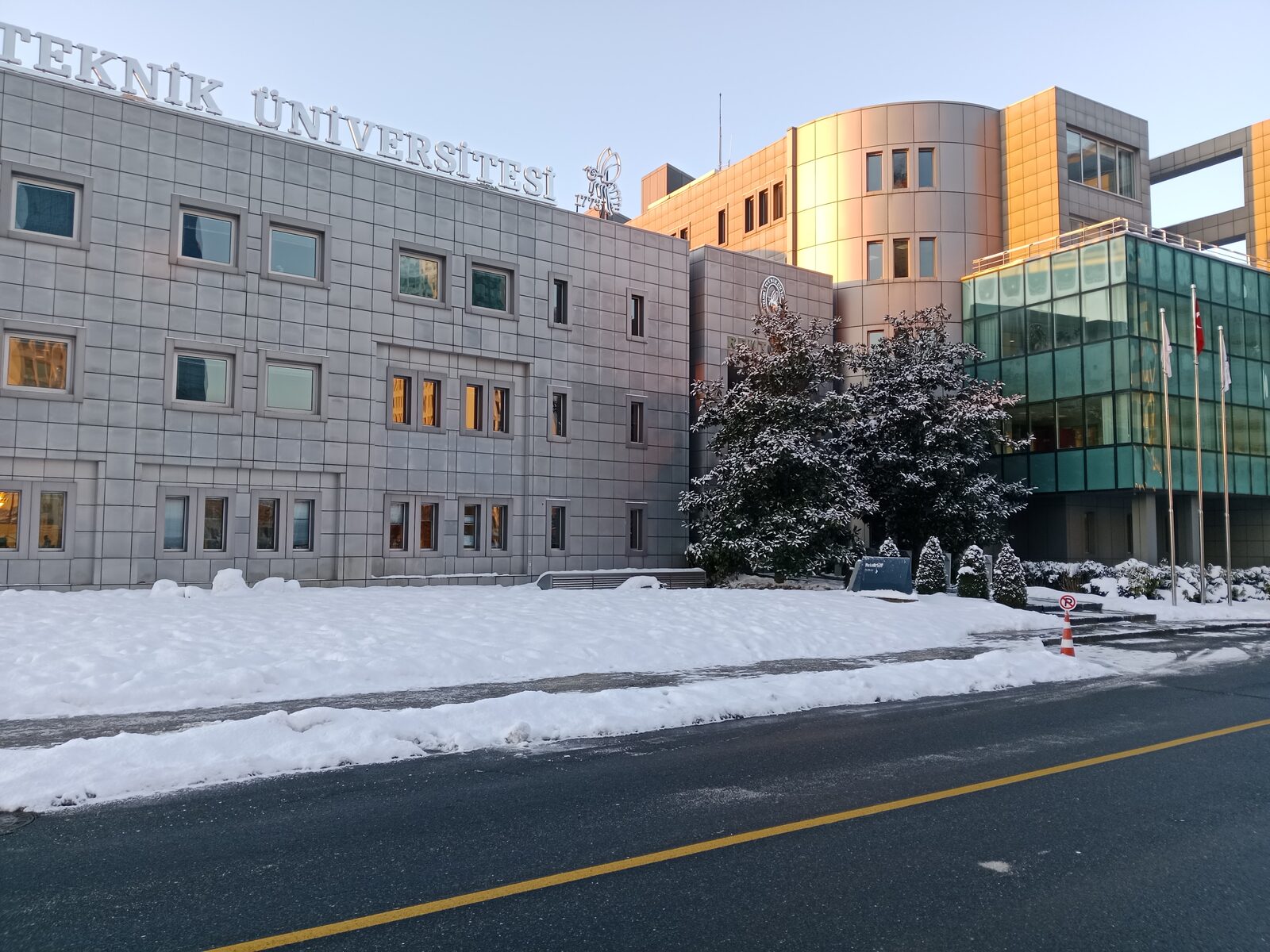
Source: Wikimedia Commons - Istanbul Technical University Rectorate

The Weak Sample: A Letter You Have Read a Thousand Times
Before the rewrite, study the failure. The letter below is grammatically clean and completely useless — it is the median letter in any application pile:
I am a hardworking and ambitious student who loves challenges. Since childhood I have dreamed of studying abroad, and Türkiye is a beautiful country with a rich culture and world-class universities. I chose computer engineering because technology is the future and I am excellent at mathematics. Your universities are ranked internationally, and I am sure I will be an excellent student who gets the highest grades. After graduation I want to return to my country and contribute to its development and make my family proud. I promise I will not disappoint you. Thank you for this opportunity.
Count the deletable sentences: all of them. No university named, no programme named, no project, no number, no country-specific detail, and a post-graduation plan that could be pasted into any application on earth. Now watch the same candidate — same grades, same history — become competitive.
The Rewrite: Same Applicant, Interview-Worthy Letter
I am writing this application in my final year of statistics, with a 3.6 GPA, after two years of a question that would not leave me alone: why do flood warnings in my region arrive after the water does? The question started as a coursework frustration and became a real project — for my bachelor's thesis I built a rainfall-prediction model using Python and five years of public weather data, cutting our test error against the baseline by 18%. That project taught me that the mathematics I love only matters when it is engineered into systems people trust before disaster, not after.
I have selected the data engineering and hydroinformatics-related programmes at Middle East Technical University and Istanbul Technical University deliberately: METU's water resources laboratory work on flood early-warning systems, and ITU's courses combining hydrology with large-scale data pipelines, are the two academic environments in my chosen list where my thesis questions scale into real warning infrastructure. I chose Türkiye because it runs one of the world's most ambitious flood and earthquake early-warning build-outs — I want to study engineering in a country that is testing it on the ground, not only in journals.
On language: instruction in my chosen programmes is largely Turkish, and I have already begun — I am at A2 through the Yunus Emre Institute's online track, and I will continue through the scholarship's language year, which I consider part of the engineering, not an obstacle to it. After graduation my plan is specific: my region's water authority publishes open rainfall and river-gauge data that no one currently models; I want to return as the engineer who changes that, and my thesis supervisor has agreed to keep the dataset open for me to extend the model with everything I learn in Türkiye.
In five years, I want flood warnings in my district to be a routine message people trust — and I want to be one of the engineers who made them trustworthy.
What changed, line by line: a named problem instead of "I love challenges"; named universities with named laboratories; a quantified project (18% error reduction, five years of data) instead of "excellent at mathematics"; the language year acknowledged with proof of progress (A2); and a return plan so specific it names the open dataset and the supervisor. None of this required inventing anything — it required the discipline of specificity.
Seven Mistakes That Eliminate Letters Before the Shortlist
- Template language. "Ambitious student", "dream of studying abroad", "won't disappoint you" — selection committees read these phrases hundreds of times per week; they are white noise with a signature.
- More Türkiye than you. Ottoman history and Bosphorus sunsets say nothing about your candidacy. Aim for roughly one-third programme and country, two-thirds you and your plan.
- Naming universities you did not select in the system. An obvious contradiction, and embarrassingly common in copy-paste submissions.
- Ignoring the Turkish language year. The programme's own rules make C1 Turkish a graduation requirement for nearly all awardees; a letter that assumes an English-only experience signals you have not read the rules.
- Grand promises over small plans. "I will transform my country's energy sector" is noise; "I will join the grid-modelling unit my professor consults for" is signal.
- Skipping "why you". Your grades live in their own field. The letter is the only place your story can exist — if your letter is all about Türkiye, the committee learns nothing about you.
- Writing it the night before the deadline. Türkiye Scholarships runs one application window per cycle — in the 2026 cycle, 10 January to 20 February — and late submissions carry the typos of haste into a document that represents your best thinking.
This is also precisely why our team built the Motivation Letter service at Truescho: an advisor writes the letter with you for your one target scholarship, built on your story and matched to the funder's expectations, with one revision round, PDF and Word delivery, and a 5-day turnaround for 30 EUR — a small investment against an application you have spent months building.
What Happens After You Submit: Exam and Interview
Understanding the next stage makes you a better letter-writer, because the interview tests your letter's honesty. The official evaluation process runs: application screening, then a written test for shortlisted candidates, then a face-to-face interview with committees of academics and experts, then final selection.
The written test, per the official page: candidates get 60 minutes for a 30-question test in the general format, with country-specific variations (50 questions in Azerbaijan; a different pattern for Greece and the Turkish Republic of Northern Cyprus; and 80–100 questions possible in high-volume countries such as Afghanistan and Sudan). Tests are held before the interview for health, science and engineering applicants, and also for social sciences applicants, whose results are compared within their own field. Questions come with explanations in both Turkish and English, plus questions requiring no translation — and health, science and engineering applicants are expected to comprehend and respond in English at a sufficient level.
The interview lasts 15–30 minutes and follows the published structure: welcome, document check, discussion of your purpose in applying, your academic knowledge and career goals, then your questions to the committee. Candidates invited to interview must bring documents and certificates of their latest completed education. The symmetry with the letter is exact — which is the deepest reason never to inflate anything. Every claim you write is a question you will answer in person, in real time, in front of academics.
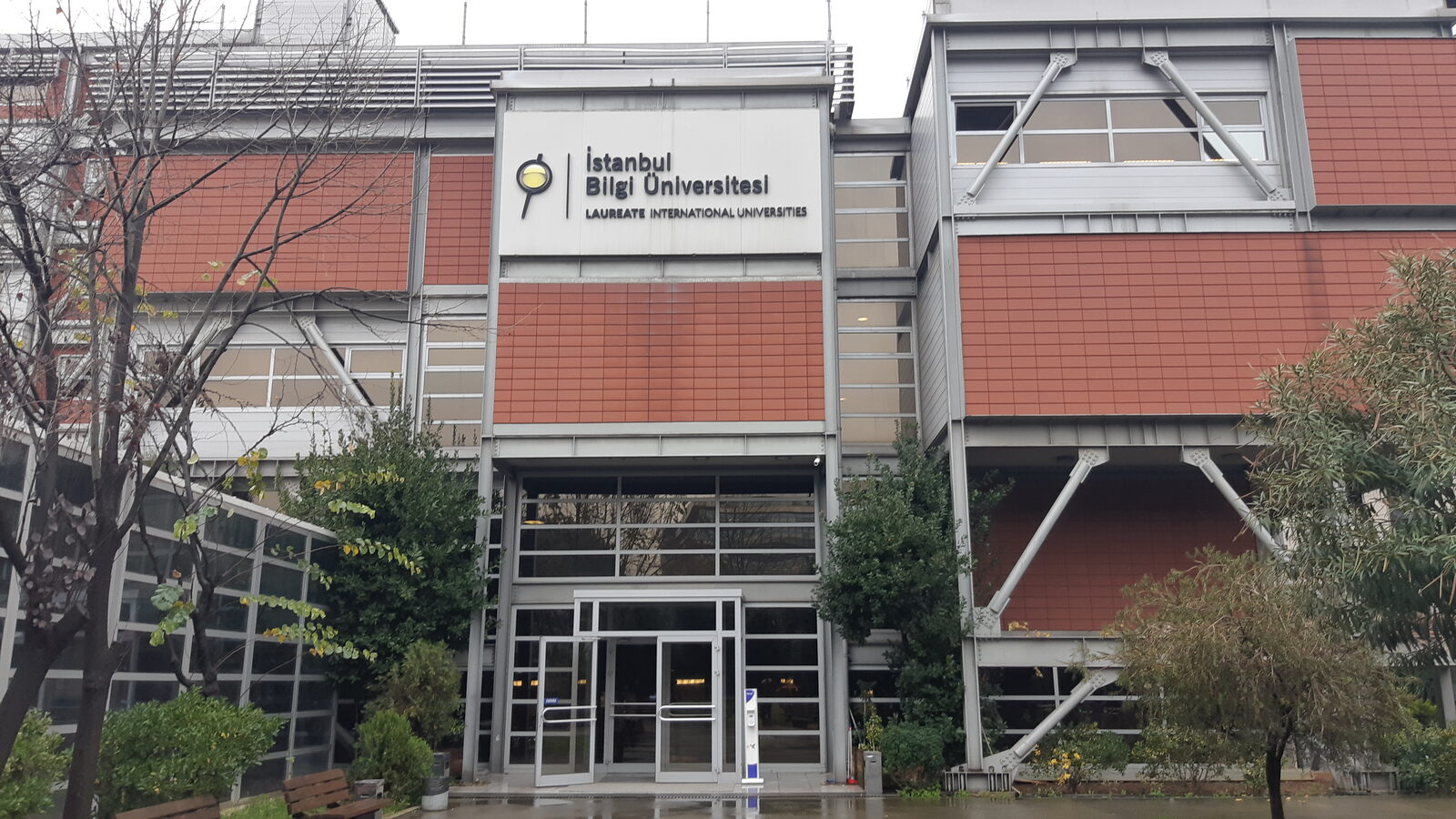
Source: Wikimedia Commons - Istanbul Bilgi University Dolapdere Campus

Planning Your 2027 Timeline
The 2027 dates have not been announced yet — the only legitimate source is turkiyeburslari.gov.tr and the programme's official channels. For planning rhythm, the documented 2026 cycle opened applications on 10 January and closed on 20 February, in a single window for all countries. Work backwards from that shape: documents, translations and a complete letter draft belong in November–December; system account creation and form-filling in the first week of the window; submission with at least a week of margin, never on the final day.
For the wider context of applying to Türkiye, read our full Türkiye Scholarships 2027 guide, prepare your folder with the scholarship application documents checklist, and if you are building a broader funding strategy, see how to get a fully funded scholarship.
Frequently Asked Questions
Should I write the Turkiye Burslari letter in Turkish?
There is no published rule forcing new applicants to write the Letter of Intent in Turkish. Write in a language you fully control among the system's options, in short clear sentences, and show your Turkish-learning plan instead of performing Turkish you cannot yet defend in an interview. The programme itself teaches you Turkish for a year — committees value trajectory over pretence.
Is there a word limit for the motivation letter?
The true character limit appears inside the TBBS writing field when the system opens, and it has changed between cycles, so no external fixed number is honest. Our editorial guidance: 500–750 words for graduate applicants, 450–650 for bachelor's, then trim to whatever the system displays. Cut filler rather than padding toward the limit.
Can I reuse one letter for multiple scholarships?
Keep your story and structure; rewrite two paragraphs every time. The "why this programme" and "why this country" paragraphs must be specific to each funder — a Türkiye letter naming German universities is an instant rejection. Your personal narrative transfers; the fit paragraphs do not.
Do I need recommendation letters for Turkiye Burslari?
The official required documents list does not include recommendation letters among the mandatory uploads: identity document, recent photo, national exam results, diploma or temporary graduation certificate, transcript, and international test results only where a chosen university requires them. Focus your energy on the letter and the documents actually listed.
Do they read the letter before or after the written exam?
Screening happens on the complete file, letter included — the letter is what earns you the exam invitation. Then the 15–30 minute interview returns to the letter's core themes: your purpose in applying, academic knowledge, and career goals, as published on the official evaluation page.
Should I mention a professor or supervisor in the letter?
For bachelor's and most master's applications it is not expected. Naming specific laboratories, courses or research projects at your chosen universities is better. For PhD applicants, the officially required research proposal carries that weight; the letter should support it, not duplicate it.
When are the 2027 results announced?
No official 2027 dates exist yet; turkiyeburslari.gov.tr announces them. Historically, results roll out over the summer months, after tests and interviews conclude in spring, and candidates are notified by email with status visible in the application system.
What if my grades are just above the minimum?
That is exactly when the letter matters most. Thresholds are thresholds — eligibility, not competitiveness. A candidate at 72% with a specific, evidence-backed letter routinely outperforms an 85% candidate with a template, because the letter is the only place the committee can see the person behind the numbers.
Want someone to handle this step for you? Truescho's team prepares a motivation letter tailored to your one target scholarship, built on your story with a revision round and 5-day delivery — get the motivation letter service for 30 EUR, or start with the instant AI-generated draft for 5 EUR if you are on a tight budget.
Sources
- Türkiye Scholarships — official website — criteria, documents, and evaluation process
- Türkiye Scholarships 2026 Applications — official announcement — the 10 January to 20 February 2026 window
- Application in 5 Steps — official documents list and language rule
- Evaluation and Selection Process — official exam and interview structure
- Criteria & Scholarship Programs — official eligibility thresholds