

"When do I apply?" sounds like the smallest question in your Turkish university plan. It is actually the whole game. Application dates in Türkiye scatter across three calendars at once: one public university keeps applications open all year, another closes its window in seven days, a third publishes its calendar in May and runs three rounds through August — and the system has no sympathy for anyone who planned around a recycled screenshot of an old deadline.
This guide was assembled from primary sources only: the exam calendar of ÖSYM, the national testing authority, and the official announcements of university international offices, each checked live during preparation. You will find the 2026 TR-YÖS session dates exactly as published, real application windows at named public universities for the current cycle, the final registration deadlines that follow admission, and a month-by-month map of the whole season you can plan against from today.
Rule one: there is no single application date
The Council of Higher Education does not open one national portal for all public universities. Each institution sets its own exams, windows and quotas, with the international seat numbers published annually on the Council's self-funded students pages. That produces three separate time layers, and you need all three in view:
- The central TR-YÖS exam calendar, fixed and published in advance by ÖSYM.
- University application windows, ranging from permanently open systems to one-week sprints.
- Final registration (Kayıt) deadlines after acceptance — the dates that actually lose seats when ignored.
Hold the three layers of application dates in one table and you own the season. Hold one and you will discover a closed door at the worst moment.
TR-YÖS 2026 dates as published by the testing authority
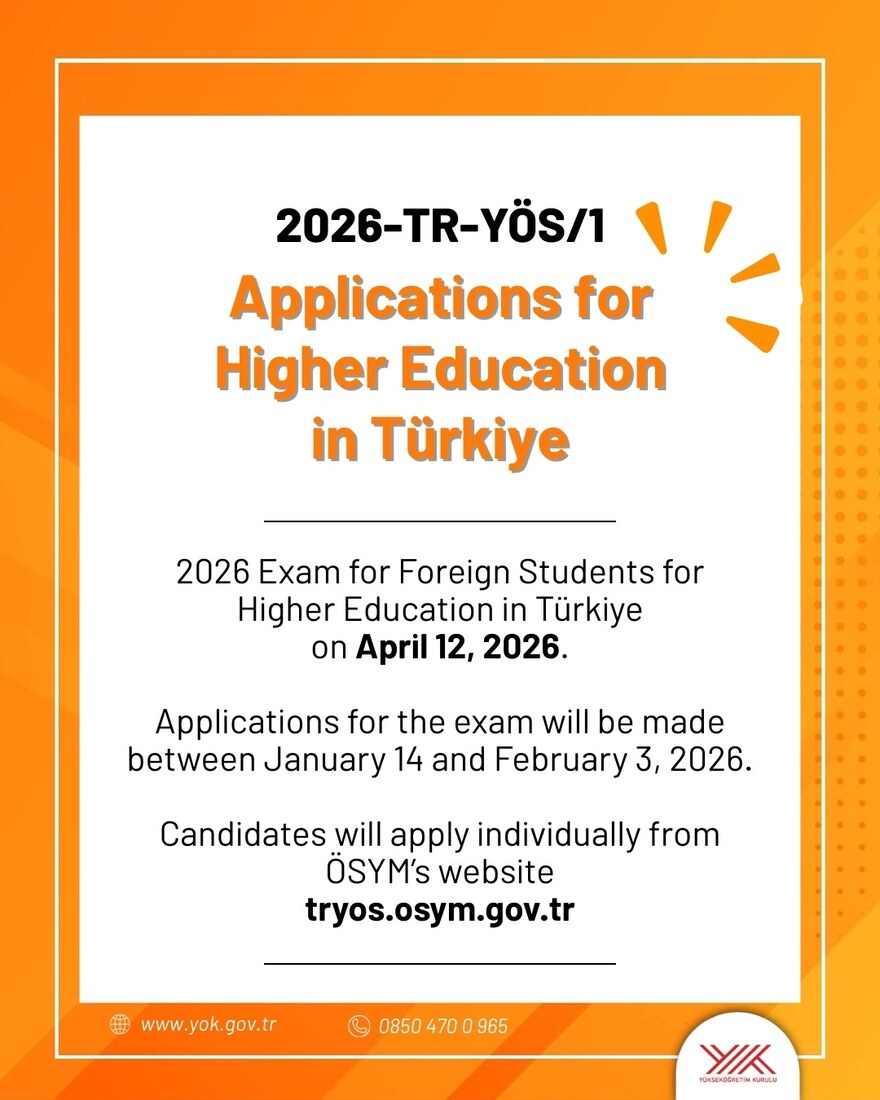
ÖSYM runs the exam twice a year. Here is the verified 2026 timeline:
| Session | Registration window | Exam date | Results |
|---|---|---|---|
| TR-YÖS 2026/1 | Registration 14 January to 3 February 2026; late applications to 11 February | 12 April 2026 | Published on schedule |
| TR-YÖS 2026/2 | Applications 9 July to 3 August 2026 | 11 October 2026 | 5 November 2026 |
The pattern is stable year over year: the first session is announced in mid-January and closes in early February; the second is prepared in summer and held in autumn. Anyone targeting the 2027 cycle should be watching the ÖSYM site in the first days of January 2027.
Two consequences deserve emphasis. First, a score is not an application: TR-YÖS qualifies you, but you still apply inside each university's own window, so two calendars govern your fate simultaneously. Second, the autumn session's 5 November results arrive after most public university windows have closed — the October exam primarily serves programmes still open in November, spring intakes and the following cycle. Realistic plans either use the earlier sessions for the same year or lean on non-exam admission routes and keep TR-YÖS as an upgrade for later.
Source: Study in Türkiye, the Council of Higher Education portal
Real application windows at public universities this cycle
The samples below come straight from international office announcements, chosen to show how far apart the doors sit:
| University | Application window | Extra rounds and results | Final registration |
|---|---|---|---|
| Karabük | Permanently open portal | Rolling review, roughly 7-15 days | Per acceptance letter |
| Bülent Ecevit (Zonguldak) | Main calendar published 22 May 2026 | Supplementary quota rounds July, August, September | One round extended to 18 September 2026 |
| Kastamonu | First round 1-14 June 2026 | Second 29 June-12 July, third 27 July-9 August | 1 September to 30 November 2026 |
| Artvin Çoruh | 29 June - 5 July 2026, closing 17:00 | First results 17 July, reserve list 7 August | Per results announcement |
| Foundation universities | Generally flexible seasons | Some monthly rounds | Before term start |
Read the table twice — once for windows, once for what follows them. An acceptance is not a seat until you register. Kastamonu keeps final registration open for roughly three months, from September to the end of November; Bülent Ecevit extended one supplementary round's registration by days. A student who treats admission as a reservation made forever will lose the seat to someone who read the last column.
Source: Kastamonu University international student admission system
What second and third rounds really mean
Kastamonu's published calendar explains the mechanism better than any theory. Round one ran 1-14 June, evaluation took just two days, results landed on 17 June, and admitted students paid the acceptance-letter fee between 17 and 28 June. Then the university repeated the pattern: a second round from 29 June to 12 July with results on 16 July, a third from 27 July to 9 August — and final registration stretching from 1 September to 30 November.
The tactical reading: later rounds are not consolation prizes. They carry real seats vacated by admitted students who never paid or registered, and the applicant pool differs each time. A rejection in round one can become an admission in round two purely through changed competition. Follow every round until the university formally closes the door.
The flip side is tempo. Supplementary rounds compress payment windows — universities want seats settled before the academic year starts — so an August applicant must be financially and documentarily ready to move in days, not weeks.
The calendar types you will meet, decoded
University pages use labels that look interchangeable and are not. This is the practical dictionary:
- Application calendar (Başvuru Takvimi): when a new application is accepted. The main object of this guide.
- Evaluation and results: sorting days and announcement dates. They tell you how long to wait before following up.
- Supplementary quota (Ek Kontenjan): follow-up rounds for unfilled seats, usually with shorter windows and faster decisions.
- Final registration (Kesin Kayıt): the personal appearance with original documents. Miss it and the admission cancels itself.
- Exam calendar: TR-YÖS and YÖS dates only — completely separate from university windows.
The label confusion is expensive: applicants routinely read "last registration date" as "last application date" and submit weeks after the door closed. Always read the verb attached to the date: apply, pay, travel, register in person.
Verify any university's window yourself in five minutes
- Search the university name plus International Student Office or ISO.
- Enter the official domain ending in edu.tr — never an agency mirror.
- Open the announcements section and find the notice naming your target academic year.
- Download the attached calendar PDF and save it.
- Check the notice's own date; a previous-year announcement is not yours, however complete it looks.
The full application dates map, month by month
| Approximate month | What happens | Your move |
|---|---|---|
| January | TR-YÖS first-session registration opens; Türkiye Bursları scholarship usually opens | Register for the exam; start the scholarship file |
| February | Exam registration closes; scholarship window closes on its announced date | Submit scholarship files a week early |
| March - May | Universities publish calendars and open windows progressively | Finalise your shortlist and record every window |
| June | Peak of first-round openings at public universities | Apply to every target the day its window opens |
| July - August | Second and third rounds, supplementary quotas, results | Track results; email offices when replies lag |
| September | Final registration begins; term starts at most universities | Travel early; register on your date |
| October - November | Late registration tails off; some universities extend into November | Latecomers lean on always-open systems |
The January row carries a parallel track worth naming: the Türkiye Bursları government scholarship opened its cycle in January and closed in February this year. It is the funded competitor to the self-funded route, and our full Türkiye Bursları scholarship guide covers its conditions and file strategy. Anyone running both tracks starts document preparation in December, not January.
What happens behind the scenes after you hit submit
Knowing the pipeline makes your waiting behaviour smarter:
- Automated completeness check: the system first verifies documents and data consistency. An incomplete file suspends without ever reaching a committee.
- Competitive evaluation: eligible files are ranked against thresholds and programme conditions, including structural limits — some universities cap students from any single country at thirty percent of a programme's international seats.
- Results and reserves: firm admissions are announced, then a ranked reserve list that promotes as admitted students decline or fail to pay. Artvin Çoruh published first-round results on 17 July and reserve outcomes on 7 August.
- Acceptance letter and payment: some universities require a fee deposit within a short window to freeze the seat; others confirm electronically until registration.
This pipeline explains why offers keep arriving after you have committed elsewhere, and why every admission stays honorary until you register in person with originals. A late, better offer still leaves you free to decline the first university politely — before its registration date.
The application sequence, step by step
- Build the digital paper file: passport valid well beyond registration, secondary certificate or provisional graduation letter, transcript, biometric photo, language proof if required.
- Translate documents with sworn translation into Turkish or English and authenticate them exactly as the announcement specifies.
- Create your account on each university's portal.
- Fill the form to the letter of your passport and certificate; triple-check the Latin spelling of your name and your birth date.
- Upload scans in the requested format and size, with stamps and numbers legible.
- Pay any application fee and keep receipts.
- On admission, download the acceptance letter and apply for the student visa immediately — consular appointments can run weeks out.
- Fly at least a week before your registration window and carry every original document; registration happens on paper originals, not copies.
- After registration, apply for the student residence permit within the deadline your university sets — our student residence permit guide walks through documents and timing.
Step eight is where procrastinators pay: one missing original inside a short registration window can cost a whole year, so pack the documents in one folder and inspect it twice before departure.
If you are new to Turkish public university admissions generally, pair this calendar with our complete guide to applying to Turkish public universities — that one builds the file and the routes, this one sets the clock they move on.
The daily machinery of this process — tracking portals, catching deficiency emails, paying on time in multiple systems — is precisely where most applicants and parents run out of stamina. It is administrative work in several languages on staggered clocks. The Truescho application service for Turkish public universities exists for exactly this: you get a pre-approved table of universities with windows and fees, your core documents are translated, accounts created, applications submitted and followed through to results. The full task list is on the official service page: https://truescho.com/en/apply-for-me/turkey-public-universities-application
The most expensive timing mistakes of the season
- Sitting the October TR-YÖS while targeting a university whose window closed in July: the score arrives after the doors.
- Not checking score validity: some universities only accept exam results one or two cycles old.
- Waiting for a prestigious answer before applying to a less competitive one — and losing both windows. Apply wide, choose later.
- Booking travel a week after registration opens, ignoring consulate appointment queues.
- Assuming a relative inside Türkiye can register on your behalf where personal appearance is required.
- Miscounting the calendar when calculating "last day to apply"; windows are merciless to conversions.
A real-world story: two conflicting calendars, two admissions
Layla finished the Jordanian Tawjihi with a 92 percent average and set her heart on architecture in Türkiye. A student group told her applications open in August, so she rested through summer. In mid-August she opened her first-choice university's site: round three closed in two days, and another had shut weeks earlier. What saved the season was Karabük's permanently open system — she applied the same day to five programmes — plus one university running a late supplementary round she calculated from its own official calendar this time, not from a group chat.
The result: an architecture admission from the supplementary round, and a delayed offer from the first university that arrived after she had already registered. Her one-line summary: the official source only, and the date is my responsibility, not the group's. One wasted month nearly cost her the entire season; two verified windows recovered it.
What if you missed everything? The recovery plan
- Head straight to permanently open systems like Karabük's, which do not close with semester seasons.
- Ask about supplementary quota rounds: several universities publish them in September for vacant seats.
- Foundation universities have more flexibility, opening late rounds and even mid-term intakes for selected programmes; quality varies, so check accreditation.
- Get ahead of the next cycle: prepare from December, watch the January TR-YÖS announcement, and build the scholarship file in parallel. Applicants who skip the exam entirely should also read our guide on public universities admitting without YÖS — the doors that never required the exam in the first place.
Frequently asked questions about Turkish university application dates
When do public university applications usually open?
There is no unified date. First-round windows commonly fall between May and July, as the documented examples show, but individual universities open as early as February or add rounds into September, and at least one system on this list stays open all year.
When are results announced?
Each university follows its own calendar: one documented first round announced results three days after closing, another released reserve-list outcomes three weeks after the main results. Only the university's own calendar is authoritative.
What is the final registration deadline after acceptance?
It ranges from a few days for a supplementary round to roughly three months — Kastamonu's window runs from September to 30 November. Missing it voids the admission.
Can I apply from outside Türkiye?
Yes. Public university portals are online and accept files from any country. Physical presence is generally required only for final registration after acceptance.
Does a late TR-YÖS result hurt my application?
It can, if your target university's window closes before results. The 2026 autumn session reports on 5 November, after most summer windows have shut. Match exam sessions to windows deliberately.
Does the academic year always start in September?
Most public universities start the fall term in September; some foundation programmes and graduate levels run February intakes. Anchor your travel to your registration date, not the generic term start.
How do I keep all dates in one place?
A three-column sheet — university, application window, registration window — filled only from official announcements, with email alerts activated on every portal after account creation. Add the professional habit: apply in the first two days of any window, because early files leave room to fix defects while late files leave none.
The bottom line
The 2026-2027 Turkish university season is not a mystery; it is a set of documented layers: a central exam with two precisely announced sessions, university windows stretching from May to September — from one week long to permanently open — and final registration ranging from days to three months. Whoever holds the official sources first owns the season before it starts.
Want someone to run this step for you? If you already know your target university by name, the Qaddimli single-university admission service takes over your whole file — documents and translation, portal application, follow-up until provisional admission, then guidance through the first payment and registration: https://truescho.com/en/apply-for-me/turkey-admission-single
Sources
- ÖSYM, official 2026 TR-YÖS announcements: https://www.osym.gov.tr/
- TR-YÖS application portal: https://tryos.osym.gov.tr/
- Study in Türkiye, Council of Higher Education portal: https://studyinturkiye.gov.tr/
- Kastamonu University international placement calendar: https://iso.kastamonu.edu.tr/index.php/basvuru/akademik-takvim
- Bülent Ecevit University application gateway: https://iso.beun.edu.tr/uluslararasi-ogrenci-basvurusu.html
- Artvin Çoruh University current-cycle announcement: https://iso.artvin.edu.tr/tr/duyuru/2026-2027-egitim-ogretim-yili-uluslararasi-yabanci-uyruklu-ogrenci-basvurulari
- Karabük University application FAQ: https://iso.karabuk.edu.tr/icerikGoster.aspx?K=S&id=63&BA=index.aspx
- Türkiye Bursları official site: https://www.turkiyeburslari.gov.tr/