
Your tourist residence permit in Türkiye expires in a few months, and the date printed on the card is less of a formality than it looks. Renewal here is a system with a strict legal window, a fixed document set, freshly updated 2026 fees, and real penalties for lateness. Handled on schedule, it is a routine online-then-in-person procedure that thousands complete every season. Handled late, it turns into doubled charges and a grey legal status that complicates everything from bank accounts to internal travel.
Everything below is anchored in what the Presidency of Migration Management (Göç İdaresi) publishes officially, together with the 2026 fee figures set by the Turkish Official Gazette. You will find the exact application window, the required documents one by one, current official fees by nationality, rejection reasons and how to avoid them, the mistakes that dominate this year's failed files, and a realistic timeline from application to card in hand.
First, know exactly which permit you hold
What most residents call a tourist residence permit is officially a short-term residence permit (Kısa Dönem İkamet İzni), granted under one of its categories for tourism purposes. The legal frame sits in articles 31 to 33 of Law No. 6458 on Foreigners and International Protection, with further detail in the implementing regulation. The key structural rule: short-term permits are issued for a maximum of two years at a time, with a few excepted categories, after which renewal is required.
One distinction decides your whole path: renewal (uzatma) is not the same as transition (geçiş) or a first application. If your tourist permit is ending and you want a student permit, you are not renewing — you are changing type, with a completely different document set. This guide covers renewing the tourist permit itself: same type, new duration.
Why does the distinction matter practically? Because the e-İkamet system asks for your application type the moment you log in, and the wrong selection routes you into a different document pipeline. Applicants have lost weeks to a mis-click, discovering the error only at the appointment desk.
The sixty-day window: when you are allowed to apply
The Presidency's published rule is explicit: extension applications are accepted starting from sixty days before the permit's expiry, and in all cases before the permit itself expires. Your legal window is the final two months printed on your card — no earlier, and never later.
What happens after expiry is equally explicit in law. A foreigner who remains in Türkiye without a permit after expiry pays the residence fee for the undocumented stay at twice the rate, under article 83 of the Fee Law No. 492. The doubling is not negotiable and accrues per day of overstay.
| Your timing | Legal status | What to do |
|---|---|---|
| More than 60 days left | Too early | Prepare documents; watch appointment availability |
| 60 to 30 days left | The ideal zone | Apply in the system and book your appointment now |
| 30 days to 1 day left | Inside the window, cutting it fine | Submit the online application today |
| After expiry | Undocumented stay | Doubled fees and refusal risk; act immediately |
| Expired months ago | Compounded status problem | Get a professional case review before filing anything |
The field-tested advice: do not spend the last two weeks waiting. Appointment slots at migration offices in Istanbul, Ankara and Izmir book out weeks ahead, and an appointment that lands after your card expires pushes you into the doubled-fee zone because of queue congestion, not negligence. Aim for a model fortnight: day one, scan every document cleanly; days two to four, draft the application in the system and save it; day five, proofread every field against your passport and card, then submit and book the appointment; from day six, chase one document per day until the appointment. That rhythm gets you to the desk complete on the first visit instead of into a deficiency loop.
Step one: the online application through e-İkamet
The official position leaves no ambiguity: first applications, extensions and transitions are all filed through the e-İkamet online system. Renewal begins at a screen, not a queue:
- Enter the e-İkamet system and select an extension application for the short-term permit type.
- Complete personal data precisely: passport number, current permit number, and your Turkish address.
- Upload clear electronic copies of the required documents.
- Book an appointment at the migration management office in your province of residence.
- Print the Application Document for Residence Permit (İkamet İzni Müracaat Belgesi) the system issues on submission — it is your proof of legal status until the new card arrives.
- Attend the appointment in person with originals, and give your biometrics.
Point six is where files collapse: the appointment is not a suggestion. An applicant who misses it without a documented force majeure is treated as never having applied — the whole cycle restarts, fees and queues included. If a genuine obstacle appears, document it and ask about rescheduling before the date, not after.
The printed application document carries a travel right worth knowing: together with your fee receipt, it allows you to exit and re-enter Türkiye within 15 days. Beyond 15 days abroad, visa rules apply on return — a detail that catches frequent travellers mid-renewal.
The required document set
The authoritative list is published by the Presidency inside the e-İkamet system's required-documents section. For a short-term tourist renewal, expect:
- A valid passport or equivalent travel document, with a copy of the data page and last entry stamp.
- Your current residence card, or proof of your previous application.
- Four recent biometric photographs.
- Proof of address: a notarised rental contract, an address registration document from the population directorate, or hotel documentation for hotel-based residence.
- Valid health insurance covering the requested permit duration.
- Proof of sufficient and sustainable financial means for the requested period.
- Receipts for the residence fee and the document (defter) fee.
- Any purpose-specific documents the system lists for your category.
Two rules govern this list. First, the address must be real: the card is mailed there, and any later move must be reported to the migration directorate and the population directorate within 20 business days — a standing obligation, not a one-time formality. Second, the list is personalised: the system generates the binding list for your exact case at application, so trust it over any circulating checklist, including this overview.
Health insurance: the condition that fails the most files
The insurance requirement is structural, not decorative. The official rule: valid health insurance must cover the requested permit duration, and the system accepts one of four documented forms — a bilateral social security agreement document issued by the provincial social security unit, an SGK provision document, a document showing application for general health insurance enrollment, or a private health insurance policy from a company licensed in Türkiye.
For most foreign residents on tourist permits, the realistic form is a private policy from a licensed Turkish insurer, and the fine print decides everything: it must be valid for the entire requested duration, meet the minimum coverage the migration authority accepts, and be issued by a genuinely licensed company. Officers verify policy numbers against the insurance registry. Cheap policies sold through anonymous pages are the shortest route to a refused file after weeks of waiting — not because insurance was missing, but because it was never real. The levels of cover and how these policies work in practice are explained in our guide to health insurance for students in Türkiye — the same policy rules the migration authority applies to any applicant.
This is the point where nearly every resident asks the same question: where do you find a policy that genuinely meets the official conditions? The Truescho Turkey health insurance service provides an annual policy from a licensed Turkish insurer meeting the immigration authority's minimum, priced by age band, delivered as a PDF within 48 hours together with guidance on using it in your file: https://truescho.com/en/apply-for-me/turkey-health-insurance
2026 official fees, exactly as published
Fees are set annually by the Ministry of Treasury and Finance and published by the Presidency on its fee page. Effective 1 January 2026, under Official Gazette No. 33117 of 24 December 2025 (document fee) and No. 33124 of 31 December 2025 (residence fees), the figures are:
| Item | 2026 amount | Official notes |
|---|---|---|
| Residence permit document fee | 964.00 TRY | Charged to every nationality, no exemptions |
| Residence fee, first month (default category) | 348.10 TRY per day, capped at 3,359.90 TRY | Floor of 653.70 TRY for the first month |
| Residence fee, each additional month | 2,232.30 TRY | Added per month beyond the first |
| Full exemption from the residence fee | Listed nationalities | Includes Syria, Palestine, Northern Cyprus (KKTC), Turkmenistan, Kosovo, Nepal, Sri Lanka, Czechia, Denmark and Ireland |
| Renewal filed after expiry | Fees doubled | Article 83, Fee Law No. 492 |
Read the table with nationality in mind. Residence fees follow reciprocity between Türkiye and your country, so categories differ: the default figures above apply to nationalities not covered by any agreement — the official page names Serbia, Fiji, Norway and the Northern Mariana Islands as examples on the default list. Before budgeting, open the official fee page and locate your nationality's category. Exempt nationalities still pay the 964 TRY document fee, from which no one is exempt.
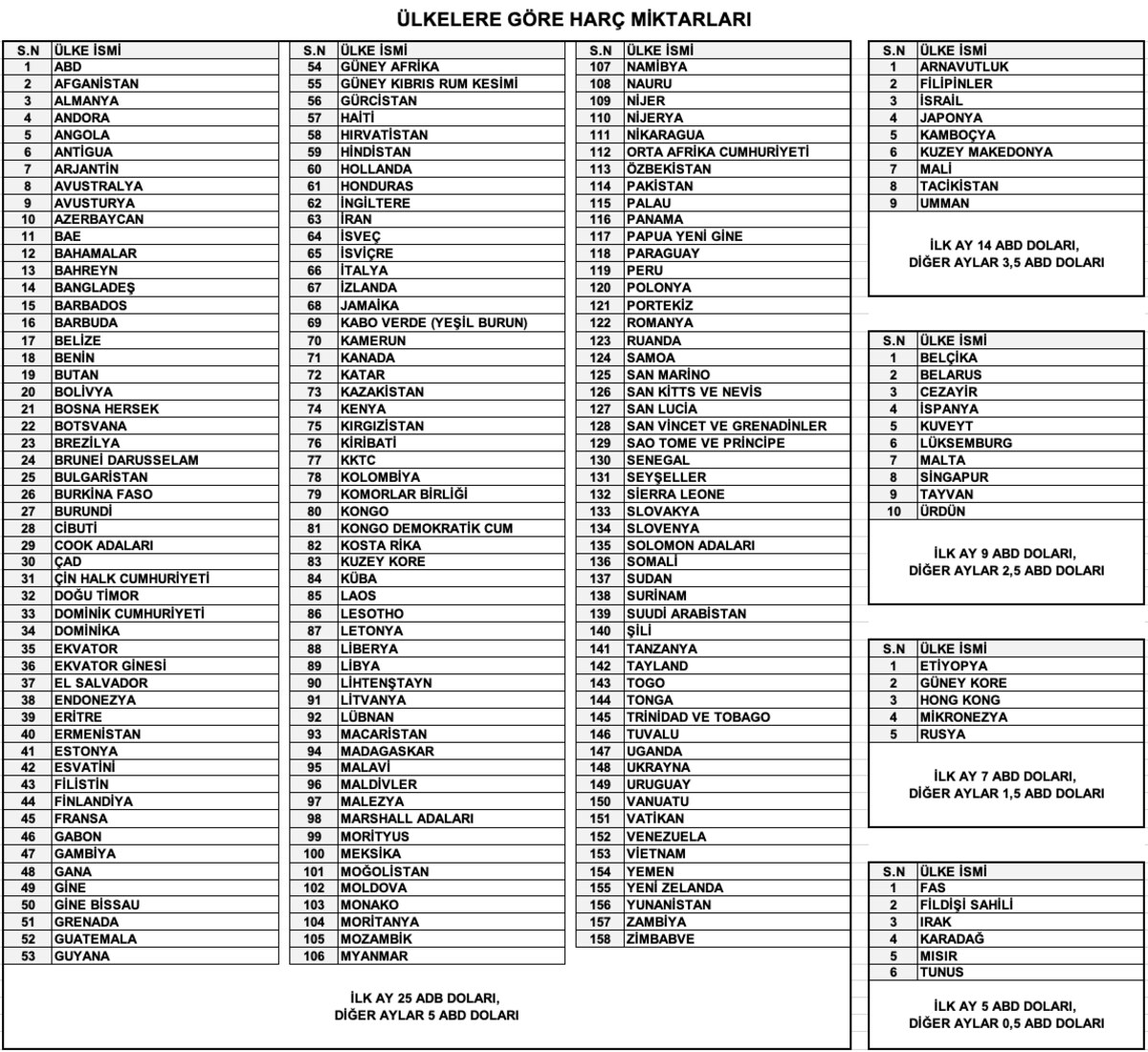
Source: Presidency of Migration Management — document fee and residence fees by nationality
For illustration only, the default category applied to three common durations: a one-month extension costs at most the 964 TRY document fee plus the 3,359.90 TRY first-month cap, roughly 4,323.90 TRY. Six months adds 2,232.30 TRY for each of five further months — about 15,485.40 TRY total. A full year approaches 28,879.20 TRY. The binding number is always what the system calculates on your application day from your duration and nationality.
How long the decision takes, and when the card arrives
Once your appointment is complete, the law sets a maximum decision period: applications are concluded within at most ninety days under article 21 of Law No. 6458, with the implementing regulation starting the clock from the date your documents are submitted complete. If an additional document is requested, the clock restarts on its delivery — one more reason to arrive complete.
During the wait, your status is legal: the printed application document covers you. On approval, the card is mailed to your declared address — hence the standing emphasis on a truthful address. A card lost to a wrong address means replacement procedures and extra weeks for which the authority bears no blame.
Source: PTT postbox photo on Wikimedia Commons, CC BY-SA

Official rejection grounds
The Presidency publishes the grounds on which a short-term permit is refused, cancelled or not extended. The ones that matter to renewal applicants:
- Failure to meet, or loss of, one or more short-term permit conditions.
- Submitting misleading information or forged documents.
- An entry ban decision against the applicant.
- Evidence the applicant poses a threat to public order, public health or public security.
- Disappearance of the purpose the permit was granted for.
- An outstanding search or deportation decision.
The same authority publishes a direct warning worth internalising: the migration management works with no third-party intermediaries, real or legal, and forged documents have been detected produced for money to be used in residence applications. The official recommendation is to apply in person and trust no one selling guaranteed outcomes. The warning exists because the intermediary market blooms precisely around renewal season — and its promises are structurally hollow.
The mistakes dominating this year's failed files
- Leaving booking to the final fortnight, then losing the legal window to appointment congestion.
- An insurance policy that expired, or covers less than the requested duration.
- A stale address: expired rental contract, or the card mailed into the void.
- Old phone and email details in the system, so document-request notices never arrive.
- Trusting an informal fixer who guarantees results the authority says do not exist.
- Moving province immediately before applying, which reopens the whole address file.
- Travelling abroad for more than 15 days while the application is pending.
If you travel to Türkiye repeatedly, the cheapest strategy is never reaching the expiry edge at all: keep your permits and travel paperwork organised as laid out in our Türkiye travel guide before trips turn into legal case files.
If your situation changes while you wait
Two changes cause the most panic: moving home and renewing your passport. The address rule is mechanical — inform the migration directorate and the population directorate within 20 business days of moving, whether or not the card has arrived, because the mail follows your updated address. For a passport renewed at your consulate, keep the old one or a certified copy: your file is tied to that passport number, and a change mid-process should be reported through official channels so the card does not vanish between two records.
A related question: can you file from a new province after relocating? The default is that extension follows your declared actual residence, and moving right before applying invites questions about the new address and its documents. If the move is optional, defer it until the card arrives; if it is unavoidable, complete its paperwork before filing.
A real-world story: a clean renewal in three weeks
Sami, a Syrian resident of Izmir, held a tourist permit expiring in early October. In late July — about 70 days ahead — he opened e-İkamet and filed the extension, receiving a mid-August appointment. The week before, his file was complete: a rental contract valid through the requested period, an insurance policy covering the full new term, a recent bank statement, and fresh biometric photos. He proofread his entries twice and kept a copy of every upload in one phone folder.
At the appointment he presented originals, gave biometrics, and printed the application document that kept him fully legal while the new card was mailed to his door in mid-September — two weeks before the old permit expired. No miracle, no fixer: an early start, an appointment weeks before expiry, full-duration insurance and a real address.
Frequently asked questions about tourist permit renewal in Türkiye
Can I file after my permit expires?
The rule is before expiry. Late filers pay doubled fees for the undocumented days and face higher refusal risk. If you have just expired, file immediately and document the reason for the delay.
How many times can a tourist permit be renewed?
Short-term permits run up to two years per grant and can be renewed whenever conditions hold — but each renewal is a full fresh evaluation of the file.
Can I travel during the pending period?
Yes, with the stamped application document and fee receipt, for absences of no more than 15 days; longer trips trigger visa rules on return.
Did fees change in 2026?
Yes. From 1 January 2026: a 964 TRY document fee for all nationalities, and default residence fees of 348.10 TRY daily for the first month — minimum 653.70, maximum 3,359.90 TRY — plus 2,232.30 TRY per additional month. Several nationalities are fully exempt from the residence fee but not the document fee.
Must I be inside Türkiye to apply?
Yes, in practice: the online filing, the biometrics and the personal appointment presume your actual residence in the country, and long absence voids the pending application.
Can a tourist permit become a work or student permit?
Through a transition application with the new type's full conditions — a separate evaluation, not a renewal stamp. The documents and timing for the student route are covered in our student residence permit guide.
What if my application is refused?
You may appeal within the legal deadlines. Request the refusal reason in writing first; a curable deficiency is often better solved by a corrected new application than an appeal. For complex files, a professional review before filing costs less than a refusal.
Where this leaves you
Renewing a tourist residence permit in Türkiye in 2026 is a rules-following exercise: the sixty-day window before expiry, an online application then a personal appointment, insurance covering the full duration, a true address, and the freshly published official fees. Files do not fail on mystery — they fail on delay and incomplete documents.
Want someone to handle this step for you? The Qaddimli residence renewal service reviews your current file, tells you what changed in your permit type's conditions, lists exactly which additional documents are missing, prepares and proofreads your renewal application before submission, and reminds you of the deadline ahead of time: https://truescho.com/en/apply-for-me/turkey-residence-renewal
Sources
- Presidency of Migration Management, residence general information: https://www.goc.gov.tr/ikamet-genel-bilgiler
- Presidency of Migration Management, residence permit types: https://www.goc.gov.tr/ikamet-izni-cesitleri
- Presidency of Migration Management, 2026 document fee and residence fees: https://www.goc.gov.tr/belge-bedeli-ve-harc-miktari
- Turkish Official Gazette, fee communiqué of 24 December 2025: https://www.resmigazete.gov.tr/eskiler/2025/12/20251224-6.htm
- e-İkamet official system: https://www.e-ikamet.goc.gov.tr/