
Tencent Hy4 Preview Is Open-Source: 770B Parameters, 1M-Token Context, and API Pricing Under a Dollar
Can a frontier-class model really cost less than a dollar per million input tokens? For most of 2026 that sounded like a pitch, not a price list. Then Tencent shipped Hy4 preview on August 28, 2026 — 770 billion total parameters under an Apache 2.0 license, a context window beyond one million tokens, and verified OpenRouter pricing of roughly $0.83 per million input tokens and $2.50 per million output tokens. This guide walks through what the model actually is, how to try it today from anywhere, what it realistically costs, and the honest limits you should weigh before betting a workflow on it. Last updated: August 30, 2026.
Source: Tencent's official Hy4 preview announcement
What exactly is Hy4 preview?
Hy4 preview is the next generation of Tencent's Hunyuan family of large language models, and the first in that line to have its full weights released to the public. The official specifications from Tencent's own announcement:
- 770 billion total parameters, about 49 billion active per query thanks to a mixture-of-experts (MoE) architecture — frontier-scale knowledge with mid-size running costs.
- A context window beyond one million tokens (1,048,576 exactly, per its OpenRouter listing) — enough to hold an entire code repository or hundreds of documents in one session.
- Apache 2.0 licensing on Hugging Face — one of the most permissive licenses in existence: commercial use, modification, and redistribution are all allowed.
Until this release, the open-weights crown was effectively a two-horse race between GLM-5.3 and Kimi K3. We covered the full GLM-5.3 weights release and the DeepSeek V4 line earlier; Tencent's entry matters for a different reason. The company behind it operates some of the world's most heavily used productivity and communication products, which means Hy4 was tuned for real work scenarios — code, documents, spreadsheets — rather than for trivia benchmarks alone.
Source: Tencent's official announcement page
What the internal blind evaluation says — and what it doesn't
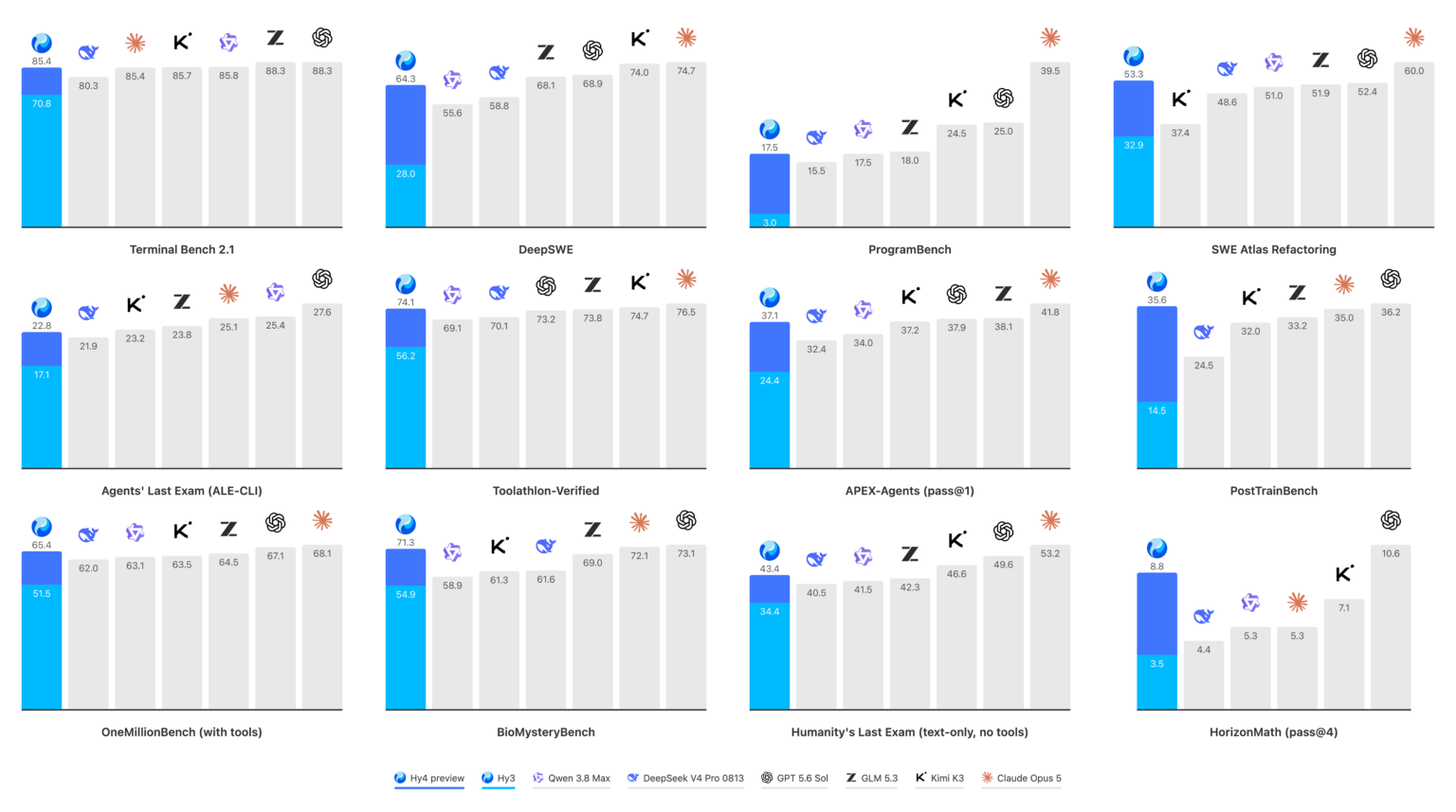
The headline number in the launch is a blind internal evaluation: 163 experts assessed 203 real engineering tasks, and Hy4 preview averaged 2.99 out of 4.00 — marginally ahead of Kimi K3 (2.94) and GLM-5.3 (2.92).
Two honest caveats before you screenshot that table. First, it is Tencent's own evaluation, run on tasks Tencent selected; independent leaderboard verdicts will take weeks. Second, the spread between the three models is small enough that an individual user may never notice it on routine work. What the evaluation does tell you is where the model aims: understanding large codebases, planning, debugging, and verification — the unglamorous work engineering teams actually pay for.
The more unusual claim is about the model helping build itself. According to the announcement, Hy4 preview participated in its own development for the first time — proposing training approaches, running experiments, and iterating on data strategies, evaluation frameworks, and low-level operators. Self-improvement loops like this were until recently a research-lab curiosity; shipping one inside a public release preview signals where Tencent thinks the next efficiency gains live.
Four capability pillars, per the official announcement
- Software engineering: stronger understanding, planning, debugging, and validation for long-context development tasks, plus improved visual quality in front-end work.
- Office productivity and analysis: better comprehension of complex working environments, enhanced financial analysis, data analysis, and cross-document collaboration — from raw information to finished documents, spreadsheets, and presentations.
- Game development: a playable prototype generated from a single natural-language request, with multi-turn refinement and game-engine compatibility.
- Scientific research: stronger reasoning on complex research problems, with named gains in AI research and development, molecular dynamics simulation, condensed-matter physics, and fundamental mathematics.
The ecosystem angle: why Tencent's empire matters
Hy4 is not arriving from a standalone lab. Tencent's own products — the WeChat universe, the WorkBuddy office suite, the CodeBuddy developer platform — put this model in front of an enormous daily user base from day one. That has two practical consequences for outsiders evaluating it. First, the model was tuned against genuine workloads: real documents, real spreadsheets, real production code, not synthetic benchmarks alone — which is consistent with where its claimed strengths sit. Second, adoption feedback will arrive faster than for most independent releases, and that velocity typically accelerates fixes and iteration. It is a plausible reason the "preview" label will not last long.
Four ways to access it today
Ranked from easiest to most powerful:
- WorkBuddy and CodeBuddy, free for two weeks. Tencent's productivity and coding platforms carry Hy4 preview at no charge during the launch window, and free access to the older Hy3 has been extended to September 30. This is the fastest zero-commitment way to test the model.
- OpenRouter API. Listed as
tencent/hy4-preview, with the pricing we verified directly: about $0.83 per million input tokens and $2.50 per million output tokens. For teams in Lagos, Manila, São Paulo, or Warsaw building products on a budget, that price point turns features that were "too expensive to AI-power" — like summarizing a whole document archive — into shippable roadmaps. - Hugging Face weights. The official
tencent/Hy4-previewrepository (plus a lighter FP8 variant) is downloadable under Apache 2.0, and passed 1,300 downloads within its first two days with hundreds of upvotes. - Tencent Cloud TokenHub. The enterprise route for organizations that want contracts, invoicing, and support directly from Tencent Cloud rather than a reseller.
Why the "49 billion active parameters" number is a cost story
The MoE design means the giant model is internally split into specialized sub-networks. On each request, only the relevant experts wake up — roughly 49 billion parameters out of 770 billion — while the rest stay dormant.
The practical consequence: you effectively get the knowledge capacity of a frontier-size model while paying compute costs closer to a mid-size one. That mechanism — not charity — is what lets OpenRouter pricing land near a dollar per million input tokens. The same logic powers GLM-5.3 and DeepSeek V4, which is why the modern open-model race is a race of architectures, not raw sizes.
What a million-token context actually buys you
A one-million-token window is roughly 700,000 English words — several full-length books, or a real codebase, or a year of project documents — visible to the model at once. Three use cases where this changes the economics:
- Legacy codebase review. Upload the repository and ask "where is payment handling, and what breaks if this function changes?" The model answers with the whole picture in view — precisely the long-context engineering scenario Tencent says it optimized for.
- Contract and document diligence. Procurement and legal teams can load hundreds of pages of agreements and amendments in one session and extract conflicting clauses — days of manual work compressed into an afternoon.
- Research synthesis. Comparing dozens of long papers against one hypothesis becomes practical for individual researchers, not just institutions with custom pipelines.
One caveat that applies to every long-context model: recall quality is rarely uniform across the full window. Most models get slightly foggy near the far end. Keep critical material near the beginning or middle, and test accuracy at your real document sizes before standardizing.
A one-hour trial plan
- Pick a real task from your own work — a report to summarize, a stubborn bug, a document set to analyze. Generic trivia questions make every large model look identical.
- Run it on the free tier (CodeBuddy or WorkBuddy) and note the time, the quality, and what needed fixing.
- Repeat the identical task on your current model, same files, same prompt, so the comparison is fair.
- Stress the edge cases you actually care about — your domain, your languages, your formatting standards.
- Do the math for production: tokens in your typical task × the OpenRouter rates above, compared against your current invoice.
- Decide in stages. A preview build should not anchor a critical production path, but it is perfect for deciding whether to be first in line when the final version lands.
Quick comparison against the leading open alternatives
| Criterion | Tencent Hy4 preview | GLM-5.3 (Z.ai) | Kimi K3 | Closed frontier models |
|---|---|---|---|---|
| Weights | Open, Apache 2.0 | Fully open | Open | Closed |
| Total size | 770B (49B active) | 753B | Large | Undisclosed |
| Context | 1M+ tokens | Large | Large | Varies |
| Input price per 1M tokens (OpenRouter) | ≈$0.83 | Competitive | Competitive | Typically far higher |
| Internal blind eval score | 2.99/4.00 | 2.92/4.00 | 2.94/4.00 | — |
Read the scores with the earlier caveats in mind: the comparison comes from Tencent's own evaluation, so treat it as an approximate ordering until independent results arrive. For a broader look at the open-versus-closed strategic picture, see our state of open models this summer.
Source: Official announcement page
Honest limitations before you commit
- It is a preview. Not the final release: behavior may shift, support is thinner, and production SLAs are absent.
- The famous evaluation is internal. Independent verdicts are pending; treat vendor-run rankings as directional.
- Hosting your own copy is heavy. Weights of this scale require serious multi-GPU infrastructure; "free license" never means "free to run."
- Privacy depends on the access route. Via OpenRouter or cloud platforms, your data passes through a third party under their terms. Self-hosting the weights is the only path that keeps everything inside your own infrastructure — at hardware cost.
- Tooling is young. Fine-tuning recipes, serving stacks, and integrations will mature over the coming weeks; expect early-adopter friction.
- Regional availability is uneven. Tencent's own free platforms may impose regional sign-up requirements or localization quirks, while the Hugging Face weights and OpenRouter API are globally accessible today — verify the route that matches your jurisdiction before rolling anything out to a team.
Why this release matters beyond the specs
Zoom out and a pattern emerges. DeepSeek proved an open model could touch the frontier; Z.ai published GLM-5.3's complete weights weeks later; now Tencent has answered with Hy4. Each release drags pricing down and makes closed-only strategies harder to defend.
If you build on these models, the strategic move is obvious: put a routing layer in front of them so switching models is a configuration change, not an engineering project. The next release — whoever ships it — will be cheaper and stronger within months.
FAQ
What is Tencent Hy4 preview?
An open-weights large language model from Tencent with 770 billion total parameters (49 billion active), launched August 28, 2026 under Apache 2.0, with a context window exceeding one million tokens.
Is Tencent Hy4 free?
The weights are free under Apache 2.0 on Hugging Face, usage is free for two weeks on WorkBuddy and CodeBuddy, and the OpenRouter API costs about $0.83 per million input tokens and $2.50 per million output tokens.
Is Hy4 better than GLM-5.3 and Kimi K3?
In Tencent's internal blind evaluation across 203 engineering tasks it scored 2.99/4.00 versus 2.92 for GLM-5.3 and 2.94 for Kimi K3 — a small lead measured by the model's own maker, so await independent benchmarks before concluding.
Can I run Tencent Hy4 locally?
Technically yes, since the weights are open, but 770 billion parameters require substantial multi-GPU infrastructure, making self-hosting realistic for institutions rather than individuals.
What is the difference between Hy4 and Tencent's Hy3?
Hy4 is a full generational leap: far larger size, a context window beyond one million tokens, and pre- and post-training improvements that place it in the top tier of open models per Tencent's evaluation, while Hy3 remains free to use through September 30 as a lighter option.
Sources
- Tencent's official announcement: releasing and open-sourcing Hy4 preview
- Official weights repository: tencent/Hy4-preview on Hugging Face
- tencent/hy4-preview on OpenRouter
New to open-weights models? Start with our GLM-5.3 open weights guide to understand how downloading and serving actually work before diving into Hy4.