
TCF Exam: Sections, Scoring System, Practice Questions and Level Chart
The TCF (Test de connaissance du français) is the standard French placement test run by France Éducation international, the public operator under the French Ministry for National Education. Every number in this guide — question counts, minutes, score bands, validity — comes from the official FEI pages checked live at writing time, and the practice questions below are original items written in the exact TCF format so you can rehearse before booking a session. If you have been hunting for a reliable TCF practice test with answers in one place, this is it.
Test-takers usually arrive with a concrete goal: a Campus France application, a French-taught program, Canadian economic immigration, or a French residence card. Each goal maps to a specific TCF version with its own section list, so the most expensive mistake is booking the wrong one. Here is the complete picture, followed by worked practice for every section.
The TCF Tout Public structure at a glance
The general version is open to anyone aged 16 or older whose first language is not French. It has three mandatory multiple-choice sections and two optional expression sections:
| Section | Format | Questions | Duration | Mandatory |
|---|---|---|---|---|
| Listening comprehension | MCQ, 4 options, 1 correct | 29 | 25 minutes | Yes |
| Grammar and vocabulary structures | MCQ, 4 options, 1 correct | 18 | 15 minutes | Yes |
| Reading comprehension | MCQ, 4 options, 1 correct | 29 | 45 minutes | Yes |
| Written expression | 3 production tasks | — | 60 minutes | Optional |
| Oral expression | 3 tasks with an examiner | — | 12 minutes | Optional |
Two details catch candidates by surprise. First, on the computer-based version the MCQ portion grows to 91 questions — the 15 extra items (five per competency) are calibration questions that do not count toward your score. Second, every listening recording is played exactly once, and the question appears only after the audio ends. Total sitting time runs from 1 hour 25 minutes (MCQ only) to 2 hours 37 minutes (everything).
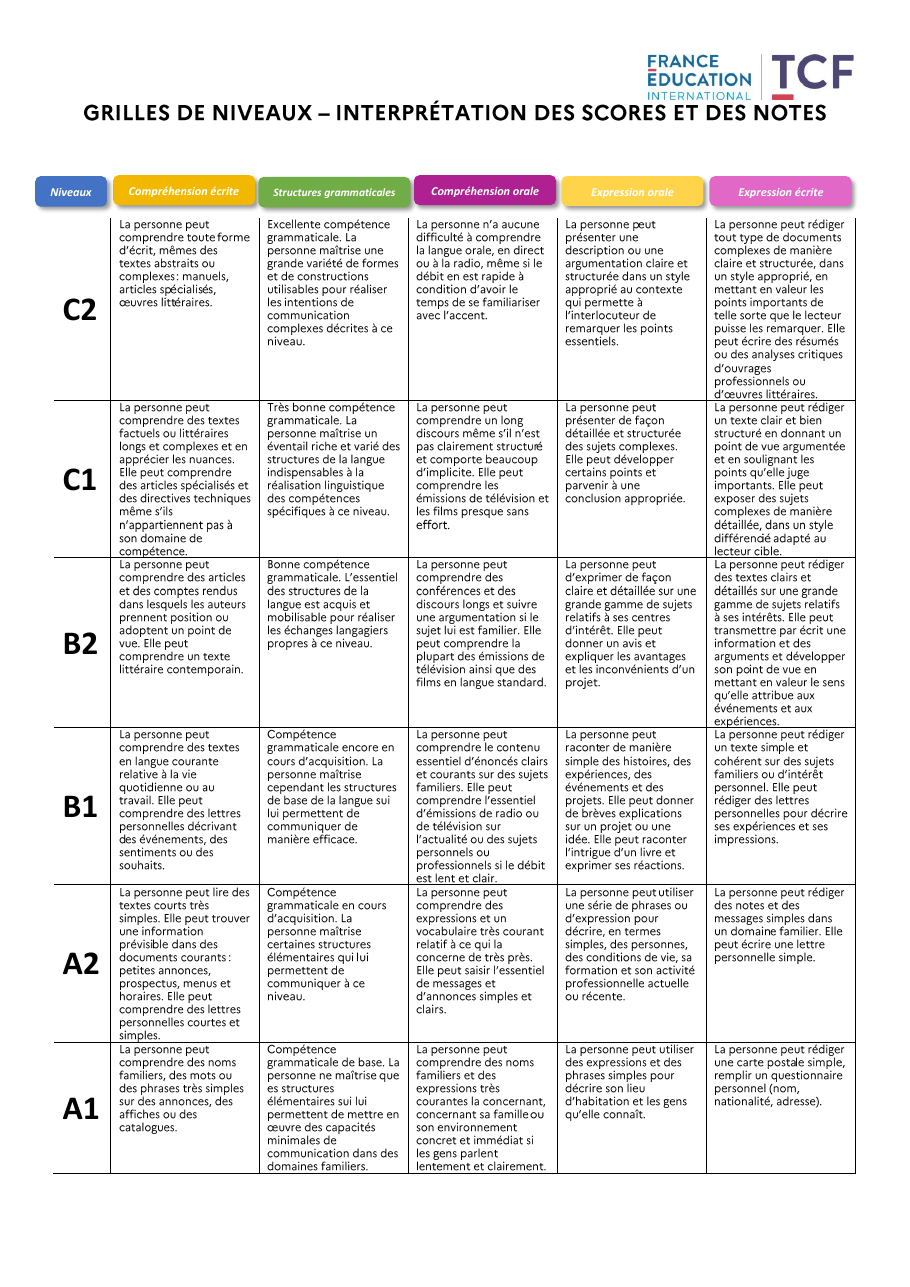
The official score-to-level conversion chart
MCQ sections produce scores on a scale from 100 to 699; expression tasks are graded out of 20. Both translate into CEFR levels using FEI's official grid:
| Score band | CEFR level | Expression grade /20 | Practical meaning |
|---|---|---|---|
| 101–199 | A1 | 1 | Basic command: simple, concrete everyday situations |
| 200–299 | A2 | 2–5 | Elementary mastery: familiar sentences, routine situations |
| 300–399 | B1 | 6–9 | Effective but limited: standard language on familiar topics |
| 400–499 | B2 | 10–13 | General, spontaneous command: detailed argument |
| 500–599 | C1 | 14–17 | Good mastery: long demanding texts, structured fluency |
| 600–699 | C2 | 18–20 | Excellent mastery: near-effortless comprehension and summary |
| Below 101 | A1 not achieved | — | Below the first threshold |
Two scoring mechanics matter for interpreting your certificate. The overall MCQ score is a weighted average of the three section scores — not a simple arithmetic mean — and a global level across all six bands is only proposed if you sit every section including both expression tasks in the same session. Also note a 2026 policy change: from sessions on 1 September 2026 onward, re-correction requests for the oral and written expression tasks are suspended for roughly one year. You cannot bank on appealing an expression grade, which makes first-attempt preparation genuinely valuable.
Listening practice questions with answers
Listening progresses from short everyday exchanges to longer broadcast-style extracts. Since audio cannot live in an article, the drills below are written transcripts in the test's style: read each once, then answer immediately, mimicking the one-play rule.
Extract 1 (cafe dialogue): The customer says: «Bonjour, un café et un croissant, s'il vous plaît.» The waiter replies: «Désolé, il n'y a plus de croissants. Il reste des pains au chocolat.»
1. What did the customer order? (a) tea and bread (b) coffee and a croissant (c) coffee and a pain au chocolat (d) a croissant and juice — Answer: b
2. What does the waiter offer? (a) another coffee (b) nothing (c) a pain au chocolat (d) to come back tomorrow — Answer: c
Extract 2 (voicemail): «Bonjour Sarah, c'est Marc. Le rendez-vous de mardi est reporté à jeudi à 14 heures, même salle. Merci de confirmer.»
3. When will the meeting take place? (a) Tuesday 14:00 (b) Thursday 14:00 (c) Tuesday morning (d) Thursday 10:00 — Answer: b
4. What must Sarah do? (a) change rooms (b) cancel (c) confirm attendance (d) call at 14:00 — Answer: c
Extract 3 (station announcement): «Le train en provenance de Lyon est retardé de vingt minutes suite à un problème technique.»
5. What happened? (a) cancellation (b) a twenty-minute delay (c) a station problem (d) the train comes from Marseille — Answer: b
6. What was the cause? (a) weather (b) a strike (c) a technical problem (d) not stated — Answer: c
Tactical note for the real audio: pre-read the four options where the interface allows it and predict two keywords. A brain hunting for specific information catches it on a single play far more reliably than one listening "in general".
Grammar and vocabulary structures practice with answers
Eight items in ascending difficulty, exactly as the section is built:
- Elle ... à la bibliothèque tous les jours. (a) vais (b) va (c) vas (d) vont — b (third person singular)
- Nous avons visité le musée ... hier. (a) la semaine dernière (b) demain (c) pendant (d) depuis — a (completed past context)
- Il faut que tu ... à l'heure. (a) es (b) seras (c) sois (d) étais — c (subjunctive after il faut que)
- C'est le livre ... j'ai parlé. (a) que (b) dont (c) qui (d) à qui — b (parler de → dont)
- Je n'ai ... compris cette règle. (a) rien (b) pas (c) jamais (d) plus — b (simple negation)
- Les étudiants ... leurs notes en ligne. (a) consultent (b) consulte (c) consultez (d) consulter — a (plural agreement)
- Si j'avais le temps, je ... plus souvent. (a) lirai (b) lirais (c) lis (d) lisais — b (unreal conditional: imparfait + conditionnel)
- La réunion commence ... 9 heures. (a) en (b) dans (c) à (d) depuis — c (clock times take à)
Half of these are solvable by agreement logic rather than memorized paradigms: subject type fixes the verb ending, the original preposition fixes the relative pronoun, and time adverbs fix the tense. Arabic speakers already think in agreement patterns, which maps surprisingly well.
Reading practice questions with answers
Text 1 (university notice): «L'université de Lyon ouvre une inscription en ligne pour le module "Français professionnel" du 5 au 20 mars. Places limitées : 30 étudiants. Niveau minimum requis : B1. Les candidatures se font exclusivement via le site.»
1. Who may apply? (a) any student (b) B1 and above (c) Lyon residents only (d) exactly thirty students — b
2. How do you register? (a) by mail (b) at the office (c) via the website only (d) by phone — c
3. What does "places limitées" mean? (a) free registration (b) limited seats (c) cancelled (d) extension possible — b
Text 2 (short biography): «Née à Alger, Yasmina a suivi des études de biologie avant de partir à Montréal pour un master. Depuis trois ans, elle travaille dans un laboratoire et anime un blog scientifique suivi par des milliers de lecteurs.»
4. Where did she study biology? (a) Algeria (b) Montreal (c) a laboratory (d) not stated — a
5. What does she do now? (a) studies a master's (b) works and runs a blog (c) travels (d) teaches biology — b
6. For how long? (a) one year (b) three years (c) ages (d) five years — b
Text 3 (mini schedule): A CV workshop runs Monday 10:00–12:00; an interview workshop runs Wednesday 14:00–16:00; nothing runs on Tuesday.
7. Which workshop lasts two hours? (a) Monday only (b) both Monday and Wednesday (c) none (d) Tuesday — b
8. Which day is empty? (a) Monday (b) Tuesday (c) Wednesday (d) Friday — b
Strategy: read the questions first, then hunt paraphrases rather than literal matches — the question says "pose sa candidature" while the text says "les candidatures se font". That paraphrase gap is precisely what separates B1 comprehension from word-matching.
The three writing tasks with model answers
Sixty minutes, three tasks, ascending word counts: 60–120, 120–150, and 120–180 words.
Task 1 (message): «Votre voisin s'absente une semaine. Écrivez-lui un message pour expliquer un petit problème survenu chez vous et lui demander un service.»
Model: «Bonjour Monsieur Dubois, je suis votre voisin du troisième étage. Je vous écris parce qu'une fuite d'eau est apparue dans ma cuisine lundi soir, et l'eau a coulé vers votre balcon. Le plombier viendra demain matin. Pendant votre absence, pourriez-vous me donner la permission d'entrer deux minutes dans votre appartement pour vérifier que rien n'est abîmé ? Je peux passer à l'heure que vous voulez. Merci beaucoup et bonnes vacances !»
Why it scores: polite register, a clear request, sufficient context, no padding.
Task 2 (narrative): «Racontez à un ami un voyage qui s'est mal passé.»
Model: «Cher Karim, tu ne vas pas croire mon dernier voyage ! D'abord, mon vol a eu trois heures de retard, et j'ai raté la correspondance. Ensuite, ma valise n'est pas arrivée : elle était restée à Paris, avec tous mes vêtements pour le mariage. J'ai dû acheter une chemise en urgence. Le pire, c'est que l'hôtel avait perdu ma réservation, et il était complet. Finalement, un cousin m'a hébergé, et le mariage a été magnifique. La prochaine fois, je prendrai le train ! À bientôt.»
Why it scores: chronological connectors, two past tenses interacting, a personal closing line.
Task 3 (comparing two viewpoints): «Deux documents présentent des avis opposés sur le télétravail. Rédigez un texte comparant les deux points de vue et donnant votre opinion.»
Model: «Le télétravail divise. Pour le premier document, travailler chez soi fait gagner du temps et réduit le stress : plus de transport, plus de flexibilité, une meilleure concentration. En revanche, le second document souligne des risques : la solitude, la difficulté de séparer vie professionnelle et vie privée, et l'oubli des jeunes collègues qui ont besoin d'apprendre sur place. À mon avis, les deux textes ont raison chacun à moitié : la solution idéale est un mélange, deux ou trois jours à la maison et le reste au bureau, pour garder les avantages des deux mondes.»
Why it scores: balanced presentation of both positions, then a reasoned personal stance — literally the marking grid.
The three speaking tasks and how they are graded
Twelve minutes face-to-face, two of them preparation time. Task 1 is a structured interview (2 minutes, no preparation): small talk with a stranger — steady questions and answers. Task 2 is an interaction exercise (5.5 minutes, 2 of them to prepare): you receive an everyday situation such as retrieving a ticket or asking about a course, and you must run the conversation toward your goal; the tested skill is asking the questions the situation needs. Task 3 is expressing a point of view (4.5 minutes, no preparation): the examiner picks a question and you speak spontaneously, continuously, and persuasively.
Preparation for this section is vocal, not read-only: record yourself answering thirty common opinion questions at two minutes each, then re-listen for exactly three things — whether you opened with a clear opinion sentence, whether you linked at least two ideas with connectors (parce que, c'est pourquoi, en revanche), and whether you closed with a wrap-up. Higher bands are awarded for coherent fluency, not rare vocabulary.
Tout Public, Canada, IRN or Québec: which TCF do you need?
| Criterion | Tout Public | Canada | IRN | Québec |
|---|---|---|---|---|
| Purpose | academic, professional, general | Canadian economic immigration and citizenship | French residence and nationality | Québec immigration files |
| Sections | 3 mandatory MCQ + 2 optional expression | 4 sections, all mandatory | 4 sections, all mandatory | per Québec file rules |
| MCQ questions | 76 (29+18+29) | 78 (39 listening + 39 reading) | 40 (20+20) | per version |
| Writing | 60 min, optional | 60 min, 3 tasks | 30 min, 3 tasks | per version |
| Total duration | 1h25–2h37 | 2h47 | 1h15 | per version |
| Top level reported | C2 | C2 on the Canadian grid | B1 | per version |
| Recognized by | FEI | IRCC (Canada) | French prefectures | Québec government |
Notice what Canada does not have: a grammar section. Its four skills are listening, reading, writing and speaking only, because Canadian immigration measures communication, and IRCC converts your results to its NCLC bands using the tables on its official language-testing page. If you are applying to a French university through the preliminary admission file (DAP), ask your approved centre exactly which version your file requires — requirements differ by file type.
TCF Canada: what changes in your preparation
Because all four sections are mandatory, weak skills have nowhere to hide. Three practical shifts: listening carries 39 questions in 35 minutes, reading 39 in 60 minutes — a pace of roughly one question every ninety seconds — and writing always ends with the two-viewpoint comparison at 120–180 words. Prepare for pace, not just content: full timed simulations every two weeks in the final month, with written error logs. Most listening errors turn out to be numbers, names and directions, not hard vocabulary. And since the certificate is valid two years, schedule your session so the validity window covers your immigration filing date, not just your preparation comfort.
Booking, results timeline and certificate validity
Registration happens directly with an approved centre — not through the FEI site — and each centre sets its own session dates, fees and paper/computer format; FEI publishes an interactive map of approved centres. Results reach the centre within 15 working days of papers reaching Paris, or 10 working days if you sat only the computer-based MCQ. The certificate is issued once, in a single copy — FEI explicitly recommends keeping it safe — and stays valid for two years from the results date, printed on the document itself.
How to prepare from scratch: a realistic sequence
Phase one is lifting your general level one band above the score you need, because the test measures skill, not memory. Phase two is pattern acquisition: work through the official sample questions FEI publishes on its examples page until nothing about the format surprises you. Phase three is simulation: a full timed sitting every two weeks in the final month, each followed by a written error review. The hardest wall for Arabic-speaking candidates is rarely reading or grammar — it is the two expression tasks, where there is no French environment at home and no one correcting your scripts. That is the specific point where one-on-one practice earns its cost. Truescho offers a one-on-one online French course running from zero (A1) to B1, whose session blocks end with a DELF or TCF-style mock test plus corrected homework and progress reports — built precisely for Campus France-style files. For the wider French application, see the study in France after the baccalaureate guide, the Eiffel Excellence Scholarship page, the Campus France CV template and the master's motivation letter guide.
TCF or DELF: the practical decision rule
If your file needs a fast, dated result and your skills are uneven across bands, TCF fits: one session covers everything and results land within weeks. If your level is solid at one specific band and you want a permanent certificate, DELF fits: it never expires and certifies that exact level. Most Campus France files accept either; Canadian and French immigration files require their specific TCF versions with no DELF substitute. The only expensive error is booking before confirming which version your file demands — a rule worth repeating because it fails silently.
Conclusion
The TCF is a knowable machine: 76 MCQ questions across listening, structures and reading with exact durations, a 100–699 scale mapped to A1–C2 by an official grid, expression tasks graded out of 20, a two-year certificate, and clearly separated versions for Canada, IRN and Québec. Master the format with the official examples and the original drills above, simulate under real timing, and walk in on test day with nothing left to surprise you.
Want someone to take the preparation off your shoulders? The one-on-one online French course on Truescho runs from A1 to B1 and ends each block with a TCF or DELF-style mock test, corrected homework, and a progress report.
Sources
- TCF main page — France Éducation international: https://www.france-education-international.fr/en/tcf
- TCF Tout Public — official sections and durations: https://www.france-education-international.fr/en/test/tcf-tout-public?langue=en
- TCF Canada — official IRCC-accredited version: https://www.france-education-international.fr/en/test/tcf-canada?langue=en
- TCF IRN — residence and nationality version: https://www.france-education-international.fr/en/test/tcf-irn?langue=en
- Understanding your TCF results: https://www.france-education-international.fr/article/comprendre-mes-resultats-au-tcf
- Official TCF level grid (PDF): https://www.france-education-international.fr/document/grilleniveauxtcf
- Official TCF sample questions: https://www.france-education-international.fr/en/test/exemples-epreuves-tcf?langue=en
- Approved language tests for Canadian immigration — IRCC: https://www.canada.ca/en/immigration-refugees-citizenship/services/immigrate-canada/express-entry/documents/language-requirements/language-testing.html