
Syrian Pound vs Saudi Riyal, Jordanian Dinar, UAE Dirham, and Euro: All 2026 Conversion Rates in One Place
Last updated: Thursday, September 3, 2026 — today's prices for the Saudi riyal, Jordanian dinar, UAE dirham, euro, and US dollar, on both the parallel market and the Central Bank of Syria's official bulletin, in new Syrian pounds with old-pound equivalents.
Three people stand in the same Damascus exchange office on the same afternoon. A retired truck driver who spent two decades on the Damascus–Amman route wants to value a 50-dinar gift from his former Jordanian employer. A mother on the phone with her daughter is calculating what a 500-riyal transfer from Saudi Arabia will deliver. A returning engineer is deciding when to convert his leftover UAE dirhams. Three currencies, one question: how many Syrian pounds is my money worth today? This guide answers with live tables for all four major currencies against the pound, explains why they are all priced through the US dollar, and gives you a four-step method to convert any amount yourself — plus sanity checks that catch stale or mislabeled numbers in thirty seconds.
How much is the Saudi riyal in Syrian pounds today?
Per the Damascus parallel-market board of Thursday, September 3, 2026:
- Buy rate (you sell riyals, receive pounds): 34.79 new pounds per riyal.
- Sell rate (you buy riyals, pay pounds): 35.27 new pounds.
- Official rate (Central Bank bulletin): 32.49 new pounds.
- Ready figures: 100 riyals = 3,479 new pounds when selling (347,900 old) and 3,527 when buying; 500 riyals = 17,395 / 17,635; 1,000 riyals = 34,790 / 35,270.
Note that the gap over the official rate is slightly wider on the riyal (about 8.6% on the sell side) than on the dollar (7.8%). The reason is liquidity depth: the dollar is the most-traded currency in the market, and every other currency is priced from it with a small additional margin compensating exchangers for thinner flow. A practical law follows: the wider a currency's gap relative to the dollar's, the thinner its parallel-market turnover.
Saudi Arabia hosts one of the largest Syrian diaspora communities, so riyal remittances are a monthly fixture for thousands of households. The channels, fees, and timing of those transfers have their own dedicated guide: Sending Money to Syria in 2026: Legal Channels and Real Costs.
How much is the Jordanian dinar in Syrian pounds today?
The Jordanian dinar is the highest-unit-value Arab currency on Syrian boards — one dinar buys about 183 new pounds today:
- Buy rate: 182.92 new pounds per dinar.
- Sell rate: 185.47 new pounds.
- Official rate: 172.07 new pounds.
- Ready figures: 50 dinars = 9,146 new pounds when selling (914,600 old) and 9,273 when buying; 100 dinars = 18,292 / 18,547; 500 dinars = 91,460 / 92,735.
A mental shortcut worth installing: the dinar is worth roughly 1.4 US dollars. So a 100-dinar gift is effectively a 140-dollar gift. Cross-currency tables using today's dollar prices live in USD to Syrian Pound Converter at Today's Rate.
The dinar also carries the widest buy/sell spread on the board — 2.55 new pounds, about 1.4%, versus 0.4% on the dollar. Intermittent demand explains it: dinar flow arrives in seasonal bursts (Amman visits, border trade, tuition payments) rather than a daily stream. The practical lesson for large dinar amounts is to negotiate the spread explicitly; shaving half a percent on a 10,000-dinar conversion saves roughly ninety dollars of value.
How much is the UAE dirham in Syrian pounds today?
The dirham Gulf workers mean when they say "dirham" is the UAE dirham:
- Buy rate today in Damascus: 35.31 new pounds per dirham.
- Sell rate: 35.81 new pounds.
- Official rate: 33.22 new pounds.
- Ready figures: 100 dirhams = 3,531 / 3,581 new pounds; 1,000 dirhams = 35,310 / 35,810; 5,000 dirhams = 176,550 / 179,050.
The UAE dirham has been pegged to the US dollar for decades at 3.6725 per dollar — and that gives you a golden verification tool: divide the dollar's pound-price by 3.6725; you should land on the dirham's price. Today: 131.00 ÷ 3.6725 ≈ 35.67, sitting neatly between the dirham's buy and sell (35.31/35.81). If you ever see a dirham quote far from that division, the board is either stale or mislabeled — the Moroccan dirham, for instance, trades far below a third of the UAE dirham's value and is thinly dealt in Syria, requiring a direct exchanger quote.
How much is the euro in Syrian pounds today?
The euro is the second foreign currency of the Syrian market — the money of diaspora communities across Germany, the Netherlands, Sweden, and beyond:
- Buy rate today: 151.00 new pounds per euro.
- Sell rate: 152.80 new pounds.
- Official rate: 141.56 new pounds.
- Ready figures: 100 euros = 15,100 / 15,280 new pounds (1,510,000 / 1,528,000 old); 500 euros = 75,500 / 76,400; 1,000 euros = 151,000 / 152,800.
The euro today buys about 15% more pounds than the dollar. The two travel together in direction with small deviations driven by the euro's global strength — which is why euro earners who spend in pounds should track the EUR/SYP pair directly rather than watching the dollar as a proxy: on a day the euro strengthens globally, your pounds increase even if the local dollar rate stands still.
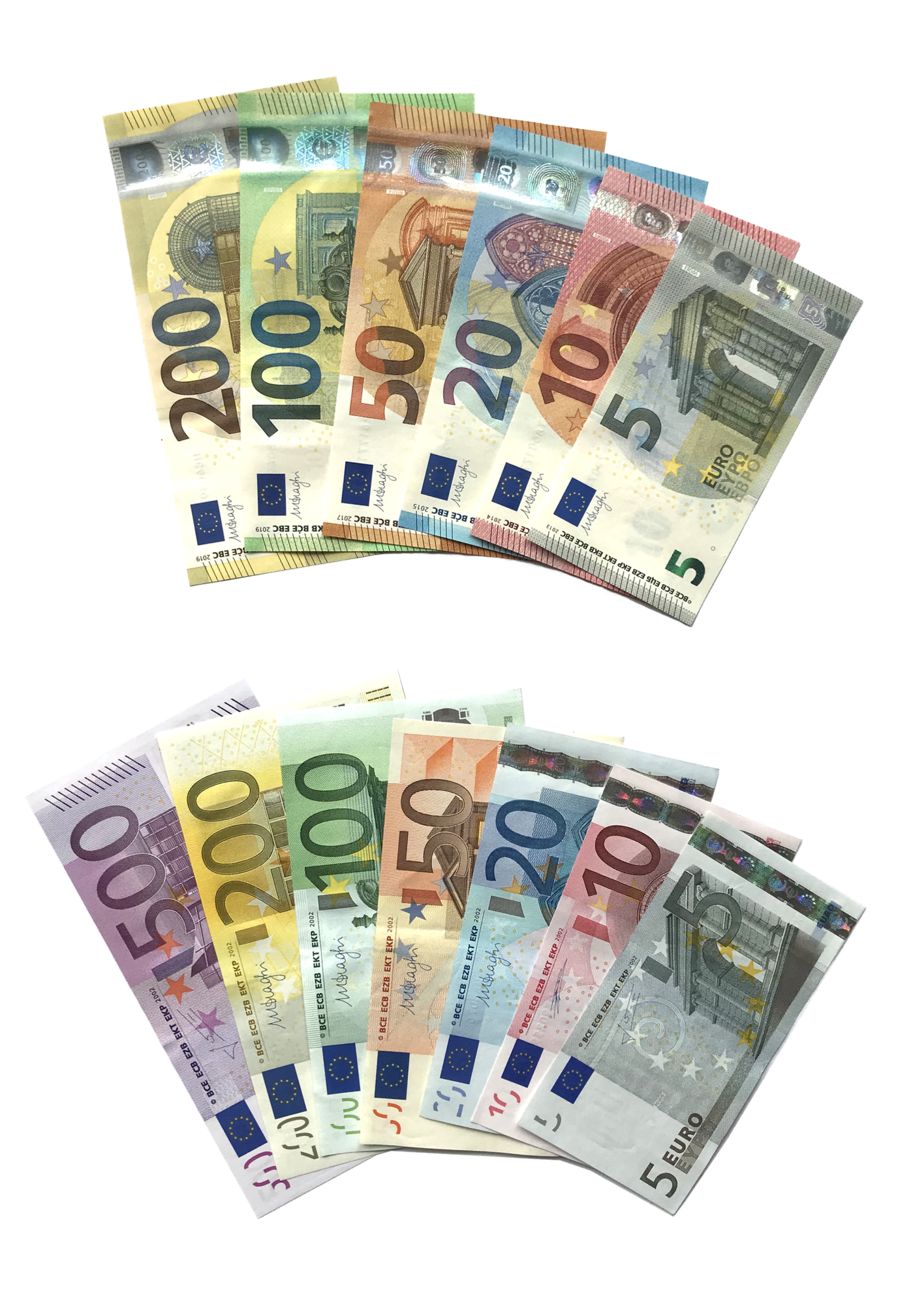
Photo: the complete range of euro banknotes — Source: Wikimedia Commons
The unified table: every currency on one board
| Currency | Official | Market buy | Market sell | 100 units receive (new SYP) | 100 units in old SYP |
|---|---|---|---|---|---|
| US dollar (USD) | 122.00 | 131.00 | 131.50 | 13,100 | 1,310,000 |
| Euro (EUR) | 141.56 | 151.00 | 152.80 | 15,100 | 1,510,000 |
| Saudi riyal (SAR) | 32.49 | 34.79 | 35.27 | 3,479 | 347,900 |
| UAE dirham (AED) | 33.22 | 35.31 | 35.81 | 3,531 | 353,100 |
| Jordanian dinar (JOD) | 172.07 | 182.92 | 185.47 | 18,292 | 1,829,200 |
The table exposes a core market truth: the gap over the official rate is nearly identical across all five currencies (7.8–8.6%) — a signature of the two-track system explained in Syrian Central Bank Dollar Rate vs Parallel Market. The parallel market reprices the entire world through the dollar — when the dollar moves twenty qirsh locally, all five currencies follow within hours. Practical implication: holding "a mix" of these five currencies is not meaningful diversification from a Syrian-market perspective; they are one risk in five costumes. Real diversification splits by purpose — pounds for near-term spending, one hard currency for distant goals. The full live board for all currencies is maintained in Syrian Pound Exchange Rate Today: Dollar, Euro, and All Currencies Live.
Photo: banknotes from multiple currencies — Source: Wikimedia Commons
Why every currency is priced through the dollar: the shuttle-currency effect
In the Syrian market the dollar is not just another currency; it is the settlement currency through which everything else passes. When the returning engineer asks to convert dirhams, the exchanger does not go hunting for a counterparty who wants dirhams — he computes through the dollar: dirhams are worth so many dollars, and dollars are worth so many pounds. The riyal, dinar, and euro all pass the same way. This is why the gap percentages and spreads in the table are so uniform, and why any local dollar move instantly reprices "everything."
The rule has seasonal exceptions worth knowing: concentrated demand for one currency — riyals before Saudi travel seasons, dinars with border-trade cycles — can temporarily tighten or widen that currency's spread outside the general pattern. Precisely there lies the value of asking the direct question, "what is your buy and sell on the riyal today?", because published boards generalize and negotiation individualizes.
City variation: Damascus vs Hasakah on every currency
Today's boards document the city dimension with hard numbers — Hasakah quotes run above the Damascus general board across the board:
| Currency | Damascus (buy/sell) | Hasakah (buy/sell) | Difference per 100 units (buy) |
|---|---|---|---|
| Saudi riyal | 34.79 / 35.27 | 34.98 / 35.46 | +19 new SYP |
| UAE dirham | 35.31 / 35.81 | 35.50 / 36.00 | +19 new SYP |
| Jordanian dinar | 182.92 / 185.47 | 183.90 / 186.46 | +98 new SYP |
| Euro | 151.00 / 152.80 | 151.80 / 153.60 | +80 new SYP |
The economics are simple: hauling currency to a city farther from the trading center costs something, liquidity is thinner, and fewer exchangers means less competition. Half a percent to one percent is today's documented scale. The direction can occasionally flip in a locality with unusual local supply — a city dense with returning Saudi-based workers during travel season may temporarily quote riyals tighter than the capital. Rule of thumb everywhere: the national board is your negotiation reference, not your final price.
Other currencies on the official bulletin: Kuwaiti dinar, sterling, Swedish krona
Beyond the five majors, today's Central Bank bulletin carries three more official rates worth knowing: the Kuwaiti dinar at 394.69 new pounds (the highest-unit currency on the entire bulletin — one KWD exceeds three dollars), the British pound at 164.71 new pounds, and the Swedish krona at 12.72 new pounds. These three trade thinly in the parallel market; holders usually either route them through a transfer channel dealing in the original currency, or convert to dollars first and then to pounds — paying two spreads instead of one, which alone justifies preferring the direct channel whenever available. The Turkish lira circulates in northern border regions given the trade relationship, moves with high historical volatility, and needs live tracking. The Egyptian pound appears mainly in visitor and student pockets rather than large transfers. The universal rule for thinly traded currencies: never hand one over without a written quote first, because surprise margins are widest exactly where published prices are absent.
How to convert any amount yourself in four steps
No financial training required — the four steps handle any amount in any of these currencies:
- Fix the currency and direction: what do you hold, and are you selling or buying? (Selling takes the buy rate; buying takes the sell rate.)
- Take today's rate from the unified table above, matching your direction.
- Multiply: 300 riyals × 34.79 = 10,437 new pounds when selling — and for dollar amounts, the hundred-dollar tables live in 100 US Dollars to Syrian Pounds.
- Sanity-check against your anchors: dollar ≈ 131, euro ≈ 151, dinar ≈ 183, riyal and dirham ≈ 35. A result a hundred times off is a zero error, not a market event.
If you prefer a ready tool over manual arithmetic, SYPNow's converter performs the four steps with live prices, and the live rates page keeps the whole board current by the minute. Disclosure: SYPNow is our own team's product, mentioned because it compresses exactly this workflow into one tap.
The seasonality behind each currency
Each currency has a human rhythm that experienced exchangers read like weather. The riyal breathes with the Saudi calendar — payday cycles, Eid seasons, Umrah travel windows — with queues doubling at month-ends and small price gaps opening between neighborhoods. The dinar follows the academic calendar and border-trade cycles, with golden weeks and slack weeks its regular users know by heart. The dirham moves with UAE construction and services pay cycles and expat leave schedules; its dollar peg makes it the calmest to track. The euro swells with the European summer, when returning diaspora bring annual savings in person. Understanding these rhythms pays twice: you transact when exchanger competition is highest (spreads tightest) and avoid the scarcity windows when your specific currency's margin bloats. None of this appears on a rate board — but it is the difference between reading the market and being read by it.
Practical checklist before converting any Arab currency
- Always ask for the two-sided quote for your specific currency; do not be routed through "the dollar rate" unless your currency is genuinely exotic.
- Compare spreads, not single numbers: the dollar's spread is about 0.4%, the dinar's can reach 1.4% — negotiating the spread beats haggling the price.
- Keep the unit straight: every figure above is new pounds; add two zeros for old pounds, remove them to return.
- Remember the dirham division test: dollar ÷ 3.67 ≈ dirham; large deviations deserve a question.
- For large sums, announce your visit: an exchanger who can prepare liquidity quotes a better margin than one surprised by a bulky exotic currency.
- Document every deal: a written receipt with rate and amount protects you and calibrates next time's comparison.
Frequently asked questions
How many Syrian pounds is one Saudi riyal today?
Per the Damascus parallel board of September 3, 2026: 34.79 new pounds buy / 35.27 sell per riyal. So 100 riyals = 3,479 new pounds when selling (347,900 old pounds). Official bulletin rate: 32.49.
How much is the Jordanian dinar in Syrian pounds?
182.92 new pounds buy / 185.47 sell today. The dinar is worth about 1.4 US dollars, so 100 dinars ≈ 140 dollars equivalent. Official rate: 172.07.
How much is the dirham in Syrian pounds?
The UAE dirham: 35.31 new pounds buy / 35.81 sell today; official rate 33.22. The Moroccan dirham is worth far less and is thinly traded in Syria, requiring a direct exchanger quote.
How much is the euro in Syrian pounds today?
151.00 new pounds buy / 152.80 sell per euro in Damascus today; official rate 141.56. One hundred euros fetch 15,100 new pounds when selling.
Why do all these currencies move together against the pound?
Because the dollar is the settlement currency of the parallel market: riyal, dirham, dinar, and euro prices are all computed from the dollar's pound-price, so any dollar move transmits to all of them at roughly the same percentage within hours, with small seasonal deviations per currency.
Is the rate the same in every Syrian city?
No. Today's Hasakah board runs about half a percent to one percent above the Damascus general board on most currencies (Hasakah riyal 34.98/35.46 vs Damascus 34.79/35.27). Gaps widen in turbulent times and tighten in calm ones.
How much is the Kuwaiti dinar in Syrian pounds?
Today's official bulletin rate: 394.69 new pounds — the highest-unit currency on the bulletin (one KWD exceeds three dollars). Parallel turnover is thin, so holders typically use transfer channels or convert via dollars first.
Conclusion
Today's prices in new pounds: Saudi riyal 34.79/35.27, UAE dirham 35.31/35.81, Jordanian dinar 182.92/185.47, euro 151.00/152.80, dollar 131.00/131.50 — with the official bulletin sitting roughly eight percent below all of them. Memorize your five anchors from the unified table, run any amount through the four steps, and remember that all these currencies ride in the same dollar-shaped boat. For numbers that wait for no one, the SYPNow live rates page refreshes the whole board minute by minute, and the converter executes the four steps for you — our own product, stated plainly.
Sources
- https://cb.gov.sy — Official Exchange Rate Bulletin, Central Bank of Syria, September 3, 2026
- https://sypnow.com/en/rates — Live parallel-market rates for the dollar, euro, and Arab currencies in new Syrian pounds
- Damascus parallel-market boards as tracked by rate-monitoring platforms (sp-today), general and Hasakah panels, September 3, 2026 evening update — source named without linking
- /en/blog/syrian-pound-exchange-rate-today-2026 — Truescho live board for all currencies