
Syrian Pound Value History 1946-2026: Every Major Devaluation, Charted
In 1947, one American dollar bought 2.19 old Syrian pounds. Eight decades later, in the first days of 2026, it bought 111 of the new pounds — after the country had deleted two zeros from its currency — and by September 2026 it bought roughly 131.50 of them. Between those endpoints lies one of the most dramatic currency histories of the modern era: three decades of rigid stability, five years of war-era slide, four years of free fall that took the pound from hundreds to tens of thousands, a sudden partial recovery, and finally a redenomination that rewrote the scale entirely.
This article walks the whole timeline, year by year where the record allows it, with the source and observation date behind every anchor figure. Two rules apply throughout, because they are the difference between understanding this history and being deceived by it. First, every figure is labeled old SYP or new SYP — since January 1, 2026, 100 old pounds equal 1 new pound, and mixing the scales produces numbers that are wrong by a factor of one hundred. Second, where sources disagree or only estimates exist, we say so plainly rather than manufacturing false precision. Rates described here are accurate at the time of writing (September 2, 2026).
If you arrived here trying to convert a specific amount of pounds to dollars rather than understand the history, jump straight to our 1 million Syrian pounds to USD conversion table; this page is the long story.
1946–1961: independence and the pound of the peg
Syria became independent in 1946, and its new currency — the Syrian pound (lira), divided into 100 piastres — entered the postwar world tied to the Bretton Woods system at a fixed par value of 2.19148 old SYP per US dollar, a rate that held from 1947 into the early 1960s. In that era the pound was, by the standards of the region, a dull and trustworthy piece of paper: backed by fixed parities, usable at face value for trade, and stable enough that a one-pound note was real money.
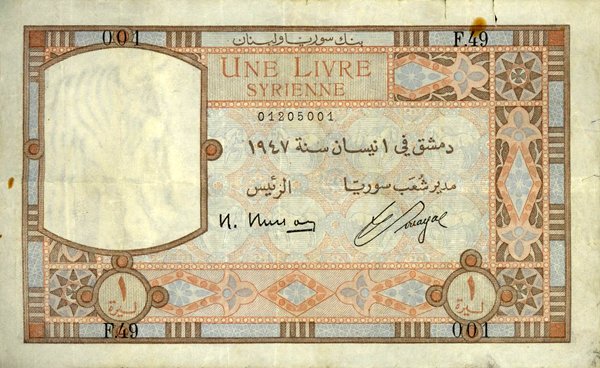
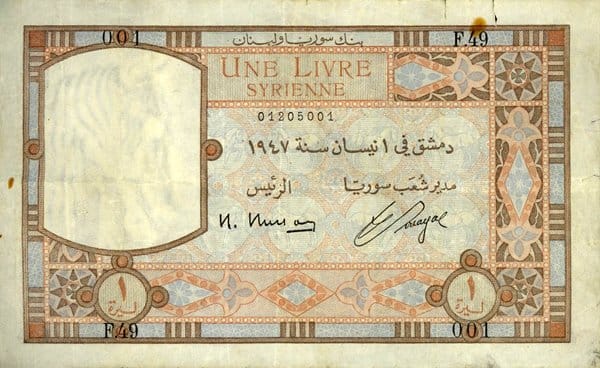
Source: Wikimedia Commons — 1 Livre Syria 1947

Look at that note and hold two thoughts. First: this was a hard-ish currency, the kind a family might keep in a drawer without fear. Second: the sum that note represented — one pound — is worth a rounding error today even after redenomination. That gap between what the pound was and what it became is the entire subject of this history.
1962–2010: stability without strength
The peg era ended in the early 1960s, and over the following decades the pound settled into the slow, managed decline typical of state-led economies: no collapses, but a persistent drift weaker as the gap between Syria's imports and its foreign-currency earnings was papered over by regulation. By 2005, the rate was around 48.4 old SYP per dollar (Wikipedia's documented anchor). On the eve of the war, in March 2011, it stood near 47 old SYP — essentially flat for years, because it was held there by administrative order and by an economy that, whatever its inefficiencies, still earned enough hard currency to keep the official price credible.
For anyone under forty in Syria, this is the "before" picture: a lifetime in which the pound lost a few percent a year against the dollar, slowly enough to ignore.
2011–2016: war and the first slide
The war that began in 2011 destroyed the assumptions under the fixed price. Earnings from oil exports, tourism, and agriculture collapsed; capital fled; sanctions began walling Syria off from the global banking system from 2011 onward. A parallel market reappeared and the two-price system described in our official vs market rate guide took hold.
The trajectory in this phase was steep but not yet catastrophic. From 47 old SYP in March 2011, the pound slid into triple digits by mid-decade. Honest sourcing matters most exactly here: for years like 2014, no single verified point figure is available in the sources we could verify, and estimates vary between trackers. The defensible statement is that by the middle of the decade the pound traded well above 100 old SYP — several times its 2011 level — and by July 2017 it reached 515 old SYP per dollar (Wikipedia's anchor), an eleven-fold loss from the eve of the war in six years.
2017–2020: from 515 to 3,000 — the collapse accelerates
What followed 2017 was not another slide but a series of cliffs, each with a recognizable trigger:
- November 2019: ~765 old SYP on the parallel market. The pressure had been building through the year as the war economy deepened.
- December 2019: ~950 old SYP parallel vs 434 official. The parallel rate blew past double the official rate in weeks — the moment the gap became one of the defining facts of Syrian economic life. New US sanctions legislation (the Caesar Act, signed into law in late 2019, taking full effect in 2020) signalled that the financial siege would tighten.
- January 2020: the parallel rate crossed 1,000 old SYP while the official rate still sat at 434.
- May–June 2020: 1,600 → 2,000 → 3,000 old SYP in weeks. The trigger pile-up: Caesar Act enforcement, Lebanon's banking collapse next door (Syrian deposits and dollar access were trapped in Lebanese banks), and the first COVID lockdowns. In roughly sixty days the pound lost a third of its remaining dollar value.
A generation earlier, a million pounds had been a fortune; by mid-2020, a million old SYP was about $330.
2021–2024: free fall to 25,000, then the fall of the house
The collapse years did not stop at 3,000:
| Observation date | Rate (old SYP per USD) | Notes |
|---|---|---|
| December 31, 2022 | ~7,150 (parallel) | Year-end anchor; more than double the level of two years prior |
| April 2023 | 7,500 official / ~15,000 parallel | Official rate roughly doubled to chase the market; the gap hit ~2× |
| 2024 (pre-December peak) | ~25,000 (record) | The pound's all-time weakest level in old-pound terms |
| December 2024 (after December 8) | 12,500 → ~10,000 | The fall of the previous government triggered an immediate partial recovery |
The December 2024 row is the strangest and most important turn in the whole series. When the previous government fell on December 8, 2024, the pound did not collapse further — it strengthened, from the 25,000 area to 12,500 and then toward 10,000 old SYP within weeks. Markets were pricing a bet: that sanctions would lift, remittances would return, and the diaspora would re-engage. It was the pound's sharpest rally of the entire war era, and it set the stage for everything in 2025–2026.
2025: sanctions relief and the decision to redenominate
2025 delivered on the bet, at least on paper, along a verifiable timeline (per the US Treasury's OFAC): the Central Bank of Syria came off the SDN list on June 30, 2025; Executive Order 14312 terminated the Syria sanctions program on July 1, 2025, revoking the executive orders of 2006–2012; the sanctions regulations left the Code of Federal Regulations on August 26, 2025; and the Caesar Act was repealed on December 18, 2025.
With the worst of the external pressure gone, the government moved to repair the currency's broken arithmetic. By late 2025, everyday transactions required absurd quantities of paper — thousands of 500-pound notes for a bag of groceries — and the currency's two-zero burden had become an operational problem, not just a psychological one. In August 2025, the government's program announced a redenomination, and on December 29, 2025, Decree 293/2025 unveiled the new banknote family carrying nature themes.
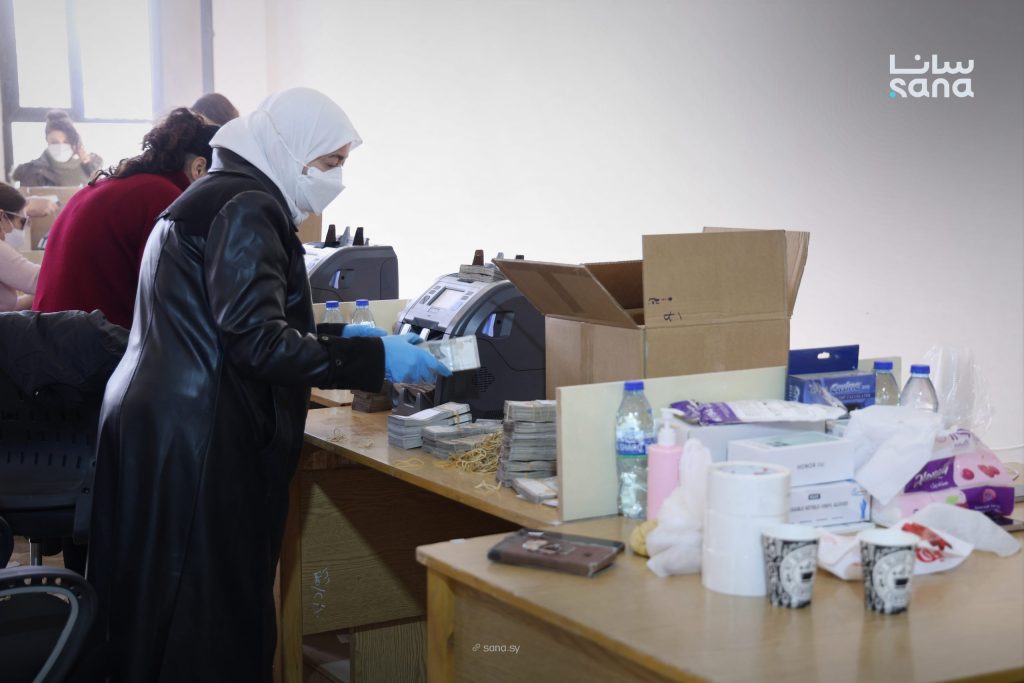
Source: SANA — Destruction of old banknotes begins
2026: the new pound — a new scale, not a new value
The redenomination executed fast, and the state news agency documented every phase:
| Date (2026) | Milestone |
|---|---|
| January 1 | Conversion effective: 100 old SYP = 1 new SYP; dual-circulation window opens |
| January 3 | New notes (25, 50, 100, 200, 500 new SYP) enter circulation |
| January 5 | Launch-week market rate: $1 = 111.00 new SYP, €1 = 129.73 new SYP |
| February 4 | Destruction of withdrawn old banknotes begins |
| February 23 | 35% of old currency replaced |
| May 1 | Exchange deadline extended from March 31 to June 30, 2026 |
| May 4 → June 1 | 56% → over 63% of old notes replaced (CBS governor) |
| End of July | ~95% of old notes swapped; second phase denominations follow |
Two clarifications prevent the most common misreadings of that table. First, the dual-circulation period was initially scheduled to end on March 31, 2026, and was extended to June 30, 2026 (SANA, May 1, 2026); by the end of July roughly 95 percent of old notes had been replaced (Wikipedia, citing the Central Bank). Second — and this is the point foreigners most often get wrong — redenomination is not revaluation. Deleting two zeros does not make anyone richer: the 111.00 new SYP launch rate was simply 11,100 old SYP with two zeros removed. If a foreign site quotes prices "100 times cheaper" than reality, it is accidentally pricing in the wrong scale; our old vs new pound explainer shows the two-way conversion in one line.
How has the new pound actually traded? Weaker, steadily. From 111.00 new SYP at launch week, the market rate drifted up through the 120s during the replacement operation and stood at 131.20–131.70 new SYP per dollar on September 2, 2026 (Damascus market, at the time of writing) — an increase of roughly 18 percent in the rate, meaning the pound lost about 15–16 percent of its dollar value over the first eight months of 2026. Modest, by the standards of this history; painful, by the standards of a paycheck.

Source: SANA — Central Bank: over 63% of old currency replaced
The whole history in one table
Every anchor in this article, consolidated — sources and observation dates included. Rates before 2026 are in old SYP; 2026 rates are in new SYP (divide pre-2026 figures by 100 to compare on the new scale).
| Period / date | Rate vs USD | Scale | Source |
|---|---|---|---|
| 1947–1961 | 2.19148 (fixed par) | old SYP | Wikipedia (IMF par value) |
| 2005 | ~48.4 | old SYP | Wikipedia |
| March 2011 (war begins) | ~47 | old SYP | Wikipedia |
| July 2017 | 515 | old SYP | Wikipedia |
| November 2019 | ~765 (parallel) | old SYP | Wikipedia |
| December 2019 | 434 official / ~950 parallel | old SYP | Wikipedia |
| January 2020 | >1,000 parallel / 434 official | old SYP | Wikipedia |
| May–June 2020 | 1,600 → 3,000 (parallel) | old SYP | Wikipedia |
| December 31, 2022 | ~7,150 (parallel) | old SYP | Wikipedia |
| April 2023 | 7,500 official / ~15,000 parallel | old SYP | Wikipedia |
| 2024 peak | ~25,000 (record) | old SYP | Wikipedia |
| December 2024 (post-fall) | 12,500 → ~10,000 | old SYP | Wikipedia |
| January 5, 2026 | 111.00 | new SYP | Wikipedia (launch week) |
| September 2, 2026 | 131.20–131.70 (market) | new SYP | Damascus market, at time of writing |
If you want to explore the day-by-day version of this story — including the new pound's full trading history since January — our team built a dedicated history view in SYPNow, with every figure labeled by scale and date. Full disclosure: SYPNow is our own project, the same team behind this site — we built the tool precisely because mixed-scale quotes are the biggest error we kept seeing. The app is on the App Store and Google Play, and the web version is here.
Three patterns to take from eighty years
Devaluation came in steps, then in cliffs. For sixty years the official rate moved by administrative decision; from 2019 it stopped pretending to lead and started chasing a market rate that moved in percentage points per day. The 2019–2023 rows — 434 to 950, 7,500 to 15,000 — are the signature of a rate that follows rather than sets.
The gap years were the expensive years. The distance between official and parallel rates (2× in December 2019, ~2× in April 2023) worked as a hidden tax on everyone earning through official channels and buying through market ones. Where the 2026 gap stands cannot be honestly stated without a verified current official rate, which we could not obtain — see the official vs market rate guide for why, and for how to judge any individual quote on its own merits.
The currency's real recovery was political, not monetary. The strongest event in the pound's recent history was not a central bank action but December 8, 2024 — and the redenomination that followed, whatever its operational success (~95% of notes replaced by end-July 2026), changed the scale of the currency, not its value. For today's live level, see the Syrian pound exchange rate today.
Sources
- Wikipedia — Syrian pound: peg-era par value, 2005–2024 anchors, launch-week 2026 rates, replacement percentages.
- SANA — Destruction of old banknotes begins (February 4, 2026)
- SANA — Exchange deadline extended to June 30 (May 1, 2026)
- SANA — Central Bank: 56% replaced (May 4, 2026) and over 63% replaced (June 1, 2026)
- OFAC — Syria sanctions FAQs, Topic 1571: the 2025–2026 relief timeline.
- Wikimedia Commons — File: 1 Livre Syria 1947: peg-era banknote image.
- Live market observations via SYPNow, September 2, 2026.
Frequently asked questions
What was the dollar rate in Syria in 2014?
Between the verified anchors of ~47 (March 2011) and 515 (July 2017), with war-era estimates varying between trackers. No single verified point figure for 2014 exists in the sources we could confirm, so we will not invent one — the honest answer is that the pound was in triple digits and sliding through the mid-2010s, several times weaker than before the war.
What was the Syrian pound worth at its strongest?
In the peg era of 1947–1961, one dollar bought just 2.19 old SYP — the pound's strongest documented level. In modern memory, March 2011 (~47 old SYP) was the strongest level of the pre-war economy.
What was the weakest the Syrian pound ever got?
The 2024 pre-December peak of roughly 25,000 old SYP per dollar — equivalent to 250 new SYP on today's scale — was the all-time low, reached before the December 2024 recovery to 10,000–12,500 old SYP.
Why did the pound strengthen in December 2024?
The fall of the previous government on December 8, 2024 triggered expectations of sanctions relief and diaspora re-engagement, and the market re-priced the currency upward immediately — from the ~25,000 area toward 10,000–12,500 old SYP. The relief subsequently materialized on the timeline listed above (June 2025 through August 2026), which is why the recovery held.
Was the 2026 redenomination a devaluation or a revaluation?
Neither. Deleting two zeros (100 old = 1 new SYP) changed the unit of account, not the value: 111.00 new SYP at launch simply equaled 11,100 old SYP. Prices, salaries, and savings all converted at the same 100:1 ratio. What has actually moved the pound's value since launch is ordinary market pressure — about 15–16 percent weaker against the dollar in the first eight months of 2026.
Can I still exchange old Syrian pounds?
The official exchange window was initially scheduled to close on March 31, 2026, then extended to June 30, 2026, and by the end of July 2026 roughly 95% of old notes had been replaced. For anything outside those verified facts — current exchange procedures, whereabouts of exchange points — check current official announcements rather than relying on this article, which describes the timeline as documented at the time of writing.
Where can I check the current rate and its recent history?
On a live tracker that labels the scale of every figure — like SYPNow from our team (same team as this site), which shows Damascus market buy/sell in both new and old pounds plus the full 2026 history since the redenomination. Always note the observation date of whatever number you use; this article's figures were captured September 2, 2026, and the market will have moved since.
Eighty years took the pound from 2.19 to 25,000, back to 10,000, and finally to a fresh start at 111 that has since drifted to about 131.50 — the whole journey is one graph of war, siege, and repair. Keep the history in your pocket if it matters to your work or your family: our team's app SYPNow carries the full rate history in both scales, free on the App Store and Google Play, with the web version here.