

Syrian Central Bank Dollar Rate vs Parallel Market Rate in 2026: Who Sets Each Price and Which One You Actually Pay
Last updated: Thursday, September 3, 2026 — all figures in this guide come from the Central Bank of Syria's official bulletin and today's parallel-market boards, quoted in new Syrian pounds (1 new pound = 100 old pounds since the January 2026 redenomination).
If you have ever tried to find "the" exchange rate in Syria, you have probably ended up with two numbers that refuse to agree. Consider the situation thousands of Syrian families and dozens of international NGOs face every month: an invoice is calculated at 122.00 pounds per dollar, while the money changer down the street quotes 131.00 to buy the very same dollar. Both numbers are correct, both are "today's rate," and the gap between them — nine full pounds, roughly 7.4 percent — is not a scam by anyone in particular. It is the visible surface of a two-track currency system that has defined Syria's economy for most of the past decade. This guide explains the whole mechanism in plain terms: who sets the official rate inside the Central Bank of Syria, how the daily bulletin reaches banks and customs offices, why the parallel market prices dollars roughly eight percent higher, and — most importantly — which of the two rates actually applies to your transaction.
Who sets the Syrian pound exchange rate?
The institution legally responsible for the official exchange rate is the Central Bank of Syria (CBS), which describes its own mandate as safeguarding the stability of the national currency and maintaining balance between money and the wider macroeconomic variables. In practice, the official rate does not appear out of thin air. It passes through a three-level governance structure:
- The Monetary and Credit Council — the highest monetary authority in the country — sets the general framework for pricing the national currency against foreign currencies.
- The Committee of the Bank's Management and Directorates issues the executive decisions and circulars, including Decision No. 211 of February 13, 2023, which formally ended the old "bulletin of allowances" (the dual-margin mechanism that once let banks trade at a spread around the central rate).
- The operational FX departments publish the daily Official Exchange Rate Bulletin, setting buy and sell prices for the main currencies the bank and public-sector banks deal in.
Here is the point most guides miss: the official bulletin is not a forecast or a tracking report of the money market. It is a contractual, mandatory price for a specific circle of transactions — mainly public-sector operations, customs valuation, and accounting entries of the state. The parallel market where individuals and private businesses buy their dollars moves entirely outside this circle, driven by supply and demand. That is why speaking of "one dollar price in Syria" is technically wrong: the system runs on two parallel tracks, a structural feature we documented in depth in our companion piece Official vs Black-Market Exchange Rate in Syria: Why Two Prices Exist and Which One You Actually Pay.
Two more bulletins complete the picture on the CBS website: the "Official Market Bulletin (average)", which tracks average prices in official channels over a wider window, and the "Exchange Companies Bulletin", which the bank used to publish daily but abandoned in 2017. That 2017 abandonment matters more than it looks: when the licensed exchange companies lost their daily official reference, their pricing detached from the central bank's orbit — and the two tracks began drifting apart.
The Central Bank of Syria official rate today (Damascus bulletin)
According to the official bulletin published by the Central Bank of Syria in Damascus on Thursday, September 3, 2026 — in new Syrian pounds — the official rates are:
| Currency | Official rate (new SYP) | Daily change |
|---|---|---|
| US dollar (USD) | 122.00 | 0.00% |
| Euro (EUR) | 141.56 | +0.20% |
| Saudi riyal (SAR) | 32.49 | 0.00% |
| UAE dirham (AED) | 33.22 | 0.00% |
| Jordanian dinar (JOD) | 172.07 | 0.00% |
| British pound (GBP) | 164.71 | −0.07% |
| Kuwaiti dinar (KWD) | 394.69 | +0.06% |
| Swedish krona (SEK) | 12.72 | +0.47% |
Three practical observations before we move to the market rate:
First, remember these are new pounds. Anyone reading older reports should mentally add two zeros: 122.00 new pounds is the same value as 12,200 old pounds per dollar. We cover the redenomination mechanics fully in Old vs New Syrian Pound: The Complete Guide to the Two-Zero Redenomination.
Second, the bulletin is published daily on the CBS website, which also offers a built-in currency calculator for conversions between the pound and the eight currencies above — a useful primary source for researchers and finance teams who want to verify calculations without intermediaries.
Third, the near-zero daily changes are not laziness; they are the point. The bulletin is an accounting and contractual instrument, not a live trading screen. It moves when the central bank decides the reference needs adjusting, not every time street demand shifts.
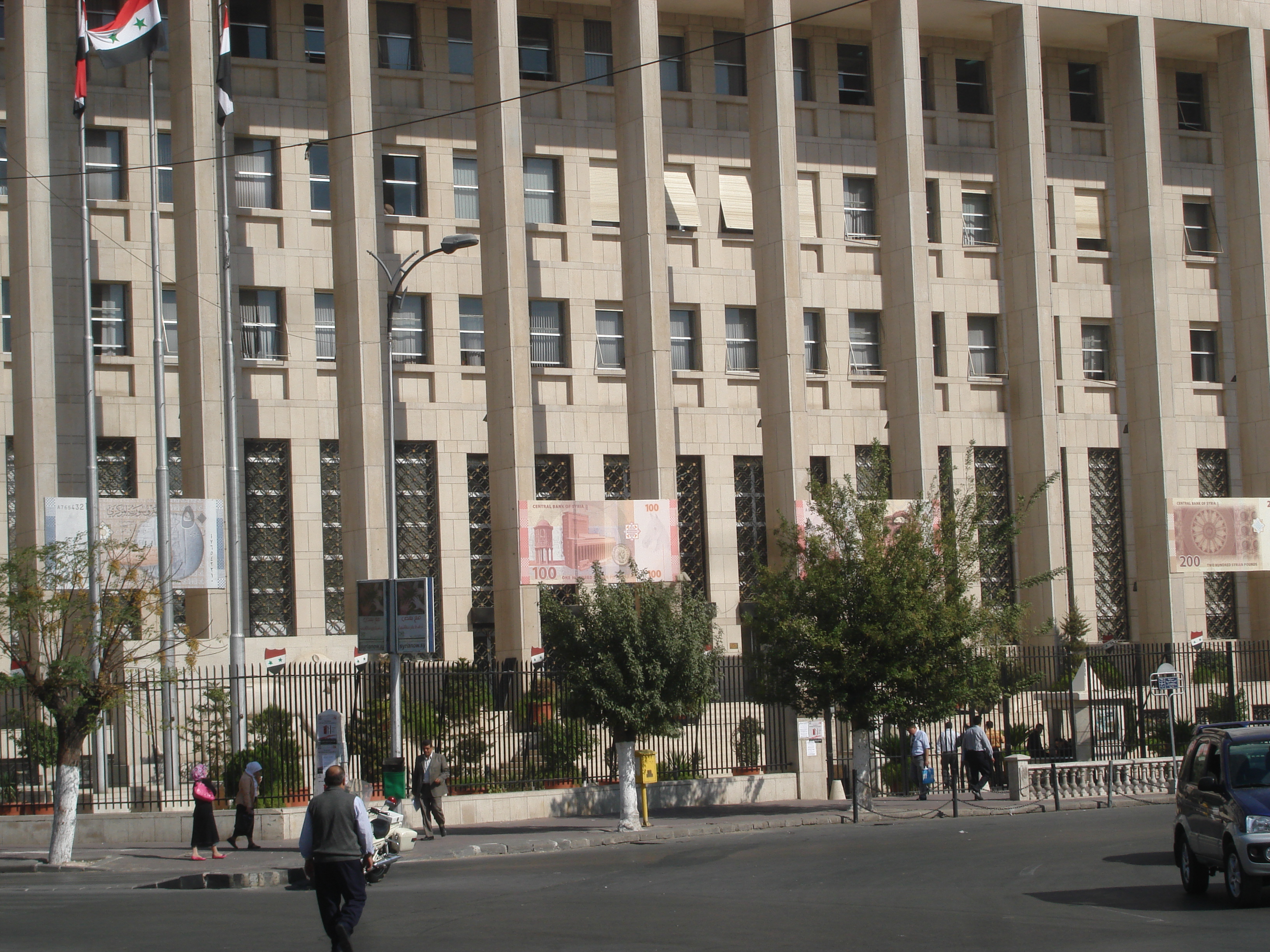
Photo: Syrian banknotes issued under the Central Bank of Syria — Source: Wikimedia Commons
Why does the central bank rate differ from the market?
Today's gap: 122.00 official vs 131.00/131.50 parallel-market buy/sell in Damascus — a premium of 9.00–9.50 pounds, or about 7.4–7.8 percent. Five structural forces keep that gap alive:
- A deliberately limited circle of application. The official rate applies mainly to public-sector channels — the central bank explicitly sells foreign currency to state institutions and official missions at the bulletin rate — and to customs and accounting valuations. Individuals and private firms source most of their foreign exchange outside that circle, and that excess demand gets priced in the parallel market.
- Persistent excess demand for hard currency. Diaspora remittances, import financing, and household dollar-savings create daily demand for foreign currency that official channels cannot fully satisfy; the unmet share is repriced on the street.
- The missing daily reference for exchange companies. Since the Exchange Companies Bulletin stopped in 2017, licensed exchangers have had no official daily anchor tying their prices to the central bank's. The two pricing systems grew separate plumbing.
- The 2023 restructuring. Decision 211 (February 13, 2023) ended the allowances bulletin that had given banks a contractual margin around the central rate. The official bulletin remained as the only published official price, and the practical distance between it and street pricing widened.
- The trust premium. In any high-inflation economy, cash dollars carry a risk premium above their reference price. This premium expands and contracts with political and economic news — often more than with supply and demand alone.
It is worth knowing that a seven-to-eight percent gap is not a constant of nature. Historical episodes have stretched it to multiples of today's figure and squeezed it to a sliver. The full time series since 1947 — pegs, collapses, and the birth of the two-track system — is documented in Syrian Pound Value History 1947–2026: Every Collapse and Stabilization by the Numbers.
The parallel market rate today, side by side with the official bulletin
Damascus parallel-market boards (as tracked by rate-monitoring platforms including sp-today, evening update of September 3, 2026) quote the following buy/sell prices in new pounds, set against the official bulletin to expose the gap per currency:
| Currency | Official | Market buy | Market sell | Gap over official (sell side) |
|---|---|---|---|---|
| US dollar (USD) | 122.00 | 131.00 | 131.50 | +9.50 (≈7.8%) |
| Euro (EUR) | 141.56 | 151.00 | 152.80 | +11.24 (≈7.9%) |
| Saudi riyal (SAR) | 32.49 | 34.79 | 35.27 | +2.78 (≈8.6%) |
| UAE dirham (AED) | 33.22 | 35.31 | 35.81 | +2.59 (≈7.8%) |
| Jordanian dinar (JOD) | 172.07 | 182.92 | 185.47 | +13.40 (≈7.8%) |
Notice how uniform the gap percentages are (7.8–8.6 percent). That uniformity is the tell: the parallel market is not pricing each currency independently — it is repricing everything through the dollar. A second observation: the buy/sell spread in the market is comparatively tight (half a pound on the dollar in Damascus), and it tends to be tightest where liquidity is deepest — a structural feature worth remembering when you compare rates between cities or channels. We track today's market boards in detail in Dollar Rate in Syria Today: Buy and Sell Prices Right Now.
If checking these two numbers several times a day is part of your job — remittance planning, procurement, NGO budgeting — you can collapse the manual board-watching into one screen: the SYPNow app shows the parallel-market and reference rates for the dollar and major currencies in real time, with a built-in converter (live rates page). Full disclosure: SYPNow is a product our own team builds, and we mention it because it genuinely solves the daily-monitoring problem.
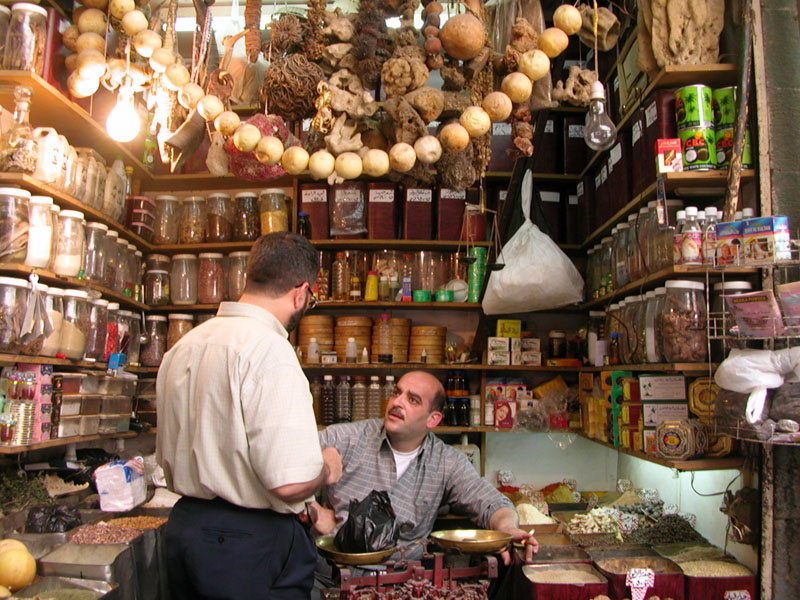
Photo: Al-Buzuriyah souq in old Damascus — Source: Wikimedia Commons
Which rate do I actually pay? The practical answer
This is the question every searcher actually means, and the answer depends on who you are and what kind of transaction you are making — not on which number is "more correct":
- You are an individual selling foreign cash (USD or EUR banknotes) for pounds. You transact at the parallel market, and the number that matters is the buy price (131.00 today in Damascus) because the money changer is buying from you. Individuals cannot normally access the official rate through this door.
- You are an individual buying foreign cash with pounds. Your number is the sell price (131.50 today) — always slightly higher, and the difference is the exchanger's margin.
- You are a state entity, an official mission, or a transaction routed through official channels. The official bulletin's 122.00 applies, because the central bank sells foreign currency to public-sector missions through dedicated channels, and customs/official valuations are booked at this rate.
- Your salary or pension is defined in dollars but paid in pounds. The first question to ask the paying entity: which bulletin do you convert at? Some convert at the official rate, some at the market rate — and on a full salary the difference can equal weeks of living costs.
- You are receiving an international transfer. Transfer channels typically settle at rates close to the market side; the cost of the channel itself is a separate topic covered in Sending Money to Syria in 2026: Legal Channels and Their Real Costs.
The one-line rule that resolves most confusion: if you are handing cash to or receiving cash from a money changer, your price is the parallel-market rate — buy-side if you are selling hard currency, sell-side if you are buying it. The official rate is not a discount you are losing; it simply does not apply to your transaction. For running the numbers on any amount, the updated calculator in USD to Syrian Pound Converter: Live Calculator at Today's Rate uses the same day's prices.
A caution about comparisons: when you hear "the dollar fell in Syria today," check which track moved. A parallel-market dip does not change your customs valuation, and a bulletin adjustment does not guarantee cheaper dollars at the exchanger tomorrow. The two tracks correlate in direction but tell different stories: the bulletin narrates state policy; the market narrates public demand.
How the official bulletin is actually calculated and distributed
The journey of the official number, from birth to your pocket, runs through a morning pipeline. FX departments at the central bank in Damascus gather the previous day's official-channel transactions and the morning's requests, draft buy/sell prices per currency, route the draft through internal approval, and publish the Official Exchange Rate Bulletin on the bank's website as the contractual basis for the working day. From there the number fans out to three concentric circles of users: public-sector banks accounting for state clients; customs and tax offices needing a uniform valuation basis; and — third circle — ordinary readers who use it mainly for comparison and understanding rather than direct transactions.
The system also has a branch dimension: the central bank operates regional branches serving public banks outside Damascus, all anchored to the same centrally-published bulletin. In other words, the official rate is identical in Damascus, Aleppo, and Latakia — unlike the parallel-market rate, which varies slightly from city to city with local liquidity and demand. That asymmetry (one uniform official price, many local market prices) answers a question expats often ask when a relative quotes a slightly different rate than the one they saw online.
What the official rate means for your wallet: customs, fees, and state transactions
Even if you never touch the official rate directly, it reaches your wallet through three hidden doors:
- Customs duties. Imported goods are valued at the official bulletin rate. An importer who bought dollars at 131.50 in the market while customs values them at 122.00 faces a real cost higher than the paperwork suggests — one reason imported-goods prices in local shops exceed what the exchange rate alone would predict.
- Government fees and fines. Various official charges are computed on formulas tied to the bulletin, so their pound amounts move with bulletin revisions even when the street rate stands still.
- Corporate accounting. Registered companies book foreign-currency assets and liabilities at the official rate while transacting at the market rate, creating a permanent book-vs-cash gap their finance teams price into everything. For NGOs and international companies operating in Syria, this is the number to reconcile first.
A short history of the two-track system
The gap was not always there. For decades the pound was effectively pegged, and the official bulletin and the street price were nearly the same number. The separation grew in stages, with two official milestones sealing it: the Exchange Companies Bulletin stopped in 2017, detaching licensed exchangers from the central bank's daily reference; then Decision 211 of February 13, 2023 ended the allowances bulletin, confining the official bulletin to state channels. What exists today is thus a clear, stable dual system: a contractual price for the state that moves rarely, and a market price for everyone else that breathes with every headline. The full historical sequence with dates and figures is preserved in the Syrian pound value history file.
Practical checklist before exchanging dollars in Syria today
- Ask for both sides of the quote (buy and sell) before committing — a single number tells you nothing about which side of the trade you are being offered.
- Keep the currency unit straight. After the redenomination, moving between old and new pounds is strictly a two-zero operation: 100 dollars ≈ 13,100 new pounds ≈ 1,310,000 old pounds. Misplacing the two zeros multiplies or divides your result by one hundred — the ready tables for every amount from 10 to 5,000 dollars are in 100 US Dollars to Syrian Pounds: New and Old Currency Tables.
- Compare cities only on equal timestamps. Rate boards update through the day; comparing a morning board in one city with an evening board in another compares nothing.
- Do not budget future obligations at today's rate. The market moves weekly in ways that can swallow a thin margin; build your plan on a conservative rate plus a safety buffer of at least one percent.
- Check the source's date and unit before trusting any number. Mixing an old official bulletin with a fresh market board — or old pounds with new — ruins even a perfect calculation.
Frequently asked questions
Who sets the Syrian pound exchange rate?
The Central Bank of Syria issues the official daily bulletin, inside a structure that includes the Monetary and Credit Council (general policy), the Committee of the Bank's Management and Directorates (decisions and circulars), and the operational FX departments (daily publication). The parallel-market rate is not set by the central bank; it emerges from supply and demand among money changers.
What is the Central Bank of Syria dollar rate today (Damascus)?
Per the official bulletin of September 3, 2026: 122.00 new Syrian pounds per US dollar (0.00% daily change), alongside 141.56 per euro and 32.49 per Saudi riyal.
Why is the central bank rate different from the market?
The official rate applies to public-sector channels and official valuations only, while individuals and private businesses buy foreign currency in the parallel market at supply-and-demand prices. The 2017 halt of the exchange-companies bulletin and the 2023 end of the allowances bulletin widened the separation. Today's gap is roughly 7.4–7.8 percent.
Which rate do I actually pay?
If you deal with a money changer, you pay the parallel-market rate: the buy price when selling hard currency, the sell price when buying it. The official 122.00 applies to public-sector channels, customs, and state valuations.
Can individuals buy dollars from the central bank at 122?
No. Sales at the bulletin rate are tied to specific channels, chiefly public-sector missions. Individuals transact through licensed banks and exchangers at market prices.
What is the difference between the official bulletin, the allowances bulletin, and the official market (average) bulletin?
The official bulletin is the daily contractual price for official channels. The allowances bulletin, which gave banks a contractual margin, was ended by Decision 211 of February 13, 2023. The official market (average) bulletin tracks average prices in official channels over a wider window. The exchange-companies bulletin has been discontinued since 2017.
Conclusion
Syria's dollar price today is two numbers, not one: 122.00 new pounds on the Central Bank of Syria's official bulletin for state channels, and 131.00/131.50 buy/sell in the parallel market where individuals live, separated by roughly 7.8 percent and explained by the two-channel structure and the bulletin history of 2017 and 2023. The official rate narrates state policy; the market rate narrates public demand — and knowing which one applies to your transaction is the entire practical skill. Because both numbers breathe hourly, a live-monitoring tool saves the daily hunt: the SYPNow live rates page shows both rates together and converts any amount instantly, and the app is available via the download page. Transparency note: it is our own product — we built it precisely for this problem.
Sources
- https://cb.gov.sy — Official Exchange Rate Bulletin and Official Market (average) Bulletin, Central Bank of Syria
- https://sypnow.com/en/rates — Live parallel-market and reference rates in new Syrian pounds
- Damascus parallel-market boards as tracked by rate-monitoring platforms (sp-today), September 3, 2026 evening update — source named without linking
- /en/blog/syria-official-vs-black-market-rate-2026 — Truescho companion file: the two prices explained