
Swiss Government Excellence Scholarship 2027: CHF 2,450 a Month for a Fully Funded Research Year in Switzerland
Last updated: October 8, 2026
Switzerland's federal government opened applications for the Swiss Government Excellence Scholarships 2027-2028 on August 20, 2026, and the first country deadline is now days away: Tunisia closes on Tuesday, October 13, 2026. Run by the State Secretariat for Education, Research and Innovation (SERI) and awarded through the Federal Commission for Scholarships for Foreign Students (FCS, known as ESKAS), the program funds early-career researchers from 183 countries with a monthly stipend of CHF 2,450 for up to 12 months, starting September 1, 2027. Application deadlines are set country by country and run from mid-October to the end of November 2026.
The short version: if you hold a master's degree (or will complete one by July 31, 2027), were born after December 31, 1991, and can secure a Swiss academic supervisor willing to endorse your research project with a formal letter of support, you can apply free of charge through the Swiss embassy serving your country — no prior PhD admission required.
Source: Wikimedia Commons — CC BY-SA 4.0

A scholarship run by the state itself, not a single university
The Excellence Scholarships are a whole-of-government program. The Swiss Confederation awards them each year "to encourage international exchange and research cooperation between Switzerland and over 180 other countries," and the current cycle is open to applicants from 183 countries. A dedicated federal body — the Federal Commission for Scholarships for Foreign Students — evaluates and selects the winners, while applications themselves are submitted to Swiss embassies and diplomatic representations in each applicant's home country.
That structure has three practical consequences many applicants miss. First, you compete within your own country's quota, because your file is assessed alongside applicants from your country at your embassy. Second, deadlines differ radically: what is still open in Riyadh until November 27 closed back in early October in Washington. Third, applying is completely free — and SERI itself has published an official warning about phishing scams that misuse the Swiss government's name to demand payments for "visa and social insurance costs." We cover that in detail below.
What the scholarship actually pays: money, duration, and start date
The official 2027-2028 documents spell out the package precisely:
- Monthly stipend: CHF 2,450, intended to cover basic living expenses for one person for the full duration.
- Duration: up to 12 months (six months minimum), with no extensions possible.
- Start date: September 1, 2027, unified for all winners.
- Legal nature: the official documentation stresses the payment is a cost-of-living scholarship, not a salary, and should not be treated as regular remuneration either financially or legally.
The figure is designed for a reasonable single-researcher life in one of Europe's most expensive countries rather than for saving money — but among comparable government scholarship programs, it remains one of the most generous monthly stipends, paid consistently for a full year with no teaching or employment obligations attached.
Country-by-country deadlines (2026 closing dates)
The table below is built from the official deadline list published by SERI (version dated September 1, 2026) — the only source you should trust for your country's date:
| Country | Application deadline | Where to apply |
|---|---|---|
| United States (PhD track) | October 6, 2026 (closed) | Embassy in Washington |
| Tunisia | October 13, 2026 | Swiss Embassy, Tunis |
| Brazil | October 27, 2026 | swissnex Brazil |
| Russia | October 30, 2026 | Swiss Embassy, Moscow |
| Bangladesh | October 30, 2026 | Swiss Embassy, Dhaka |
| Pakistan | October 31, 2026 | Swiss Embassy, Islamabad |
| United Arab Emirates | November 10, 2026 | Swiss Embassy, Abu Dhabi |
| Bahrain | November 10, 2026 | via Abu Dhabi embassy |
| Egypt | November 10, 2026 | Swiss Embassy, Cairo |
| Kuwait | November 10, 2026 | Swiss Embassy, Kuwait |
| Qatar | November 10, 2026 | Swiss Embassy, Doha |
| Libya | November 10, 2026 | via Tunis embassy |
| Morocco | November 10, 2026 | Swiss Embassy, Rabat |
| Sudan | November 10, 2026 | via Cairo embassy |
| India | November 10, 2026 | Swiss Embassy, New Delhi |
| Iran | November 10, 2026 | Swiss Embassy, Tehran |
| Germany | November 10, 2026 | Swiss Embassy, Berlin |
| Algeria | November 13, 2026 | Swiss Embassy, Algiers |
| United Kingdom | November 13, 2026 | Swiss Embassy, London |
| Ethiopia & South Sudan | November 13, 2026 | Swiss Embassy, Addis Ababa |
| Saudi Arabia | November 27, 2026 | Swiss Embassy, Riyadh |
| Jordan | November 27, 2026 | Swiss Embassy, Amman |
| Iraq | November 27, 2026 | Swiss Embassy, Baghdad |
| Oman & Yemen | November 27, 2026 | Swiss Embassy, Muscat |
| Palestine | November 27, 2026 | Swiss Representative Office, Ramallah |
| Nigeria | November 27, 2026 | Swiss Embassy, Abuja |
| Lebanon & Syria | November 30, 2026 | Swiss Embassy, Beirut |
| China & Japan | November 30, 2026 | Embassies in Beijing and Tokyo |
| Indonesia, Malaysia, Kenya | November 30, 2026 | Embassies in Jakarta, Kuala Lumpur, Nairobi |
Two practical notes: contact your responsible embassy well before the deadline, because some require appointments or paper submissions; and the complete global list (including Latin America and Oceania) is in the official PDF linked in the Sources section — never rely on intermediary websites for dates.
Who is eligible: the full requirements, as officially stated
The FCS sets precise criteria for the research track, which is the program's broadest and most important route:
- Degree: a master's degree or equivalent completed by July 31, 2027 (June 30, 2027 for ETH Zurich).
- Age: born after December 31, 1991 — roughly a 35-year ceiling at application time.
- Career stage: early-career researchers from all academic fields, including young medical doctors, with priority given to candidates who have not previously studied or researched in Switzerland.
- Research plan: a detailed research proposal with a timeline specifying the project's key milestones and activities.
- A supporting letter from a Swiss supervisor: the decisive requirement — applications without one are not considered. The next section explains why.
Selection rests on four published criteria: academic profile, research competence and motivation; originality and methodological quality of the project; and the quality of supervision and potential for future collaboration with the Swiss institution.
The golden rule: no application without a Swiss supervisor
The official guidance states it bluntly: "scholarship applications without an academic supervisor will not be considered." You must find a professor or laboratory group leader at a recognized Swiss institution who endorses your project and writes a letter of support — and SERI itself warns that finding one "can take weeks or even months," given how many inquiries professors receive.
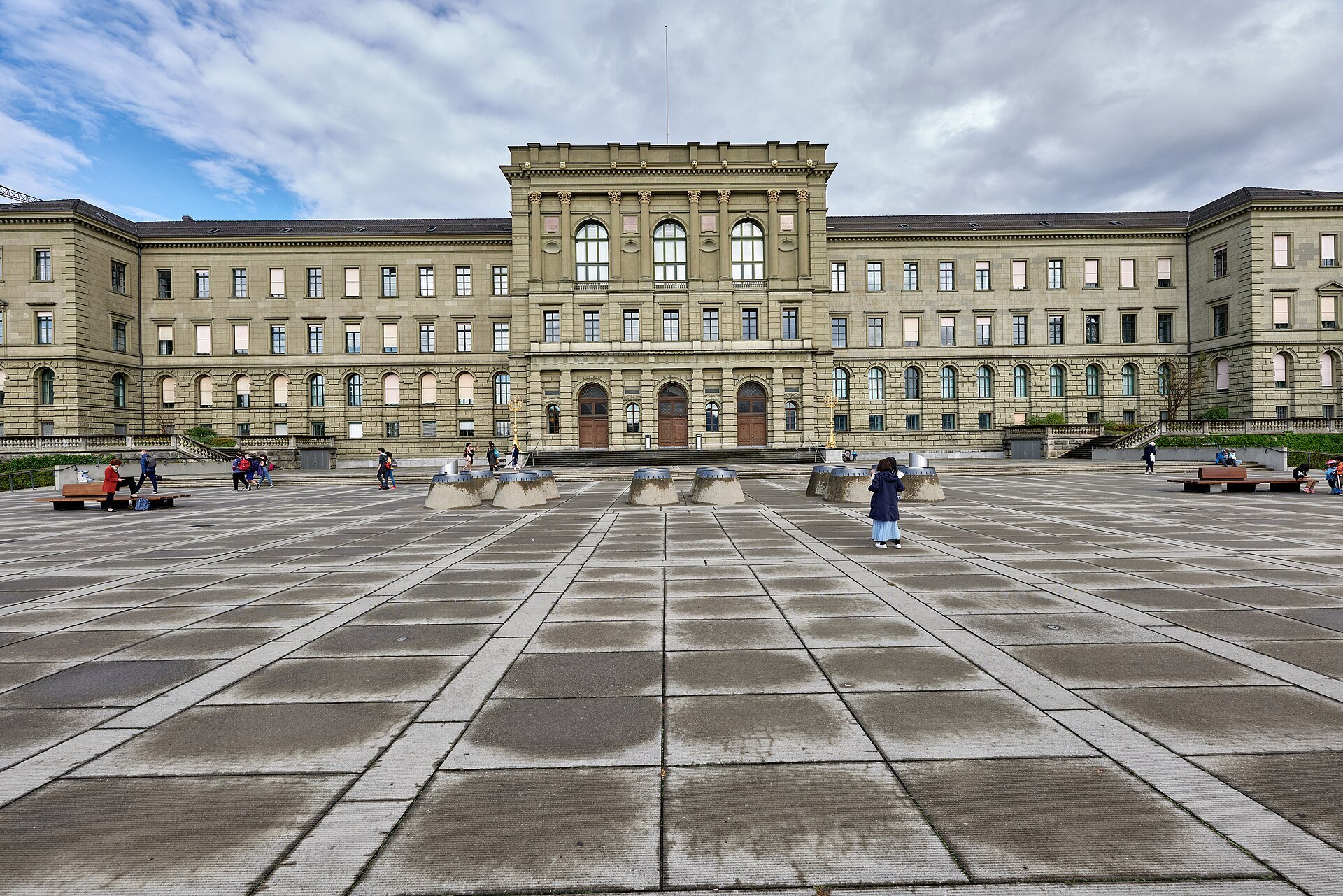
Eligible host institutions include cantonal universities, universities of applied sciences, the two federal institutes of technology (ETH Zurich and EPFL), and the four research institutes of the ETH Domain: PSI, WSL, Empa, and Eawag.
Source: Wikimedia Commons — CC0

A practical tip: start emailing potential supervisors now, even if your country's deadline is in late November. Attach a concise academic CV and a one-page project idea, and verify that their current research genuinely overlaps your field before reaching out. For the PhD route specifically, note that the scholarship application and the doctoral programme admission are two completely separate procedures in the Swiss system.
The second track: art scholarships
Beyond research grants, the program offers art scholarships for students seeking an initial master's degree in an artistic field (music, visual arts, theatre, and related disciplines). Unlike the research track's 183-country reach, the art track is limited to a smaller set of countries — check the official deadline file to see whether yours is included before planning around it.
How to apply, step by step
- Confirm your country's deadline from the table above or the official file, and contact the responsible Swiss embassy early to learn its submission process (electronic or paper) and any local requirements.
- Find a Swiss academic supervisor and obtain their letter of support, attached to a short CV.
- Prepare the core file: a complete academic CV covering education, degrees, awards, positions, publications, teaching and practical experience; a motivation letter of maximum two pages explaining your reasons for the research stay in Switzerland and its significance for your future career; and your research plan with its timeline.
- Submit through the Swiss representation for your country before the deadline, and follow up on any missing documents.
- After the embassy's first screening, qualifying files go to the Federal Commission for Scholarships, which evaluates, selects, and announces results through the embassies themselves.
Official warning: applying is free, and any payment demand is a scam
SERI has published an explicit warning on its official page about fake scholarship offers that misuse the Swiss government's name via email and social media, aiming to push victims into money transfers under pretexts such as visa and social insurance costs. The Commission's advice is unambiguous: never answer such emails and never send money — "the application for a Swiss Government Scholarship is free of charge." Worth sharing with first-time applicants every season, because these scam waves grow each cycle.
What this means for you
For a master's degree holder looking for a European research opening, this is one of the shortest credible paths available: no prior PhD admission, no application fee, and a fixed monthly stipend in one of the world's most advanced research economies, beginning less than a year from the deadline. The real differentiator is time management: the supervisor search is the only element that cannot be compressed, while the rest of the file can be assembled in weeks. Tunisia's window closes within days; the Gulf countries have roughly five weeks; everyone else has November — but every country's quota is competitive, and early preparation is what separates funded files from near-misses.
Comparable opportunities worth benchmarking
If you are building a full scholarship season, benchmark this against currently open programmes in our updated October-November 2026 deadlines list, explore German funding routes in the Germany scholarships guide, and read our comprehensive study in Switzerland guide. You can also track the latest open programmes on the Truescho opportunities page, or use our application preparation services to have your research plan and file reviewed before the deadline.
FAQs
Who is eligible for the Swiss Government Excellence Scholarship 2027-2028?
Early-career researchers from 183 countries who hold a master's degree (or complete one by July 31, 2027 — June 30, 2027 for ETH Zurich), were born after December 31, 1991, in any academic field, provided they secure a Swiss academic supervisor's formal letter of support for their research project.
How much is the scholarship worth and how long does it last?
CHF 2,450 per month to cover basic living expenses for one person, for up to 12 months (six months minimum) with no extensions, and a unified start date of September 1, 2027.
What is the nearest closing date?
Tunisia closes Tuesday, October 13, 2026, followed by the October 27-31 group (Brazil, Russia, Bangladesh, Pakistan). November brings the biggest wave: November 10 for the UAE, Kuwait, Qatar, Morocco, Egypt, and India; November 27 for Saudi Arabia, Jordan, Iraq, Oman, Yemen, and Palestine; and November 30 for Lebanon, Syria, China, Japan, and others.
Do I need PhD admission before applying?
No. The application centres on a research project endorsed by a supervisor at a recognized Swiss institution. For the PhD route, SERI explicitly notes that the scholarship application and the doctoral programme admission are two separate procedures.
Is the application really free?
Yes, entirely free — and SERI has officially warned against scam emails demanding money for "visa or insurance costs" in the scholarship's name, advising applicants never to reply and never to send any amount.
Where do I submit: the university or the embassy?
The Swiss embassy or diplomatic representation responsible for your country (see the table above). The host university and your supervisor participate only through the support letter and academic endorsement; embassies handle receipt and first screening before files go to the Federal Commission.
Sources
- Official Swiss Government Excellence Scholarships 2027-2028 page — sbfi.admin.ch
- Official at-a-glance overview: conditions, funding, supervision — sbfi.admin.ch
- Official country-by-country deadline list (September 1, 2026 version, PDF)
Start your journey with Truescho
A sharp research plan and the right supervisor are the heart of a winning Swiss Excellence application. Truescho helps you prepare your application file, refine your research plan, and shortlist the universities and supervisors that fit your field — and you can follow the newest funded opportunities as they open.