
All Streaming Price Hikes in 2026 So Far: Netflix, YouTube Premium, Disney+, Peacock, Apple TV+ — Full Comparison Table
Last updated: September 2026
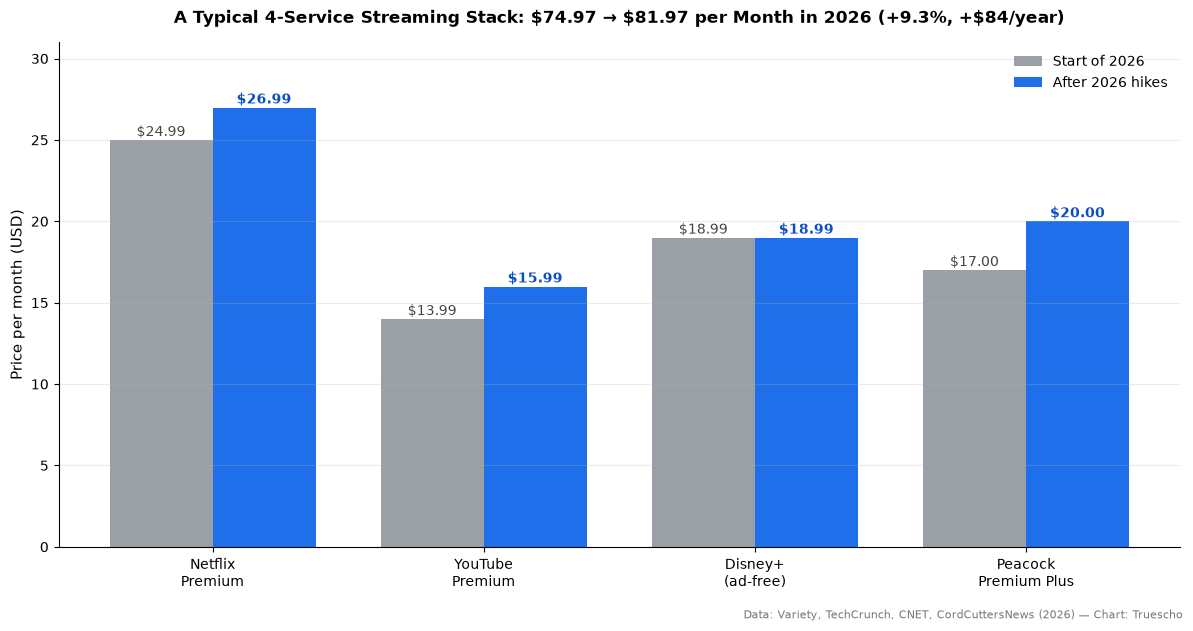
$983.64 a year — that is what four standard streaming subscriptions now cost in the United States after the 2026 price hikes, up from about $899.64 at the start of the year. The streaming price increases of 2026 have been smaller individually than any single year's headline rise, but they have arrived from almost every direction at once: Netflix in two markets, YouTube Premium on two continents, and quiet surcharge changes in places subscribers rarely look. Added together, they have pushed a typical four-service stack up $7 a month (about 9.3%) in nine months.
This tracker gathers every verified increase in one table — in dollars, pounds and euros — followed by a service-by-service read on what actually changed and a practical section on cutting your bill back down. Figures come from the pricing reporting of CNET, Variety, TechCrunch, 9to5Google and Deadline; where a service has not raised prices, we say so explicitly, because in 2026 that is the more newsworthy fact.
The full 2026 streaming price increase table
Every confirmed 2026 change is below, with old and new prices in the currency of the affected market. Where existing subscribers see the rise later than new ones, the effective date reflects the later of the two. Use it as the reference for any subscription decision this year.
| Service | When | Markets | Old → New price |
|---|---|---|---|
| Netflix | 26 March 2026 | US | Ads $7.99→$8.99 · Standard $17.99→$19.99 · Premium $24.99→$26.99 |
| Netflix | 3–4 September 2026 | UK | Ads £5.99→£7.99 (+33.4%) · Standard £12.99→£13.99 · Premium £18.99→£20.99 |
| Netflix | During 2026 | Europe | Ads €6.99–8.99 · Standard €13.99–15.99 · Premium €17.99–25.99 (varies by country) |
| YouTube Premium | Announced 10 April 2026 (existing from June) | US | Individual $13.99→$15.99 · Family $22.99→$26.99 · Lite $7.99→$8.99 |
| YouTube Premium | Announced ~21 August 2026 (existing from 23 September) | Europe & more | €13.99→€15.99 · Finland €14.99→€16.99 · Romania RON 29→32 · Singapore S$13.98→15.98 individual / S$27.98→31.98 family (~10–15%) |
| Disney+ (Legacy bundle) | Billing from 17 September 2026 | US | Bundle $24.99→$27.99; single tiers unchanged |
| Peacock | August 2026 | US | Premium $11→$13 · Premium Plus $17→$20 · Select $8→$9; annual $110→$130 / $170→$200 / $90 |
| Apple TV+ | August 2026 | US + mostly global | Monthly →$15 · annual →$119; Apple TV+ Peacock bundle $18 with ads / $23 without |
| Spotify | Announced 15 January 2026 (existing from February) | US | Individual +$1 → ~$12.99 · Duo ~$18.99 · Family ~$21.99 · Student ~$6.99 |
| Paramount+ | Mid-January 2026 | US | Essential $8→$9 (annual $60→$90) · Premium $13→$14 (annual $120→$140) |
| Amazon Music Unlimited | 3 February 2026 (existing from 5 March) | US | Individual →$13 ($12 for Prime members) · Family +$2 → $22 |
| Prime Video (ad-free) | 10 April 2026 | US | Ad removal $3→$5, renamed Prime Video Ultra (4K exclusive to Ultra) |
| Crunchyroll | 2 February (new) / 4 March (existing) 2026 | US | Fan / Mega / Ultimate +$2 → $10 / $14 / $18 |
| Sling TV | January 2026 (existing from 20 February) | Select US markets | Blue locals surcharge $5→$9 (three channels) / free→$4 (one or two) |
| HBO Max (2025 context) | 21 October 2025 | US | With ads $10→$11 · Standard $17→$18.50 · Premium $21→$23 |
A note on accuracy: several aggregator pages still circulate pre-2025 figures — Netflix Standard at $16.99 or £11.99 — so if a comparison article contradicts the table above, trust the table. The dates matter as much as the numbers, because most services split their increases: new subscribers pay more immediately, while existing subscribers get a grace window measured in weeks or months.
Netflix: two continents, one direction
Netflix set the tempo for the 2026 streaming price increases with a US rise on 26 March, then followed with a UK rise in early September — its first British increase since February 2025. In the US, all three tiers moved: the ad plan to $8.99, Standard to $19.99 and Premium to $26.99. In the UK, the ad plan jumped a striking +33.4% to £7.99, Standard to £13.99 and Premium to £20.99, making Premium the most expensive mainstream streaming plan in Britain at £251.88 a year. We work through the UK rise in detail — billing timing, plan-splitting maths and workarounds — in our dedicated Netflix UK price increase guide.
European pricing moved within ranges rather than uniform steps — roughly €6.99–8.99 for the ad tier, €13.99–15.99 for Standard and €17.99–25.99 for Premium depending on the market. The company framed the rises as reflecting "improvements to our wide range of entertainment and the quality of our service," and it enters the increases from strength: more than 325 million subscribers, revenue guidance of $50.7–51.7 billion for 2026 and content spend running near $20 billion a year.
The pattern subscribers should internalise is geographic sequencing. The US rose first, the UK followed within months, and euro-zone adjustments trailed both — a repeat of the 2025 sequence. Wherever you are reading this, an American Netflix increase is a reasonably reliable early warning that your own bill is months away from moving, which makes the pre-emptive moves in the savings section below worth taking during the gap rather than after the email arrives.
YouTube Premium: the year's quietest big increase
YouTube Premium executed the most logistically complex rise of 2026: two waves, dozens of countries, and effective dates that depend on when you subscribed. In the US, the 10 April announcement took Individual from $13.99 to $15.99, Family from $22.99 to $26.99 and Lite from $7.99 to $8.99 — the first American increase since 2023, as TechCrunch and CNET reported. New subscribers paid the new prices immediately; existing ones began seeing them in June.
Then in late August came the international wave. Euro-zone markets moved Individual from about €13.99 to €15.99, Finland from €14.99 to €16.99, Romania from RON 29 to RON 32, and Singapore from S$13.98 to S$15.98 for individuals and S$27.98 to S$31.98 for families — increases in the 10–15% range, with existing subscribers moving over from 23 September, per 9to5Google. The family plan's $4 rise in the US makes it the single largest dollar increase of any standard plan this year.

Source: YouTube
Premium's rise lands differently from Netflix's because its utility is different: subscribers are mostly paying to remove advertising from a platform they already use daily rather than to unlock a catalogue. That makes the family plan — now $26.99 at US list — the logical target for savings, since up to five household members can share it under the same-address rule YouTube applies to family plans.
If you are weighing tiers, the differences between full Premium, Lite and Music Premium now matter more than ever, and our YouTube Premium versus Premium Lite versus Music Premium comparison works through them.
Disney+: what actually went up (and what did not)
Disney+'s September 2026 entry in the streaming price increases list is the most misunderstood, because the headline and the substance diverge. What rose is the Legacy bundle — the grandfathered combination of ad-free Disney+, Hulu and ESPN Select — which moves from $24.99 to $27.99 with billing changes applying from 17 September. The bundle is closed to new sign-ups, so this increase touches existing bundle holders only.
What did not rise: Disney+'s single tiers. The ad-supported plan remains around $11.99–$12, the ad-free tier around $18.99–$19, and the annual plan about $190. For subscribers who left the bundle years ago or never joined one, September's "Disney+ price rise" headlines effectively describe someone else's bill — a distinction worth verifying before reacting on social media.

Source: Disney+
The strategic read is that Disney is using the closed bundle as a revenue dial it can turn without touching advertised prices — existing bundle holders are the least price-elastic audience the company has. If you still hold a Legacy bundle, the September change is a prompt to price out whether à-la-carte tiers now beat the bundle for your household's actual viewing, since the bundle's value assumption was set years ago.
Peacock: the sharpest percentage jumps of the year
Peacock delivered the largest proportional increases of any major service in August 2026. Premium, the ad-supported tier, rose from $11 to $13 a month — roughly +18%. Premium Plus, the ad-free tier, rose from $17 to $20, about +17.6%. Even Select, the limited tier, moved from $8 to $9. Annual pricing followed: $110→$130 for Premium, $170→$200 for Premium Plus and $90 for Select.
Two things make Peacock's move notable beyond the percentages. First, the monthly-versus-annual spread is now substantial: Premium Plus at $20 monthly costs $240 a year against the $200 annual plan, so the annual commitment saves $40 without changing anything else. Premium's spread is $156 against $130 — a $26 saving — as we work through in the bill-cutting section below.
Second, Peacock's pricing has become a study in rapid escalation, and its Premium Plus tier at $20 now costs more than several rivals' ad-free plans. Subscribers who originally signed for a single sport or a single show should be the first to check the rotation maths, because a service paid for eleven idle months a year is the most expensive kind.
Source: Peacock
Apple TV+ and Spotify: small rises, fast repeats
The audio and "one great catalogue" ends of the market moved early and modestly, but with a rhythm that matters. Spotify's rise was announced on 15 January — new subscribers immediately, existing ones from February — adding $1 to Individual for a price of about $12.99, with Duo around $18.99, Family around $21.99 and Student around $6.99. It was the latest in a series of regular step-ups rather than a shock.
Apple TV+ followed in August, roughly a year after its previous increase: the monthly plan moved to $15 and the annual plan to $119. Apple also introduced bundle pricing that pairs Apple TV+ with Peacock — $18 a month with ads, $23 without — which, read carefully, is one of the first times a major platform has openly discounted a rival's service inside its own billing.
That bundle is the most interesting pricing signal of 2026, because it is what consolidation looks like before it has a name. If stacking costs are the disease subscribers complain about, cross-service bundles are emerging as the cure the industry prefers — discounting your neighbours' catalogue instead of cutting your own price. Expect more of these pairings as every service runs out of solo price headroom.
Source: Apple
The rest of the table: Paramount+, Amazon Music Unlimited, Prime Video Ultra, Crunchyroll, Sling
The long tail of the 2026 streaming price increases is where the quieter — and sometimes stranger — changes live. Paramount+ moved in mid-January: Essential from $8 to $9, Premium from $13 to $14, with annual plans jumping from $60 to $90 and $120 to $140 respectively. Note the Essential annual maths: the old plan cost $30 less per year than the new one, a 50% increase hiding in a $1 monthly headline.
Amazon Music Unlimited rose on 3 February (existing subscribers from 5 March) to $13 for individuals — $12 for Prime members — and added $2 to the family plan for a new $22. Prime Video's change on 10 April was structural rather than simple: the ad-removal surcharge doubled from $3 to $5 a month, and the option was renamed Prime Video Ultra, with 4K quality made exclusive to the Ultra tier — effectively a quality downgrade for anyone who keeps the cheaper ad-supported default.
Crunchyroll raised all three anime tiers by $2 on 2 February for new subscribers and 4 March for existing ones, landing at $10 / $14 / $18 for Fan, Mega and Ultimate. Sling TV's January change is the easiest to miss because it is a surcharge, not a base price: the locals fee on Blue packages went from $5 to $9 where three local channels are included, and from free to $4 where only one or two are — existing subscribers saw it from 20 February.
What has not gone up this year
For balance, 2026's wave of streaming price hikes has limits, and knowing the holdouts is as useful as knowing the movers. Disney+'s single tiers — the ad plan around $11.99–$12, ad-free around $18.99–$19, annual about $190 — are unchanged this year; only the closed Legacy bundle rose. Max has not raised prices in 2026 either, its last increase being October 2025's move to $11 with ads, $18.50 Standard and $23 Premium.
Holdouts tend to be timing, not philosophy — every service in this table has raised prices within the last two years. But a pause creates a window: households that rotate subscriptions can deliberately schedule their paid months on services mid-pause, and anyone comparing platforms in September 2026 gets slightly more value from the services that held still than from the ones that did not.
The holdouts also clarify what the increases are buying. The risers this year were the services pushing live sport, weekly-event programming and music licensing; the holders were the ones whose content cadence had not changed. Price follows ambition, which is why the forward look at the end of this tracker expects the holdouts to move eventually — the ambition rarely stays contained.
One household, three services, and the year's price hikes in miniature
Marcus and Elena Reyes run a three-screen household in Chicago with two teenagers, and their subscription stack is close to the American median: Netflix Premium, YouTube Premium family and Peacock Premium Plus. In January 2026 that stack cost $64.98 a month — $24.99 plus $22.99 plus $17 — or $779.76 a year. After the 2026 increases, the same three subscriptions list at $73.98 a month — $26.99 plus $26.99 plus $20 — or $887.76 a year: a $9 monthly increase worth $108 a year, a stack inflation of about 14%.
They responded with the three moves this article recommends, and the ledger is worth copying. First, Peacock moved to the annual Premium Plus plan: $200 against $240 paid monthly — an instant $40 back. Second, Netflix stayed Premium through the autumn slate but with a calendar note to re-decide in the spring; dropping to the ad tier would save $216 a year, and they will take it if the winter viewing does not justify 4K. Third, the YouTube Premium family plan — the single biggest dollar rise of their year at +$4 a month — moved to the Truescho shop, which lists a YouTube Premium family plan at €2.50 a month, alongside Shahid, ChatGPT Plus and Gemini subscriptions. The shop does not sell Netflix or Peacock, so two of their three services stay on list pricing.
| Item | 2026 list price | Reyes plan | Yearly cost |
|---|---|---|---|
| Netflix Premium | $26.99/month | Keep, review in spring | $323.88 |
| Peacock Premium Plus | $20/month or $200/year | Annual plan | $200.00 |
| YouTube Premium family | $26.99/month list | Family plan via Truescho shop | €30 (€2.50/month) |
| Total | $887.76 at list | engineered stack | $523.88 + about €30 |
The result: $363.88 below the new list-price normal in dollar terms — and below even their January 2026 cost of $779.76, despite every service they use having raised prices. That is the realistic promise of bill engineering in a streamflation year: not boycotting the platforms, just refusing to pay the sticker on all of them simultaneously.
How to cut your streaming bill in 2026
Every serious saving technique falls into one of five families, and all of them work better before an increase hits your billing date than after. None requires anything sketchy — no shared logins across continents, no grey-market accounts — just the arithmetic the platforms themselves publish. Start with the annual-plan and family-plan levers, which are the largest.
- Buy annual where the discount is real. Peacock Premium Plus annual is $200 versus $240 monthly; Premium is $130 versus $156; Paramount+ Essential annual is $90 versus $108; Premium annual $140 versus $168. Annual commitments only suit services you use year-round — pair them with rotation for the rest.
- Split family plans within one household. YouTube Premium family at $26.99 shared five ways is $5.40 per person; Netflix Premium at 20.99 in the UK split four ways is £5.25. The catch is the same-address rule platforms enforce on family plans.
- Take the ad tier honestly. US Netflix with ads at $8.99 saves $18 a month against Premium; YouTube Premium Lite at $8.99 trades background play and music for price. If nobody in the house notices commercials anymore, the premium for adlessness is the first thing to cut.
- Rotate instead of stacking. The Reyes method: keep one or two anchors, cycle the rest around their actual release calendars. A service watched two months a year should be paid for two months a year.
- Check student and bundle rates. Spotify Student at about $6.99 and the Apple TV+ Peacock bundle at $18 with ads are the remaining official discounts in a market that has mostly eliminated them.
And one market-specific note for readers whose anchor platform is YouTube: list price is not the only price. The Truescho shop carries YouTube Premium family at €2.50 a month — under a tenth of the US list price — alongside Shahid, ChatGPT Plus and Gemini plans, which is the single largest structured saving available on any service in this year's table.
Questions subscribers are asking about the 2026 increases
Why do streaming services keep raising prices?
Because costs keep rising and subscriber growth has matured. Content and sport rights are inflationary, music licensing resets upward, and with more than 325 million Netflix subscribers worldwide the industry now grows revenue through price, not new sign-ups. The Hollywood Reporter's coinage for the pattern — "streamflation" — became standard shorthand precisely because every major service moved in the same direction within months of each other.
How much did Netflix go up in 2026?
In the US, from 26 March: ads $7.99→$8.99, Standard $17.99→$19.99, Premium $24.99→$26.99. In the UK, from early September: ads £5.99→£7.99, Standard £12.99→£13.99, Premium £18.99→£20.99. Euro-zone prices moved within country-specific ranges. The UK ad-tier rise of +33.4% was the steepest of any Netflix plan this cycle.
When does the YouTube Premium increase take effect for existing subscribers?
US existing subscribers began paying the new prices — $15.99 individual, $26.99 family — in June 2026, after the 10 April announcement. In Europe and the other international markets of the August wave, existing subscribers move over from 23 September 2026. New subscribers paid the new prices immediately in both waves.
Is Disney+ raising prices again in September 2026?
Only the Legacy bundle — the closed, grandfathered Disney+ / Hulu / ESPN Select combination — rises, from $24.99 to $27.99, with new billing from 17 September 2026. Disney+'s individual tiers are unchanged this year: roughly $11.99–$12 with ads, $18.99–$19 ad-free and about $190 annually.
Did Spotify raise prices in 2026?
Yes. Announced on 15 January, the increase added $1 to the US Individual plan, taking it to about $12.99, with Duo around $18.99, Family around $21.99 and Student around $6.99. New subscribers paid it immediately; existing subscribers moved over from February.
Did Apple TV+ raise its price in 2026?
Yes, in August — roughly a year after its previous increase. The monthly plan moved to $15 and the annual plan to $119. Apple also introduced the Apple TV+ Peacock bundle at $18 a month with ads or $23 without, one of the first openly cross-platform discounts in streaming.
What are the cheapest streaming services in 2026?
Among major ad-supported tiers: YouTube Premium Lite at $8.99, Netflix with ads at $8.99, Peacock Select at $9, Crunchyroll Fan at $10 and Paramount+ Essential at $9. On annual math, Paramount+ Essential at $90 a year and Peacock Premium at $130 are the cheapest full-year commitments.
How much does it cost to stream everything in 2026?
A standard four-service US stack — Netflix Premium, YouTube Premium, Disney+ ad-free and Peacock Premium Plus — now runs $81.97 a month, about $983.64 a year, up $7 a month (about 9.3%) from $74.97 at the start of the year. Nobody needs "everything": the engineered stack in this article runs the same usage for hundreds less.
Where prices go from here
The last quarter of 2026 will complete two migrations already scheduled — YouTube Premium's international wave reaching existing subscribers on 23 September and Disney+'s Legacy bundle rebilling from 17 September — and the open question is who moves next. Max, unchanged since October 2025, and Disney+'s single tiers are the obvious candidates in any 2027 first wave, and Apple's cross-service bundle with Peacock suggests the industry's next pricing frontier is alliances rather than another solo increase. The pattern of 2025 repeating in 2026 — US first, UK and Europe following within months — is your best early-warning system: watch the American announcements, and you generally get a one-season head start on your own bill. Households that treated this year's increases as a prompt to annual-plan, split and rotate their subscriptions ended 2026 paying less than they did in January; households that did nothing absorbed a mid-teens increase and called it inevitability. The difference was never the platforms' pricing — it was an afternoon of arithmetic.