

State of Open Models Summer 2026: What Hugging Face's Numbers Actually Show
Last updated: August 2026
Strip away the launch-event spotlights and the loudest shift in AI this year is happening in public repositories that developers download around the clock. That is the argument of State of Open Models: Summer 2026, the semiannual report Hugging Face published on August 14, 2026, covering January through August 2026 with platform data: nearly three million model repositories and one million datasets. The short version: Chinese labs now build far larger open models than their American counterparts, small models remain where actual usage happens, and the gap between what gets attention and what gets adopted has never been wider. This article unpacks every major finding and converts it into decisions for developers, founders, and analysts choosing model stacks this year.

Source: Hugging Face Blog — State of Open Models: Summer 2026 Observations
What is this report and who wrote it?
The report is a recurring (twice-yearly) analysis produced by Hugging Face, the largest platform for hosting open models and datasets, with named authors including Irene Solaiman, the platform's head of AI policy. What separates it from journalistic hot takes is its data source: operational numbers from the platform itself — downloads, repositories, and engagement from January to August 2026 — rather than surveys or sentiment.
While mainstream coverage follows the closed-model subscription race, this report tracks the quieter, deeper layer: who actually builds, at what model sizes, and what developers run on their own hardware. That layer determines, over time, the tools that reach end users: faster, cheaper, and increasingly runnable locally without an internet connection.
For a concrete example of the open-weights momentum the report describes, see our coverage of Meta's Muse Glimmer open-weights release — a model the report cites as Meta reigniting its open roots.
How many new open models appeared in 2026?
The headline growth numbers, verbatim from the report:
| Resource | Start of period (Jan 2026) | August 2026 | Growth |
|---|---|---|---|
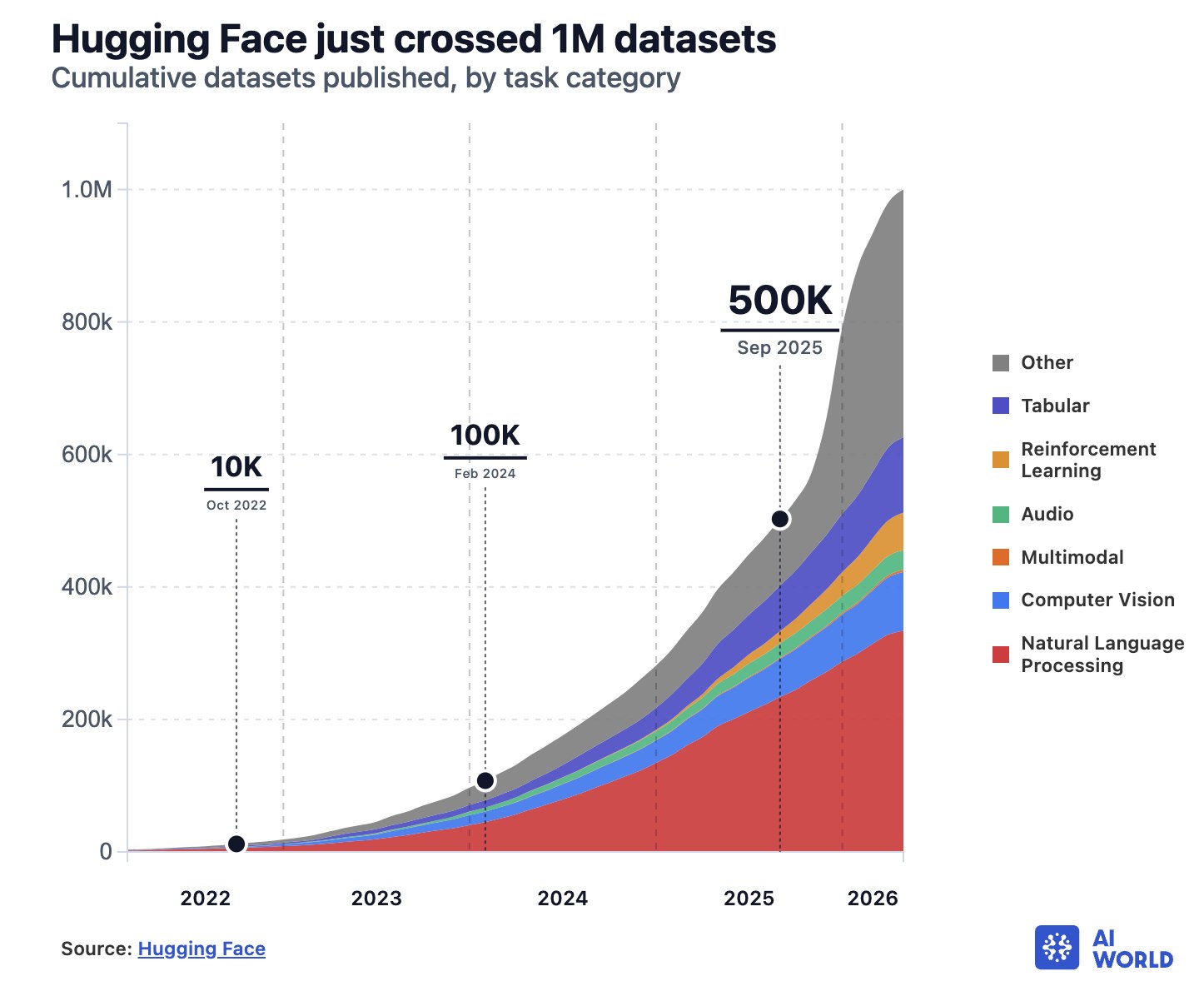
| Public model repositories | 2.43M | 2.96M | +22% |
| Datasets | 711K | 1M | +41% |
| Spaces (demo apps) | 1.00M | 1.44M | +44% |
Source: Hugging Face official documentation datasets

Half a million new models in seven months sounds astronomic — until you read the number printed beside it: 85.6% of models have fewer than 200 lifetime downloads, while just 1.5% of repositories account for 99.2% of all downloads. The ecosystem grows like a giant pyramid whose effective tip — the models people actually use — is tiny and concentrated.
Who leads the size race: China or the US?
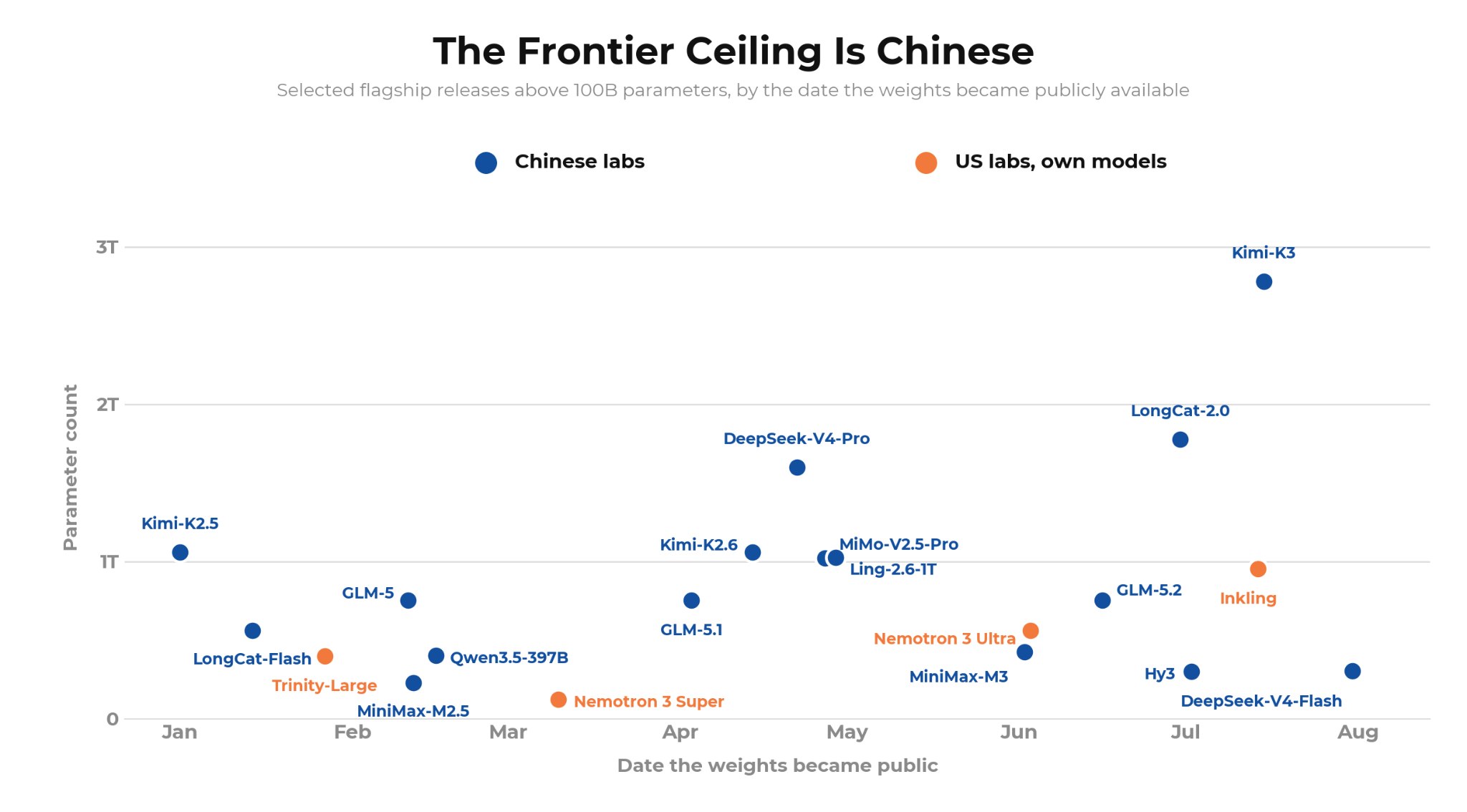
Here is the report's biggest revelation: in nearly every month of 2026, the largest open model from a Chinese lab was bigger than anything released by an American lab that month. The Chinese ceiling ran between 754 billion and 2.78 trillion parameters monthly; US releases stayed under 130 billion in five of seven months, with two exceptions — NVIDIA's Nemotron 3 Ultra at 561B (May–June) and Inkling from Thinking Machines Lab.
One distinction matters before drawing conclusions — the report splits labs into two strategies, not "good versus bad":
| Strategy | Who follows it | What it means practically |
|---|---|---|
| Frontier-only portfolio | Moonshot, MiniMax, Xiaomi, Z.ai | Publish almost nothing under 70B; a developer's first encounter is a model too large to run locally |
| Full-spectrum portfolio | Tencent, Alibaba Qwen | Cover every size from under 1B to the frontier; both phone developers and datacenter teams are served |
Behind the first camp's ability to leap to the top, the report names two enablers: building large stopped being a differentiator (Xiaomi and Meituan each cleared a trillion parameters this year, and neither was a household name in open weights twelve months ago), and the community quantization layer makes a large model runnable within days of release — a dependency we return to below.
Source: Hugging Face official documentation datasets

Did the US miss the open-source boat?
No — and the next datapoint flips the picture. The two organizations publishing the most new open models this year are American, and they are the hardware makers themselves: AMD and NVIDIA, each with more than 200 new model repositories, well ahead of third-place LiquidAI at around 100. Chip vendors realized that a model optimized for your silicon and freely available is the clearest proof the silicon works.
The report also records a finer detail: some large US releases (above 100B parameters) are built on top of Chinese models or leverage artifacts from Chinese labs — Thinking Machines' Inkling at 952B is the named example — while original large American releases include NVIDIA's Nemotron 3 Ultra (561B), Nemotron 3 Super (124B), and Arcee AI's Trinity-Large (399B). We covered the practical side of the Nemotron family in our piece on the NVIDIA Nemotron 3.5 Lightning open model for agents.
The economic translation: competition moved from "who owns the best model" to "who owns the distribution and optimization layer." The Americans play it through hardware, conversions, and quantization; the Chinese through frontier scale and full-spectrum coverage. The developer who understands both can mix them freely.
Attention is not adoption
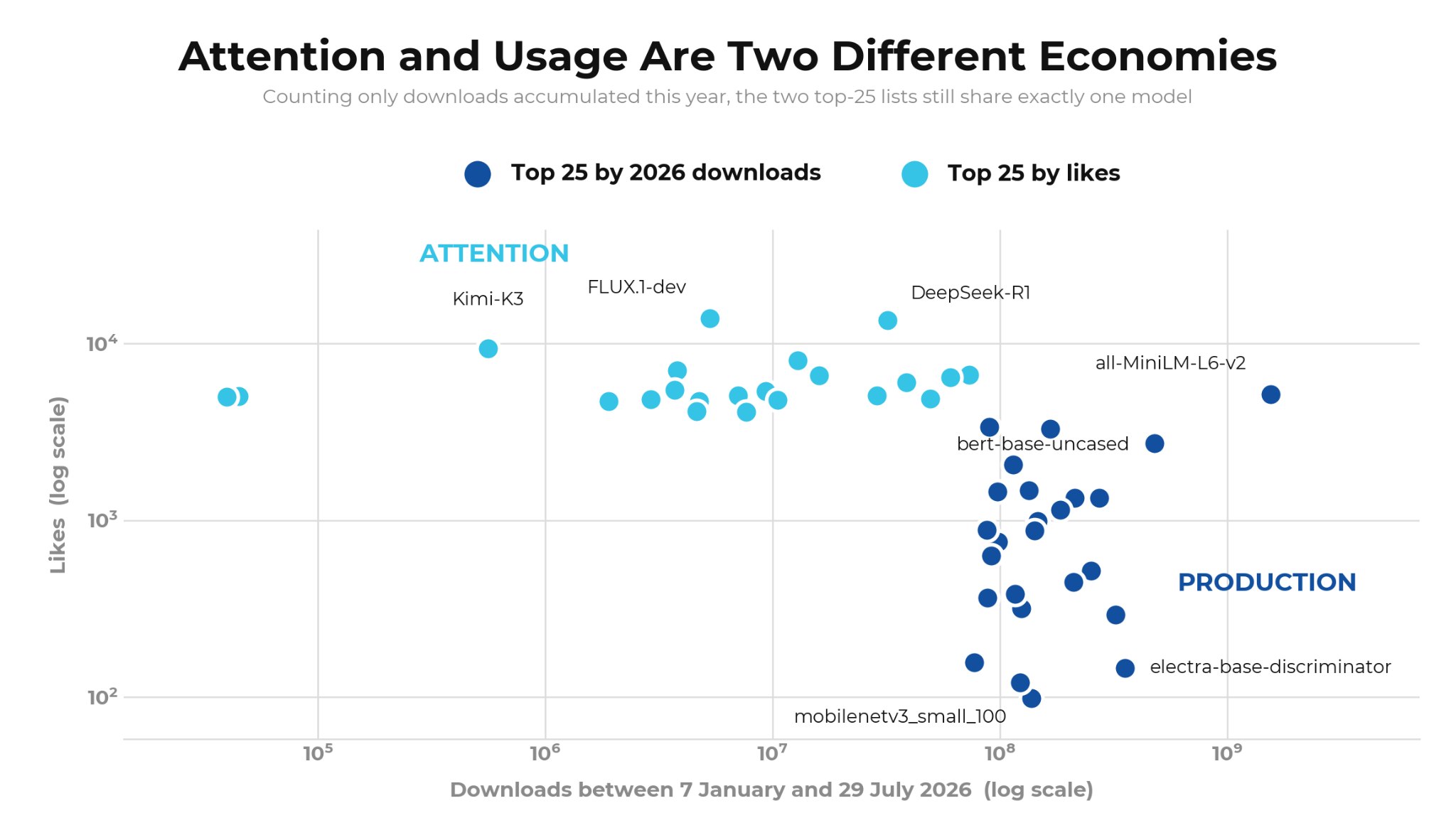
The report's most quotable finding carries its own heading: attention ≠ adoption. The researchers compared the top 25 repositories by downloads this year against the top 25 by likes, and found exactly one repository appears on both lists. A model dominating social discussion may never touch production, while a model quietly running inside thousands of apps may never trend.
Source: Hugging Face official documentation datasets

Why should you care? Because choosing a model for your project based on launch-week buzz is a costly mistake: you adopt something "hot," then discover weeks later it has no tooling ecosystem, no stable quantized builds, and thin documentation. The more honest signals: active monthly downloads, recency of updates, and a live community of derivatives (fine-tunes) — all visible on any model page on the platform.
Why Qwen became the community's base model
One of the report's structural findings: Alibaba's Qwen family has become the base layer the community builds on — the volume of derivatives and models built atop it leads the field. The logic is straightforward: Qwen is effectively the only full-spectrum portfolio from either camp, covering every size from under a billion parameters to the frontier, which makes it a safe default regardless of your deployment target. We have covered both ends of that spectrum: Qwen 3.8-Max at 2.4 trillion parameters and the open-weights Qwen3.8-27B coding model.
Small models remain the practical layer, as the report states plainly — which is where most real products live, and where a developer with a laptop or a cheap GPU instance can ship something today. The agentic layer, the report's final observation, is becoming the new front door: users increasingly meet models inside agents rather than chat windows.
What this means for you, practically
- Founders and CTOs: do not pick a model — pick a spectrum. A full-spectrum family gives you an upgrade path from a small dev-box model to a production frontier model without rewriting your stack. If you serve non-English users, test language support yourself on your real queries; general reports do not settle that question.
- Independent developers: start with a small model (under ~10B) that runs locally or on cheap compute, and scale only once the product proves itself. The community quantization layer lets you trial the giants at very low cost.
- Researchers: one million public datasets are now on the platform, and the publish-versus-use gap is a research question in itself — why does adoption concentrate on 1.5% of repositories? What separates the models that cross from fame to production?
- Investors and analysts: chip makers topping the publishing charts (AMD and NVIDIA ahead of AI labs themselves) signals where value is settling in the open stack: hardware and the optimization layer, not weights alone.
- Non-technical users: everything above means the paid tools you use daily — writing editors, coding assistants — get cheaper to run and more private (local execution) in the coming months as the free layer improves. And if you pay for multiple AI subscriptions, shared AI subscriptions in the Truescho shop can cut that bill substantially.
Quick comparison: open vs closed models in 2026
| Criterion | Open weights | Closed (API-only) |
|---|---|---|
| Access | Download and run locally or on your provider | Use via the owner's service only |
| Cost at scale | Compute costs, often no per-token fee | Per-request or subscription pricing |
| Privacy | Your data never leaves your infrastructure | Data transits third-party servers |
| Cutting edge | Usually weeks-to-months behind the frontier | Newest capabilities first |
| Customization | Full fine-tuning and quantization | Limited to what the plan allows |
The practical decision is hybrid, not tribal: many teams prototype on closed models for speed, then move stable workloads to open weights — or jump back when they need a capability today. Understanding both layers is the actual cost saver.
What the report does not tell you
- Platform figures reflect Hugging Face specifically; some open models circulate through other channels (GitHub releases, direct downloads) and are not fully counted.
- Parameter count is not quality: a huge model trained on thinner data can lose to a smaller, better-trained one. The report itself notes that a size profile is "a statement of intent rather than of capability."
- Downloads measure technical interest, not guaranteed production use; commercial API usage is a separate number entirely.
- The report does not evaluate language coverage — for anyone building outside English, that dimension requires your own testing on your own tasks.
Frequently asked questions
What are open-weight AI models?
Open-weight models publish their trained parameters publicly, so any developer can download, run, and modify them instead of only calling them through the owner's paid service. The best-known families include Qwen, Llama, Nemotron, and Mistral's open releases, most hosted on Hugging Face, the platform behind this report.
Who leads open-source AI in 2026?
By frontier size, Chinese labs: their monthly largest open model ran between 754 billion and 2.78 trillion parameters, per the report. By number of new releases, AMD and NVIDIA lead. By community adoption as a base family, Alibaba's Qwen leads, because it covers every model size from under 1B to the frontier.
Why are Chinese open models bigger than American ones?
Strategy. Labs like Moonshot, Xiaomi, and Z.ai pursue frontier-scale releases to compete on benchmarks and API demand, while the community's quantization layer makes those models runnable on smaller hardware within days. American publishers — especially chip makers — release more mid-size models optimized for their hardware instead.
What is model quantization and why does it matter?
Quantization reduces the numerical precision inside a model (say, from 16-bit to 4-bit), shrinking it so it runs on far weaker hardware with limited quality loss. It matters because it turns models that would require a datacenter into ones that run on a desktop within days of release — the enabling dependency of the whole large-open-model strategy.
How do I pick an open model for my project?
A three-step rule: first fix your compute budget (laptop? dedicated server? cloud?) since it caps model size. Second, check the model page for three signals — active recent downloads, recent updates, and a live set of community derivatives (not likes). Third, benchmark on a sample of your project's real tasks and judge quality yourself before committing.
The report's quiet thesis: the open ecosystem is no longer a poor substitute for closed frontier labs — it is a full structural layer with its own sizes, channels, and rules of thumb. Learning to read its numbers (downloads over likes, spectrum over summit, quantization over raw size) puts your technical decisions on firmer ground than launch-week noise ever will.
Sources
- Hugging Face Blog — State of Open Models: Summer 2026 Observations — the full original report with all data
- Google Official Blog — Gemini reaches 1 billion monthly users — closed-ecosystem context for the competition
- OpenAI — Advancing the price-performance frontier with GPT-5.6 — the closed-model frontier the report benchmarks against