
Sony Music and Warner Sue Anthropic: Inside the New Multi-Billion-Dollar Claude Lawsuit
At up to $150,000 per willfully infringed work, the math gets brutal fast. Multiply it by the "tens of thousands" of songs named in a complaint filed late Friday, August 28, 2026, and the ceiling of the music industry's latest case against Anthropic climbs into billions of dollars — this time with the Claude maker's own CEO named as an individual defendant. We obtained and read the full 48-page complaint so you don't have to. Last updated: August 30, 2026.
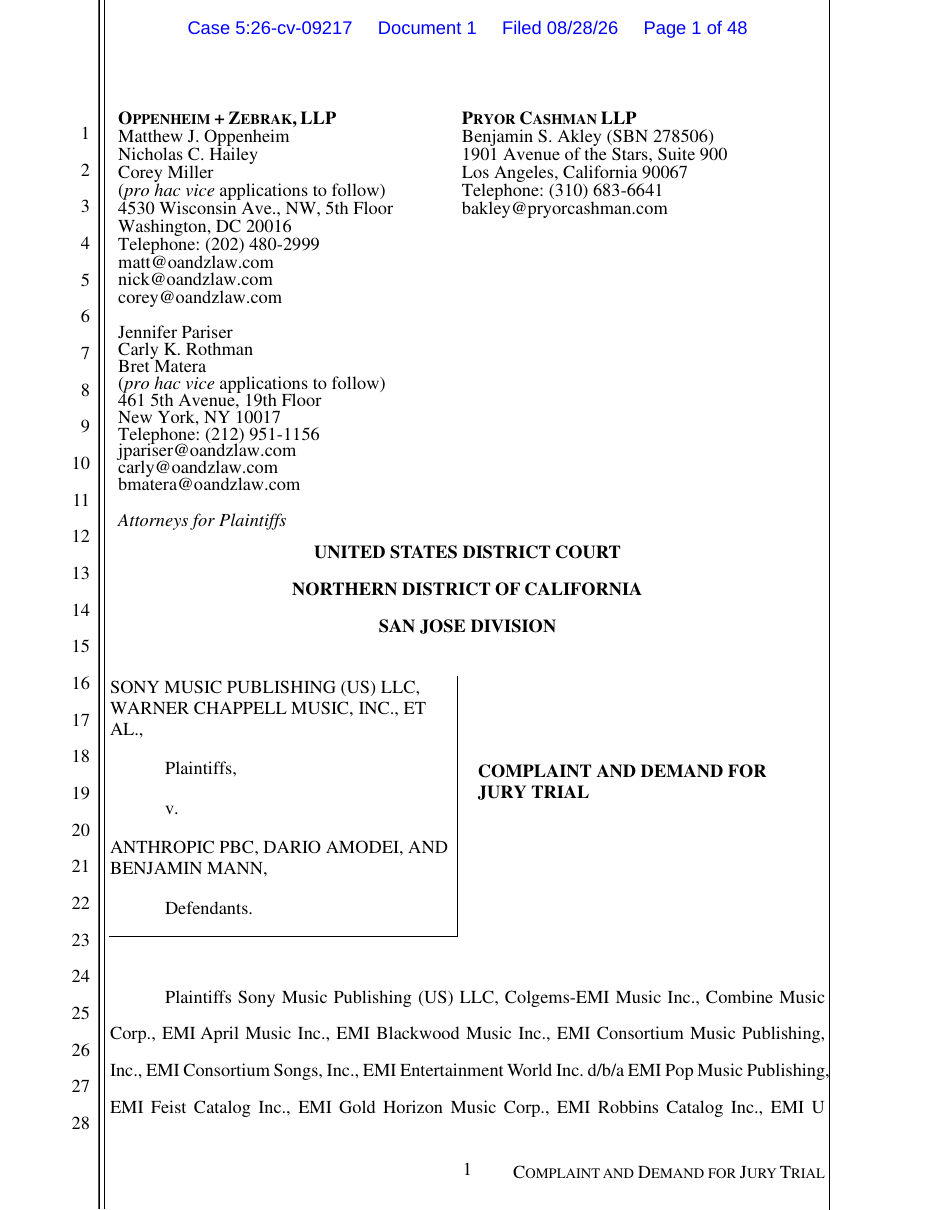
Source: Official complaint — Case 5:26-cv-09217
Who is suing whom, exactly?
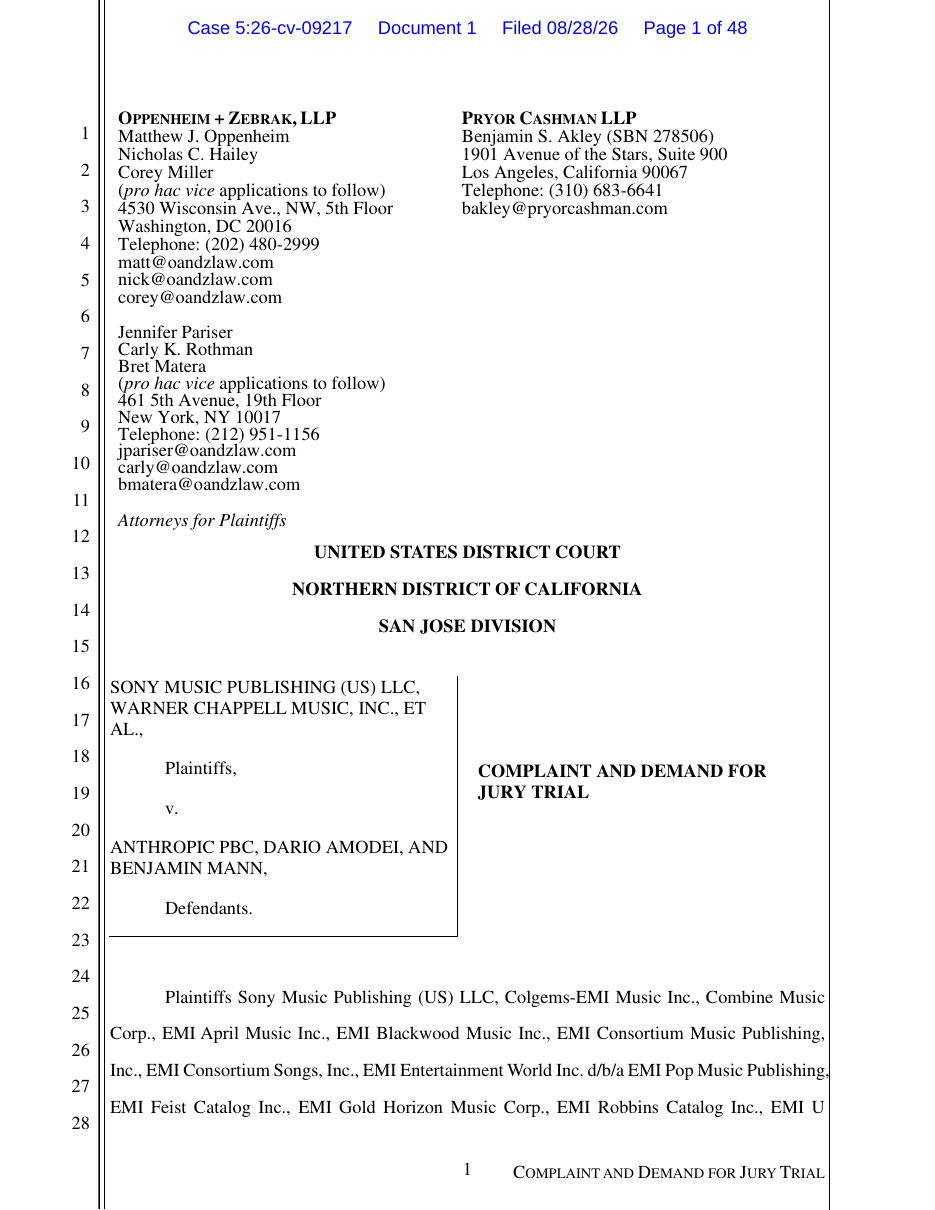
The suit was filed in the U.S. District Court for the Northern District of California, San Jose Division, under case number 5:26-cv-09217, styled as a "Complaint and Demand for Jury Trial." The plaintiffs are Sony Music Publishing (US) LLC and Warner Chappell Music, Inc. — along with a long tail of affiliated publishers including EMI April Music, Jobete Music, Famous Music, Hipgnosis Songs, and more than a dozen others.
Two details make this filing sharper than the average copyright complaint:
- The founders are named personally. Defendants are not just Anthropic PBC but also CEO Dario Amodei and co-founder Benjamin Mann as individuals — an aggressive move that puts personal legal pressure on the company's leadership.
- The accusation targets acquisition, not just output. The complaint alleges a "brazen campaign of illegally torrenting, scraping, and downloading copyrighted works" — hundreds of references to LibGen and BitTorrent tools fill the document, accusing Anthropic of obtaining millions of pirated books, including lyric and sheet-music collections, to fuel Claude's training data.

Source: Anthropic official newsroom
What the complaint actually says
Reading the filing directly, several facts stand out:
- Named songs: among the works identified are "Ain't No Mountain High Enough," Mariah Carey's "All I Want for Christmas is You," "Eye of the Tiger," "Here Comes Santa Claus," and Taylor Swift's "Paper Rings."
- Damages sought: statutory damages of up to $150,000 per willfully infringed work, plus up to $25,000 for each alleged removal of copyright management information.
- Jury demand: the publishers explicitly requested a jury trial, signaling appetite for a public fight rather than a quiet settlement.
Anthropic's response, sent to TechCrunch: "We disagree with the publishers' claims and we intend to defend ourselves robustly in court."
Why this case is different from the previous ones
This is not the industry's first rodeo with Anthropic — but it completes a pattern:
| Case | Filed | Scope | Status |
|---|---|---|---|
| UMG, Concord, ABKCO v. Anthropic | October 2023 (Nashville, later transferred to California) | ~500 songs | Ongoing |
| The same publishers' second suit | January 2026 | 20,000+ works, $3B+ sought | Ongoing |
| BMG v. Anthropic | March 2026 | 493 compositions | Ongoing |
| Round Hill Music v. Anthropic | August 17, 2026 | — | Ongoing |
| Sony Music Publishing & Warner Chappell v. Anthropic | August 28, 2026 | Tens of thousands of works | New |
The strategic foundation is the Bartz v. Anthropic ruling, which ended in a $1.5 billion judgment against the company. In Bartz, the court drew a line that now defines this whole legal frontier: training AI models on copyrighted works can be lawful, but acquiring that content through piracy is not. The new complaint is built directly on that line — its core theory is about torrented and pirated acquisition, not about what Claude says when you ask it for lyrics.
What happens next in court
Expect a procedural rhythm familiar from the earlier cases. Anthropic will file a response within weeks, the court will set a schedule, and then comes discovery — the phase the publishers clearly want. Discovery is where internal documents about training-data sourcing, download tooling, and vendor decisions surface, and it is where Bartz became painful for Anthropic.
A wildcard is settlement. Tech and content industries have repeatedly converted lawsuits into licensing partnerships once the economics became clear. But the personal naming of founders and the jury demand both point the other way: toward a long fight.
What this means if you use Claude professionally
- No service disruption is on the table. Nothing in the complaint asks to halt Claude, and nothing changes for subscribers in the near term.
- Pricing pressure is the real long-term story. Legal risk of this scale becomes a line item in any AI lab's model, and licensing costs — from settlements or deals — tend to reach subscription prices eventually.
- For publishers and writers anywhere, this case is shaping how content gets licensed for AI training. If you publish protected work, the outcome will inform what your leverage looks like when AI companies come calling.
- For organizations choosing AI vendors, it reinforces a trend: regulatory and legal exposure of the model provider is now part of procurement risk. That is one reason open-weights models you can host yourself keep gaining ground — see our coverage of Anthropic's own open-weights position and the GLM-5.3 full weights release.
Honest limitations of this reporting
- Everything above the allegations line is drawn from the official complaint and major-outlet coverage; the claims are unproven and Anthropic denies them.
- Copyright litigation of this scale routinely takes years to resolve.
- The complaint's damage figures are maximums sought, not amounts awarded.
FAQ
What is the Sony and Warner lawsuit against Anthropic about?
Sony Music Publishing and Warner Chappell accuse Anthropic and its founders of mass pirating books, lyrics, and sheet music via torrenting and sites like LibGen to train Claude, seeking up to $150,000 per willfully infringed work.
How much money is at stake in the case?
With tens of thousands of works covered at up to $150,000 each, plus $25,000 per copyright-management violation, the theoretical exposure runs into billions of dollars.
Will Claude be shut down because of this?
No. The complaint seeks damages, not a shutdown, and no court order affects Claude's availability or pricing today.
How is this different from the 2023 music lawsuits against Anthropic?
The earlier suits focused on Claude reproducing lyrics; this one attacks how Anthropic allegedly obtained training data in the first place, building on the Bartz ruling that pirated acquisition is illegal even when training on copyrighted works is not.
Why are Anthropic's founders personally named?
The publishers' strategy holds leadership directly responsible for data-acquisition decisions, increasing legal and settlement pressure on the company.
Sources
- Official complaint, Case 5:26-cv-09217 (PDF)
- Music Business Worldwide: Sony Music Publishing and Warner Chappell sue Anthropic
- TechCrunch: Sony Music, Warner sue Anthropic
For the wider legal picture around Anthropic, read our coverage of the US court ruling against the Pentagon's Anthropic label and the Hugging Face incident report.