
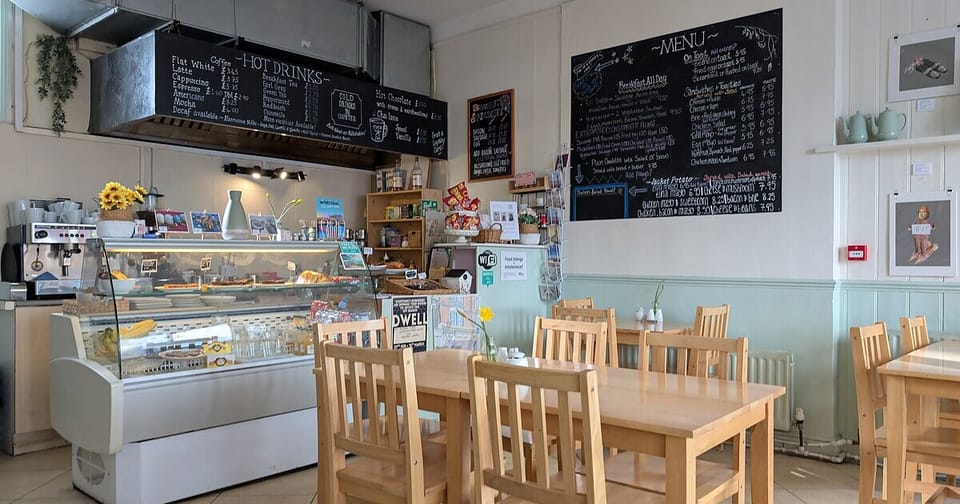
Meet Raffle: The Cafe Behind This Example
Yara and Saeed signed the lease on a 45-square-meter corner shop in a middle-class Cairo neighborhood, shook hands, and then did what most first-time founders do: nothing. For three weeks they talked about the cafe they would open — they even named it, Raffle — without writing a single page. The moment that changed the project was not the lease. It was the evening they sat down and wrote the business plan, section by section, and discovered that their dream had a shape, a cost, and a break-even point.
This article is that plan, written out in full. You will follow Raffle through all nine sections a funder expects — executive summary, problem and solution, market, competitors, marketing, operations, team, three-year financial projections, and the funding request — with numbers in every section. The line items for equipping a small cafe in Egypt are anchored to published market research, and every other figure is a clearly labeled illustrative assumption you can replace with your own.
Why write one at all? The U.S. Small Business Administration, whose official "plan your business" pages walk founders through exactly this process, published a short official video titled "The Essence of a Business Plan and Why You Need One" — its core message is that the plan is how you test the idea on paper before you pay for it in the real world. And a 2025 University of Kyoto literature review cited by Shopify found that companies with structured plans achieve higher survival rates — while, interestingly, spending more than three months polishing a formal plan was associated with lower survival. The lesson: write a real plan, in weeks, not a perfect one in seasons.
One practical size note before you start: experienced guides suggest a finished plan of 20 to 30 pages, with a maximum of about 10 pages of appendices. Raffle's fits in 24.
Sections 1 to 4: Summary, Problem, Market, and Competitors
Section 1: The Executive Summary
The executive summary is the one page every reader sees, and for some, the only page. An experienced angel investor writing on the SBA's official blog described rejecting many pitches from the summary alone — before ever reading a full plan. Raffle's summary reads:
"Raffle is a 28-seat specialty coffee shop opening in a middle-class Cairo neighborhood, serving espresso-based drinks, fresh juice, and light pastry to office workers and university students. The cafe requires 100,000 EGP to open and expects to reach monthly revenue of 37,800 EGP in its first year, rising to 48,600 EGP by year three, with net profit growing from about 4,200 to 10,700 EGP per month over the same period. Founded by Yara (operations) and Saeed (finance), Raffle breaks even in month 18 on the founders' illustrative model. We are seeking 40,000 EGP in partner capital; the founders invest 60,000 EGP."
Write this section last, put it first, and keep it to one page: what you sell, to whom, what it costs to open, what you project to earn, and what you are asking for.
Section 2: The Problem and the Solution
Funders fund problems, not products. State the problem in the customer's life, then the solution in one sentence each.
Raffle's version: the neighborhood has three crowded, aging cafes with slow service and inconsistent coffee quality, and nothing within a 10-minute walk offers a quick, reliable specialty option for people who have 20 minutes between meetings. Raffle's solution is a focused menu of about a dozen drinks, prepared on quick-service equipment, with average service time under four minutes.
The discipline of this section is refusing to solve everything. A cafe that promises great coffee, co-working, events, and delivery on day one convinces a funder of nothing. One sharp problem, one sharp solution.
Section 3: The Market
Here you size the demand and prove it exists. Raffle's plan keeps it honest and countable: an estimated 6,000 people pass the corner daily (illustrative assumption based on two one-hour counts at morning and evening peak); the shop sits between a university gate and an office cluster; published market research on opening a cafe in Egypt puts the total opening cost at roughly 50,000 EGP in a village setting, 100,000 EGP in a popular neighborhood, and up to 500,000 EGP in an upscale area — which both validates Raffle's 100,000 EGP budget for its segment and shows the founders they are not overbuilding.
Wait — before any number goes in your plan, check it the way a funder would. In Raffle's case the market section answers three questions: who is the customer (office workers and students), how many are reachable (the passing-traffic estimate, its counting method stated), and what they currently pay (the 15-to-25 EGP typical spend at nearby cafes, an illustrative local observation). Every market claim in your plan should name its source or its counting method — this is exactly the kind of proof of market that official SBA guidance says some funding requires.
Section 4: The Competitors
Name them. All of them. Then say, in one line each, what they do better than you — and what you do better than them. Raffle's table lists three nearby cafes plus the university canteen, with columns for seating, price range, speed, and coffee quality. The honest line in Raffle's plan: "Cafe B has the best location and the loyal morning crowd; Raffle does not try to win at 8 a.m. It wins the 10 a.m. meeting break and the 4 p.m. student hour."
A plan without a competitor section tells a funder one of two things: you did not look, or you are afraid of what you would find. Both are rejection reasons — keep that list for later, it gets worse.
Sections 5 to 7: Marketing, Operations, and Team
Section 5: The Marketing Plan
Marketing is where a plan usually turns vague ("we will use social media"). Vague is un-fundable. Raffle's marketing section commits to channels, costs, and a measurable first-quarter target:
- Opening: 5,000 flyers in the two nearest office buildings and the university gate, plus a loyalty card (buy 9, the 10th is free) — cost inside the 1,000 EGP launch budget line
- Always-on: an active Google Maps profile with photos and review replies, and a WhatsApp number printed on every cup for orders — because in this market the order arrives by chat — and if you scale that channel later, we break down WhatsApp Business per-message pricing separately
- Measurable target: 300 loyalty-card sign-ups in the first 90 days (illustrative)
Note what the section does: each activity has a cost line, a channel, and a number that can be checked in three months. That is the difference between a marketing plan and a marketing wish.
Section 6: The Operations Plan
Operations answers: what does it take to open, and what does each month cost to run? This is where Raffle's plan gets its backbone — the startup budget, built line by line from published Egyptian market research for small cafes:
| Startup item | Cost (EGP) | Source of the figure |
|---|---|---|
| Equipment and interior fit-out | 32,000 | Market research: 25,000-35,000 range |
| Chairs (28 seats) | 7,000 | Market research: 4,000-10,000 for 25-30 chairs |
| Tables (10) | 7,000 | Market research: 5,000-10,000 |
| Display screens | 2,500 | Market research: from 2,500 |
| Quick-service coffee machine | 2,500 | Market research: from 2,500 |
| Blender | 1,500 | Market research: from 1,500 |
| Cups and serving tools | 6,000 | Market research: 5,000-10,000 |
| Small fruit refrigerator | 5,500 | Market research: from 5,500 |
| Electric orange juicer | 1,500 | Market research: from 1,500 |
| Rent deposit and 3 months' advance | 27,000 | 9,000/month within the 8,000-10,000 range |
| Licenses and opening extras | 7,500 | Illustrative assumption |
| Total to open | 100,000 | Matches the published popular-area figure |
The monthly running side names the fixed costs that survive whether or not a single customer walks in: rent of 9,000 EGP, two staff at about 2,750 EGP each (market research cites 2,500-3,000 per worker), coffee beans at roughly 1,000 EGP per 10 kg, flavorings at roughly 1,200 EGP per 10 kg, and about 1,800 EGP for utilities and consumables (illustrative). Total fixed operations: 18,500 EGP per month. That single number is the cafe's heartbeat — it is what Raffle must earn before its first pound of profit.
Section 7: The Team
Funders back people, and — as we noted — plans that skip this section get rejected. Raffle's is honest and short: Yara ran the floor of a 40-seat cafe for three years and handles operations and suppliers; Saeed is an accountant by training and owns the numbers, the cash book, and the supplier payment calendar; a part-time barista completes the opening team. Each named role carries one concrete responsibility, and the plan states who is accountable if the coffee machine breaks on a Friday.
Section 8: The Three-Year Financial Projections
Everything before this section was narrative; this is the part a funder reads with a calculator. Two documents work in tandem here: a feasibility study proves the idea deserves to exist, while the business plan explains how you will run it — if you have not stress-tested the idea itself yet, our fully worked feasibility example walks through costs, break-even, and payback with the same discipline.
Raffle's projections rest on four illustrative assumptions, stated openly so any reader can swap in their own: an average ticket of 18 EGP, a 30-day month, variable costs (milk, cups, pastry, packaging) at 40 percent of revenue, and the 18,500 EGP fixed base from Section 6.
| Projection line | Year 1 | Year 2 | Year 3 |
|---|---|---|---|
| Average tickets per day | 70 | 85 | 90 |
| Monthly revenue (EGP) | 37,800 | 45,900 | 48,600 |
| Variable costs, 40% (EGP) | 15,120 | 18,360 | 19,440 |
| Fixed costs (EGP) | 18,500 | 18,500 | 18,500 |
| Net profit per month (EGP) | 4,180 | 9,040 | 10,660 |
| Net profit per year (EGP) | 50,160 | 108,480 | 127,920 |
Three-year cumulative net profit: 286,560 EGP. On these illustrative assumptions, the 100,000 EGP invested to open is recovered around month 18 — the first year builds the habit, the second year pays back the investment. Also budget the quiet costs of staying organized: accounting software — we track the recent QuickBooks price increases — and bookkeeping time — messy books have sunk more small cafes than bad coffee.
If building these projections and drafting all nine sections is the step where you would rather have professional hands on the keyboard, Truescho's business plan writing service writes the plan from your information: a €89 package for up to 15 pages within 5 days, or €159 for a plan plus a 12-slide pitch deck within 7 days, including an introductory session, a business model canvas, simplified two-year financial projections, Word and PDF delivery, and revisions per package. The team writes from your information and does not invent numbers or customers, and the service does not include a detailed three-year feasibility study or finding investors.
Section 9: The Funding Request
State the amount, the use, and the terms in one page. Raffle asks for exactly what the startup table totals: 100,000 EGP, of which the founders invest 60,000 EGP from savings and seek 40,000 EGP in partner capital. The use of funds mirrors Section 6 precisely — about 65,500 EGP for equipment and fit-out, 27,000 EGP for the rent deposit and advance, 7,500 EGP for licenses, launch marketing, and opening buffer — because a funder will check the funding request against the startup budget line by line, and any mismatch reads as carelessness at best.
The terms paragraph is deliberately simple: the partner's share of profits and exit conditions are set by written agreement before any money moves, and the founders retain operating control. Notice what the section never does: it never promises a guaranteed return. Funders distrust guarantees; they respect plans whose numbers they can retrace.
What the Bank Asks For vs What an Investor Asks For
Raffle's request targeted a partner. Yours might target a bank's business desk or an angel investor — and the two readers want almost opposite documents. The U.S. Small Business Administration's own guidance notes that some funding requires documented proof of market, and an experienced angel writing on the SBA blog described rejecting pitches from the executive summary alone. Here is how the two audiences differ:
| What they want to know | The bank asks for | The investor asks for |
|---|---|---|
| Core question | Can this business cover its costs reliably? | How big can this become? |
| Financial evidence | Realistic cash-flow projections tied to the startup budget | Three-year growth projections with best and worst cases |
| Market proof | Evidence the demand exists in the service area | Traction: early sales, waitlists, signed letters of intent |
| Security and return | Collateral and the owner's credit history | An equity stake and a credible exit path |
| Lead document | The full plan plus business registration papers | A sharp pitch deck riding on a one-page summary |
| Team focus | The owner's stability and repayment track record | The founders' ability to execute and scale |

Image: U.S. Small Business Administration
The practical takeaway: build one master plan, then produce two front doors. The bank version leads with cash flow and steadiness; the investor version leads with growth and the summary. Sending the same cover page to both is how good projects get forgettable responses.
The Mistakes That Get Business Plans Rejected
Collect the rejection reasons before a funder collects them for you. These are the recurring ones:
- A vague executive summary. The angel on the SBA blog rejects many plans from the summary alone — if page one says nothing countable, page forty is never read.
- No proof of market. "The market is huge" is not market evidence. Name the counting method, the passing traffic, the survey, the comparable business.
- Numbers that do not talk to each other. The funding request must equal the startup budget; the revenue assumptions must drive the projections. One orphan number anywhere and the whole plan becomes suspect.
- A missing or decorative team section. Funders read people before pages. No named responsibilities, no fundable plan.
- Ignoring the competition. Claiming "we have no competitors" means you have not looked. Name them and concede one thing they do better.
- Polishing forever instead of opening. The Kyoto-cited research associated spending more than three months on a formal plan with lower survival — at some point, the plan must collide with real customers.
- Sending the wrong version to the reader. A growth story to a bank, or a collateral story to an investor, reads as not understanding your own audience.
Conclusion
A ready-made small business plan is not a document you download; it is a decision you make on paper before you make it on lease. Raffle's nine sections took Yara and Saeed three weekends and roughly 24 pages: a one-page summary written last, a problem worth solving, a market counted rather than guessed, competitors named, marketing with numbers, operations priced line by line, a team with responsibilities, projections an accountant can retrace, and a funding request that matches the budget to the pound. Copy the structure, replace every illustrative number with your own counted ones, and keep the whole thing under 30 pages — then let the real world start grading it.
Want someone to handle this step for you?
If drafting the nine sections and the two-year numbers is where you want professional help, Truescho's business plan writing service writes your plan from your information, from €89 with Word and PDF delivery. Your numbers and your market stay yours — nothing is invented.
Frequently Asked Questions
How do you write a business plan for a small business?
Use the nine sections funders expect: executive summary, problem and solution, market, competitors, marketing, operations, team, three-year financial projections, and the funding request. Fill every section with numbers — a startup budget, a fixed-cost base, revenue assumptions — and write the one-page executive summary last, once the rest is final.
How do you write a business plan step by step?
Start with your assumptions (average ticket, volume, variable costs), build the startup budget and monthly fixed costs from them, let those numbers drive the projections, then draft the narrative sections around the numbers, and finish with the executive summary. Check the result against a rejection-mistakes list before anyone else sees it.
What does a bank look for in a business plan?
Banks look for reliable cash flow more than explosive growth: realistic projections tied to the startup budget, documented proof that demand exists, business registration papers, and the owner's credit and repayment history. Official guidance notes that some funding requires market proof, so evidence beats enthusiasm.
What is the right format for a small business plan?
Aim for 20 to 30 pages plus at most about 10 pages of appendices, organized into the nine standard sections. Deliver it as a clean Word or PDF document; official and free templates exist, including Shopify's downloadable template and the Word template published by Jordan's Tamweeli platform.
How much does it cost to have a business plan written for you?
Market figures for outsourcing a plan range from about 500 to 1,000 US dollars for a small project up to around 5,000 dollars for a larger, more complex one. The cheaper alternative — writing it yourself from a worked example like the one above — costs a few weekends and produces a plan you understand deeply enough to defend.
Do I need a business plan for a very small business?
Yes, though it can be short. Surveys reported in SBA workshop guidance suggest roughly 20 to 30 percent of owners keep a lean, regularly revised plan instead of a long formal one. Even one page that states the problem, the customer, the costs, and the break-even point will catch fatal math before the lease does.
What happens if you start a business without a plan?
You make your most expensive mistakes with real money instead of paper. Research cited by Shopify associates structured plans with higher survival rates, and the SBA's own framing is blunt: the plan is how you test the idea before you pay for it. Without one, pricing, staffing, and even location choices rest on optimism.
Sources
- U.S. Small Business Administration — Plan Your Business (official guidance): https://www.sba.gov/counseling/plan-your-business/
- U.S. Small Business Administration — 8 Business Plan Myths (official blog): https://www.sba.gov/blog/2018/2018-03/8-business-plan-myths-can-hurt-your-business/
- U.S. Small Business Administration — The Essence of a Business Plan (official video): https://www.youtube.com/watch?v=Wtf9HOX9yxM
- Shopify — Business Plan Template (includes the Kyoto-cited survival research): https://www.shopify.com/blog/business-plan-template
- Tamweeli (Jordan) — official downloadable business plan template (Word): https://tamweeli.jo/wp-content/uploads/2020/09/Advance-Business-Plan-Template.docx
- Tiqnea — cafe feasibility study with Egyptian market cost ranges: https://tiqnea.com/دراسة-جدوى-مشروع-كافيه-في-مصر/