
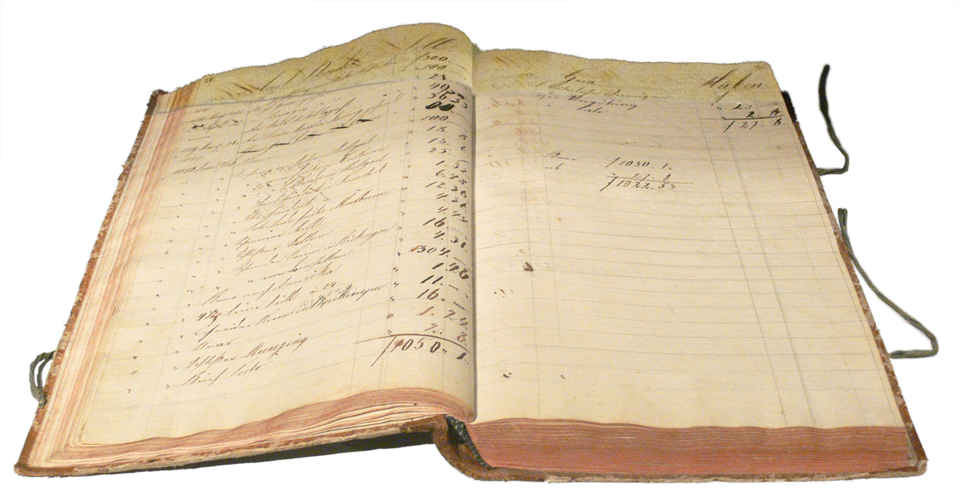
Three months after opening a small perfume shop, its owner sat down in front of a torn bag of receipts to calculate his profit, and discovered he could not answer three simple questions: how much inventory had he actually purchased? How much had he sold on credit and not yet collected? How much cash had left the drawer for household expenses? This is not a story told by owners of large companies; it is the first year of every small business that does not start bookkeeping in its first week. This guide skips the theory and builds the system with you: the four ledgers every small business needs, a table showing when each one becomes mandatory, a ready journal template with ten real entries for a retail shop, and a weekly and monthly routine of 8 steps that one person finishes in under an hour per week.
What Is Bookkeeping? The Definition Worth Memorizing
Bookkeeping is the recording of every financial transaction of a business — purchases, sales, receipts, and payments — at the moment it happens and in chronological order. The definition is that simple, but its consequences go far beyond record-keeping: an organized ledger is what makes the question "am I actually profitable?" answerable with a number instead of a feeling. It is also what protects you in any dispute with a supplier, a customer, or a tax authority, because a document recorded with its date is evidence you cannot buy retroactively.
The definition used by the English-language reference on the subject describes bookkeeping precisely as "the recording of financial transactions," a record that exists to serve everything after it: preparing financial statements, calculating taxes, and measuring performance. It is important to separate bookkeeping from accounting itself: bookkeeping is the first layer (organized recording), while accounting is a higher layer that analyzes what you recorded and turns it into decisions and filings. Without the first layer the second collapses, which is why the first accounting investment in your business is not an accountant — it is an organized ledger.

The double-entry system every company uses today was described in 1494 by the Italian friar Luca Pacioli in his book on mathematics and commerce, earning him the title "Father of Accounting." The idea he handed down more than 500 years ago is simple: every transaction changes at least two different ledger accounts, a debit side and a credit side, and total debits always equal total credits. That equality is not decoration — it is an error-detection machine. If the two sides do not match, some entry was recorded incomplete or duplicated.
Single-Entry or Double-Entry? The Decision That Shapes Your Ledgers
There are two paths at the start. Single-entry bookkeeping resembles a personal checkbook: you record money in and money out in two columns, and it suits a solo business with no inventory and no credit sales — but it will never show you who owes you money or whom you owe. Double-entry bookkeeping is the method in which every transaction or event changes at least two different ledger accounts, giving you the complete picture: assets, liabilities, equity, income, and expenses. The practical recommendation for any shop or online store that sells on credit and carries inventory: start with double-entry from day one, even in a simple spreadsheet, because migrating to it later means re-recording entire months of history.
The difference between the two paths is not academic. A single-entry owner knows only the cash balance, while a double-entry owner additionally knows the value of inventory, accounts receivable (what customers owe you), accounts payable (what you owe suppliers), and the profit of each month separately. These are exactly the numbers any bank or investor will ask for later, as we explained in our ready small business plan example, and the same numbers you need to update the cost tables of your feasibility study with real operating figures.
The Four Core Ledgers: A Table Defining When Each Is Required
Practical knowledge starts with knowing which ledger serves which need. The table below summarizes the core ledgers of any small retail business, the purpose of each, and when it stops being optional and becomes mandatory:
| Ledger | What it records | When you need it | Example entry |
|---|---|---|---|
| The journal (daily book) | Every financial transaction in date order with date, description, and amount | From the business's very first transaction; it is the backbone | Cash sale of goods for 500 riyals on March 3 |
| The general ledger | Journal entries posted to each party's own account (cash account, supplier account, sales account) | From the end of week one, so every account knows its standalone balance | "Supplier S" account sums all purchases and deducts payments |
| The cash book (and bank) | Every cash movement in and out, with voucher reference | From opening day, to protect cash from leakage | Paying 200 riyals market rent in cash by voucher |
| The inventory book | Everything entering and leaving stock, by quantity and cost | With the first shipment of goods; it is the difference between real and imaginary profit | Receiving 40 perfume bottles, selling 12 |
Supporting daybooks make the work lighter: a sales daybook, a purchases daybook, and a cash book, each described in the reference literature as a "descriptive and chronological (diary-like) record," whose totals are then posted to the ledgers in a process called posting. At month-end, three ledgers matter to you in practice: the sales ledger (customers' receivables), the purchase ledger (suppliers' payables), and the general ledger where the remaining accounts live — assets, liabilities, equity, income, and expenses.
A Ready Journal Template: 10 Complete Entries for a Retail Shop
This is the section that saves you weeks of trial and error. Imagine a small perfume shop, "Abeq," that started the month with 10,000 riyals in cash and bought its opening stock with it. Here are ten entries from its first month as they would be recorded in a double-entry journal (debit/credit):
| # | Date | Description | Debit account | Credit account | Amount |
|---|---|---|---|---|---|
| 1 | 3/1 | Opening stock purchase, cash | Inventory | Cash | 6,000 |
| 2 | 3/3 | Opening-week cash sales | Cash | Sales | 2,750 |
| 3 | 3/5 | Credit sale to a gift office | Accounts receivable | Sales | 900 |
| 4 | 3/8 | Collecting half the gift office's debt | Cash | Accounts receivable | 450 |
| 5 | 3/10 | Monthly shop rent | Rent expense | Cash | 1,500 |
| 6 | 3/12 | Electricity and water bill | Utilities expense | Cash | 230 |
| 7 | 3/15 | Shop assistant salary | Salaries expense | Cash | 1,800 |
| 8 | 3/18 | Display and cooling unit purchase (asset) | Shop equipment | Cash | 1,200 |
| 9 | 3/22 | Customer returns two bottles | Sales returns | Accounts receivable | 140 |
| 10 | 3/28 | Owner's personal withdrawal | Owner drawings | Cash | 700 |
Notice the logic governing the entire table: cash coming in debits the cash account, cash going out credits it, a credit sale creates an asset at the customer rather than cash in the drawer, a personal withdrawal is not a business expense but a reduction of the owner's equity, and buying equipment is an asset serving years — not one month's expense. If you understand these ten entries, you understand 80% of the daily bookkeeping of any retail shop. Copy the table into a spreadsheet, add a serial-number column and a voucher or invoice reference column, and you have a working journal template ready for immediate use.
From Journal to Ledger: Posting Step by Step
After recording entries in the journal comes posting: transferring each entry to the relevant account in the ledger. In our example you open an account called "Cash": debit side 2,750 + 450 (entries 2 and 4), credit side 6,000 + 1,500 + 230 + 1,800 + 1,200 + 700 (entries 1, 5, 6, 7, 8, 10), leaving a debit balance of 10,000 + 3,200 − 11,430 = 1,770 riyals available in cash. You open a "Sales" account and see a credit balance of 3,650 (2,750 + 900), reduced by returns of 140. Every party now holds its own balance, which at month-end lets you prepare a simple statement: revenue 3,510, estimated cost of goods sold, expenses 3,530 — the first real profit picture of your business.
Manual posting in a spreadsheet takes minutes a week if you keep the routine, and this is where procrastination becomes dangerous: two weeks of deferred entries turn into a full-day session full of gaps and guesses. The golden rule: never enter the weekend with the week's entries unposted. A field-tested executive tip: give every entry a paper or digital reference (invoice or voucher number), because an entry without a reference cannot survive any later audit — the reference is what turns your ledger from a personal memo into a complete systematic record accepted by any official or banking party.
The Weekly and Monthly Routine: 8 Steps You Never Skip
A system that does not become a routine dies in month two. These eight steps are deliberately ordered from weekly to monthly, and one person completes them in 45 minutes weekly and 90 minutes monthly:
- Flexible daily capture: keep a small box for receipts and vouchers, and never let a paper enter the drawer before copying it into the month folder. Recording itself can happen twice a week; papers must never get lost.
- A fixed weekly posting slot: every Thursday, for example, record and post the week's entries completely, and verify debits equal credits before closing.
- Surprise cash count: once a week, physically count the cash and compare it to the ledger's cash account balance; any gap is caught immediately with a shortage or surplus voucher.
- Bank reconciliation (if the business has a bank account): compare the bank statement with your entries and record the bank fees everyone forgets.
- Monthly inventory count: physically count remaining quantities per item and compare with the book; the difference is either theft, damage, or a recording error — finding the cause early protects your margin.
- Monthly customer and supplier statements: send a statement to every customer with a balance, and review supplier balances before making any new payment.
- A mini monthly close: build the month's revenue and expense table, compute approximate profit, and compare with last month to read the trend, not just the number.
- Digital archiving: photograph the month's receipts into a PDF folder named by month; any tax or funding request will demand vouchers, not memory.
An honest note: steps five and six are the ones most small businesses skip, and they are precisely the two that protect you from silent losses — stock that disappears and money sitting at customers nobody chases.
Closing the Month with Real Numbers: A Full Exercise on Abeq's Entries
To see how the ten entries above turn into an understandable result, let us close March for the "Abeq" shop in front of you. Opening balance was 10,000 riyals in cash. From the journal we extract account balances: Cash debited 3,200 (2,750 + 450) and credited 11,430 (6,000 + 1,500 + 230 + 1,800 + 1,200 + 700), leaving 1,770 riyals. Sales credited 3,650 and returns 140, so net revenue is 3,510. Accounts receivable: debit 900, credits 450 + 140 = 590, leaving 310 riyals still owed by the gift office. Inventory: purchases of 6,000; suppose the month-end count shows remaining stock costing 5,100, so cost of goods sold is 900.
Now assemble the mini statement: net revenue 3,510, minus cost of goods sold 900, minus rent 1,500, utilities 230, and salaries 1,800 — the result is an operating profit of just 80 riyals. Notice what the ledger revealed even though the drawer looked full all month: profit is nearly zero because salary and rent consume the margin, and the 700 personal drawing, if repeated, turns the month into an actual cash loss. That specific piece of information — a profit of 80, not a feeling that the month was "great" — is the difference between a business run on numbers and a business run on mood, and it appears only for those who keep books current. Repeat this exercise on your own data at month-end: pull cash, receivables, and inventory balances, compute profit with the same formula, then ask yourself only two questions: which expense can be squeezed, and which product line deserves expansion? One simple monthly table like this replaces expensive consulting, and with months of practice it gives you comparison power: March profit against April, this quarter's margin against last — the seed of the dashboards you will graduate to as your numbers grow.
The Five Mistakes a Ledger Review Exposes in Small Businesses
The weekly review is not a punishment but a magnifying lens on mistakes that repeat even in committed businesses:
- Mixing personal and business cash: unrecorded personal withdrawals are the number one error worldwide; the fix is a clear monthly drawings entry no matter how small, because a business that does not know what its owner took never knows its true profit.
- Recording revenue at collection instead of at sale: a credit sale is earned revenue and an asset at the customer; deferring it makes one month look weak for no reason and the next strong for no reason, and loses the debt from your tracking.
- Ignoring small expenses: coffee runs, delivery fees, and payment-platform charges look marginal until the month-end total shows a line item five times what you expected; record them daily in a "petty expenses" category.
- Not recording returns: returned goods that go unrecorded are sold twice on paper or vanish from physical stock while still counted as sold; precise return entries preserve both inventory cost and customer balances.
- Buying assets as expenses: a 1,200-riyal cooling unit is not March's expense but an asset serving years; loading it onto one month creates an imaginary loss, and spreading its cost over its life (depreciation) shows realistic profit.
Catching any of these five early costs minutes; catching them late — usually at the first tax audit or funding request — costs weeks of reconstruction and sometimes fines or lost trust.
When Does a Spreadsheet Suffice, and When Do You Need an Accountant?
The honest answer is graduated. If your volume is under 100 entries per month, you sell little on credit, and you have no employees, a spreadsheet with the eight-step routine is enough and costs you only time. But once your entries exceed that volume, or you carry receivables and payables worth tracking monthly, or a monthly profit-and-loss report becomes a real input to purchasing and hiring decisions, you have reached the "needs an accountant instead of a ledger" stage — and there is a practical middle option between costly hiring and self-discipline: Truescho's online bookkeeping service, which offers a 49-euro plan for up to 100 monthly entries and a 99-euro plan for up to 300 monthly entries with receivables and payables tracking and a monthly profit-and-loss report delivered within 7 days of month-end, working from your Excel file or your existing accounting software. The service excludes tax return preparation, audit signature, and payroll, because those are licensed specialist work — and this clarity of boundaries is what makes the comparison fair.
The signal telling you that you have reached this stage is not the number of years but three symptoms: you hesitate before every purchase decision because you do not know your real balance; month-close becomes a perpetually postponed project; and deferred credit invoices surprise you at payment time. At the first of these three, decide: either a strict weekly spreadsheet habit, or delegating the task to people who do it professionally.
Your First 90 Days: How a New Business Starts Its Books Without Complexity
Month one is the setup month: create a spreadsheet with only three sheets (journal, simplified ledger, inventory), record the opening entry (opening cash, equipment, and first stock), fix two standing recording slots per week, and buy no paid software yet — discipline always precedes tools. Close the month with one table: revenues, expenses, remaining cash, however small the numbers, because you are building a muscle, not a report.
Month two is the control month: introduce the surprise weekly cash count, send your first receivables statement, and watch your three largest expense lines by percentage rather than feeling. Here the first real deviations appear: missing stock, late-recorded invoices, or a customer slow to pay. Month three is the evaluation month: compare the three months' profits, compute your inventory turnover (how many times stock sold and renewed), and decide confidently whether the current tool still fits or your volume has outgrown it. The same plan fits an online store, a workshop, or a private clinic; what changes is the account names, not the logic — and if you need to connect these months' numbers into an expansion plan in front of a funder, return to the nine-section checklist in the business plan guide mentioned earlier.
From Ledger to Decision: Your Numbers Deserve a Dashboard
The real value of ledgers appears not in recording but in reading. After three months of routine you will own the most valuable asset a small business can have: your own real data. Turn the monthly sales and expense table into indicators displayed on a single screen, and you will discover patterns the ledger hides: the best day of the week, the product line dragging margin, the expense quietly ballooning. To start free, study our Power BI dashboard examples for turning your ledger figures into interactive KPI dashboards — the natural path for any business: organized books first, then measurement dashboards, then faster and bolder decisions.
Want Someone to Handle This Step for You?
If you have read this far and realized your business exceeds 100 monthly entries, or that receivables, bank, and inventory have outgrown your time, this exact step can be delegated end-to-end: Truescho's online bookkeeping team records and posts your entries, tracks your receivables, and sends you a monthly profit-and-loss report within 7 days of each month-end, so your brain works on trade while the ledger works on itself. You submit a request, agree together on the right plan (49 euros up to 100 entries, or 99 euros up to 300 entries with receivables and the report), then hand over your receipts and receive your numbers.
Frequently Asked Questions
What is the difference between bookkeeping and accounting?
Bookkeeping is the first-layer recording of financial transactions in the journal and ledger as they happen. Accounting is the higher layer that turns that data into financial statements, analysis, tax filings, and decisions. Bookkeeping is the indispensable foundation, and accounting is impossible without it — which is why every small business starts with bookkeeping before anything else.
Can I do small business bookkeeping in Excel?
Yes, and excellently for small businesses. A single sheet with columns for date, description, debit account, credit account, amount, and voucher reference covers a full shop's needs up to hundreds of entries monthly. What matters is not the software but discipline: a fixed weekly recording slot, consistent posting, and a weekly cash match. Moving to dedicated accounting software becomes worthwhile with multiple branches or employees.
What do debit and credit mean in plain language?
Debit is the side that receives value (cash receives money so cash is debited; inventory receives goods). Credit is the side issuing value (sales issued goods; the supplier issued goods). Every transaction needs at least two sides, total debits always equal total credits, and whenever the equality breaks there is a recording error to fix before continuing.
Which ledgers does a small business actually start with?
Start with only three: the journal for all transactions in date order, the cash account inside the ledger for every cash movement, and a simple quantity-based inventory book. Add customer and supplier accounts at the first credit sale. This minimum spares you anything more complex in year one and makes later growth a migration of clean data, not a rebuild.
How do I know my real profit from the ledger?
At each month-end: total confirmed sales revenue (cash and credit) minus returns, minus cost of goods sold (opening stock + purchases − closing stock), minus operating expenses for rent, salaries, and utilities. The difference is pre-tax operating profit. Never mix personal drawings into expenses — they reduce your capital, not the business's costs.
What do I do if cash and ledger disagree?
First, recount to rule out counting error. Second, review the week's entries for a forgotten, duplicated, or transposed record. Third, if the gap remains, book it as a shortage or surplus voucher at its exact amount and date — never leave it hanging. Small recurring gaps are a signal to investigate deeper: an invoice recorded twice, petty cash never recorded, or a point-of-sale problem.
Is bookkeeping legally required in my country?
Systems differ between countries, but the general rule across most Arab jurisdictions is that commercial records are regulated by law and required upon tax registration or crossing a revenue threshold, kept organized for inspection. Even where compulsion is not explicit, the ledger remains your first evidence in any commercial or tax dispute, and its time cost is far below the cost of its absence.
Sources
- Wikipedia — Bookkeeping (definition of recording financial transactions, single vs double entry, Luca Pacioli 1494, daybooks and posting): https://en.wikipedia.org/wiki/Bookkeeping
- Truescho — Small business plan example (financial projections section): https://blogs.truescho.com/small-business-plan-example-ar/
- Truescho — Small business feasibility study (updating costs with operating figures): https://blogs.truescho.com/small-business-feasibility-study-ar/