
Setting Up a Business in Bahrain for Foreign Investors 2026: Costs, Benefits & Licensing
Setting Up a Business in Bahrain for Foreign Investors 2026: Costs, Benefits & Licensing
Last updated: July 2026
If you want to set up business bahrain foreign investors 2026 opportunities are more accessible than ever before. The Kingdom of Bahrain has spent the past decade methodically dismantling barriers to foreign investment, and the results speak for themselves: zero corporate income tax for most businesses, 100% foreign ownership across nearly all sectors, and some of the lowest setup costs in the entire GCC region. Whether you are a fintech entrepreneur, a manufacturing company seeking a regional base, or a consultant looking for a strategic foothold in the Gulf, Bahrain offers a compelling proposition that deserves serious consideration.
This guide walks you through every aspect of establishing your company in Bahrain — from choosing the right legal structure and understanding the true costs, to navigating the Sijilat registration portal, comparing Bahrain with the UAE and Saudi Arabia, and learning from a real investor case study. Everything here is based on current regulations, official fee schedules, and the lived experiences of entrepreneurs who have gone through the process.
Why Bahrain? A Compelling Value Proposition
Bahrain may be the smallest country in the Gulf Cooperation Council, but it punches well above its weight as a business destination. Here is what makes it stand out in 2026:
Zero Corporate Income Tax
Bahrain does not levy corporate income tax on most business activities. The rate sits at a flat 0% for the overwhelming majority of companies, with only two exceptions: the oil and gas sector (where a 46% rate applies to exploration and production companies) and large multinational enterprises subject to the OECD Pillar Two 15% Domestic Minimum Top-up Tax (DMTT), which applies only to groups with global revenues exceeding EUR 750 million. For a startup, SME, or mid-sized foreign investor, this means every dinar of profit stays in your business.
Full Foreign Ownership Since 2015
The Commercial Registrations Law (Decree-Law 27 of 2015, updated in 2021) eliminated the requirement for a local sponsor or partner in most commercial sectors. Foreign investors can now own 100% of their Bahraini company across manufacturing, services, technology, consulting, logistics, and dozens of other activities. This was a transformative reform that brought Bahrain in line with — and in some cases ahead of — its regional competitors.
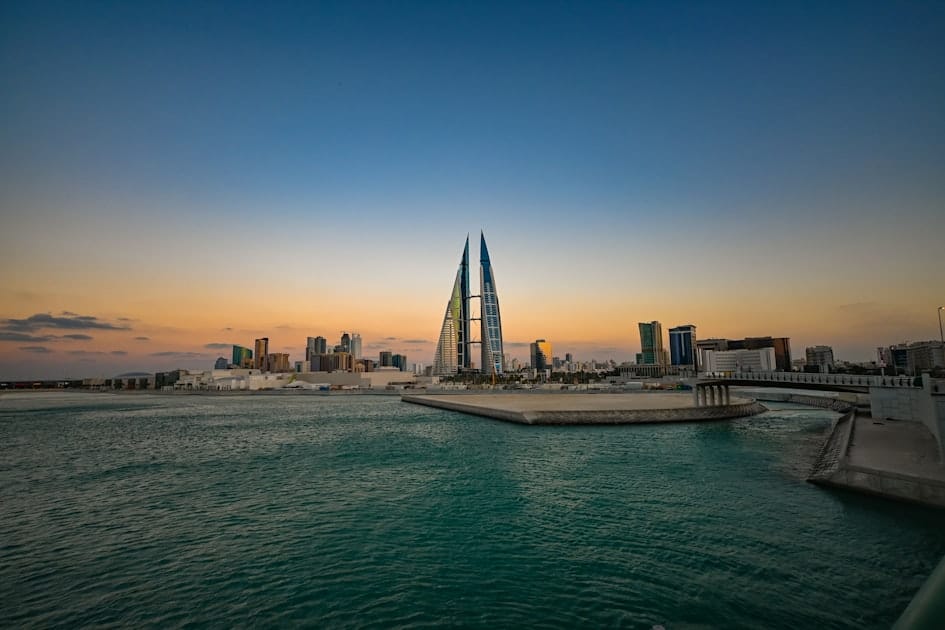
Official image from the Bahrain Economic Development Board (bahrain.bh)
The Lowest Operating Costs in the Gulf
Office rents, labour costs, and administrative fees in Bahrain run significantly lower than in Dubai, Abu Dhabi, or Riyadh. A virtual office costs as little as USD 800-2,500 per year. A physical office in Manama starts around USD 8,000 annually. The Bahraini Dinar (BHD) is pegged to the US Dollar at a fixed rate of 1 BHD = 2.65 USD, eliminating currency risk for dollar-denominated businesses.
A Skilled, Supported Workforce
The Labour Fund (Tamkeen) provides wage subsidies covering up to 50% of salaries for Bahraini employees during their first months of employment, plus training grants. This reduces your hiring costs while helping you build a local team. The LMRA (Labour Market Regulatory Authority) handles work permits for expatriate staff through a streamlined online system.
Choosing Your Business Structure in Bahrain
Bahrain offers several company types tailored to different investor profiles. Understanding the distinctions is critical to making the right choice:
With Limited Liability Company (WLL)
The WLL is by far the most popular structure among foreign investors. It requires a minimum of two partners and a maximum of fifty. Each partner's liability is limited to their capital contribution. Since the 2021 amendments, foreigners can hold 100% ownership in most sectors. This structure is ideal for small to medium-sized enterprises, trading companies, and professional services firms.
Single Person Company (BSC)
If you are a solo entrepreneur, the BSC allows you to incorporate with a single owner. Your liability is limited to your invested capital. This is the simplest route for independent consultants, freelancers scaling into a company, and solo founders who want personal asset protection.
Closed Joint Stock Company (CJSC)
The CJSC is designed for larger operations. It allows a limited number of shareholders and requires a higher minimum capital. This structure suits companies planning to raise institutional investment or eventually list publicly. Governance requirements are more stringent, with mandatory audited financial statements.
Branch Office of a Foreign Company
An established foreign company can register a branch in Bahrain to conduct the same activities as its parent company. This is a common route for international firms expanding into the GCC. The branch operates under the parent company's name and legal umbrella.
Free Zone Company
Bahrain's two main free zones — the Bahrain Logistics Zone (BLZ) and the Bahrain International Investment Park (BIIP) — offer customs incentives and streamlined procedures, particularly for manufacturing and logistics businesses.
Business Structure Comparison Table
| Structure | Foreign Ownership | Min. Capital | Owners | Best For |
|---|---|---|---|---|
| WLL | 100% (most sectors) | Varies by activity | 2-50 | SMEs, trading, services |
| BSC | 100% | Varies by activity | 1 | Solo entrepreneurs |
| CJSC | 100% | Higher than WLL | Limited shareholders | Large companies, capital-intensive |
| Branch Office | 100% | N/A | Parent company | Regional expansion |
| Free Zone | 100% | Varies by zone | Varies | Manufacturing, logistics |
The Real Cost of Setting Up in Bahrain
One of Bahrain's strongest selling points is its affordability. Here is a detailed breakdown of what you will actually pay:
Commercial Registration (CR) Fee
The CR fee ranges from BHD 50 to BHD 100 (approximately USD 133 to USD 265) depending on your business activity. This is paid through the Sijilat portal and renewed annually.
Full Setup Cost Breakdown
| Expense Item | Estimated Cost (USD) |
|---|---|
| Commercial Registration (CR) fee | 133 - 265 |
| Legal advisor / contract drafting | 265 - 800 |
| Office rent (annual) | 3,000 - 15,000 |
| Virtual office (annual) | 800 - 2,500 |
| LMRA work permit fees | 265 per expatriate employee |
| Certified accountant | 1,500 - 4,000 per year |
| Total estimated setup cost | 500 - 2,000 (excluding rent) |
For context, setting up a comparable company in a Dubai free zone would cost AED 12,000-30,000 (USD 3,300-8,200). Bahrain's total setup cost is roughly half or less.
The official Sijilat portal for online commercial registration in Bahrain (sijilat.bh)
Step-by-Step Guide: How to Set Up Your Business in Bahrain
The entire registration process runs through the Sijilat portal (sijilat.bh), the Ministry of Industry and Commerce's online platform. Most investors complete the process in one to four weeks.
Step 1: Select Your Business Activity
Choose your commercial activity from the approved list maintained by MOIC. Some activities require pre-approval from sector regulators — for example, financial services need Central Bank of Bahrain (CBB) approval, and telecommunications require approval from the Telecommunications Regulatory Authority (TRA).
Step 2: Reserve Your Company Name
Submit your preferred company name through the Sijilat portal. The name must be unique, not already registered, and compliant with Bahraini naming conventions. Name approval typically takes 24-48 hours.
Step 3: Submit Your Registration Application
Complete the online application form and upload the required documents:
- Passport copy of the founder(s) or authorised representative
- Notarised Memorandum of Association (MoA)
- Office lease agreement or proof of business address
- Copies of any pre-approvals from regulatory authorities
Step 4: Pay the Registration Fee
Pay the CR fee online via credit card or bank transfer through the Sijilat portal. You will receive an electronic receipt.
Step 5: Receive Your Commercial Registration
Once approved, your Commercial Registration (CR) certificate is issued electronically. You can download and print it immediately from the portal. This document is your company's legal identity in Bahrain.
Step 6: Obtain Work Permits (If Applicable)
If you plan to hire expatriate employees, register with the LMRA and apply for work permits. The standard fee is approximately USD 265 per permit. Bahraini employees do not require LMRA permits.
Step 7: Open a Corporate Bank Account
Present your CR, MoA, and office lease to your chosen bank. Bahrain's banking sector is well-accustomed to foreign investors and offers a full range of corporate banking services. Major options include National Bank of Bahrain, Ahli United Bank, BBK, and Standard Chartered.
Bahrain Economic Vision 2030 - Towards a diversified, sustainable economy
Step 8: Register for VAT
If your annual revenue exceeds BHD 37,500 (approximately USD 100,000), you must register for Value Added Tax. The current VAT rate is 10% (increased from 5% in January 2022). Registration and filing are handled through the National Bureau for Revenue (NBR) online portal.
Bahrain vs UAE vs Saudi Arabia: A Head-to-Head Comparison
| Criterion | Bahrain | UAE | Saudi Arabia |
|---|---|---|---|
| Corporate income tax | 0% (general) | 9% | 20% |
| Setup cost | ~USD 500-2,000 | USD 3,300-8,200 | Varies |
| Foreign ownership | 100% most sectors | 100% (mainland since 2021) | 100% with MISA license |
| Setup speed | 1-4 weeks | 1-2 weeks (free zone) | 2-6 weeks |
| VAT rate | 10% | 5% | 15% |
| Cost of living | Low-moderate | High | Moderate-high |
| Sector focus | FinTech, manufacturing, logistics | Trade, services, technology | Energy, industry, tourism |
Bahrain wins decisively on cost and tax advantages. The UAE offers faster setup and unmatched infrastructure. Saudi Arabia provides access to the largest market in the GCC and aggressive investment incentives under Vision 2030. Your choice depends on your industry, budget, and strategic goals.
Case Study: Khalid Mansoor — Building a FinTech Startup in Manama
Khalid Mansoor, a 34-year-old software engineer from Pakistan, had spent six years working at a major bank in Karachi before deciding to launch his own digital payments company, "PayBridge." After evaluating Dubai, Abu Dhabi, and Manama, he chose Bahrain as his base in March 2025.
Why Bahrain?
"I looked at Dubai first, obviously," Khalid explains. "But the costs were prohibitive for a pre-seed startup. Dubai free zones wanted AED 15,000-25,000 just for the license, plus mandatory office space. Saudi Arabia was interesting but the regulatory environment for fintech was less mature. Bahrain offered three things I could not find elsewhere: the Regulatory Sandbox from the Central Bank, the lowest setup costs in the Gulf, and Bahrain FinTech Bay's ecosystem."
The Setup Journey
Khalid registered PayBridge as a WLL (With Limited Liability) company through the Sijilat portal in March 2025. The entire process took 14 calendar days from application submission to CR issuance. His actual costs were:
- Commercial Registration fee: BHD 100 (USD 265)
- Legal advisor for MoA drafting: USD 450
- Virtual office in Seef District, Manama: USD 2,200 per year
- LMRA work permit (for himself): USD 265
- Monthly accountant retainer: USD 167 per month
Total initial setup cost: approximately USD 3,180, including the full year of virtual office rent.
Results After 12 Months
By Q1 2026, PayBridge had grown to a team of seven — three Bahraini developers (supported by Tamkeen wage subsidies covering 30% of their salaries for the first six months), two expatriate engineers, a product manager, and Khalid himself. The company had secured a regional payment services provider license from the CBB and was processing approximately USD 220,000 in monthly transaction volume.
"The Tamkeen support was a genuine surprise," Khalid notes. "They covered a significant portion of my Bahraini hires' salaries for months, plus training programs. And the CBB's Regulatory Sandbox let me test my payment product with real users before going fully live. That kind of flexibility is rare in this region."
His advice to other investors: "Talk to the Bahrain EDB before you do anything. They assigned me a relationship manager who walked me through every step, introduced me to banks, and even helped with the CBB application. And the cost difference versus Dubai is not marginal — it is transformational for an early-stage company."
Are you planning to set up your business in Bahrain? Our team of specialist consultants can guide you through every step, from choosing the right legal structure to obtaining licenses, navigating regulatory approvals, and opening your corporate bank account.
Book a free consultation now via Truescho
Bahrain's Most Promising Sectors for 2026
Financial Technology (FinTech)
Bahrain is the Gulf's pioneer in fintech regulation. The Central Bank of Bahrain operates a Regulatory Sandbox that allows startups to test financial products in a controlled environment before full commercial launch. Bahrain FinTech Bay, the largest fintech hub in the Middle East, provides co-working space, mentorship, and investor connections. The CBB has issued comprehensive rulebooks for crypto-assets, open banking, and robo-advisory — some of the most advanced regulatory frameworks in the region.
Manufacturing and Industrial Processing
The Bahrain International Investment Park (BIIP) offers manufacturing companies customs exemptions on raw materials and equipment, plus access to a skilled workforce. Bahrain's manufacturing sector contributes approximately 14% of GDP, with strengths in aluminum downstream industries, food processing, and packaging.
Logistics and Supply Chain
Bahrain's strategic location at the center of the Gulf, combined with Khalifa bin Salman Port and the Bahrain Logistics Zone, makes it a natural hub for shipping, warehousing, and distribution companies serving the broader GCC market. The country is also integrated into the GCC Customs Union, giving manufacturers duty-free access to all six member states.
Technology and Digital Services
Startup Bahrain, a government-backed initiative, has built one of the region's most active startup ecosystems. It connects entrepreneurs with accelerators, angel investors, and venture capital funds. Bahrain was also among the first countries in the region to establish a comprehensive data protection law, creating a trusted environment for tech companies handling personal data.
Tourism and Hospitality
Tourism is a strategic pillar of Bahrain's Economic Vision 2030. The kingdom has invested heavily in hotels, entertainment venues, and cultural attractions. Events like the Bahrain Grand Prix (Formula 1) bring hundreds of thousands of visitors annually, creating opportunities in hospitality, event management, and tourism services.
Understanding Bahrain's Tax and Regulatory Framework
Corporate Taxation
The general principle in Bahrain is simple: no corporate income tax. The exceptions are narrow and specific:
- Oil and gas sector: 46% rate on exploration and production companies operating under concession agreements
- Large multinationals (Pillar Two DMTT): 15% Domestic Minimum Top-up Tax on groups with consolidated global revenues above EUR 750 million, aligning with OECD's global minimum tax framework
For the vast majority of foreign investors — startups, SMEs, mid-market companies — the effective corporate tax rate remains 0%.
Value Added Tax (VAT)
- Current rate: 10% (increased from 5% effective January 2022)
- Mandatory registration threshold: BHD 37,500 annual revenue (approximately USD 100,000)
- Voluntary registration threshold: BHD 18,750 annual revenue
- Administration: National Bureau for Revenue (NBR)
- Filing: Quarterly returns submitted online
Municipal Fees
Commercial property tenants pay a municipal tax of 10% of the annual rent. This applies to office space, retail outlets, and industrial facilities.
Social Insurance
Employers contribute to the Social Insurance Organization (SIO) for both Bahraini and expatriate employees. Rates vary by employee nationality and contract type.
Halal Financing Options for Foreign Investors
Bahrain is a global leader in Islamic finance, offering Sharia-compliant funding alternatives that avoid interest-based (riba) structures:
Murabaha (Cost-Plus Financing)
A bank purchases an asset (equipment, vehicles, machinery) on your behalf and sells it to you at an agreed markup, payable in installments. This is the most common Islamic financing structure for business asset acquisition.
Ijara (Lease-to-Own)
The bank buys an asset and leases it to your company. At the end of the lease term, ownership transfers to you. This structure works well for vehicle fleets, heavy equipment, and office technology.
Mudaraba (Profit-Sharing Partnership)
An investor (rab al-mal) provides capital while you (mudarib) manage the business. Profits are shared according to an agreed ratio. Losses are borne by the capital provider. This is ideal for startup founders seeking Sharia-compliant equity investment.
Venture Capital via Startup Bahrain
The Startup Bahrain ecosystem connects founders with regional VC funds, many of which operate on Islamic finance principles. Tamkeen also offers non-repayable grants for qualifying businesses, particularly those hiring and training Bahraini nationals.
Office and Address Requirements
Bahrain offers flexibility in how you establish your business presence:
Virtual Office
Allowed for certain activities — typically consulting, technology, and professional services. You get a registered commercial address without renting physical space. Costs range from USD 800 to USD 2,500 annually. This is the most popular option for solo founders and early-stage startups.
Physical Office
Required for activities that involve physical operations, inventory, or client visits. Costs vary significantly by location:
- Manama (central business district): USD 8,000 - USD 20,000 per year
- Seef District: USD 10,000 - USD 25,000 per year
- Muharraq and Northern Governorate: USD 5,000 - USD 12,000 per year
- Industrial areas (Sitra, Mameer): USD 4,000 - USD 10,000 per year
The Golden License: Premium Incentives for Major Investors
Bahrain introduced the Golden License in 2023 to attract large-scale investments. It is granted to companies that invest BHD 50 million (USD 132 million) or more, or that create at least 500 jobs.
Golden License benefits include:
- A dedicated relationship manager at the Bahrain EDB
- Fast-tracked processing across all government agencies
- Priority allocation of industrial land and commercial property
- Comprehensive logistical and operational support
- Streamlined access to senior government decision-makers
For more information on Bahrain's investor residency options, see our guide on the Bahrain Golden Visa for Investors 2026.
Watch: Why Invest in Bahrain
Watch this official video from the Bahrain Economic Development Board outlining the business and investment opportunities in the Kingdom:
Official video from the Bahrain Economic Development Board YouTube channel
Free Zone vs Mainland: Which Is Right for You?
| Criterion | Free Zone (BLZ/BIIP) | Mainland |
|---|---|---|
| Foreign ownership | 100% | 100% (most sectors) |
| Customs duties | Exemptions on equipment and raw materials | Standard rates |
| Local market access | Limited | Full access |
| Government contracts | Not eligible | Eligible |
| Permitted activities | Zone-specific | All licensed activities |
| Best for | Manufacturing, logistics, export | Services, trading, consulting |
Frequently Asked Questions
1. How long does it take to set up a business in Bahrain?
The standard timeline is one to four weeks through the Sijilat portal, depending on the business activity and completeness of documents. Activities requiring regulatory pre-approval (such as financial services or healthcare) may take longer.
2. Can a foreigner own 100% of a company in Bahrain?
Yes. Under the Commercial Registrations Law (Decree-Law 27 of 2015, amended 2021), foreign investors can own 100% of a company in most commercial, industrial, and service sectors. A very small number of activities still require a local partner or special government approval.
3. What is the annual cost to maintain a Commercial Registration?
The CR renewal fee ranges from BHD 50 to BHD 100 (USD 133-265) depending on your business activity. Renewal is done online through the Sijilat portal and takes minutes.
4. Do I need a physical office to incorporate?
Not always. Certain activities — typically consulting, technology, and professional services — allow a virtual office. Others, such as general trading and manufacturing, require a physical premises. The Sijilat portal will indicate the requirement based on your chosen activity.
5. What taxes apply to businesses in Bahrain?
Most businesses pay zero corporate income tax. VAT at 10% applies to most goods and services if your annual revenue exceeds BHD 37,500. There is also a 10% municipal tax on commercial property rent.
6. Can I get residency through company formation?
Yes. As a company owner, you can obtain a residency permit and work permit through the LMRA. You can also sponsor residency for expatriate employees. Investors meeting the Golden License thresholds (BHD 50 million investment or 500+ jobs) receive enhanced residency and operational benefits.
7. How does Bahrain compare to the UAE for business setup?
Bahrain offers lower costs (roughly half the UAE's setup fees), zero corporate income tax, and a more relaxed regulatory environment. The UAE provides faster free-zone incorporation (1-2 weeks), a larger expatriate community, and world-class infrastructure. Your choice depends on budget, industry, and target market.
8. Are there free zones in Bahrain?
Yes. The Bahrain Logistics Zone (BLZ) and the Bahrain International Investment Park (BIIP) are the two main free zones, offering customs incentives and streamlined procedures for manufacturing, logistics, and export-oriented businesses.
Important Compliance Notes
- CR Renewal: Renew your Commercial Registration at least 30 days before expiry to avoid penalties
- Financial Statements: Larger companies must submit audited financial statements from a certified accountant
- LMRA Compliance: Keep all work permits current; expired permits incur monthly fines
- VAT Filing: Late VAT returns carry significant penalties — set calendar reminders for quarterly deadlines
- EDB Support: The Bahrain Economic Development Board offers free support to foreign investors. Contact them through bahrain.bh or bahrainedb.com before, during, and after your setup
If you are considering relocating or expanding your personal horizons, also check our guide on health insurance for expats in Bahrain 2026.
Conclusion: Is Bahrain Your Next Business Destination?
To set up business bahrain foreign investors 2026 provides an opportunity window that is genuinely exceptional. Zero corporate tax, full foreign ownership, minimal setup costs, a sophisticated banking sector, and a government actively courting international investment — these factors combine to make Bahrain one of the most attractive business destinations in the Middle East.
The advantages are quantifiable: setup costs half those of Dubai, zero corporate income tax versus 9% in the UAE and 20% in Saudi Arabia, and a registration process that can be completed online in under a month. Add in the Tamkeen wage subsidies, the CBB's fintech-friendly regulatory sandbox, and Bahrain's strategic position connecting the GCC, Indian subcontinent, and African markets, and the case becomes very strong.
The window for early movers is open now. As more international companies discover Bahrain's advantages, costs and competition will inevitably rise. The investors who arrive first will secure the best positions, the strongest local relationships, and the most favourable terms.
Ready to take the first step? Our team of accredited business setup consultants specialises in GCC company formation and is ready to support you at every stage — from legal structure selection and document preparation to CR issuance, regulatory liaison, and corporate banking.
Connect with a specialist consultant now via Truescho
Your Bahraini business starts here. Do not leave it for tomorrow.