

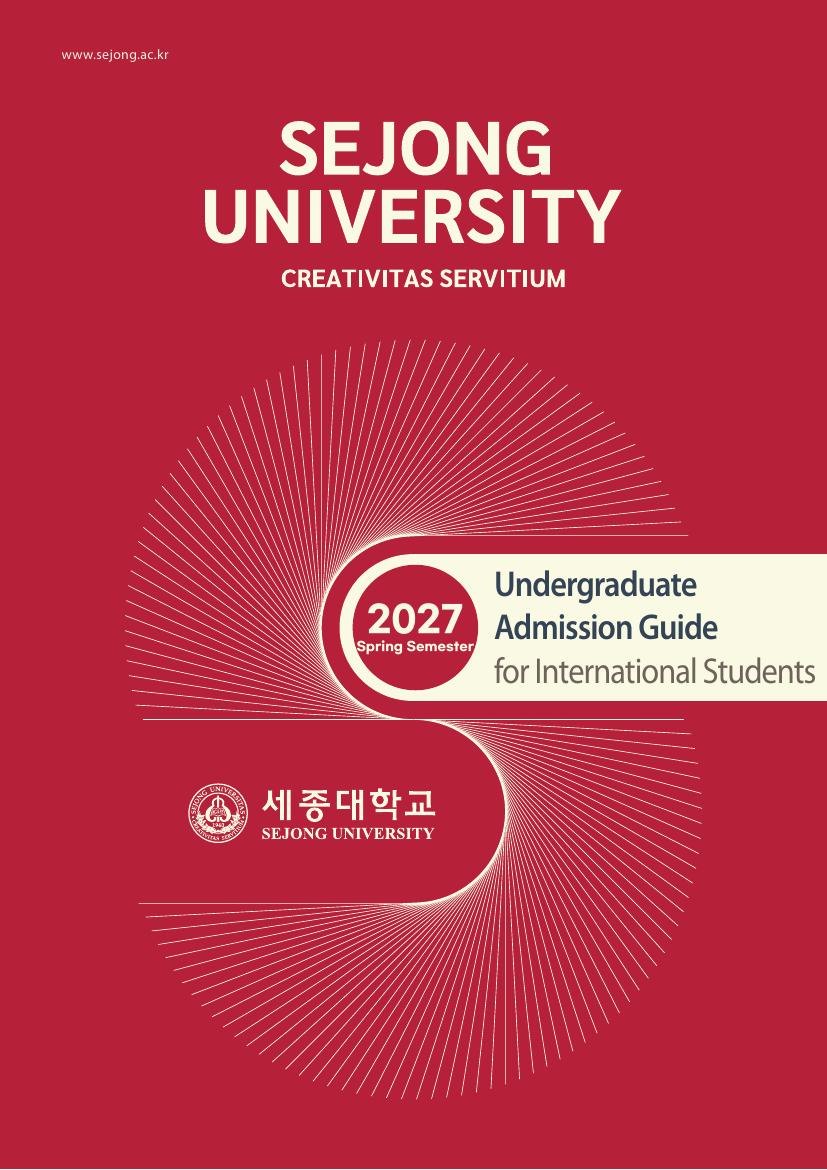
Sejong University in Seoul has opened one of the clearest international admission tracks in South Korea for the 2027 intake: apply in either Korean or English, earn a first-semester scholarship that scales from 30% up to a full 100% tuition waiver depending on your TOPIK level, and join a brand-new college built specifically for international students launching with the 2027 academic year. The second and final application round runs from October 22 to November 13, 2026, closing at 5:00 PM Korean Standard Time — a window measured in days, not months. This guide breaks down every official number: scholarship tiers, annual tuition without funding, the application fee, dormitory costs, eligibility rules, and the admission-certificate timeline you need for a D-2 student visa.

What Is Sejong University and Why International Students Are Looking at It
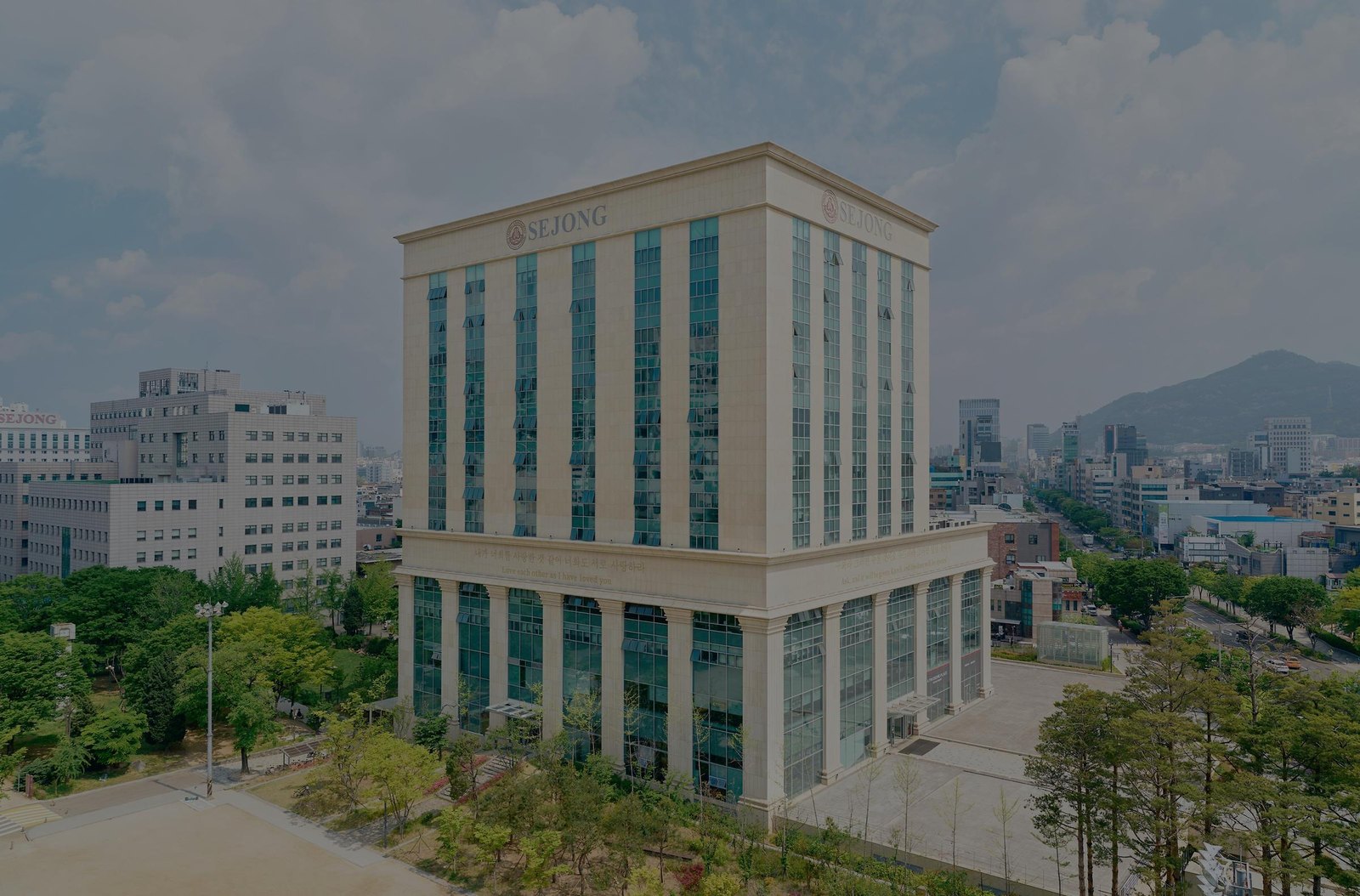
Sejong University sits in Gwangjin-gu, eastern Seoul, and takes its name from King Sejong the Great, the inventor of the Korean alphabet. It is a private university with strong colleges of engineering, business, hospitality and tourism, computer science, AI convergence, and the arts. Its hospitality and food-service management programs are among the best-known in Korea, and its College of AI Convergence has expanded aggressively into semiconductors, quantum information, and autonomous systems.
Three things matter specifically for the 2027 intake. First, the university is launching the Daeyang Global College (DGC), a college reserved for international students, with its first cohorts starting in the 2027 academic year. Second, international admission runs on two parallel tracks — a Korean Track requiring TOPIK and an English Track accepting TOEFL iBT, IELTS, or New TEPS — so applicants with no Korean background can still apply. Third, every scholarship percentage is published as an exact table in the official admission guide: no agents, no verbal promises, no hidden criteria.
If you are comparing Asian destinations, also read our guides on the KAIST undergraduate scholarship 2027 to understand the difference between a government-backed research university and a private one like Sejong, and on the GKS-U, MEXT and CSC scholarship cycle if you are targeting full government funding.
Spring 2027 Application Timeline: Round 2 Is the Live Window
The current cycle admits students for the Spring 2027 semester (March start) and is split into two rounds. Round 1 closed on September 21, 2026. Round 2 — the last chance for this intake — runs on the following official schedule, all times KST:
| Stage | Round 2 dates |
|---|---|
| Online application, fee payment, document upload | October 22 – November 13, 2026, 5:00 PM |
| Document evaluation | December 4 – 9, 2026 |
| Results released (provisional) | December 23, 2026, 5:00 PM |
| Original documents by post + tuition payment | December 23, 2026 – January 5, 2027, 4:00 PM |
| Certificate of Admission issued | From January 19, 2027 |
Three practical warnings come straight from the official page. Applications are accepted only through the university's One Stop Service Center portal — never by email or phone. Original physical documents are mailed only by admitted students who choose to enroll, and a late original cancels your admission. Tuition wire transfers must actually arrive before the deadline; a transfer stuck in correspondent banking on the final day is not a registration.
What a Year Costs at Sejong Without Any Scholarship
The official 2027 guide publishes tuition on a 2026 basis, with an explicit note that 2027 rates may rise slightly and be covered by a preliminary deposit. The verified figures:
| Program group | Annual tuition (KRW) | Approximate USD |
|---|---|---|
| Humanities, Social Sciences, Business, Economics, Hospitality & Tourism | 4,669,000 | about 3,380 |
| Natural Sciences, Physical Education | 5,521,000 | about 4,000 |
| IT, Advanced Convergence, Engineering, Life Sciences | 6,340,000 | about 4,600 |
| Arts (excluding PE) | 6,392,000 | about 4,630 |
(USD equivalents use an indicative rate of roughly 1,380 KRW per dollar at guide publication; treat them as planning estimates only.)
On top of tuition, budget a fixed application fee of 150,000 KRW (about 110 USD), which is non-refundable after the application deadline. A humanities student paying full freight faces roughly 3,500 USD per year in tuition, an engineering student around 4,700 USD — before any scholarship is applied, and before discovering that first-semester awards can erase up to 100% of that bill. Note the university's own payment warning: if exchange-rate swings or bank charges shrink your remittance below the invoiced amount, the payment is not recognized as registration, and the university recommends dedicated international transfer services for exactly this reason.
The Full Sejong Scholarship Ladder, in Official Numbers
This is the financial core of the article, sourced directly from the scholarship tables on page 15 of the official guide. Sejong runs simultaneous freshman tracks, and you may combine Scholarship A and Scholarship B as long as the total does not exceed your tuition bill.
Scholarship A, Korean Track (TOPIK-based) — first-semester tuition discount:
| TOPIK level | First-semester discount |
|---|---|
| Level 6 | 100% |
| Level 5 | 70% |
| Level 4 | 50% |
| Level 3 | 30% |
Scholarship A, English Track (English test-based) — first-semester tuition discount:
| Profile | Discount |
|---|---|
| High scores (TOEFL iBT / IELTS 6.0 / New TEPS equivalent) | 80% |
| Mid-range scores | 50% |
| Entry-level scores | 30% |
| Passport holders from native-English countries (UK, USA, Canada, Australia, NZ, Ireland, South Africa) | automatic 30% |
Scholarship B, for Sejong Language Center alumni:
| Situation | Award |
|---|---|
| Completed the Sejong Prep Course at the required level | 100% of first-semester tuition + admission fee waiver |
| 4+ semesters of the Korean Language Program | 1,000,000 KRW |
| 3 semesters completed | 750,000 KRW |
| 2 semesters completed | 500,000 KRW |
The money does not stop after semester one. The Sejong International Scholarship "Outstanding Academic" continues for enrolled students at 20% to 50% of tuition for anyone maintaining a GPA of 3.0 or higher while completing at least 15 credits in the previous semester — and transfer students, who are excluded from freshman awards, are explicitly eligible for this one.
Daeyang Global College: 8 Majors Reserved for International Students From 2027
The headline novelty of this cycle — and its first appearance in an official admission guide — is the Daeyang Global College, a college dedicated entirely to international students starting with the 2027 academic year. It is organized into four schools offering eight specific majors:
- School of Global Liberal Studies: a exploratory first year combining Korean language and culture with broad coursework; students choose a major when advancing to year two, either inside the college or in another college under university transfer rules.
- School of Humanities and Social Sciences: Korean Language & Culture Education, International Trade & Commerce, International Affairs.
- School of Convergence Technologies: AI and Software; Smart Mobility Engineering.
- School of Entertainment Contents: K-POP Entertainment; Performing and Visual Contents; Contemporary Music.
The design serves two profiles at once: the technical student who wants an English-friendly AI and software route, and the student aiming at Korea's globally exporting content and entertainment industries. Language requirements for entering each specific major are set out in the eligibility pages of the guide — generally TOPIK 3 before graduation, with TOPIK 2 admits required to complete 300 hours of Korean within their first year.
The first-year exploration model also solves a problem every international applicant knows: committing to a major at seventeen with no real exposure to the field. Here you spend a full year sampling fields alongside academic advisors before locking in your choice, with the safety valve of transferring to majors outside the college under university regulations if your plan changes after you arrive in Seoul.
The English Track in Detail: Admission With Zero Korean
The guide opens a complete door for applicants with no Korean whatsoever. Under the English Track you apply with a TOEFL iBT, IELTS, or New TEPS score issued within two years of the application semester and verifiable online, and you compete for the same first-semester scholarships — up to 80% with strong scores. Applicants holding passports from the seven recognized native-English countries do not need a test at all; proof of secondary education completed in English is sufficient, and they receive an automatic 30% first-semester award.
Three facts worth internalizing. First, some majors set minimum language levels for entry after admission, so the track that admitted you does not automatically unlock every major — cross-check the eligibility table before ranking your choices. Second, the university's own Korean language courses remain available to you after admission, and bilingual graduates are systematically preferred by large Korean employers. Third, for applicants from the Middle East, Africa, and South Asia, the English Track is usually the fastest entry point: a strong IELTS band can be converted into an 80% discount within one application cycle, with no waiting for the region's limited TOPIK sittings.
Sejong vs KAIST vs the GKS Government Scholarship
International applicants to South Korea typically juggle three parallel tracks, and understanding the differences saves a full year of misdirected effort:
| Criterion | Sejong 2027 (private) | KAIST 2027 (research) | GKS-U (government) |
|---|---|---|---|
| Core funding | 30-100% first semester, then merit awards | Generous international packages with housing | Full ride: tuition + monthly stipend + airfare |
| Competition level | Moderate to high by major | Very high (olympiad and research profiles) | Highest of all (roughly 286 seats worldwide) |
| Language | Korean or English | English-primary | Mandatory Korean language year in most cases |
| Flexibility | New international college + wide internal transfer | Science and engineering only | Placement across dozens of partner universities |
| Post-graduation bond | None | None | None |
The practical takeaway: GKS offers the best funding but the narrowest door, and its 2027 round closed on September 30. KAIST belongs to applicants whose files lead with competition medals and research. Sejong is the most manageable route for a strong student without an olympiad record — especially now that a brand-new international college needs to fill its first cohorts.
Eligibility and Documents: What Gets a File Silently Rejected
Sejong requires that the applicant hold non-Korean nationality and that both parents also hold non-Korean nationality. Naturalized Korean citizens are not considered foreigners, and Korean dual citizens cannot apply as internationals. Single-parent applicants (death, disappearance, divorce, non-marriage) must document the relevant parent's nationality with government-issued evidence. Academically: completion (or expected completion) of primary and secondary education, and transfer applicants must have earned more than 50% of their graduation credits.
The core document list from the guide: passport copy; language proficiency certificate (TOPIK, TOEFL, IELTS, or New TEPS, issued within two years and verifiable online); high-school graduation or expected-graduation certificate, translated and notarized with an apostille or consular confirmation; full high-school transcript; and optional national exam scores that feed into evaluation. Documents are uploaded scanned during the application window; originals follow only for admitted enrolling students.
The guide's "Important Notes" section lists the silent-kill failures: incomplete or late documents, false or incomplete form entries, suspected non-study intentions, or insufficient academic or financial capability — in all of which cases results are simply not disclosed. One more trap for a specific group: students in the university's own Sejong Prep Course must apply in Round 2, not Round 1. And because the university does not return submitted documents, keep certified duplicates of everything you send.
Dormitory and Cost of Living
International student housing holds about 255 residents, is allocated per six-month semester, and opens applications every January and July before the semester begins. The fee runs about 1.6 million KRW per six months (roughly 1,160 USD). Demand exceeds supply, so unsuccessful applicants look at private housing around the university's neighborhood in eastern Seoul at similar or slightly higher rates.
A realistic monthly student budget in Seoul — food, transport, phone, incidentals — runs 600 to 900 USD without luxuries. That places a full self-funded year (humanities tuition + dorm + living) at roughly 9,500 to 12,000 USD before scholarships. With a TOPIK 6 first-semester waiver plus continuing merit awards, first-year outlays can drop by a third or more. For a structured comparison with a fully-funded alternative, see our Turkiye Burslari 2026/2027 guide, which covers stipends and housing in a lower-cost destination.
How to Apply, Step by Step: A 2026-2027 Roadmap
- Until October 21: secure a passport valid 18+ months; book the nearest TOPIK sitting if you lack one — each additional level is worth 20-30 percentage points of first-semester discount; order notarized English translations and apostilles for your graduation certificate and transcript, since these take weeks in many countries.
- October 22 – November 13: create an account on the One Stop Service portal, complete the form, pay the 150,000 KRW fee, and upload clearly scanned documents before 5:00 PM KST on the final day.
- December 4 – 9: documents are evaluated; results appear on your personal page December 23 — no individual emails are sent.
- Until January 5, 2027: mail the physical originals by international courier and complete the tuition payment through an approved transfer channel.
- From January 19, 2027: receive your Certificate of Admission and file your D-2 student visa application at the Korean embassy in your country.
While the file is in motion, keep a parallel plan alive: browse the currently open scholarship opportunities on Truescho so a single committee's decision never costs you a whole academic year, and price your route early with our guide to cheap student flights using ISIC and StudentUniverse — January fares to Seoul climb steeply once admission letters go out.
Final Verdict: Is Sejong Worth Your 2027 Application?
The decisive arithmetic is simple. With a TOPIK 6 scholarship or the Prep Course full waiver, the first semester can start at effectively zero tuition inside Seoul, at a university whose new international college launches with your class in 2027. Competition will concentrate on the Entertainment Contents school and the AI & Software major; the final deadline is November 13, 2026 at 5:00 PM KST with no announced extension. If you already hold TOPIK 4 or higher, or a strong English score, and your high-school documents can be apostilled in time, you have thirty days to a complete file. If you are exactly one language level short, the university's own language institute is not a detour — it is the entrance ramp to Scholarship B and a stronger 2027 file. Measure the distance to your next certificate, and start.
Frequently Asked Questions
How much does the Sejong scholarship cover?
Freshman awards cover a percentage of first-semester tuition only: 100% for TOPIK Level 6, 70% for Level 5, 50% for Level 4, and 30% for Level 3, while English-track awards reach 80% based on test scores. After enrollment, the Outstanding Academic scholarship renews at 20-50% of tuition for students holding a GPA of 3.0 or higher.
What is the final deadline for Spring 2027?
Round 2 closes on November 13, 2026 at 5:00 PM Korean Standard Time, covering the form, the 150,000 KRW fee, and all uploaded documents. Results are announced on December 23, 2026, and enrollment runs until January 5, 2027.
Can I be admitted without TOPIK?
Yes, through the English Track with a TOEFL iBT, IELTS, or New TEPS score issued within two years and verifiable online. Applicants from the seven recognized native-English countries are exempt from testing and receive an automatic 30% first-semester award.
What does a year cost with no scholarship at all?
Between 4,669,000 and 6,392,000 KRW per year depending on the program group — roughly 3,380 to 4,630 USD on the official 2026 table — plus a one-time admission fee, and about 1.6 million KRW per six months for the dormitory.
Is on-campus housing guaranteed for international students?
No. The dormitory holds about 255 international students and is allocated competitively each semester, with applications every January and July at roughly 1.6 million KRW per six months. Most students should research private housing near the Gwangjin-gu campus as a backup.
Is a Sejong University degree recognized outside Korea?
Sejong is a fully accredited private university under the Korean Ministry of Education, and its bachelor's degrees are generally accepted by Arab and international credential evaluators. Recognition rules are updated periodically, so confirm current requirements with your country's equivalency authority before committing.
Can I combine two scholarships in the first semester?
Yes. The guide explicitly allows combining Scholarship A and Scholarship B up to the total amount of tuition fees, so a language-institute graduate with a strong TOPIK score can stack awards — capped at the invoice value.
Sources
- Sejong University official Spring 2027 Undergraduate Admission Guide for International Students (PDF, issued 2026-09-03): https://sos.sejong.ac.kr/pdf/488157/2027%ED%95%99%EB%85%84%20%EC%A0%84%EA%B8%B0%20%ED%95%99%EB%B6%80%20%EC%A0%95%EC%9B%90%EC%99%B8%20%EC%99%B8%EA%B5%AD%EC%9D%B8%20%EB%AA%A8%EC%A7%91%EC%9A%94%EA%B0%95%20(%EC%98%81%EB%AC%B8)_2026.09.03.pdf
- One Stop Service Center, international admission timeline: https://sos.sejong.ac.kr/eng/admission/guide/univ.do
- International application portal and round history: https://sos.sejong.ac.kr/eng/admission/univ/index.do
- Daeyang Global College overview page: https://en.sejong.ac.kr/eng/daeyang_global_college_overview.do
- Sejong University official English site: https://en.sejong.ac.kr/
Every page and document above was verified by the editorial team on October 14, 2026. All figures are quoted from the official admission guide; any subsequent changes are announced first through the One Stop Service Center site.