
Last updated: October 2026
Every January, thousands of students from Lagos to Jakarta search for a "ready recommendation letter PDF" for Türkiye Bursları. The official record says something that should stop that search cold: the current Türkiye Scholarships document list, published on the official apply-steps page, contains no recommendation letter at all. This guide is built on that gap between what students fear and what the portal actually demands.
So where does a recommendation letter genuinely decide your fate in 2027? In graduate applications outside Türkiye Bursları, in Turkish universities' own scholarship schemes, and in most Saudi and European scholarship files, where the letter is often the only voice besides your own that the committee trusts. This article answers the real questions applicants type, shows what a professor actually writes paragraph by paragraph, gives you a full sample letter and a polite request email, and closes with a timeline built on the official 2026 cycle. One rule frames everything: you may prepare materials for your referee, but the professor writes, edits and signs, never you.
Does Türkiye Bursları require a recommendation letter at all?
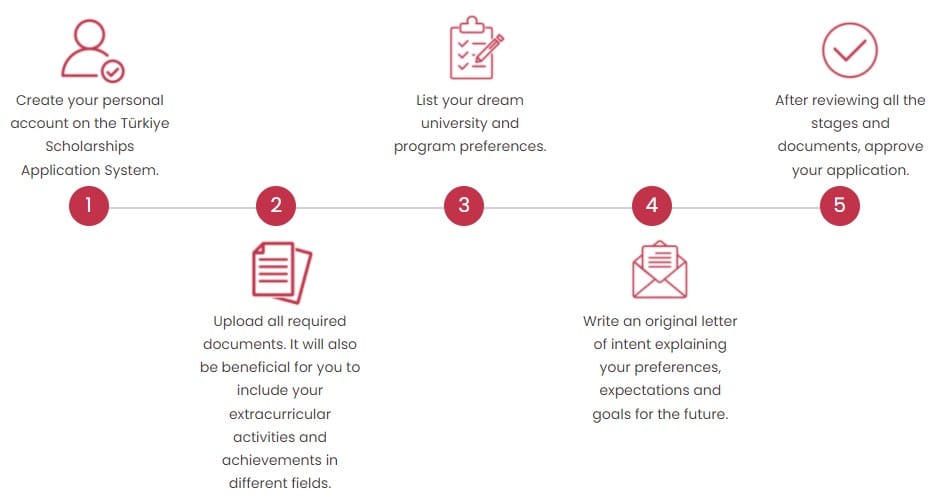
No, not on the current official document list. The apply-steps page on turkiyeburslari.gov.tr names identity documents, a recent photo, national exam results where applicable, a diploma or transcript, international exam results if the university requests them, and a language test if needed for the program. For PhD candidates only, it adds a research proposal and a writing sample. Recommendation letters appear nowhere on that list.
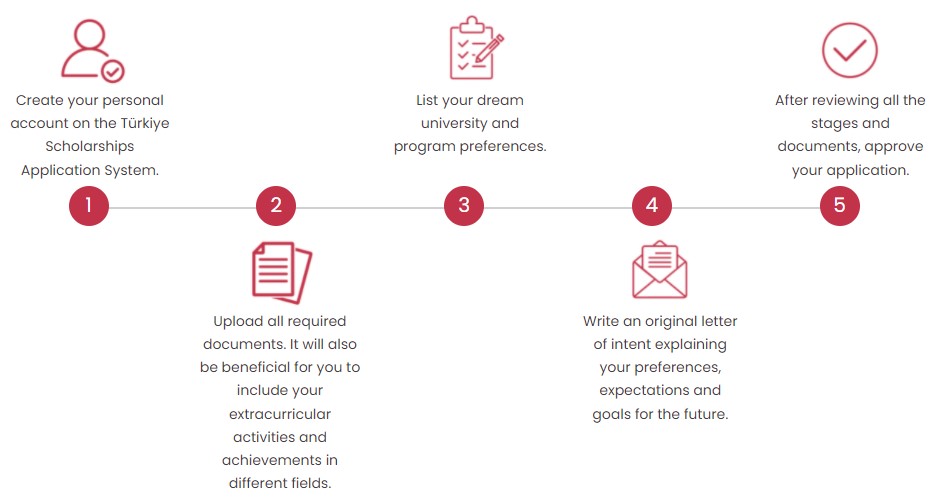
Source: Türkiye Scholarships, application steps
That is the fact no agency site states with a source, so it deserves precision. The list you just read is the current one, verified against the official page, and none of the five official evaluation stages mentions recommendation letters either. If a portal field for referee letters ever appears for graduate applicants in a future cycle, the mechanism below, where the system contacts your professor directly, is the only honest way to use it.
This changes where your effort belongs. Hours spent hunting a downloadable letter for Türkiye Bursları are hours stolen from the documents and stages that actually carry points: the statement of purpose, the consistency of your academic record, and the interview. The next question covers exactly what the committee evaluates instead.
If not letters, what does the committee actually evaluate?
The official evaluation and selection page names its real criteria: your statement of purpose, the consistency of your grades and academic history, your social and extracurricular activities, your exam performance against the program's bar, and finally an interview of roughly 15 to 30 minutes with document checks. Recommendation letters are not part of any published stage.
Source: Türkiye Bursları official YouTube channel
The published eligibility bars are concrete, so check them before writing anything. The official programs page sets minimum academic averages at 70 percent for bachelor and diploma candidates, 75 percent for graduate programs, and 90 percent for health sciences, with age limits under 21, 30 and 35 respectively. Your statement of purpose is the one document that speaks in your voice, which is why the Türkiye Bursları motivation letter guide is the companion piece to this article.
For the interview stage, committees ask about your field, your project and your statement, in the language of your program. Consistency is the keyword across all stages: grades, documents, statement and answers must tell one story. That is also, not coincidentally, exactly what a strong recommendation letter does for the scholarships that do want one.
So when does a recommendation letter actually decide my fate?
Letters decide outcomes in three situations: graduate programs outside Türkiye Bursları, scholarships run by individual Turkish universities, and Saudi or European scholarships where two academic letters are standard. If any of those sit on your 2027 list, start preparing referees in parallel with your Türkiye Bursları file, because the same professors serve both.
Turkish public universities run their own tuition waivers and scholarships alongside the government scheme, and those local schemes plus graduate admission files often ask for academic references. European and German graduate programs almost always do, and the wider planning path is covered in master and PhD admission steps 2026. For the general anatomy of a strong letter, the recommendation letter guide breaks the format down field by field.
Treat letters as portfolio assets with a shelf life. A signed letter from a professor who taught you last semester is credible for this cycle and reusable, with a date refresh, across several applications. The templates and phrasing banks in recommendation letters for scholarships show how one well-managed referee can serve your whole application season, which is the practical approach funded applicants use.
Who should write my recommendation letter?
Choose a professor who taught you, supervised your project, or graded your thesis, and who can cite specifics from direct contact with your work. Academic referees outrank employers for academic programs, because the committee is assessing scholarly potential. Two letters from two different angles, a course professor and a project supervisor, is stronger than two letters from the same department.
Seniority helps but specificity wins. A lecturer who supervised your final-year project and can write "she rebuilt the data pipeline and cut processing time by 40 percent" beats a dean who writes "an excellent student" once. Choose accordingly: the person who knows your work, not the person with the longest title who barely knows your name, is who you want writing this.
What does the professor actually write, paragraph by paragraph?
A strong letter has five movements, and committees read them in order: who the referee is to you, how you performed against peers, one specific incident that proves it, why this program or scholarship fits you, and an unequivocal closing recommendation. Each paragraph answers one implicit committee question, and a missing movement is visible.
| Paragraph | What the professor writes | The committee question it answers |
|---|---|---|
| 1, Relationship | Course name, semester, capacity, how long and how closely they taught you | Is this referee qualified to judge? |
| 2, Performance | Your standing against classmates, with a concrete comparison | How good is this student, really? |
| 3, Evidence | One project, paper or incident with numbers and outcomes | Is the praise verifiable? |
| 4, Fit | The specific traits this scholarship or program rewards | Will this student succeed there? |
| 5, Recommendation | An explicit, unhesitating endorsement plus contact details | Would the referee stake their name on it? |
What sinks letters is just as predictable. Generic praise with no incident, no signature, no letterhead or no date, dates that contradict your transcript, and the same recycled template signed for dozens of students are the five classic failure patterns committees report. Every one of them is avoidable, because all five are failures of preparation rather than of the student's actual record.
Can I see a full sample letter to show my professor?
Here is a complete sample in the professor's voice, written for a master's application. Use it the only defensible way: as a structural reference to show your professor, who then writes, edits and signs their own letter with their own facts. A sample you copy and sign yourself is fraud, and committees detect it.
The sample assumes a realistic scenario: an economics graduate applying to a funded master's program.
On university letterhead, dated, addressed to the scholarship selection committee:
"Dear Members of the Selection Committee, I have taught Ms. Amara Okafor for three courses across four semesters in the Department of Economics at the University of Lagos, most recently supervising her final-year research project, and I rank her among the top three students I have taught in eleven years. In my econometrics course, a class of 84, she earned the highest grade, and in her project she built a household survey dataset from 400 respondents and estimated the models herself after teaching herself the statistical software during one semester.
What distinguishes her is not only performance but initiative: when her first data collection round failed on response bias, she redesigned the instrument unprompted and reran the fieldwork. A funded master's program in development economics is precisely the environment where this combination of rigor and persistence compounds, and I recommend her without any reservation. I am glad to answer questions at the email and phone below. Sincerely, Dr. Adaeze Nwosu, Associate Professor of Economics, with signature, departmental stamp and contact details."
Notice the mechanics that make it credible: the relationship established with course names and numbers in the first paragraph, the peer comparison with a class size, the single vivid incident with quantities, the explicit fit sentence, and an unhesitating final recommendation. Every strong letter you will ever collect follows this same skeleton with different facts, which is exactly why showing a structural reference to your professor works so well.
How do I ask my professor, and what do I hand them?
Ask early, ask in writing, and make saying yes effortless. A polite request names who you are, what you are applying for, the deadline, and what you are attaching to make their job fast. Then attach the information pack: your CV, your transcript, a draft of your statement of purpose, a one-paragraph description of each program, and a short list of projects and results from their own courses.
A request email you can adapt in five minutes:
"Dear Professor Rahman, you supervised my compiler design project in the spring semester, and I am applying this January to funded master's programs in computer science in Türkiye and Europe. Two programs ask for a letter from a project supervisor by 20 February, and I would be grateful if you would write one for me. I have attached my CV, transcript, statement of purpose draft, a page describing each program, and a summary of my project results in your course, so everything you need is in one place. Would two weeks be enough time, or is there a better window for you? Thank you for considering this. Best regards, Your Name, student ID, phone."
Now the ethical line, stated plainly because agencies blur it. Professors worldwide routinely ask students for a first draft, and preparing a draft that the professor then reviews, edits and signs is accepted global practice. Writing the letter and signing it yourself, or uploading it on the professor's behalf without their involvement, is not practice, it is forgery, and a discovered case ends the application and can end the degree. If your professor asks you for a draft and you want professional wording, Truescho's recommendation letter service writes an academic-language draft for EUR 25 with 4-day delivery, which your referee then reviews, edits and signs, or reviews a letter you already have; it is delivered as both PDF and Word, and the signature is never yours to give.
How did Chidi from Lagos get two signed letters in three weeks?
Chidi, 22, an economics graduate of the University of Lagos with a 78 percent average, applied in one season to a Türkiye Bursları master's, which needed no letters, and to two European master's programs, which each required two academic letters by 20 February. He asked three professors in the last week of January, and one declined because of conference travel, which is exactly why you ask three for two slots.
He handed each referee the same pack: CV, transcript, statement of purpose draft, program pages, and a half-page of specific incidents from their courses. His econometrics professor asked him for a first draft, which is normal, and Chidi prepared one in the structure above; the professor rewrote two paragraphs, corrected the class ranking and signed on letterhead with the departmental stamp. His project supervisor wrote hers from scratch in six days.
Both letters arrived as signed scans eleven days before the earliest deadline, and one program used a referee-email system that contacted the professors directly, while the other accepted signed PDF uploads in the application portal itself. Chidi's file reached every committee complete, his Türkiye Bursları interview invitation arrived in April, and his letters cost him three weeks of polite coordination instead of one panicked weekend. That sequencing, ask early, pack well, verify the delivery channel, is the entire skill.
How does the letter actually reach the committee?
There are only two delivery mechanisms in the scholarship world, and you must know which one each program uses before you ask anyone for anything. In referee-email systems, the portal emails your professor a private upload link, which means you can see the field but never touch the file, and the committee trusts the letter precisely because of that. In upload systems, the applicant uploads a signed PDF, and only there does a scan with signature, letterhead and date travel through your hands.
For Türkiye Bursları specifically, the current official pages describe neither mechanism, because the current document list includes no recommendation letter at all. The honest guidance is therefore conditional: if the 2027 portal opens a letter field for graduate applicants when applications launch, expect the referee-email route and have your professor's institutional email ready, and if a Saudi or European program on your list uses referee emails, your professor, not you, receives the link.
One rule survives every mechanism: the signature belongs to the academic. Systems that require referee delivery exist to guarantee it, and upload systems verify it with letterhead, stamps, dates and sometimes direct confirmation calls to the department. The delivery method is the committee's choice; the authenticity of the signature is never negotiable.
What about scholarships in Saudi Arabia for 2027?
Saudi scholarships are a parallel track where recommendation letters genuinely are common file items at the graduate level, though no single verified national checklist governs every program. The national umbrella is the Study in Saudi portal of the Ministry of Education, and because official pages evolve between cycles, verify the current requirements there directly rather than through agents.

Source: Islamic University of Madinah
Two universities with live official evidence are worth naming. The Islamic University of Madinah states on its official site that it offers scholarships covering bachelor, master and PhD programs for both resident and international students, and it processes international applications through its own admissions portal. King Saud University in Riyadh maintains a live admissions and scholarship section on its English site, ksu.edu.sa/en, where graduate admission requirements are published per program.
For your referee strategy, treat Saudi graduate applications like European ones: two academic letters from professors who know your work, on letterhead, signed and stamped. The same request email, the same information pack, and the same January timeline serve Türkiye, Europe and Saudi Arabia together, which is the entire point of building one referee portfolio instead of one letter per application. For the wider file around the letters, the scholarship application documents guide lists what sits beside them in a funded application.
When does Türkiye Bursları open for 2027, and when do I ask for letters?
The 2027 dates have not been announced, so the honest plan is built on the official 2026 cycle: applications ran 10 January to 20 February in a single period for all nationalities, expert evaluation ran March to April, interviews ran April to June, and results were announced in early August. Expect a similar shape for 2027, and update the calendar the day the official announcement appears.
| Period, based on the official 2026 cycle | Stage | Your move on letters and files |
|---|---|---|
| Before 10 January | Portal opens soon | Ask your professors now, hand over information packs, finish statement drafts |
| 10 January to 20 February | Applications open | Submit the Türkiye Bursları file, upload the official document list, request referee letters for parallel programs |
| March to April | Expert evaluation | Chase pending referee uploads politely, prepare interview answers |
| April to June | Interviews, 15 to 30 minutes | Practice your story: grades, statement and answers must match |
| Early August | Results announced | Accept, then start the residence paperwork in the Türkiye residence permit guide |
| Any time | Parallel funding | Track the fully funded scholarships roadmap and open opportunities |
Notice how the timeline rewards the January ask. Professors return from breaks slowly, conferences collide with February, and a letter requested on 12 January comfortably clears a 20 February deadline, while one requested on 10 February does not. The students who win funded places are rarely the ones with the best letters, they are the ones whose files were complete on time, and letters are the slowest component you cannot rush.
Quick Answers to Remaining Questions
Does the letter need a signature, letterhead and a stamp?
Yes to the signature and letterhead, effectively always, because unsigned undated letters are discarded on arrival. A stamp or seal is customary in most of Asia, Africa and the Middle East and strengthens the scan. A date is mandatory, and it must sit inside the application cycle.
Can recommendation letters arrive after I submit the application?
In referee-email systems, yes, the professor's response often lands after you submit, and the portal keeps the field open for them. In applicant-upload systems, no, the letter is part of your file and dies with the deadline. Learn which system each program uses before you promise any professor a date.
Does Türkiye Bursları require SAT or IELTS, and is it fully funded?
No single exam is universally required: the official list mentions international exam results only if the university requests them and a language test only if the program needs one, so the program page decides. There is no official source confirming Duolingo acceptance. The scholarship is fully funded, covering tuition, a monthly stipend, accommodation, health insurance, a Turkish language year and flights, per the official program pages.
Can I send letters myself if the professor agrees?
Never as a substitute for their hand: if the portal uses referee email, the system contacts the professor and you are out of the loop by design. If the program accepts uploads, you upload a letter they wrote and signed, which is delivery, not authorship. The moment the signature is yours, the letter is worthless and the risk is yours.
Want someone to take this step off your plate? Truescho's recommendation letter service drafts or reviews your letter in academic English, ready for your professor to edit and sign, delivered in 4 days as PDF and Word. Students who want a letter they never draft at all can instead join the funded-scholarships workshop, 3 live sessions for EUR 75 ending with an English recommendation letter written and signed by the workshop trainer based on your actual participation and uploaded by the trainer himself for up to 3 scholarships on request; it does not replace two academic letters where a program requires them.