
Last updated: October 2026
Farhan, a 24-year-old engineering student from Dhaka, opened a thin envelope from a European consulate and found his Schengen visa refusal letter inside: two boxes ticked, numbered 2 and 9, and a paragraph of legal text he could barely parse. He spent three days reading forum threads about "reason 13" before anyone told him the one thing that mattered: the ticked boxes on his own letter, not forum folklore, define his situation. Seven weeks later he reapplied with a cleaner file and flew to a 10-day conference with a granted visa.
A Schengen visa refusal feels like a locked door, but the letter in your hand is actually a map. It tells you which official ground the consulate used, where the law lets you appeal, and how much time you have. This guide decodes all eleven official grounds, separates the numbering myths from the official form, and gives you a decision matrix for the only real question after a refusal: appeal, or reapply?
Read Your Own Letter First, Not the Internet's
Your refusal letter is an official notification built on the European Union's standard form, and everything that matters is printed on it: the ticked boxes with their numbered grounds, the legal reference behind the decision, and, because Article 32(3) of the Visa Code obliges every member state to state it, the competent appeal authority, the appeal procedure and the time limit. No forum post carries more weight than those three lines.
Two official documents are worth keeping open while you read your letter. The standard refusal form itself is published as the Annex VI visa refusal form (PDF) by the European External Action Service, so you can compare your letter box by box. The full legal text behind every ground is the Community Code on Visas (PDF) on EUR-Lex, Regulation 810/2009.
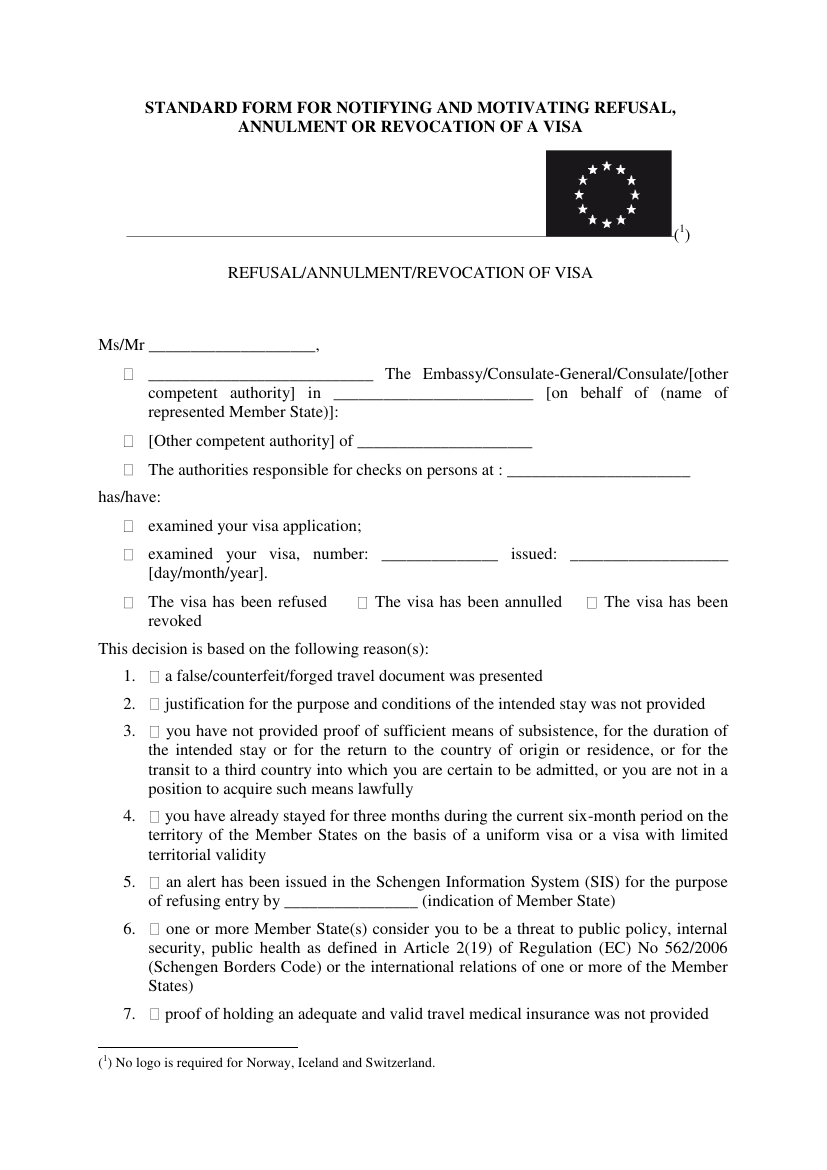
Source: European External Action Service — official Annex VI form
A practical reading habit: photograph the letter immediately, then transcribe every ticked number and the entire "rights of appeal" paragraph into your notes. The numbered items are not decoration; they are the exact claims you must overturn on appeal or repair on reapplication. If two boxes are ticked, you have two separate problems, and fixing only one produces a second refusal.
The Official List: All 11 Grounds in Plain English
The standard EU form contains exactly eleven numbered items, and item 11 is not even a refusal ground against you. Here is the full list from the official form, translated into plain English.
| Number | What the form says | What it means in practice |
|---|---|---|
| 1 | False or forged travel document | A document in your file was fake, altered, or suspected of being either |
| 2 | Justification for purpose and conditions of stay not provided | You did not prove why you are going or how the trip is organized |
| 3 | No proof of sufficient means of subsistence | Your money did not credibly cover the stay and the return trip |
| 4 | You already stayed 90 days in any 180-day period | Your visa history shows the 90/180 rule was already exhausted |
| 5 | Alert in the Schengen Information System for refusal of entry | An SIS alert exists in your name, independent of this application |
| 6 | Threat to public policy, internal security or international relations | A security, criminal-record or sanctions-based ground |
| 7 | No valid travel medical insurance | You had no qualifying insurance or it did not match the trip |
| 8 | Information on purpose and conditions of stay was not reliable | Your story contained contradictions the officer could not reconcile |
| 9 | Intention to leave before expiry could not be ascertained | Your ties to home, job or studies were too weak to predict return |
| 10 | Border application: impossibility of applying in advance not established | You asked for a visa at the border without proving you could not apply earlier |
| 11 | Visa annulled or withdrawn at holder's request | You cancelled it yourself; not a ground used against you |
Read the table twice before panicking. Items 2, 3, 7 and 8 are documentation problems, and documentation problems are fixable in weeks. Items 5 and 6 are status problems that need legal advice rather than a thicker file. Item 4 is arithmetic, and item 10 only exists for applications made at the border.
Is There a Reason 12 or Reason 13? The Honest Answer
No item above 11 exists on the current standard EU refusal form. The numbered grounds run from 1 to 10 for refusals, with 11 reserved for withdrawal at the holder's request, and the official Annex VI form linked above is the document to verify that claim yourself.
So where do the famous "reason 12" and "reason 13" come from? Some consulates attach national annexes or locally formatted letters whose numbering differs from the standard form, and agents then generalize one country's layout into universal folklore. The threads that built the myth usually describe an item meaning something like "other reasons" or document inconsistencies, which map onto items 8 and 2 of the standard form.
The method that never fails: match your letter against the official form item by item. If your letter shows a number above 11, the legal text printed next to that number, not the number itself, tells you what happened. Quote that text, not the number, in any appeal or new application, and check it against the Visa Code on EUR-Lex.
Reason 8 vs Reason 9 vs Reason 10: The Distinction That Decides Your Next Move
Items 8, 9 and 10 sound similar and are routinely confused, yet they demand opposite responses. Item 8 says your information was unreliable, item 9 says your intention to return was unproven, and item 10 says you applied at the border without justifying why you could not apply in advance. Misdiagnosing one as another is the fastest route to a second refusal.
| Ground | The officer's actual doubt | What it demands from you |
|---|---|---|
| 8, unreliable information | Your invitation, bookings, employer letter or dates contradicted each other | One consistent story across every document, then a fresh application |
| 9, intention to leave not ascertained | Nothing anchored you to home: no job, enrollment, family role or assets | Stronger proof of ties, and often a written appeal if ties existed but were ignored |
| 10, border application | You requested a visa at the border, which is exceptional | Apply at a consulate well before travel next time; the ground usually disappears |
Item 8 is the most curable, because contradictions are documentary and a reorganized file removes them. Item 9 is the most demanding, because the officer judged your life circumstances, not your paperwork, and only new evidence such as an employment contract, a next-semester enrollment or a sponsor structure changes that judgment. Item 10 is procedural and cures itself once you apply through the normal channel.
How Common Is Refusal? The Official 2025 Numbers
A Schengen visa refusal is common enough that you should treat it as a recoverable setback, not a life sentence. The European Commission's published statistics for 2025 count more than 12 million applications, a 4.3 percent rise on the 11.7 million of 2024 though still below the 17 million of 2019, with over 10 million visas issued and a global refusal rate of 14.6 percent, down from 14.8 percent the year before.
Source: European Commission, Directorate-General for Migration and Home Affairs
The country-level spread matters more than the global rate. Refusal rates in 2025 included Senegal at 51.9 percent, Burundi at 53.4 percent, the Democratic Republic of Congo at 40.1 percent, Ethiopia at 34 percent, Algeria at 31 percent, Cabo Verde at 21.4 percent and Russia at 6.4 percent. The highest-volume applicants were China with 1.9 million, Turkey with 1.26 million, India with 1.15 million, Russia with 679,000 and Morocco with 620,000 applications, and 51.7 percent of issued visas were multiple-entry.
Two honest conclusions follow from these numbers. First, a refusal places you inside a very large group of ordinary applicants, not on a blacklist. Second, refusal rates differ enormously by consulate and nationality, so your benchmark is your own consulate's rate, not the global average, and the Commission publishes those detailed files for every consular post.
Appeal or Reapply: The Decision Matrix
Appeal when the decision looks legally wrong, reapply when the file was weak, and get legal advice when the ground is security-based. That single sentence resolves most dilemmas, and the matrix below applies it to each numbered ground.
| Your ticked ground | Better first move | Why it wins |
|---|---|---|
| 1, forged document | Correct the document and reapply; legal advice if the forgery was not yours | Appeals rarely overturn forgery findings; clean documents do |
| 2, 3 or 7, missing proof | Reapply quickly with the missing pieces | The doubt was documentary, and the right papers dissolve it |
| 8, unreliable information | Reapply after rebuilding consistency | The contradiction, not the outcome, was the problem |
| 9, return not ascertained | Appeal in writing if your ties were real but ignored; otherwise reapply with stronger ties | A refusal under 9 is a judgment call, the one ground where arguing it can work |
| 5 or 6, SIS alert or security | Consult a lawyer before either move | These grounds involve records and law, not file thickness |
| 10, border application | Apply in advance at a consulate | The ground disappears when the procedure is used correctly |
On appeals, the law is precise and your letter is the source of truth. Article 32(3) of the Visa Code obliges the member state to inform you of the competent authority, the procedure and the time limit, which is why every properly issued letter prints all three. Use the country's official portal rather than agents: France centralizes the process through France-Visas, and Spain publishes its procedures on the Ministry of Foreign Affairs site. Never trust anyone who promises a guaranteed reversal or quotes you a fixed "official" appeal fee, because both vary by country and are stated only by the authority on your letter.
Timing interacts with your travel date, so be blunt with yourself. If your trip is within weeks, an appeal rarely concludes in time, and a corrected new application is usually the faster route. If you have months, an appeal can run in parallel while you strengthen the file for a possible reapplication.
Strengthening Your File Item by Item
Whatever the ticked ground, your next file must visibly answer it. The table below maps each ground to the documents that change the outcome, and every row is something you can assemble yourself.
| Ticked ground | Add or fix in the next application |
|---|---|
| 1 | Genuine documents only, with certified copies and a certified translation for anything not in a consular language; see certified translation for academic documents |
| 2 | A concrete invitation or acceptance letter, a day-by-day itinerary, and proof of every booking |
| 3 | Six months of bank statements with a stable balance, plus a sponsor letter with the sponsor's documents |
| 4 | A calendar calculation showing your 90/180 allowance before the new dates |
| 5 | Legal advice on the SIS alert itself before applying anywhere in Schengen |
| 6 | Written legal counsel on the underlying record; more documents rarely help |
| 7 | A qualifying travel medical insurance policy, as covered in detail in Schengen travel insurance for students |
| 8 | One story told identically in the form, the invitation, the bookings and the employer letter |
| 9 | Employer letter with approved leave and a return date, next-semester enrollment, family or property ties |
| 10 | A pre-travel consulate application, which removes the ground entirely |
If the trip behind your refusal letter is a conference, volunteering or training program you have already been accepted to, Truescho's visa file pack exists for exactly this rebuild: for EUR 29 with 4-day delivery you get an embassy-specific document list, a cover letter in your name with your program details, an initial travel itinerary and accommodation plan, a review of your invitation letter and bank statement with gap alerts, and a visa form review. It does not book appointments or pay embassy fees, and no visa is guaranteed.
For a full rebuild from zero, the student visa documents checklist covers the complete file, and readers funding their studies through scholarships should keep the scholarship application documents guide beside it, since refusal grounds 2 and 3 are usually argued with exactly those admission and funding letters.
Does a Refusal Mark Your Passport or Follow You to the UK and the US?
No stamp, sticker or mark is placed in your passport after a refusal. The record lives in the Visa Information System, VIS, and the official visa application form's privacy statement says the application and the decision are stored there for five years. Schengen consulates see that record; border officials in London or New York do not query VIS directly, because the UK and the US run their own separate systems.
That separation comes with a duty. UK and US application forms ask their own questions about previous refusals, and the honest rule is to read each question literally and answer what it asks. An undisclosed refusal discovered later is treated as deception, which is far harder to overcome than the original refusal itself. Disclosed and explained, a Schengen refusal is a normal part of many successful UK and US files.
Within Schengen, the data-sharing is real. VIS carries the application history to every member state's consulates, and the Schengen Information System, item 5 on the form, is a separate alert database used for entry refusals. Applying to a different Schengen country after a refusal is legal and sometimes sensible, for example when your main destination genuinely changed, but "consulate shopping" without fixing the ticked ground usually produces a second refusal, because the same record and the same weakness travel with you.
Frequently Asked Questions
How long does a Schengen visa appeal take?
There is no EU-wide duration; each member state's authority states its own procedure and time limit on the refusal letter itself. Backlogs vary by country and by season. If your travel date is close, plan a corrected new application in parallel instead of betting the trip on the appeal.
Can I apply to a different Schengen country after a refusal?
Yes, it is legal, and it makes sense when your genuine main destination changed. But every Schengen consulate sees your VIS record for five years, so the refusal ground itself must be answered in the new file. Switching embassies without changing anything usually ends in a second refusal.
Will a Schengen refusal affect my UK or US visa application?
Not automatically, because the UK and the US do not sit in the Visa Information System. Their forms ask their own questions about past refusals, and you must answer those questions truthfully. An explained refusal is survivable; a discovered omission is treated as deception.
Which refusal reason is the most serious?
Items 5 and 6, the SIS alert and the security grounds, are the serious ones, because they rest on records and law rather than paperwork. Items 2, 3, 7 and 8 are the most common and the most fixable with a rebuilt file. Item 9 sits between them and responds best to genuinely stronger ties to your home country.
Our Verdict
Read your letter, believe your letter. The ticked boxes, not forum numbering myths, define what went wrong, and the appeal authority printed on the letter is the only deadline you should trust. If the ground was documentary, rebuild and reapply, because most grounds are exactly that. If the ground was a judgment about your ties or a security record, weigh a written appeal with the exact wording from your own letter, and spend your energy on the file, not on the folklore.
Want someone to take this step off your plate? Truescho's visa file pack reviews your invitation letter and bank statement, flags the gaps, and rebuilds your cover letter and itinerary in your name for your next application.
While you retool the file, browse open funded programs worth attaching to a stronger application, and see the fully funded scholarships roadmap for building the admission and funding letters that answer grounds 2 and 3.