
Saudi Arabia Work Visa Quotas 2026: 5 Instant Visas for New Companies and the 50-Worker Cap for Older Firms
Last updated: September 2026
It is a Tuesday evening in Riyadh, and a founder — let's call her Amira — opens the Qiwa platform on her laptop to request work visas for the twelve foreign staff her fourteen-month-old logistics company needs. The system returns a number she did not expect: 5. What she has run into is the Saudi work visa quota rules that took shape in 2026, announced through Qiwa in June and rippling through boardrooms from Mumbai to Manila to Lagos by late August. If you hire in the Kingdom, or you plan to, this guide is for you.
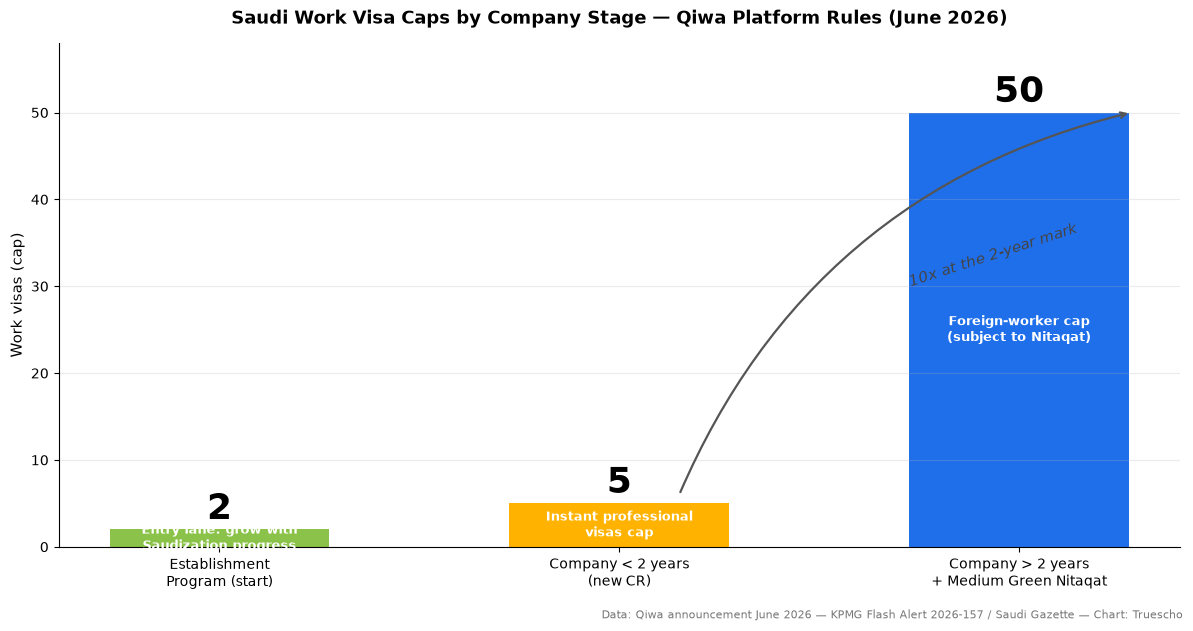
The new framework ties the number of instant work visas a company can issue to one simple variable: how long the establishment has existed. Firms younger than two years can secure up to 5 instant visas; firms older than two years can recruit up to 50 foreign workers; and companies in the Establishment Programme start from 2 visas and grow with their Saudization performance. Below is how to calculate your own number, the ten conditions you must satisfy, the mistakes that freeze hiring, and the workarounds that keep a young company moving.
The short answer: your cap depends on your company's age
Under the Saudi work visa quota rules announced for 2026, every establishment that recruits from abroad falls into one of three categories. The caps are hard limits on instant visa issuance through Qiwa, the Ministry of Human Resources and Social Development platform that replaced scattered paper processes. Here is the complete mapping.
| Company profile | Instant visa cap |
|---|---|
| Younger than 2 years | Up to 5 instant visas |
| Older than 2 years | Up to 50 foreign workers (one request or several within the same week, at establishment level) |
| Registered in the Establishment Programme | Starts at 2, expands as Nitaqat band and Saudization improve |
The rule was announced via the Qiwa platform in June 2026 — Saudi Gazette reported it on 17 June, and KPMG documented it in Flash Alert 2026-157 the same month. It was not a separate ministerial decree with a regulation number; it is platform policy, which is why law firms like Meysan noted the absence of a published decree while confirming the numbers. The international coverage wave came later, between 25 and 31 August, when outlets from India's Economic Times and NDTV Profit to Nigeria's BusinessDay and Legit, Pakistan's ProPakistani and Kenya's Tuko all picked it up.
One correction is worth making loudly, because a lot of the August coverage compressed it: the 50 cap is not universal. It belongs to establishments older than two years. A newly registered company reading headlines about "50 visas" and planning a recruitment drive will discover the real ceiling is 5 — a tenfold difference that has redrawn hiring plans for foreign investors opening Saudi branches, the group Meysan identified as hardest hit.

Source: Ministry of Human Resources and Social Development
What changed compared with the old system
Before June 2026, Saudi Arabia did not impose visa caps based on how long a business had been operating — a point Nairametrics highlighted in explaining what is genuinely new. Recruitment capacity was governed by your Nitaqat band, your compliance record and your line of business, but not by a birthday clock. The new rules bolt an age test onto that machinery.
The result is that foreign recruitment capacity is now tied to Saudization performance from day one, as visa-news trackers have described it. A young company cannot simply buy its way to a large foreign workforce in year one; it proves itself through the Establishment Programme, improves its Nitaqat band, and unlocks larger caps as it matures and hires Saudi nationals. The two-year threshold then acts as a graduation gate to the 50-worker ceiling.
For employers, the practical consequence is sequencing. Headcount plans that assumed "incorporate, then import a full team" need to become "incorporate with a lean foreign core, build Saudization credentials, then scale past the two-year mark." For recruitment agencies in India, the Philippines, Pakistan, Egypt and Nigeria placing workers into the Kingdom, it means client expectations must be reset at contract stage, not after a rejected Qiwa request.
How to calculate your company's quota on Qiwa: four steps
You can compute your own visa ceiling in under ten minutes if you have your commercial registration details to hand. The calculation is deterministic — the same inputs always produce the same cap — and knowing it before you file prevents the most common failure mode: a request that exceeds your category. Work through the steps in order.
- Confirm your establishment's status. Pull up your commercial registration (the CR) and check the issuance date. That date starts the two-year clock: if your CR is younger than 24 months, your instant-visa ceiling is 5; if it is older, you may request up to 50 foreign workers. While you are there, confirm the registration is valid and the establishment is recorded as active — an expired or inactive CR blocks everything downstream.
- Check your Nitaqat band. Log in to Qiwa and read your current colour under the Nitaqat system. Recruiting foreign workers requires Medium Green or higher, and your band also controls how your cap grows within the Establishment Programme. If you are below Medium Green, no quota arithmetic matters until the band improves — start with our full explainer on Nitaqat and Saudization in 2026.
- Run the ten-condition audit. Before any request, walk the checklist in the next section. Most rejected applications die on conditions two through five — expired existing work permits, a lapsed CR, WPS gaps or an empty Absher/Muqeem wallet — not on the quota itself.
- Size your request against the cap and file. For an older firm, remember the 50 is measured at establishment level across one request or multiple requests within the same week; splitting filings across weeks to dodge the ceiling is exactly the pattern the platform watches. For a young firm, plan the 5 slots around genuinely critical roles, and use the alternatives later in this guide for everything else.

Source: Saudi Press Agency
The ten conditions to recruit foreign workers through Qiwa
Every instant visa request through Qiwa must clear the same ten conditions, which visa trackers and the Meysan analysis compiled from the platform's requirements. Print this list and audit yourself before filing — satisfied conditions are invisible, but a single failed one surfaces as a rejected request and a delayed hire. They apply to all establishments, regardless of age category.
- The establishment must be active in the Qiwa system.
- Work permits for all current employees must be valid and unexpired.
- A valid commercial register — the CR must not be lapsed.
- A Nitaqat band of Medium Green or higher.
- Compliance with the Wages Protection System (WPS) — salary payments filed on time.
- A sufficient balance in the linked Absher/Muqeem wallet to cover fees, held in riyals.
- Completion of the annual self-assessment for establishments with ten or more employees.
- All work locations registered in Qiwa.
- The work owner must be at least 18 years old.
- An available quota for the requested visa type and category.
Notice how the list mixes one-off items (CR validity, age) with ongoing disciplines (WPS filings, permit renewals, wallet balance). The ongoing ones are where established firms stumble: a single late WPS filing cycle or an unnoticed permit expiry can freeze new recruitment even for a company that comfortably clears its category cap. Treat conditions two through six as a monthly compliance ritual, not a pre-application errand.
The three visa types the caps sit on top of
The caps announced in June 2026 attach to Qiwa's instant visa channel — the professional, employment-oriented visas used to bring workers in from abroad. Within that channel the platform distinguishes three types, and choosing the right one is part of using your quota well. Each type serves a different contract shape.
Permanent work visas are the standard instrument for open-ended employment — the visas a growing company burns its 5 or 50 slots on. Temporary work visas, valid for up to three months, serve defined short engagements: a commissioning project, a seasonal peak, a specialist intervention. Hajj and Umrah visas are a separate seasonal category issued with ministry approval for religious-season work and sit outside ordinary corporate planning.
The temporary track deserves particular attention from young companies, and we return to it in the alternatives section, because three-month visas are the classic pressure valve when the instant-visa cap is the binding constraint. The conditions list applies across the channel, so compliance hygiene is universal — but the strategic question of which visa type to spend a slot on is uniquely yours.
Source: HRSD Ministry YouTube channel
The growth path: how a cap moves from 2 to 5 to 50
Read as a timeline rather than a list of restrictions, the new system describes a progression any patient operator can climb. It rewards exactly the behaviour Saudi labour policy has pushed for a decade — Saudi hiring, wage compliance, real premises — and prices impatience in visas foregone. Here is the arc in three stages.
A company that registers under the Establishment Programme begins with an allocation of 2 instant visas. As it hires Saudi nationals and its Nitaqat band strengthens, the allocation expands from day one — the platform lifts recruitment capacity in step with Saudization performance, not after a waiting period. This is the proving ground where disciplined newcomers differentiate themselves from shell registrations.
At the two-year mark, the establishment graduates into the senior category and its ceiling jumps to 50 foreign workers. That is a tenfold increase on the young-firm cap, and it is why the smartest hiring plans we see front-load Saudi recruitment in years one and two: the company arrives at its second birthday with a strong Nitaqat band, a clean ten-condition record, and immediate access to the full 50, rather than arriving compliant-but-throttled.
The system also punishes drift in both directions. An older firm that lets its band slip below Medium Green loses the ability to recruit at all, cap notwithstanding. A young firm that burns all 5 slots in week one on junior roles, without securing its Saudization trajectory, arrives at the expansion gate with nothing left to hire the managers who would have improved the band. Quota strategy is succession planning.
A Lagos-founded logistics company learns its number
Tunde Adeyemi founded his logistics company in Lagos in 2019, and in July 2025 — fourteen months before this article — he registered its Riyadh branch to chase Saudi contract work. His plan, built with his recruitment partner in Lagos and an agency in Manila, assumed twelve foreign staff in year one: seven drivers, three warehouse operatives and two operations supervisors. Then he opened Qiwa and met the number 5.
The arithmetic was unforgiving. His establishment is younger than two years, so his instant-visa ceiling is 5 — covering barely two-fifths of the planned intake, and not even all seven drivers. Filing for twelve would have produced rejections; filing for five meant choosing which roles to protect. He kept the five slots for the supervisors and the two most senior drivers, the roles where continuity genuinely mattered.
For the remainder, he rebuilt the plan around the system instead of against it. Seasonal peaks get three-month temporary work visas rather than permanent ones. Short commissioning visits run on the business visit visa he previously overlooked. A marketing designer moved onto a freelance permit through Qiwa instead of a work visa altogether. And in July 2027, when the branch passes its second birthday, his ceiling steps from 5 to 50 — at which point the original twelve-person plan fits with room to spare, provided his Nitaqat band and WPS record hold.
His summary, in his own words to his board, is the cleanest one-line description of the reform we have heard: "The Kingdom will sell you a big workforce, but only after it has watched you build a real company." For a fuller picture of the visa itself — documents, process, timelines — see our complete Saudi work visa guide, and for a regional comparison, our guide to UAE work permit types in 2026.
Common mistakes employers make with the 2026 caps
Most quota problems we see are self-inflicted and avoidable with a monthly half-hour of admin. The patterns repeat across nationalities, industries and company sizes, which suggests the rules' logic — not their complexity — is what catches people out. Audit your own operation against this list before it audits you.
- Assuming the 50 cap is universal. The August headlines buried the lede: 50 belongs to firms older than two years. Young companies planning around 50 discover 5 at the moment of filing.
- Letting Nitaqat slip below Medium Green. The band is the gate through which every cap passes. A firm at Red or Low Green with perfect paperwork still cannot recruit.
- Carrying expired work permits on existing staff. Condition two is unforgiving: one lapsed permit freezes new requests until it is renewed.
- Gaps in WPS filings. Late or missing salary records under the Wages Protection System read as non-compliance, not as an accounting footnote.
- Spending the whole quota in one week. For older firms the 50 is measured across requests within the same week at establishment level; for young firms, exhausting all 5 slots early leaves nothing for the roles you have not anticipated yet.
- Unregistered work locations. Condition eight requires every operating site to appear in Qiwa — a common miss for companies that moved or added a warehouse without updating the platform.
- Skipping the self-assessment. Establishments with ten or more employees must complete the annual self-assessment; it takes minutes and its absence takes months to unwind.
Smart alternatives while your company is young
A cap of five instant visas constrains permanent foreign hires — it does not criminalise getting work done. The Kingdom's wider toolkit, assembled over several reform cycles, offers legitimate routes for short, specialised or freelance-shaped work that never touch your quota. The skill is matching the route to the actual shape of the need.
For short projects, the temporary work visa of up to three months is the natural fit — commissioning, installations, audits, seasonal logistics peaks. For meetings, inspections and negotiations, the business visit visa covers entry without any employment pretence, and misuse of it is the fastest way to complicate future applications. For individual specialists — designers, developers, consultants — the freelance permit lets a person work legitimately under their own registration rather than yours.
Two structural options sit above these. Outsourced staffing through licensed Saudi providers moves the workers onto someone else's establishment and their quota, at a premium. And if your business model genuinely cannot wait for the two-year gate, the question worth asking with your advisors is whether a partnership with an established Saudi entity reaches the market faster than a subsidiary does — the older partner's 50-worker ceiling is part of what it brings to the table.
On the other side of these caps are the workers themselves — engineers, drivers, technicians and supervisors across India, the Philippines, Pakistan, Egypt, Nigeria and beyond tracking Gulf openings weekly. Live roles carrying Saudi and wider Gulf hiring appear continuously in the Truescho opportunities feed, which is also where many candidates first encounter the quota realities their employers are managing.
Questions employers ask about the 2026 Saudi visa caps
How many work visas can a new company get in Saudi Arabia?
A company younger than two years can secure up to 5 instant work visas through Qiwa under the rules announced in June 2026. That cap covers the professional instant-visa channel for recruiting from abroad. Additional capacity must come from the Establishment Programme path, alternatives like temporary visas, or waiting for the two-year graduation.
Can a new business hire more than 5 foreign workers in Saudi Arabia?
Not through the instant-visa channel — but yes in practice, using the right instruments. Temporary work visas of up to three months, business visit visas, freelance permits and outsourced staffing through licensed providers all add capacity without breaching the cap. Saudi nationals you hire are, of course, outside these limits entirely.
What is the visa quota for companies older than two years?
Establishments older than two years can recruit up to 50 foreign workers, whether in a single request or multiple requests within the same week, measured at establishment level. The cap assumes the ten Qiwa conditions hold, including a Nitaqat band of Medium Green or higher and current WPS compliance.
What Nitaqat level is required to recruit foreign workers?
Medium Green or higher under the Nitaqat colour bands. Nitaqat scores your Saudization performance — the share and quality of Saudi nationals on your payroll — and the band also governs how your allocation grows within the Establishment Programme. Below Medium Green, no amount of quota helps.
What is Qiwa and how does it issue instant work visas?
Qiwa is the Ministry of Human Resources and Social Development's digital platform for labour services — permits, quotas, contracts and establishment records. "Instant" work visas are issued electronically through it once your establishment passes the ten-condition check, your category cap allows the request and your Absher/Muqeem wallet holds sufficient funds for the fees.
What is the Establishment Programme visa allocation?
Companies enrolled in the Establishment Programme start with an allocation of 2 instant visas. The allocation expands as the company's Nitaqat band and Saudization ratio improve, effectively from day one of better performance. The programme is designed to let genuine new businesses begin hiring immediately, then scale lawfully.
How does Saudization affect work visa quotas in 2026?
Directly: foreign recruitment capacity is now tied to Saudization performance from day one. Better Nitaqat bands unlock larger allocations within the Establishment Programme, while weak bands can suspend recruitment altogether. Hiring Saudi nationals is no longer just a compliance cost — it is the mechanism that expands your foreign-hiring ceiling.
When did the new visa quota rules take effect?
The caps were announced through the Qiwa platform in June 2026, reported by Saudi Gazette on 17 June and documented by KPMG in Flash Alert 2026-157. International awareness peaked between 25 and 31 August as coverage spread through Indian, Nigerian, Pakistani and Kenyan media. The announcement came via the platform itself, not a separate published decree.
Before your next Qiwa session: an executive checklist
Run this list the day before any planned filing, and again on the first business day of each month. It compresses everything above into five minutes of verification that protects weeks of hiring timeline.
- Confirm the commercial registration date — know whether you are in the 5 category or the 50 category today, and diary the two-year graduation date if it is approaching.
- Read your current Nitaqat band; if it is at or near Medium Green, fix the underlying Saudi-hiring ratio before filing anything.
- Walk the ten conditions in order, with special attention to existing work-permit expiry dates and the latest WPS filing.
- Top up the Absher/Muqeem wallet in riyals and confirm every operating location is registered in Qiwa.
- Match each planned hire to the right instrument: permanent slot, three-month temporary visa, business visit visa, freelance permit or outsourced staffing.
- For establishments with ten or more employees, verify the annual self-assessment is complete and current.
- Re-check Qiwa's announcements page — the platform iterates, and the caps described here are the June 2026 state of a moving system.
Sources
- KPMG Flash Alert 2026-157 (PDF)
- Saudi Gazette
- Nairametrics — news coverage of the June 2026 Qiwa cap announcement
- Qiwa platform
- Ministry of Human Resources and Social Development
Additional reporting and requirements compilation: visasupdate and Saudi-Expatriates.