
Kafala Transfer in Saudi Arabia 2026: Steps, Fees, and Qiwa Rules Explained
Last updated: August 2026
You have a signed offer from a new employer in Riyadh, but your work permit and residency are still tied to your current sponsor. What now? In 2026, a kafala transfer in Saudi Arabia is a largely electronic process handled through the Qiwa platform and Absher Business, costs a transfer of services fee of about 2,000 SAR (approx. USD 530), and, in one clearly defined situation, can be completed without your current employer's consent. This guide walks through both transfer routes, every condition, the real fees, and what to do if a sponsor refuses to release you.
The rules changed meaningfully in March 2021, when the job mobility initiative gave expatriate workers a legal path to change employers at the end of a contract without begging for a release letter. Since then, the integration between Qiwa, Absher Business, and the passport authority has made the process close to fully electronic, with wage protection records and authenticated contracts linked to every transfer. Most guides still describe only the old consent-based route. This one covers both, plus the employer-side rules that quietly decide whether a transfer succeeds.
What a Kafala Transfer Actually Is
Under Saudi Arabia's sponsorship rules, an expatriate worker's legal status is attached to a specific employer, the sponsor. A kafala transfer, officially called a transfer of services, moves that sponsorship from one establishment to another: your work permit, residency record, and employment contract all switch to the new employer without you having to leave the country.
Three official systems run the process. Qiwa, the Ministry of Human Resources and Social Development's platform for labor services, hosts the Employee Transfer Service where offers and contracts live. Absher Business is where employers manage and approve transfer requests. And the Nitaqat Saudization program determines whether the receiving establishment is even allowed to open its door to you, through something called a transfer budget.

Source: Saudi Ministry of Human Resources and Social Development
One point that confuses newcomers: the contract documented on Qiwa is the legal reference for everything. If your paper contract says one thing and your Qiwa contract says another, the platform version is what the transfer process reads. Workers arriving on a new contract often meet this system for the first time during the Saudi work visa process, and it follows them through every job change afterward.
Two Routes to Transfer: Mutual Consent and Job Mobility
Every kafala transfer in Saudi Arabia follows one of two routes, and knowing which one applies to you is the single most important step in the process. The first is the classic mutual consent route: your current employer electronically approves your release. The second is the job mobility route introduced in March 2021: when your contract has ended, you can move without that approval, subject to a notice period.
| Point | Mutual consent transfer | Job mobility transfer |
|---|---|---|
| Current employer's approval | Required, given electronically via Absher Business | Not required once the contract has ended |
| When it can be used | Any time, if the employer agrees | At the end of the contractual relationship |
| Notice requirement | Timing is agreed between the parties | 60 days' notice on open-ended contracts |
| Employer's counter-right | Governed by the contract itself | Compensation claim, capped at one month's wage per remaining contract year, up to two months' total |
| Worker's status requirement | On duty, clean record, no absence or absconding flag | Same requirements apply |
| Contract on Qiwa | New contract must be authenticated | Same; expiry of the old contract is the trigger |
| Where the request lives | Qiwa Employee Transfer Service | Qiwa job mobility service |
The compensation rule in the second column deserves attention, because it is the part most often misunderstood. A former employer cannot block a qualifying job mobility transfer, but the rules do preserve a reduced right to compensation: up to one month's salary for each year remaining on the contract term, with a hard cap of two months' salary in total. It is a payment mechanism, not a veto.
The Six Conditions Every Transfer Must Meet
Whether you use the consent route or the mobility route, the platforms check the same underlying conditions. Failing any one of them pauses the transfer until it is fixed.
- Approval or a qualifying exception. Either the current employer consents electronically, or you qualify for the job mobility route because the contractual relationship has ended.
- The employment relationship is over, or both parties agree to end it. The Qiwa-documented contract is the reference point for whether the relationship has genuinely concluded.
- The worker is on duty and in good standing. A worker flagged as absent or absconding cannot transfer. If your status has been wrongly reported, that report must be resolved first.
- The current establishment's government dues are settled. Outstanding fees or expired work permits on the current employer's account will block the release.
- The receiving establishment has a transfer budget. Its Nitaqat band must allow it to absorb another transfer. In practice, establishments at Low Green and above are the realistic targets for expansion hiring.
- The new contract is authenticated on Qiwa before the new work permit is issued.
Notice that most of these conditions sit on the employer side of the table. That is why smart workers check the receiving employer's standing before resigning anywhere, and why smart employers clean up their government account before making an offer they cannot process.
The Kafala Transfer Process Step by Step
The mutual consent route, which is still the most common path, runs through seven electronic stages. None of them require a paper form or a visit to a government office in the classic sense; everything happens inside the platforms.
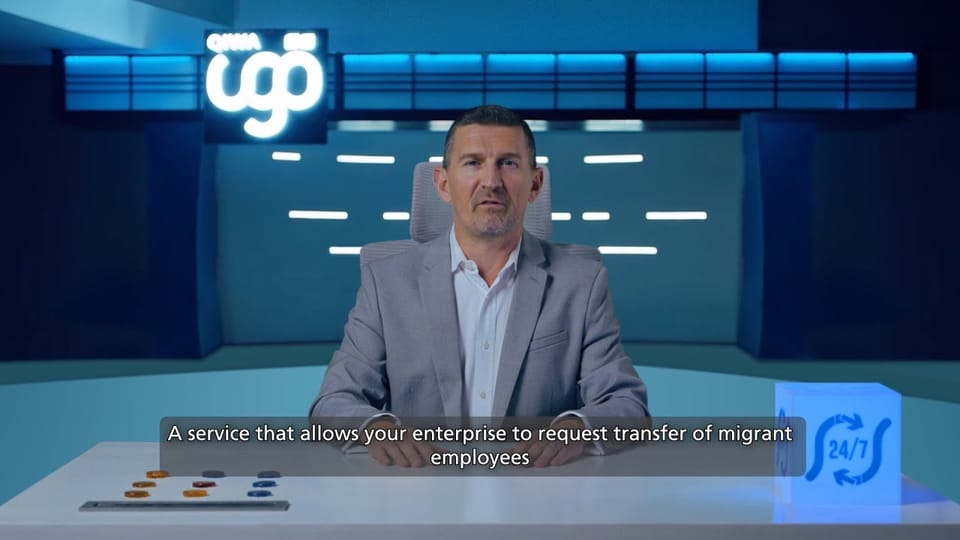
Source: Qiwa official YouTube channel
Step 1: The new employer issues an offer on Qiwa. The receiving establishment initiates the process by sending a formal job offer through the platform. This offer is not a casual email; it is the document that opens the transfer file.
Step 2: The worker accepts. You review the offer, including the wage that will later become the basis for your end of service entitlements, and accept it electronically. Acceptance signals to both establishments that a transfer is in motion.
Step 3: The new establishment files the transfer request. Through the Employee Transfer Service, the receiving employer formally requests the transfer of your services from the current sponsor.
Step 4: The current employer responds. Under the consent route, the current sponsor approves through Absher Business. Under the job mobility route, the objection window simply runs out once notice requirements are satisfied.
Step 5: Government fees are settled. The transfer of services fee of about 2,000 SAR is paid as part of the receiving establishment's work permit charges, along with any related permit fees for the new sponsorship.
Step 6: The new contract is authenticated on Qiwa. The contract becomes the legal basis of the new relationship. Until authentication is complete, the permit will not issue.
Step 7: Status is updated and the residency follows. The worker's record is switched across the connected systems, and the iqama is issued or amended under the new sponsor. If you are planning further status changes, our guide to renewing your iqama explains what comes next.
How long does all of this take? In smooth cases, the electronic stages complete within days. Realistically, from offer to fully transferred sponsorship, expect anywhere from a few days to two to four weeks, depending mainly on how fast approvals move and how clean both employers' accounts are.
The 60-Day Notice Rule for Job Mobility
The job mobility initiative is the closest thing Saudi labor rules have to a release valve for expatriate workers, and it deserves a precise explanation because so much misinformation surrounds it. The rule does not say you can walk out of a running contract whenever you like. What it says is narrower and more useful: when the contractual relationship has ended, you may transfer to a new employer through Qiwa without the former employer's approval.
For workers on open-ended contracts, the mechanism is a 60-day notice submitted through the job mobility service. During that window the current employer can review the request and raise whatever compensation claim the rules allow, but cannot hold the worker hostage indefinitely. Once the window closes and conditions are met, the transfer proceeds.
Three practical points make or break a mobility case. First, the old contract must genuinely have reached its end; a fixed-term worker who tries to leave midway will be pushed back to the consent route. Second, the worker's record must be clean, because an absconding flag suspends everything. Third, the former employer's compensation right is capped, which turns the negotiation from an open-ended demand into a bounded calculation.
Workers weighing a move sometimes ask whether a complete exit from the sponsorship system exists. It does, in the form of long-term residence products; our overview of premium residency options explains how they differ from employer sponsorship entirely.
Contract Authentication: The Step That Stalls Most Transfers
If there is one single bottleneck in the modern transfer process, it is contract authentication. The receiving establishment cannot finalize a work permit until the new employment contract is documented and authenticated on Qiwa, and the old contract's status matters just as much for mobility cases, because the platform reads the documented end date.
Source: Qiwa official YouTube channel
Authentication protects both sides. For the worker, the authenticated contract is the wage record that later supports end of service claims and dispute cases. For the employer, it is what keeps the establishment compliant with the wage protection linkage that now sits behind every transfer. Deals done on unsigned side letters simply do not exist as far as the transfer system is concerned.
What a Kafala Transfer Costs in 2026
The published fee attached to the transfer itself is the transfer of services charge of about 2,000 SAR per worker, stable for years and collected as part of the receiving establishment's work permit fees through Qiwa and Absher Business. Around it sit the ordinary costs of a new work permit, and, if you compare against the alternative, the much heavier costs of a fresh visa from abroad.
| Cost item | Typical amount | Who pays it |
|---|---|---|
| Transfer of services fee | About 2,000 SAR (approx. USD 530) per worker | Receiving establishment |
| New work permit charges | Set per official portals, billed with the permit | Receiving establishment |
| Iqama issuance or amendment after the transfer | Per official portals | Employer |
| Outstanding government dues on the current establishment | Must be settled before release | Current establishment |
| Fresh work visa route from abroad (the alternative) | Typically past 10,000 SAR all-in once permit, medical, and issuance fees stack up | Hiring company |
| Amount the worker should pay | Nothing; transfer fees are not the worker's legal burden | Not the worker |
Two warnings follow directly from the table. First, the fee comparison is why employers often prefer transferring a worker who is already in the Kingdom over flying someone in: a 2,000 SAR transfer against a visa bundle that typically runs into five figures. Second, if any employer proposes recovering these charges from your salary, that arrangement has no basis in the rules; the fees belong to the establishment. If you want a second pair of eyes on your paperwork before you commit to a move, Truescho consultants review transfer situations and employment documents as part of their work and residency advisory services.
Nitaqat Transfer Budget: The Gate on the Employer's Side
Nitaqat is Saudi Arabia's Saudization scoring system, and every establishment sits in a band that determines its privileges, including how many transfers it can absorb. This transfer budget, or transfer balance, is the number that decides whether a willing employer can actually receive you.
For workers, the practical takeaway is simple: before you resign or burn bridges anywhere, ask the prospective employer whether their transfer balance is open for your profession. Many failed transfers die not on the worker's side but on the receiving establishment's band, and no amount of document preparation fixes a closed balance. For a fuller picture of how establishments think about workforce structuring, our guide to hiring through an employer of record in the Gulf covers the alternatives companies use when direct sponsorship does not fit.
For employers, the budget logic rewards Saudization: the stronger the band, the more room to bring in transferred workers. In practice, establishments at Low Green and above are the ones expanding through transfers, which is why savvy candidates treat a company's Nitaqat standing as due diligence, not trivia.
What Happens When a Sponsor Refuses
Refusal scenarios split into two very different situations. If your contract has not ended and you are on the consent route, a refusal simply means there is no transfer yet: the employer's consent is a genuine requirement, and your leverage is negotiation, contract terms, and time. Resigning in frustration before securing a transfer is the single worst move, because it can leave you neither employed nor transferable.
If your contract has ended and you qualify for the mobility route, refusal is not the end of the road. The objection window is bounded, and once it closes with the conditions met, the transfer proceeds. Employers who dispute the terms can pursue their capped compensation, and workers who dispute bad-faith blocking, wage withholding, or false absence reports can take the matter to the labour court, which handles these disputes electronically.
Document everything. The authenticated contract, wage protection records, and the platform timestamps of your requests are the evidence the court reads. Workers often discover that a firm, polite reference to the electronic dispute route changes an employer's posture faster than weeks of argument.
A Realistic Timeline: A Nurse Moving From Jeddah to Riyadh
Consider an illustrative case built on the standard process. A nurse from Lagos finishes her second fixed-term contract at a hospital in Jeddah, four years of continuous service at a monthly wage of 14,000 SAR. A Riyadh hospital group wants her on a new contract. Because her contract has reached its end date, she qualifies for the job mobility route rather than needing the Jeddah hospital's blessing.
Her sequence looks like this: the Riyadh group issues the offer on Qiwa and she accepts; the transfer request is filed; the notice and objection window runs its course over the following weeks; the receiving hospital settles the roughly 2,000 SAR transfer fee within its work permit charges; the new contract is authenticated; and her sponsorship and residency flip to the Riyadh establishment. Total elapsed time: about five to six weeks, which sits comfortably inside the typical range of days to four weeks for the electronic stages plus notice.
One more thing happens before she moves: her four years of service entitle her to a full end of service payment from the Jeddah hospital, roughly 28,000 SAR at half a month per year, because her fixed-term contract expired rather than being abandoned. The calculation rules, resignation tiers, and employer obligations behind that number are covered in detail in our guide to the Saudi end of service benefit, and every transferring worker should run those numbers before switching sponsors.
Mistakes That Delay or Block Transfers
Starting the move before the contract ends. The mobility route needs a concluded relationship. Mid-contract departures require consent, full stop.
Leaving contract authentication to the end. The new permit cannot issue without it, and haggling over terms at this stage freezes everything.
Ignoring the worker's status record. A disputed absence report or absconding flag suspends the transfer until cleared, and clearing it is far slower than preventing it.
Targeting an employer with a closed transfer balance. Their Nitaqat band decides absorbability. Ask before you resign anywhere.
Accepting fee deductions from salary. Transfer fees are the receiving establishment's burden; agreeing to repay them quietly is both unnecessary and unlawful.
Trusting verbal promises over the Qiwa record. If it is not in the authenticated contract, the system does not see it, and neither will a court.
Questions Expats Ask Before Transferring Sponsorship
How much is the kafala transfer fee in Saudi Arabia?
The transfer of services fee is about 2,000 SAR (approximately USD 530) per worker, charged as part of the receiving establishment's work permit fees through Qiwa and Absher Business. The figure has been stable for years and is the one published fee attached to the service, though related work permit and residency charges are settled separately by the employer.
Can I transfer my sponsorship without my employer's consent?
Yes, in one specific situation: when your contract has ended. Under the job mobility rules introduced in March 2021, a worker whose contractual relationship has concluded can move to a new employer through Qiwa without the former sponsor's approval, giving 60 days' notice on open-ended contracts. Mid-contract transfers still require the current employer's electronic consent.
How long does a Qiwa transfer of services take?
In straightforward cases the electronic stages complete within days, and the whole process typically takes from a few days up to two to four weeks. Speed depends on how quickly the current employer approves or the objection window closes, whether the new contract is authenticated on Qiwa, and whether the receiving establishment has an open Nitaqat transfer budget.
Who pays the transfer fee, the worker or the new employer?
The receiving employer does. The 2,000 SAR transfer fee and the associated work permit charges are the responsibility of the establishment hiring the worker, and deducting them from the worker's salary has no basis in the rules. If an employer proposes salary deductions for transfer fees, treat it as a warning sign.
What is the 60-day notice rule for job mobility in KSA?
Workers on open-ended contracts who change employers at the end of the employment relationship must give 60 days' notice through Qiwa's job mobility service. During this window the current employer can review the request. The former employer may also claim compensation, capped at one month's salary per remaining contract year, up to two months in total.
Can I change employers before my contract ends?
Not by your own decision alone. Before a fixed-term contract expires, a transfer needs the current employer's consent through Absher Business, with both sides agreeing to end the relationship. Attempting to force a move while the documented Qiwa contract is still running, outside the consent or mobility routes, will block the transfer.
What happens if my employer rejects the transfer request?
On the consent route, the transfer cannot proceed without approval, so negotiation comes first. If your contract has ended and you meet the job mobility conditions, the objection window eventually closes and the transfer proceeds anyway. Disputes over refusals, contract terms, or withheld dues can be taken to the labour court electronically.
Do I need to exit Saudi Arabia to change sponsorship?
No. A transfer of services moves your sponsorship between establishments inside the Kingdom, and your residency record is updated electronically once the process completes. Exiting and returning on a new work visa is a separate, typically far more expensive route used for new hires from abroad, not something residents need for a transfer.
Your Transfer Checklist Before You Start
Run through this list before you resign anywhere or sign anything. Confirm which route applies to you: consent or end-of-contract mobility. Verify your own status record is clean. Ask the receiving employer two questions: is your transfer balance open, and will the new contract be authenticated promptly? Agree in writing who bears the fees, knowing the rules already answer that question. And calculate the end of service dues your current employer owes you before the relationship closes, because leaving them unclaimed is the most common and most avoidable loss.
If you want experienced eyes on your situation before you move, the consultants listed on Truescho advise workers and employers on work and residency procedures across the Gulf. And if the transfer is part of a wider career search, the latest openings across the region are listed among Truescho opportunities.
References and Official Portals
- Qiwa Official Platform - the Ministry of Human Resources and Social Development platform hosting the Employee Transfer Service
- Ministry of Human Resources and Social Development - the authority regulating labor rules and transfer conditions
- Qiwa Official YouTube Channel - official video walkthroughs of the transfer and contract services