
On August 18, 2026, Replit announced a fundamental change to how its AI agent is priced and used: a new Free Mode inside Replit Agent, powered by OpenAI's GPT-5.6 Luna, letting Core subscribers create up to 30 times more than before without burning credits on everyday tasks. A day later, OpenAI published its own post on the partnership, confirming that recent GPT-5.6-series price cuts are what made the model viable at the scale of millions of users. The update targets the single most annoying part of AI app-building tools in 2026: watching a meter, rationing ideas, and fearing token burn on every small experiment. This in-depth guide explains what actually changed, runs the cost math for working professionals, compares the new mode with the alternatives, and states the honest limits before you pay anything.
Source: Replit's official blog
What is Free Mode, and what problem does it solve?
Before this update, using Replit Agent meant managing credits: every conversation, every idea, every small tweak consumed your balance, and users constantly weighed whether an idea was "worth" the credits. The official announcement describes the problem precisely: "using AI today still means choosing models, managing context, watching usage, and juggling a growing collection of sprawling tools. Intelligence is now abundant, but access remains complicated."
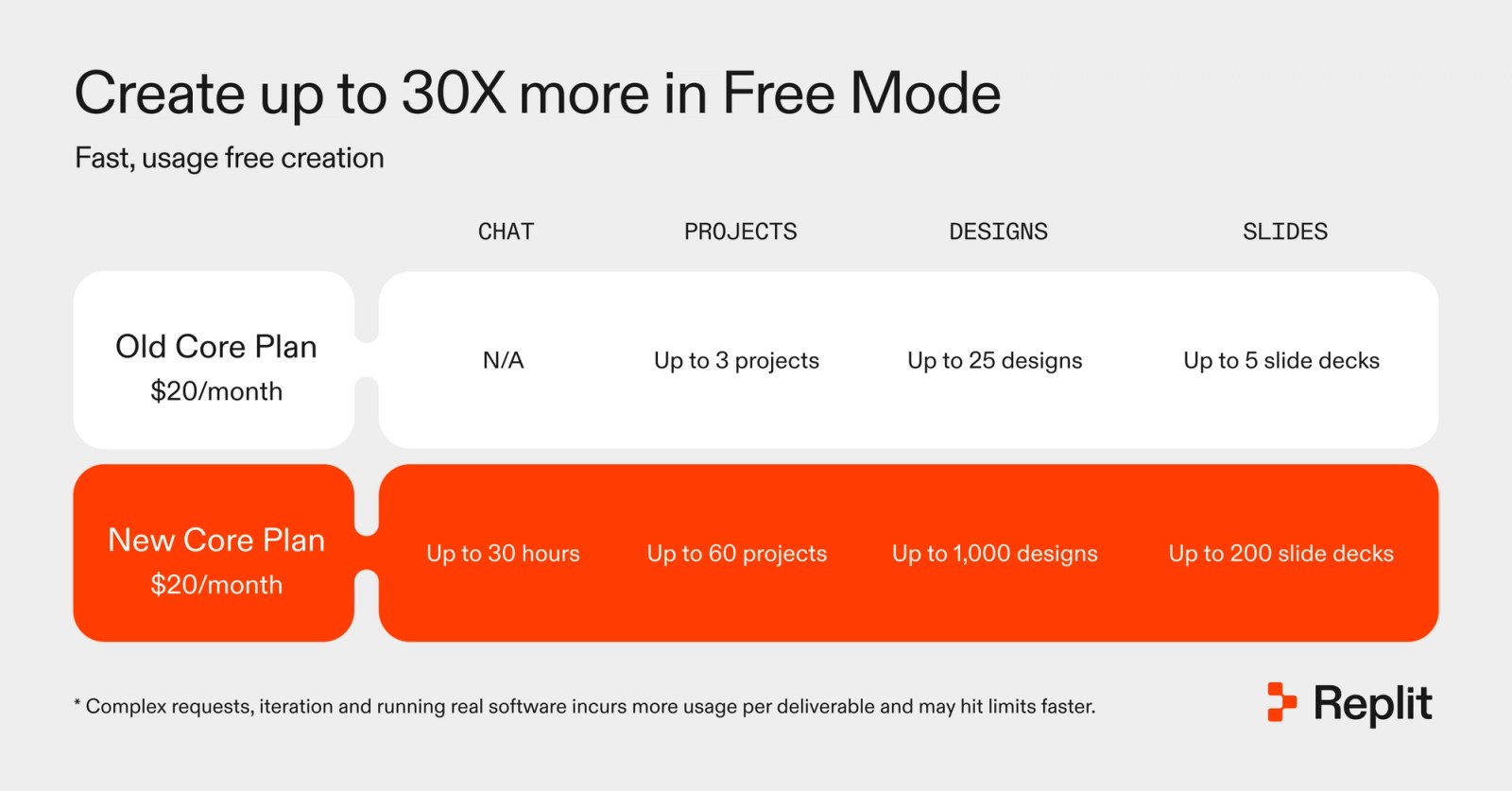
Free Mode flips the equation: inside this mode, everyday tasks — chatting, ideating, routine operations — consume no credits at all. The announced result: Core subscribers can create up to 30 times what they produced before the update, with up to 30 hours of chat per month. The model running the mode is GPT-5.6 Luna, the OpenAI series member engineered for the best price-to-performance balance.
Source: Replit's official blog
The announced numbers, exactly as the official sources state them
- Dates: Replit's announcement on August 18, 2026; OpenAI's post on August 19, 2026.
- Model: OpenAI's GPT-5.6 Luna powers Free Mode.
- Productivity: up to 30x more creation for Core subscribers; up to 30 hours of chat per month.
- Price: Core plan at $20 per month.
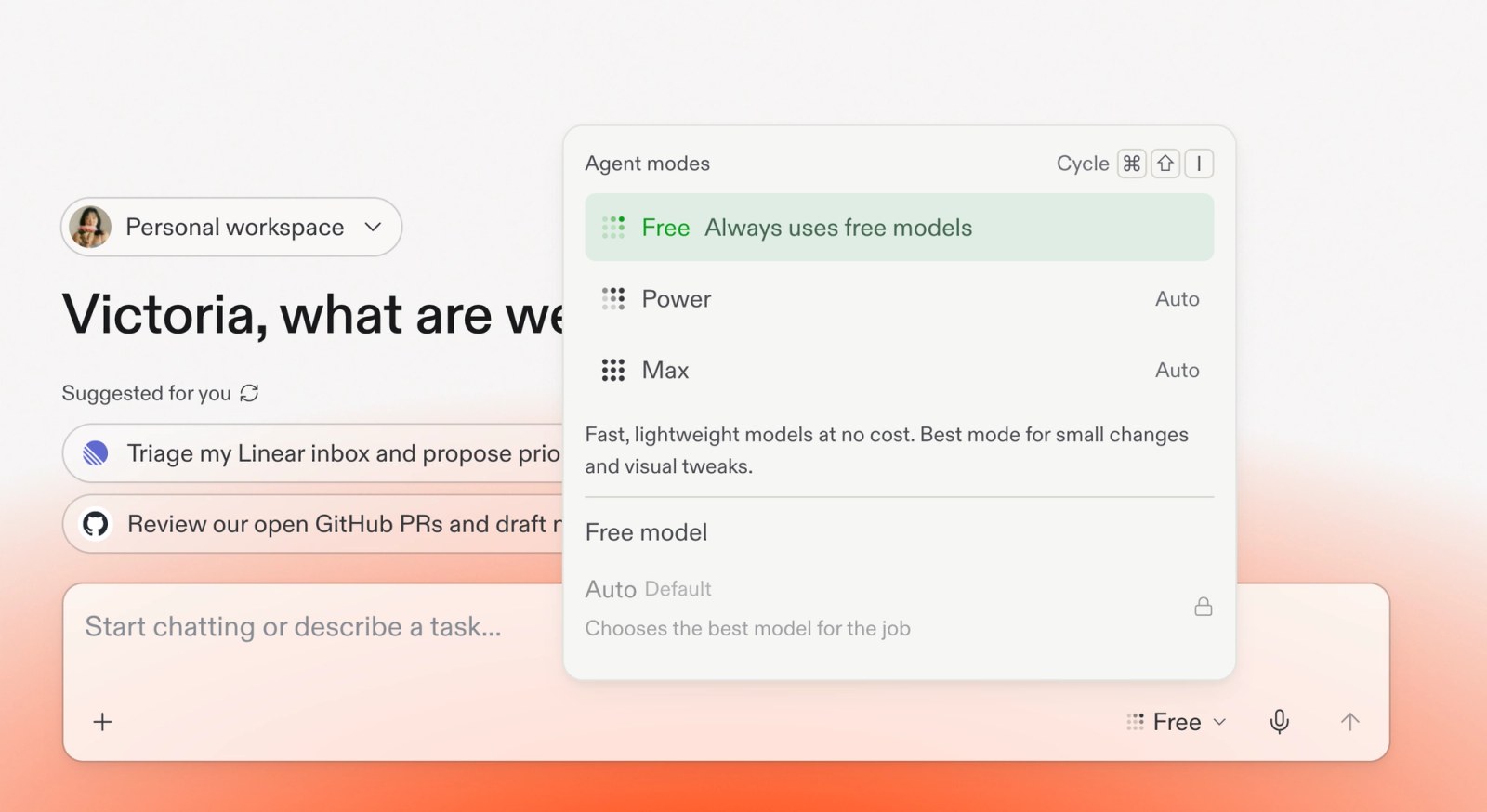
- Usage limits: limits in Free Mode reset every 5 hours; when reached you can wait or move up to Power or Max modes.
- Mode structure: Power Mode (formerly Economy Mode) uses cost-optimized models for everyday tasks at the same performance and cost as the old mode; Max Mode uses higher-performance models for larger changes, deeper reasoning and longer builds.
The phrases "up to 30x" and "as much as" matter: the maximum figure arrives in light everyday usage patterns (chats, ideas, small tasks), not in building a full complex application — that still consumes credits in the higher modes.
Why GPT-5.6 Luna specifically? The story from OpenAI's side
OpenAI's post puts the partnership in context: Replit was an early GPT-3 user from the beginning of natural-language software development, and today GPT-5.6 Luna powers Free Mode to demonstrate how the series' recent price cuts and price-performance balance translate into genuinely broader access. The announcement quotes Replit co-founder and CEO Amjad Masad: "For the first time, you'll get access to an amazing experience where you can build applications, build agents, build all sorts of software in Free Mode. And that's powered by GPT-5.6 Luna," adding in a second quote: "Thanks to OpenAI and the price cuts that you made recently, you made it possible for us to offer it to millions of users in Free Mode."
The technical takeaway for professionals: the equation of "relatively cheaper model + tightly engineered agent" is now sufficient for most everyday tasks, while stronger models are reserved for complex work. That is the broader direction of the AI building-tools market in 2026: a daily layer with no meter, and a heavy layer paid by consumption.
The experience: a new UI that goes straight to the outcome
Alongside the new mode, Replit shipped a redesigned interface meant to make it your daily driver: one space that moves from simple chat to full builds, carrying context automatically from conversation to creation and across projects, so you never feel like starting from scratch each day. Their own framing is vivid: "It's less like hiring a contractor for a single project, and more like working with a chief of staff who deeply understands you and the outcomes you care about." Early-access user quotes the company published cluster around two points: speed ("Insanely fast!" as one user put it) and the disappearance of credit anxiety ("I was trying to find the outer limits of Free Mode. I haven't yet. My choices are bolder because I'm not worrying about burning tokens").
Source: Replit's official blog
Replit also published an official video explaining the new mode on its YouTube channel, plus a second video covering the three modes, both watchable directly from the official blog.
What this means for professionals in the Gulf and beyond
- The math is simple: $20 per month for 30 hours of chat and multiplied everyday output costs less than a single hour of a freelance developer's time in the region. Anyone who paid a developer or agency for quick prototypes now has an alternative for experimenting without a meter running.
- Access works regionally: Replit is a web-based service that runs from the browser across Gulf countries, international-card payment is standard, and no regional restrictions on the service have been announced.
- The interface is English: you can write prompts in Arabic and the model will generally understand, but there is no official announcement of full Arabic support for the interface or agents; plan for an English-first experience.
- Who genuinely benefits: the e-commerce owner who needs an internal tool, the marketing manager who wants a tracking dashboard, the freelance developer accelerating prototypes. Building a complex technical product with strict security requirements still needs a human team and Max modes.
- Quick comparison with familiar alternatives: comparable subscriptions in competing builder tools (Lovable, Bolt) sit around the same monthly price, but Replit's historical edge is the integrated environment — editor, database, deployment and domain in one place. We previously covered how fast-model tooling serves professional workflows in our review of Cerebras and the ultrafast GPT-5.6 Sol.
How to start, step by step
The experience is designed to be fast, but this sequence saves you detours:
- Create a free account on replit.com and explore the new interface first; getting familiar with the environment needs no subscription.
- Honestly assess your need before paying. If your daily projects are light (questions, small data analysis, quick prototypes), the Core plan with Free Mode is enough; if you build complete products regularly, compare Pro limits directly on the official pricing page.
- Start with a small real project, not a toy. The best test of the new mode is a task you actually owe this week: a dashboard for your business metrics, a data-organizing tool, or a landing page for an idea under study.
- Watch how the modes behave. Notice when the agent suggests moving from Free to Power or Max; that boundary line is the most valuable practical information your first week will produce.
- Security-review the output before any real use, especially if it will touch customer data or user accounts.
Three realistic scenarios for understanding the value
- A business owner: you need a tool that tracks orders or inventory your own way, and off-the-shelf options never match how you work. In Free Mode you describe the idea, try it and refine it during afternoon sessions without calculating the cost of each attempt — exactly the freedom the update advertises.
- A marketer or content maker: you want a prototype landing page or an interactive calculator to show a client before committing to the idea. Speed from concept to presentable artifact is the competitive edge here; early-access users described the experience as "insanely fast."
- A freelance developer: you use Free Mode as a daily thinking partner — analyzing a problem, testing an approach, generating a code foundation — then switch to Max Mode for serious builds. Context carrying across projects saves you from re-explaining your project in every session.
In all three scenarios the real value is not "free" usage but a shift in experimentation mentality: when there is no meter, you try ten ideas instead of one, and ten attempts are what raise the odds of finding the winning one.
Quick comparison: Replit's three modes after the update
| Criterion | Free Mode | Power Mode | Max Mode |
|---|---|---|---|
| Model | GPT-5.6 Luna | Cost-optimized models | Higher-performance models |
| Credit consumption | None for everyday tasks | Consumes | Consumes |
| Best for | Ideas, daily tasks, prototypes | Medium builds | Complex projects, long builds |
| Usage limits | Reset every 5 hours | Per plan | Per plan |
Limitations you should know before subscribing
In full honesty: "Free Mode" is an attractive name but it is not free — it is "free" inside a paid Core subscription ($20/month), with Pro-tier subscribers getting higher limits. The 30x figure is a marketing maximum based on light usage patterns, not a guarantee for every user. Usage limits reset every 5 hours; heavy users will hit them during long building sessions and be nudged toward higher modes — an intentional commercial pattern, not a hidden flaw. We have not yet seen independent, documented evaluations of Luna's output quality in Free Mode versus stronger models; every published quote comes from early-access users selected by the company. Finally: applications built quickly with AI need a security review before public launch or connection to real customer data — a rule we repeat in every review we publish.
Two further practical notes the first impression ignores. First, the real cost can exceed the subscription when you move from building to continuous public operation: persistent deployment and a custom domain may carry separate additional costs under the deployment plans, so review the official pricing page before any real launch. Second, code ownership and quality are your responsibility: the agent accelerates writing but does not guarantee security best practices or clean architecture, and a project that will grow later needs sound engineering habits from day one — clear naming, data separation, periodic review — or you will pay for the speed later in maintenance and fixes.
Frequently asked questions
What is Free Mode in Replit?
A new mode inside Replit Agent launched on August 18, 2026, powered by OpenAI's GPT-5.6 Luna. Everyday tasks — chatting, ideating, routine work — consume no credits, and Core subscribers can create up to roughly 30 times more than before.
Is Free Mode actually free?
It requires no extra payment beyond the Core subscription at $20 per month, but it is not fully free: everyday usage is unmetered within limits that reset every 5 hours, and complex tasks consume credits in Power or Max modes.
What does GPT-5.6 Luna have to do with Free Mode?
It is the model powering the entire mode, chosen for its cost-performance balance after OpenAI's price cuts to the GPT-5.6 series — which is what let Replit open the mode to millions of users.
What is the monthly cost in the Gulf region?
The Core subscription is $20 per month, including up to 30 hours of monthly chat in Free Mode with usage limits resetting every 5 hours.
Does Free Mode require coding experience?
No — Replit Agent builds from natural-language descriptions, but experience helps you steer the agent, judge output quality, and security-review it before relying on it for real work.
The bottom line
The Free Mode update is genuinely good news for a specific group: people who want to test software ideas daily without the credit meter, and who find $20 a fair deal for 30 hours of chat and multiplied output. It is also a more important market signal: the 2026 battle of building tools has shifted from "who has the strongest model" to "who grants the most daily freedom," and model price cuts are the hidden fuel of that battle. Use it for everyday projects, keep Max mode for mission-critical builds, and before any real launch: always run human and security review — the same standard we hold every tool to in our AI tools reviews on Truescho.
Sources
- Replit's official announcement: Replit Introduces Free Mode
- OpenAI's announcement: OpenAI × Replit — GPT-5.6 Luna
- Interface updates and Agent modes are documented in the official announcement page itself.