
On August 3, 2026, Alibaba officially launched the full version of Qwen 3.8-Max, the latest and most powerful model in the Qwen family and one of the largest AI models in the world. With 2.4 trillion parameters and a context window of up to 1 million tokens, it positions itself as a direct competitor to the world's most advanced models like OpenAI's GPT-5 and Google's Gemini 3.
What Is Qwen 3.8-Max and Why Does It Matter?
Qwen 3.8-Max is a multimodal model capable of processing text, images, and video simultaneously. It was built by the Qwen team at Alibaba Cloud using a dense Mixture-of-Experts (MoE) architecture, where only 95 billion parameters are active during inference out of the 2.4 trillion total, making it both powerful and resource-efficient.
The launch was significant enough to move Alibaba's stock price noticeably and generate coverage from global outlets like CNBC and TechNode as a genuine competitor to advanced American models. The announcement came two weeks after a preview at the WAIC 2026 (World AI Conference) in Shanghai on July 19, where it drew considerable attention from the international tech community.
Context: The China-US AI Arms Race
To understand the significance of Qwen 3.8-Max, it must be placed within the accelerating race between China and the United States in artificial intelligence. The model arrives after a series of important releases from both sides:
- DeepSeek V4 (April 2026): An open-weight Chinese model at 1.6 trillion parameters
- Kimi K3 (July 2026): An open-weight model from Moonshot AI at 2.8 trillion parameters
- Qwen 3.8-Max (August 2026): The newest and most powerful from Alibaba
This acceleration means Chinese companies are no longer content with mimicking American models — they are now surpassing them in some areas like model scale and cost-efficiency. The ultimate beneficiary is the developer and consumer who gets more options at lower prices.
Technical Specifications in Detail
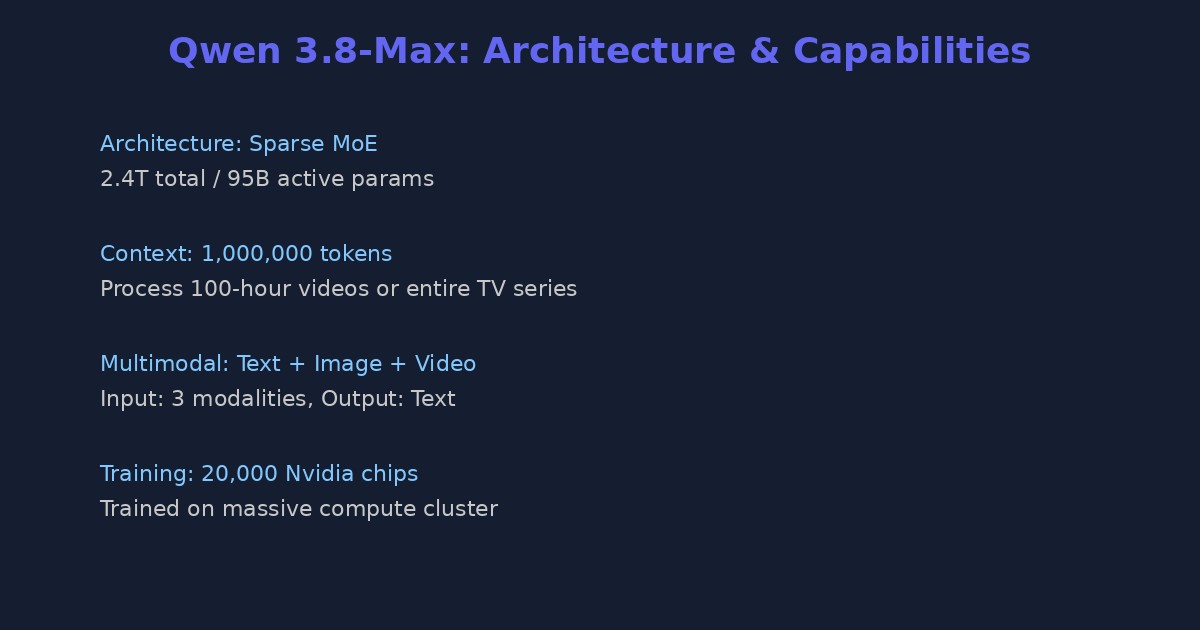
To understand the scale of this model, here are the official specifications:
| Feature | Value |
|---|---|
| Total Parameters | 2.4 trillion |
| Active Parameters at Inference | 95 billion |
| Context Window | 1,000,000 tokens |
| Architecture | Sparse Mixture-of-Experts (MoE) with hybrid attention mechanism |
| Supported Input Modalities | Text + Images + Video |
| Supported Output Modalities | Text |
| Launch Date | August 3, 2026 |
| Foundation | Built on Qwen 3.5 base |
The one-million-token context window means the model can read hundred-page documents, watch entire TV series, or process 100-hour livestreams and turn them into searchable knowledge bases. This is unprecedented in the open-weight model space and opens new possibilities for enterprise knowledge management and education.
What Is MoE Architecture?
Mixture-of-Experts is an AI architecture that distributes processing across a set of specialized "experts." Instead of activating the full model (2.4 trillion parameters) for every query, only the most relevant experts (95 billion active parameters) are selected based on the task type. This means:
- Inference efficiency: The cost of running the model scales with active parameters (95 billion), not the total (2.4 trillion)
- Deeper specialization: Each expert evolves to specialize in a specific type of task (coding, translation, logical reasoning, etc.)
- Scalability: Adding new experts increases model capability without increasing inference cost
Benchmark Results
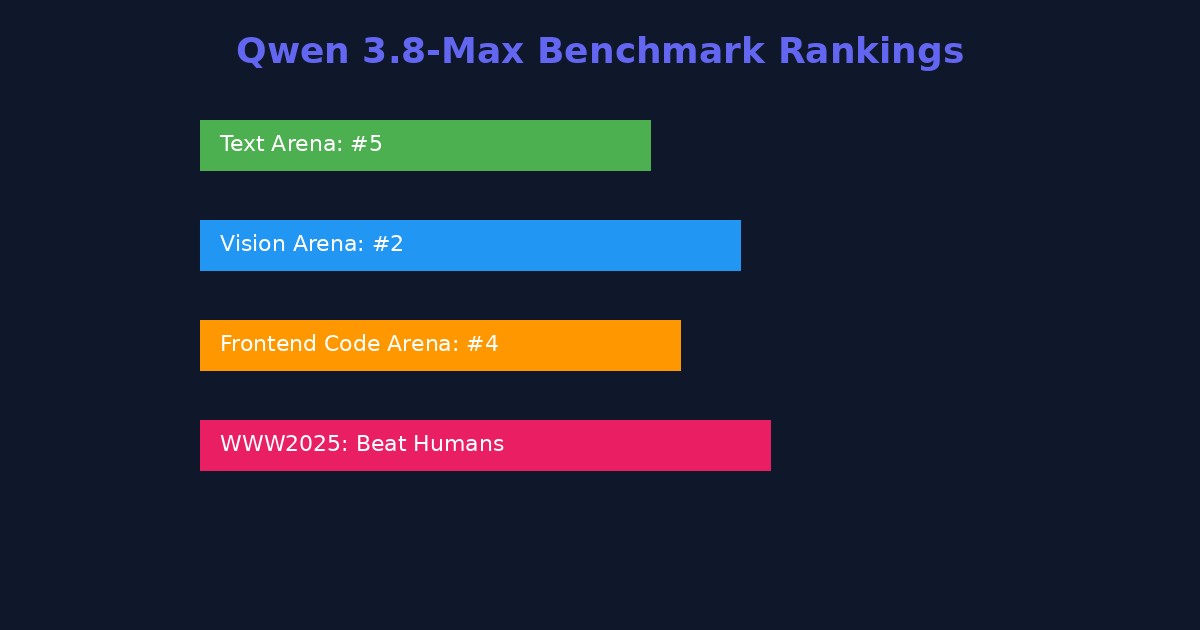
Qwen 3.8-Max achieved remarkable results on independent global benchmarks:
- Text Arena: 5th globally — strong competition with GPT-5, Claude, and Gemini
- Vision Arena: 2nd globally (outperforming most models in image understanding)
- Frontend Code Arena: 4th globally — strong capability in building web interfaces
- WWW2025 Multimodal Dialogue Intent Recognition Challenge: outperformed human participants in understanding multimodal dialogue intent
These results mean the model can compete in image and video understanding, an area where Chinese models have traditionally lagged. The 2nd place in Vision Arena is particularly impressive, as it places the model ahead of well-known American models that have dominated this field.
The New RecreationBench
Alibaba introduced a new benchmark called RecreationBench, which measures the model's ability to reconstruct applications in a "black-box environment" with no internet access. This benchmark tests deep engineering reasoning rather than simple information retrieval, representing a new direction in how AI models are evaluated.
Pricing and Availability
Qwen 3.8-Max is available through Alibaba Cloud Model Studio via API, and also through QwenWork, Alibaba's workplace AI agent platform. It is also available via OpenRouter for developers who prefer a unified platform for accessing multiple models.
Detailed Pricing:
| Category | Price per Million Tokens |
|---|---|
| Input | $2.00 |
| Output | $6.00 |
| Cache Read (5min) | $0.17 |
| Cache Creation (5min) | $2.50 |
Alibaba plans to release the model weights for direct download in the week following the launch, enabling developers to run it locally on their own servers. This is a strategically important decision because it places Qwen in the "open weights" category where it competes with DeepSeek and Kimi K3.
Price Comparison with Competitors
| Model | Input $/M | Output $/M |
|---|---|---|
| Qwen 3.8-Max | $2.00 | $6.00 |
| GPT-5 | ~$5-10 | ~$15-30 |
| Gemini 3 Pro | ~$3-7 | ~$10-21 |
| Claude Opus | $5.00 | $25.00 |
| DeepSeek V4 Pro | ~$1.40 | ~$5.60 |
Qwen 3.8-Max offers very competitive pricing, cheaper than all competing American models and close to DeepSeek, which is the cheapest in the market.
How to Access It from Around the World
There are several ways to access Qwen 3.8-Max:
1. Via Alibaba Cloud Model Studio
Developers and organizations can sign up for Alibaba Cloud International and access the API. Alibaba Cloud services are available in most regions globally and support payment via international credit cards. The main advantage is direct access with lower latency from Asian servers.
2. Via OpenRouter
The OpenRouter platform (openrouter.ai) provides access to Qwen 3.8-Max at a unified price ($2/$6 per million input/output tokens). Access is simpler than going through Alibaba Cloud directly and requires no complex setup. OpenRouter also allows easy switching between models, benefiting developers who test multiple models.
3. Via Qwen Chat
The model can be tried for free via the official website at chat.qwen.ai, available in most countries worldwide. This method is suitable for evaluation before committing to paid usage.
What Does This Mean for Developers?
For Startups and Independent Developers
Qwen 3.8-Max offers GPT-5-level power at a price three to five times lower. At $2 per million input tokens, a startup processing millions of tokens daily can save thousands of dollars per month compared to using GPT-5.
Practical example: An app that analyzes 10,000 documents per month (average 5,000 tokens each):
- With GPT-5 (~$5/M input): ~$250/month for input only
- With Qwen 3.8-Max ($2/M input): ~$100/month for input
- Savings: 60% monthly
For Researchers and Academics
The open-weight release will enable researchers to:
- Study the model's architecture and understand how MoE works
- Develop improvements and customizations for specific applications
- Build fine-tuned models for specific domains (medical, legal, educational)
- Publish papers contributing to the scientific community
For Government and Educational Institutions
With multimodal support (text + image + video), Qwen 3.8-Max can be used in applications such as:
- Archiving and analyzing large government document collections
- Analyzing educational videos and extracting learning points
- Converting 2D architectural plans into 3D visualizations
- Creating interactive educational content from text
- Building question-answering systems on massive knowledge bases
Quick Comparison: Qwen 3.8-Max vs. Alternatives
| Criterion | Qwen 3.8-Max | GPT-5 (OpenAI) | Gemini 3 (Google) | Kimi K3 (Moonshot) |
|---|---|---|---|---|
| Parameters | 2.4 trillion | Not disclosed | Not disclosed | 2.8 trillion |
| Context | 1 million tokens | 2 million tokens | 2 million tokens | 1 million tokens |
| Input $/M | $2.00 | ~$5-10 | ~$3-7 | Not directly via API |
| Output $/M | $6.00 | ~$15-30 | ~$10-21 | Not directly via API |
| Open Source | Coming soon (weights) | No | No | Yes (Kimi K3 License) |
| Multimodal | Yes (text/image/video) | Yes | Yes | Yes (text/image) |
Qwen 3.8-Max's biggest competitive advantage is price and openness: at a third to a fifth of what competing American models cost, and with a promise to release weights, it offers exceptional value.
Unique Capabilities That Set This Model Apart
Alibaba showcased several impressive demonstrations during the announcement:
- Processing hundreds of pages or hundreds of hours of video: The model can transform very long content into a searchable knowledge base, opening doors for enterprise knowledge management applications. Imagine uploading 100 hours of video meetings and getting instant text search across all of them.
- Rebuilding web interfaces from screenshots: Given a screenshot of a website, the model rebuilt the complete frontend code. This is useful for developers who want to quickly replicate designs or understand competitor site architectures.
- Converting 2D plans to 3D visualizations: It took a 2D floor plan and converted it into a 3D interior design visualization. Immediate applications in real estate and architecture.
- Building interactive games from text descriptions: A simple natural language description was turned into a complete playable game. This creative capability rivals specialized game-generation tools.
- 16-day autonomous software engineering project: The model autonomously executed a complete software engineering project over 16 days, creating a self-evolving agent framework called oh-my-cli (open-sourced on GitHub). This demonstrates the model's long-horizon task capability.
The oh-my-cli Project
The framework created autonomously by the model is interesting because it demonstrates Qwen 3.8-Max's ability to:
- Plan over long time horizons across multiple days
- Write complex, organized code
- Test and debug independently
- Document its work
- Publish the project as open source
This level of autonomy in engineering tasks was previously exclusive to very advanced models, and is now available from a Chinese model.
Limitations You Should Know
Despite the clear power, there are caveats to keep in mind:
- Speed: With 2.4 trillion parameters, the model is slower than smaller models in initial response time (time-to-first-token). Best suited for tasks that require depth rather than speed. For applications requiring instant interactivity (interactive chatbots), smaller models may be more appropriate.
- Privacy and Data Sovereignty: When using the API via Alibaba Cloud, data is processed on servers in China or other regions. Sensitive organizations may need to wait for the weight release to run it locally, or use a middleware layer to prepare data before sending.
- Language Coverage: While the model supports multiple languages, its performance on dialectal or highly specialized text may vary. Testing is recommended before full production deployment. It's advisable to test the model on specialized texts (legal, medical, technical) to verify quality.
- Licensing: It has not yet been announced whether the weights will come with an Apache 2.0 license (like some previous Qwen models) or a restricted commercial license. The license affects commercial use and derivative development.
- Geopolitical Considerations: The model is from a Chinese company, which may raise regulatory concerns in some countries. Government institutions in certain nations may face restrictions on using AI technology from Chinese companies.
Frequently Asked Questions
Is Qwen 3.8-Max available for free?
Yes, you can try it for free via chat.qwen.ai. For commercial use via API, it costs $2 per million input tokens and $6 per million output tokens, making it one of the cheapest models in its class.
Can I run Qwen 3.8-Max locally?
With 2.4 trillion parameters, the model requires enormous resources. Even with pruning and quantization, running it locally requires hardware worth hundreds of thousands of dollars (approximately 8-16 H100-class GPUs). Using the API is recommended until pruned versions become available.
Does Qwen 3.8-Max support multiple languages well?
Yes, but to varying degrees. The model handles general conversation and coding well, but may face challenges with regional dialects or highly specialized terminology. Extensive testing is advised before relying on it for critical production applications.
How does Qwen 3.8-Max compare to GPT-5?
On independent benchmarks, Qwen 3.8-Max achieves competitive results with GPT-5 in image understanding and coding, though GPT-5 may excel in creative tasks and complex reasoning. The biggest difference is price: Qwen is three to five times cheaper.
What is MoE architecture and why does it matter?
Mixture-of-Experts is an architecture that distributes processing across specialized experts, where only a small portion of the model activates for each query (95 billion out of 2.4 trillion). This allows the model to be large and powerful without linearly increasing inference cost.
Is the model suitable for commercial use?
Yes, Alibaba provides a commercial API with a Service Level Agreement (SLA) for enterprises. Pricing is very competitive, but you should review the terms of service regarding data privacy and intellectual property rights before full adoption.
What is the difference between Qwen 3.8-Max and previous versions?
Qwen 3.8-Max is the largest and most powerful in the family. It succeeds Qwen 3.5, 3.6, and 3.7, with significant improvements in image and video understanding and an increase in context size to one million tokens. It is also the first model in the family to achieve top-5 rankings in Text Arena.
Conclusion
Qwen 3.8-Max represents a pivotal moment in the global AI race. For the first time, a Chinese model with 2.4 trillion parameters achieves competitive results with the most advanced American models, at a fraction of the cost. For developers worldwide, this means a new, powerful, and affordable option for building AI applications without relying exclusively on American companies.
With the promise of open-weight release, impressive multimodal capabilities, and competitive pricing, Qwen 3.8-Max deserves testing and close attention. The competition between Chinese and American companies ultimately benefits the end user: lower prices, more options, and faster progress.