

Professional Indemnity Insurance For Consultants 2026: Cost, Cover And Triggers
Last updated: July 2026
Professional indemnity insurance is one of the most misunderstood policies in consulting. It is essential for many consultants, mandatory for some, and contractually unavoidable for others, but it is not universally required by one global law. The correct answer depends on your profession, regulator, licence, professional body, tender documents, and client contract.
The short answer: professional indemnity insurance, often called PI or E&O, covers claims that your professional advice, design, report, analysis, or service caused a client financial loss. It is mandatory where a regulator or professional body requires it, such as RICS-regulated surveying firms or certain FCA-regulated firms in the UK. For general management, technology, marketing, and independent advisory consultants, PI is often not a blanket legal requirement, but enterprise clients, public-sector tenders, and large master services agreements frequently make it a condition of doing business.

Source: Companies House
This guide is written for international consultants, founders, CFOs, and professional service firms. It focuses on decision-making: when PI is required, how much cover to buy, why retroactive dates and run-off clauses decide whether past work is protected, how subcontractors affect your assumptions, and how to read provider cost benchmarks without pretending they are universal prices.
What Professional Indemnity Insurance Covers
Professional indemnity insurance protects a consultant or professional firm when a client alleges that professional work caused financial loss. The claim might relate to negligent advice, an error in a report, missed deadlines, breach of professional duty, flawed design, inaccurate modelling, poor implementation, or accidental misuse of confidential client information.
Companies House describes PI as cover for businesses that provide professional service or advice where a mistake, or alleged client financial loss, leads to legal and compensation costs. That definition is useful because it separates PI from insurance for physical accidents. PI is about the economic consequences of professional judgement.
Examples include:
- A strategy consultant’s market-entry report leads a client into a costly failed rollout.
- An IT consultant’s system specification misses a critical security requirement.
- A quantity surveyor’s cost advice is alleged to be materially wrong.
- A marketing consultant publishes a claim in a client campaign that triggers a covered professional claim.
- A financial-sector consultant gives regulated advice without the right permission or scope controls.
The claim does not have to be valid to be expensive. Defence costs are often the immediate risk. A consultant can spend heavily proving that the advice was reasonable.
PI vs Public Liability vs E&O vs D&O
Many consultants buy the wrong policy because the terms sound similar. They are not interchangeable.
| Policy | Main risk covered | Typical claim | Does it replace PI? |
|---|---|---|---|
| Professional indemnity | Financial loss from advice, service, design, or professional duty | Client says your report caused a bad business decision | This is PI |
| Errors and omissions | US-market term for similar service-failure risk | Software implementation error or missed deliverable | Usually equivalent to PI for many sectors |
| Public liability / general liability | Bodily injury or physical property damage | Visitor slips in your office; equipment damages client property | No |
| D&O | Governance decisions by directors and officers | Investor claim against board decisions | No |
| Cyber | Data breach, network incident, incident response | Security incident involving client data | No |
If you run a funded consultancy or SaaS-services business, read the line carefully. PI protects the work product. D&O insurance for startups protects leadership decisions. Cyber insurance for small business protects cyber incident response and related liabilities. Business interruption insurance addresses income disruption, not professional negligence.
Is PI Mandatory For Consultants?
There is no single universal rule requiring every consultant to hold PI. That statement matters because many pages overstate the law and scare small consultancies into thinking every sector has the same obligation.
PI becomes mandatory through five pathways:
- Regulated profession: A regulator requires firms in a defined activity to hold cover.
- Professional body: Membership or firm regulation requires adequate and appropriate insurance.
- Licence condition: A local or sector licence requires proof of cover.
- Tender requirement: Public-sector or enterprise procurement documents set a minimum limit.
- Client contract: A master services agreement or statement of work requires a certificate before work begins.
RICS is a clear official example. RICS states through its requirements that firms must ensure previous and current professional work is covered by adequate and appropriate professional indemnity cover meeting RICS standards. For UK and Republic of Ireland RICS firms, the 2025 Version 11 requirements set minimum limits based on turnover, including GBP 250,000 for turnover of GBP 100,000 or less, GBP 500,000 for turnover from GBP 100,001 to GBP 200,000, and GBP 1 million for turnover above GBP 200,000.
Source: RICS
FCA is another official example. The FCA says certain firms must hold professional indemnity insurance and points relevant firms to specific handbook requirements. It also highlights continuous cover, retention limits, and cover for Financial Ombudsman Service awards. This does not mean every consultant is FCA-regulated. It means financial-sector permissions can turn PI from sensible protection into a regulatory requirement.
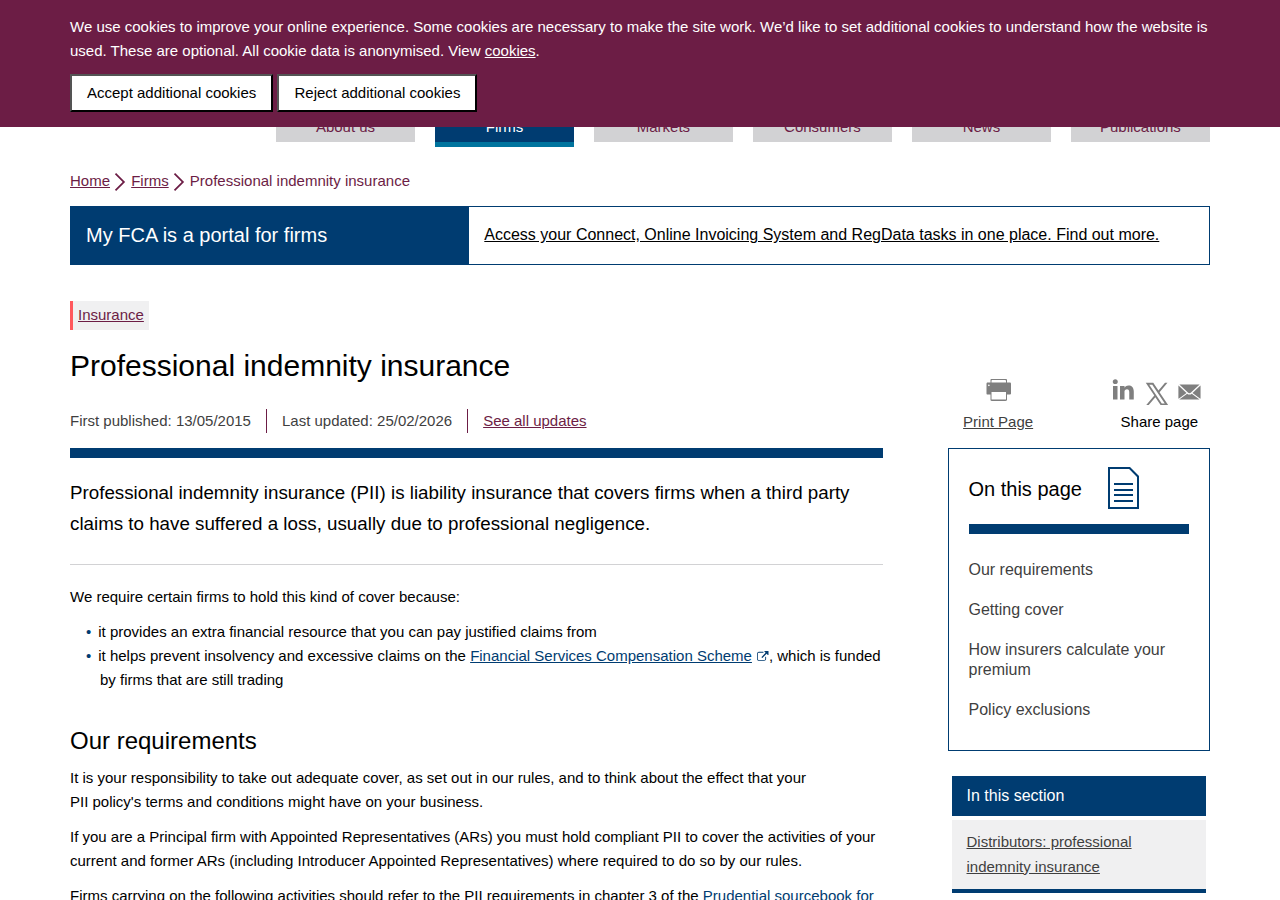
Source: FCA
For Gulf consultants, the safest wording is sector-specific. Do not assume a UAE-wide or Gulf-wide rule for all consultants unless your licence, professional activity, free-zone authority, municipality, tender, or client contract says so. Engineering, surveying, design, insurance distribution, financial services, public-sector work, and enterprise procurement are different from a solo marketing consultant advising small private clients.
The Client Contract Test
For most consultants, the client contract is the real trigger. A consultant may not be legally required to hold PI, yet still be commercially unable to sign enterprise work without it.
Read these clauses before you price a project:
- Minimum limit per claim.
- Aggregate annual limit.
- Whether defence costs are inside or outside the limit.
- Required territory and jurisdiction.
- Whether subcontractors must be covered.
- Whether the client must be named on certificates.
- Notice requirements after a potential claim.
- Required run-off period after termination.
- Whether the policy must be maintained for the contract term plus several years.
An enterprise MSA may say the consultant must maintain USD 1 million, USD 2 million, GBP 1 million, or a sector-specific amount. A tender may require a certificate before award. A regulated client may require cover even if your own profession does not. The practical result is the same: no compliant certificate, no contract.
This is why consultants should ask for insurance requirements during commercial negotiation, not after legal review. If the contract requires a USD 5 million limit and your current policy is USD 1 million, your price, margin, and delivery risk change.
How Much Professional Indemnity Insurance Costs In 2026
Cost benchmarks are provider ranges, not official global prices. Premiums depend on jurisdiction, profession, annual revenue, claim history, limit, retention, client sector, geography, and whether the policy covers past work.
Hiscox US shows illustrative professional liability examples such as USD 42.92 per month for a USD 500,000 limit and USD 102.46 per month for a USD 1 million limit, with a clear note that premiums vary by business profile. Hiscox also says professional liability premiums start at USD 270 per year. Simply Business reports that professional liability customers typically pay a median of about USD 42 per month. Insureon publishes consulting business insurance cost benchmarks, but its figures are US-focused and should not be applied mechanically to UK, Gulf, or cross-border firms.
Use the following table as a budgeting conversation, not a promise:
| Consultant profile | Typical pricing direction | Why it changes |
|---|---|---|
| Solo marketing or creative consultant | Lower provider ranges may be possible | Lower direct financial-loss severity, subject to contract size |
| Management consultant | Moderate to high | Advice can affect strategic decisions and budgets |
| IT or implementation consultant | Moderate to high | Data, uptime, integration, and security dependencies |
| Financial-sector consultant | Higher and more regulated | Permission, client reliance, and regulator scrutiny |
| Engineering, surveying, or built-environment consultant | Often higher | Long-tail defects, professional-body rules, project value |
| Cross-border enterprise consultant | Quote-specific | Territory, governing law, and client contract requirements |
Do not universalize US or UK web quotes to a Gulf consultant. A Dubai, Riyadh, Doha, Singapore, London, or New York consultancy may face different underwriting, local policy wording, and admitted-insurance rules. Get quotes from brokers who understand your operating jurisdictions and client contracts.
How Much Cover Should A Consultant Buy?
Start with four numbers:
- The minimum required by your regulator, licence, or professional body.
- The highest limit required by any client contract or tender.
- The largest financial loss one error could reasonably cause a client.
- The maximum uninsured retention your firm can pay without cash stress.
The right limit is the highest credible requirement produced by those four numbers, adjusted for legal advice and broker input.
For a solo consultant working on USD 15,000 marketing retainers, USD 1 million may satisfy most clients and exceed the likely claim. For an IT consultant implementing a USD 2 million ERP system, USD 1 million may be too low. For a RICS-regulated firm, minimum limits are driven by the RICS requirements, with higher limits considered where risk requires it. For an FCA-regulated firm, the relevant FCA handbook rules and permissions matter.
Two policy details are just as important as the headline limit:
- Per claim vs aggregate: A USD 1 million per-claim limit with USD 1 million aggregate can be exhausted by one claim. A USD 1 million per-claim limit with USD 2 million aggregate can handle more than one covered claim in the policy year.
- Defence costs: Some wordings include defence costs inside the limit; others provide them in addition, subject to terms. If defence erodes the limit, a long dispute can leave less for settlement.
Retroactive Date: The Clause That Decides Whether Past Work Is Covered
Most PI policies are claims-made. That means the policy responds to claims made during the policy period, subject to the retroactive date and other terms. The retroactive date is the historical boundary for covered work.
If your policy has a retroactive date of 1 January 2024, a claim made in 2026 about work done in 2023 may not be covered. If your policy is fully retroactive, past work may be protected subject to wording and exclusions. RICS requirements explicitly discuss claims-made cover and retroactive treatment for regulated firms, which shows how central this clause is in professional practice.
The danger appears when switching insurers. A consultant sees a lower premium and moves, but the new policy resets the retroactive date to the current year. That can expose years of past work. Before switching, ask the broker in writing:
- Will the retroactive date be preserved?
- Is past work covered?
- Are known circumstances excluded?
- Are there gaps between expiry and inception?
- Do subcontracted projects remain covered?
No consultant should change PI provider until the retroactive date has been checked.
Run-Off Cover When You Sell, Retire Or Move Abroad
Run-off cover protects past work after the firm stops trading, sells, merges, changes structure, or lets its live policy end. It matters because claims often arrive years after the work is delivered.
RICS requirements give an official example of how serious this is: run-off cover is required for firms that cease trading, with consumer claims requiring GBP 1 million for six years in the stated circumstances and non-consumer run-off expected for a minimum period of six years. Your sector may differ, but the principle is universal: closing the consultancy does not erase past professional exposure.
International consultants often overlook run-off when they move countries. A consultant may close a UK company, move to Dubai, and start trading through a free-zone entity. If a former UK client brings a claim two years later and the old policy ended with no run-off, the consultant may be personally exposed. The move did not remove the past-work risk.
Plan run-off before:
- Closing a firm.
- Selling a consultancy.
- Retiring.
- Moving client contracts into a new entity.
- Changing from sole trader to company.
- Moving between jurisdictions.
- Ending a regulated professional activity.
Subcontractors: The Hidden Insurance Assumption
Subcontractors create one of the largest gaps in consultant PI programs. A client hires your firm. You hire a freelance analyst, developer, designer, engineer, or implementation partner. The subcontractor makes the error. The client sues you because your firm signed the contract.
Whether your PI responds depends on the wording and facts. Some policies cover work performed by subcontractors on your behalf. Some require you to maintain written subcontractor agreements. Some require subcontractors to hold their own PI at equal limits. Some exclude certain professional services that are outside your declared activities.
Before using subcontractors, require:
- Written scope and deliverables.
- Indemnity clauses that are legally reviewed.
- Proof of PI or E&O cover where appropriate.
- Cyber and confidentiality obligations for data access.
- No client-facing advice outside the subcontractor’s competence.
- Clear quality-control review by your firm before delivery.
Do not assume a subcontractor’s mistake is their problem alone. To the client, it is usually your contract.
Step-By-Step: Buying PI Without Weakening The Policy
- List every professional service you provide, including informal advice, reports, implementation, training, and subcontracted work.
- Pull your largest client contracts and tenders to identify required limits, territories, certificates, and run-off obligations.
- Check whether your regulator, professional body, licence, or free-zone authority imposes PI requirements.
- Estimate the largest financial loss a single error could cause, not just your fee.
- Decide on candidate limits and aggregate amounts.
- Confirm whether defence costs sit inside or outside the limit.
- Preserve the retroactive date when renewing or switching insurers.
- Ask how subcontractors are treated.
- Review exclusions for services, geography, known circumstances, dishonesty, cyber, employment, and intellectual property.
- Store the policy, certificate, proposal answers, contracts, and renewal calendar in one folder.
This process also improves your client proposals. A consultant who can answer insurance questions quickly looks more credible in enterprise procurement.
Scenario: A Remote IT Consultant Winning An Enterprise Contract
Maya runs a remote IT consulting firm from Lisbon and serves clients in the UK and Gulf. Her current policy has EUR 500,000 of PI cover, a retroactive date from 2024, and no clear wording for subcontractors. A UAE enterprise client sends an MSA requiring USD 2 million per claim, worldwide work coverage, subcontractor compliance, and three years of run-off after contract termination.
If Maya signs without changing insurance, she breaches the contract on day one. If she only raises the limit but lets the retroactive date reset, she exposes work from 2024 and 2025. If she uses a freelance integration specialist with no PI, she may still carry the claim.
Her better path is to send the MSA insurance schedule to her broker, request USD 2 million options, preserve the retroactive date, confirm territory and jurisdiction wording, add subcontractor requirements to her vendor agreements, and price the higher premium into the client proposal. The contract is now profitable and insurable.
Common Mistakes Consultants Make
- Saying PI is legally mandatory for every consultant in every market.
- Assuming a public liability or general liability policy covers bad advice.
- Buying the client’s required limit but ignoring aggregate erosion.
- Switching insurers and losing the old retroactive date.
- Letting the policy lapse between projects.
- Using subcontractors without checking whether their work is covered.
- Treating provider cost benchmarks as global prices.
- Ignoring run-off when retiring, selling, or moving abroad.
- Forgetting that tenders and MSAs can be stricter than the law.
- Under-declaring services to lower premiums, then finding the real work is outside scope.
If you are building a professional-services business, the insurance file should connect to contracts, tax, banking, and client operations. Truescho’s guides to UAE corporate tax for freelancers, best CRM software for small business, and best accounting software for small business can help tighten the wider operating setup.
Frequently Asked Questions
Is professional indemnity insurance mandatory for consultants?
Not universally. It is mandatory when a regulator, professional body, licence, tender, or client contract requires it. RICS-regulated firms and certain FCA-regulated firms are official examples. General consultants often buy PI because clients require it or because the risk is commercially too large to self-insure.
What is the difference between professional indemnity and public liability?
Professional indemnity covers financial loss caused by your professional advice, report, design, or service. Public liability covers bodily injury or physical property damage to third parties. A client suing over a flawed strategy report is a PI issue. A visitor injured at your office is public liability.
Does PI cover bad advice, missed deadlines, or errors in reports?
Usually, yes, if those allegations fall within the professional services described in the policy and are not excluded. PI can cover defence costs and covered settlements for negligence, errors, omissions, and professional duty claims. Always check the exact wording and service description.
How much professional indemnity cover should a consultant buy?
Start with your highest client contract requirement, regulator or professional-body minimum, and realistic worst-case client loss. Many contracts use USD 1 million, GBP 1 million, or higher limits, but sector and client size can push the required amount up. The right number is quote-specific.
What is a retroactive date in a claims-made policy?
It is the historical date after which covered work may be protected. If a claim is made today about work performed before the retroactive date, the policy may not respond. Preserving the retroactive date is critical when renewing or switching insurers.
Do remote consultants need professional indemnity insurance?
Often, yes. Remote work does not remove the risk that professional advice causes client financial loss. It can add territory and jurisdiction questions. A remote consultant serving international clients should confirm where work is covered and where claims may be brought.
Why do enterprise clients ask consultants for PI certificates?
Enterprise clients use PI certificates to confirm that the consultant can fund defence and compensation if professional work causes loss. It is part of procurement risk control. Many tenders and MSAs will not proceed without proof of the required limit.
What is run-off cover after a consulting business closes?
Run-off extends protection for past work after the live business stops, sells, retires, or changes structure. Because PI is usually claims-made, a claim can arrive years after the work. Without run-off, there may be no active policy to notify.
Does professional indemnity cover subcontractors?
It depends on the policy. Some policies cover subcontracted work performed on your behalf; others require written agreements or separate subcontractor insurance. Always disclose subcontractor use to the broker and require proof of cover where the client contract demands it.
How can consultants reduce PI premiums without weakening cover?
Use clear scopes of work, limit liability contractually where lawful, maintain quality-control records, avoid services outside your competence, preserve a clean claims history, compare multiple quotes, and choose a retention your firm can actually pay. Do not lower premium by hiding services.
Official And Provider Sources
- Companies House - What insurance does a small business need?
- RICS - Professional indemnity
- RICS - Professional indemnity insurance requirements UK and Republic of Ireland, Version 11
- FCA - Professional indemnity insurance
- FCA Handbook - MIPRU 3
- Hiscox - Professional liability insurance
- Insureon - Consulting business insurance costs
- Simply Business - Professional liability insurance cost
Professional indemnity is not just a purchase. It is a contract-readiness system. Truescho helps international consultants and service founders think through structure, compliance, client contracting, tax exposure, and operating tools so that insurance supports the business model instead of patching it after the fact.