
Payoneer vs Airwallex 2026: An Honest Fee Comparison for Founders and Freelancers
💬 Disclosure: Some links in this article are affiliate links. We may earn a small commission when you complete a purchase at no extra cost to you. This does not affect the neutrality of this comparison — every figure below comes from the platforms' official pricing pages.
The one-line answer: Airwallex is cheaper if you have a registered business. Payoneer is the practical choice if you do not. That single distinction — entity versus individual — decides this comparison more than any fee table, because Airwallex generally requires a registered company, while Payoneer happily onboard freelancers and marketplace sellers. Everything else in this guide explains how big the gap actually is, who should pick which, and why plenty of busy operators end up using both at the same time.
Quick Verdict: Which One Should You Choose?
- Choose Airwallex if you run a registered company, an e-commerce store, or an agency moving $5,000+/month across currencies: a flat 0.5% FX markup above interbank on major currencies, free batch transfers to 120+ countries, unlimited free virtual cards, and a genuinely free entry plan. Open a free Airwallex account here.
- Choose Payoneer if you are a solo freelancer or a marketplace seller (Amazon, eBay, Upwork-style platforms) without a registered entity: simple individual onboarding, decade-deep marketplace integrations, free receiving accounts in roughly ten currencies, and an annual fee that is waived as soon as you receive $2,000 in a year.
The math gap is real: a business receiving $3,000/month pays roughly $558/year less on Airwallex than on Payoneer, and the gap widens with volume.
The Volume Math Before We Start
Percentages sound abstract until you scale them. The table below assumes Payoneer's ~2% average corridor cost versus Airwallex's flat 0.5% — close to what our real-world tests show for common Gulf-facing corridors:
| Monthly volume converted | Payoneer (~2% avg) | Airwallex (0.5%) | Annual difference |
|---|---|---|---|
| $1,000 | $20 | $5 | ~$180 |
| $5,000 | $100 | $25 | ~$900 |
| $20,000 | $400 | $100 | ~$3,600 |
| $50,000 | $1,000 | $250 | ~$9,000 |
The pattern is linear and unforgiving: every additional $10,000 of monthly conversion volume widens the annual gap by roughly $1,800. Volume turns small percentage differences into payroll-level money — which is why this comparison deserves ten minutes of your attention.
Who the Two Platforms Are
| Monthly volume converted | Payoneer (2% avg) | Airwallex (0.5%) | Annual difference |
|---|---|---|---|
| $1,000 | $20 | $5 | ~$180 |
| $5,000 | $100 | $25 | ~$900 |
| $20,000 | $400 | $100 | ~$3,600 |
| $50,000 | $1,000 | $250 | ~$9,000 |
The pattern is linear and unforgiving: every additional $10,000 of monthly conversion volume widens the annual gap by roughly $1,800. Platforms are not charity — the cheaper rail simply takes less, and volume turns small percentage differences into payroll-level money.
Airwallex, founded in 2015 in Melbourne by a team of former ANZ bankers and engineers, has raised over $900 million in equity, carries a valuation around $8 billion, and holds 60+ financial licences across the US, UK, EU, Hong Kong, Singapore, and Australia. It serves more than 150,000 businesses and processes over $235 billion in annual payment volume. Its center of gravity is the operating company: multi-currency accounts, corporate cards, payouts, and native plugins for Shopify, WooCommerce, and Magento.
Payoneer is the elder statesman here — an American company founded in 2005, publicly listed on Nasdaq since 2021. It built its reputation as the default payout rail for marketplace sellers on Amazon, eBay, Fiverr, and similar platforms, and it remains one of the most accessible cross-border accounts for individuals across the Middle East, Africa, and South Asia. Its strength is the front door: anyone can sign up, get local receiving details in about ten currencies, and start collecting from global clients the same week.
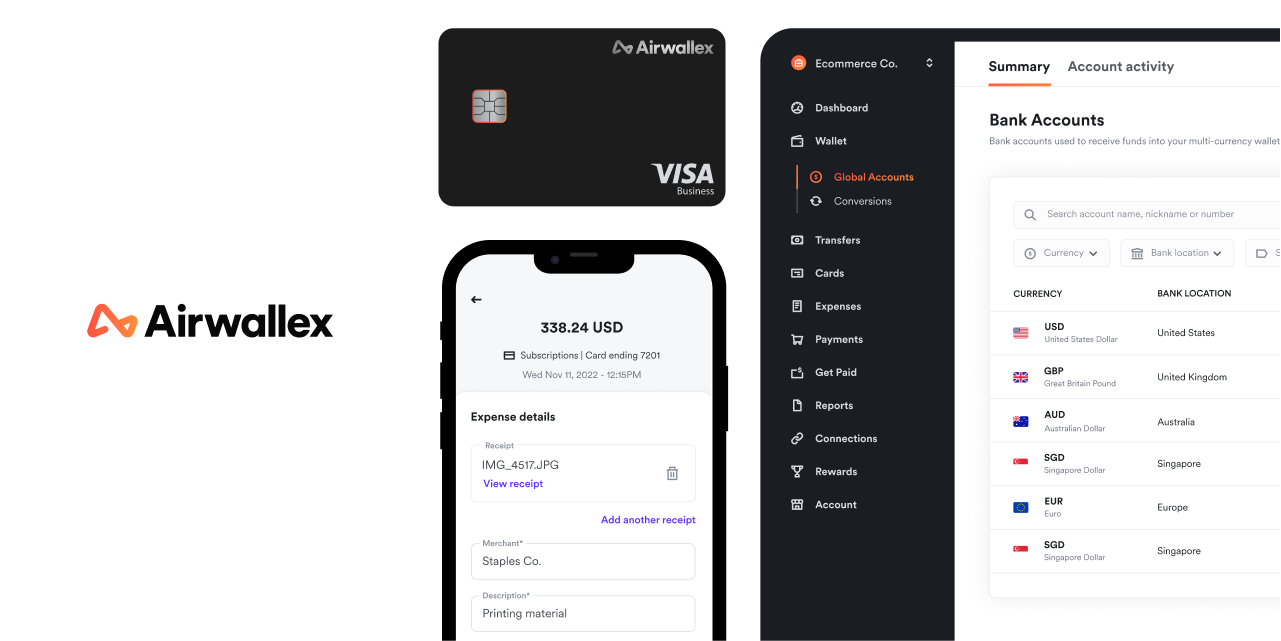
Airwallex, official image from the company website
The 2026 Fee Comparison, Line by Line
All figures below were verified against the platforms' official pricing pages in August 2026.
| Cost item | Airwallex | Payoneer |
|---|---|---|
| Account registration | Free | Free |
| Monthly subscription | $0 (Explore plan) | $0 |
| Annual fee | $0 | $29.95 (waived if you receive >$2,000/year) |
| FX markup, major currencies | 0.5% above interbank | 0.5%–2.0% by corridor |
| FX markup, other currencies | 1.0% | Up to 3.5% |
| Receiving payments | Free from other Airwallex accounts; 0.3% from non-account holders in some cases | Free |
| Withdrawal to bank, same currency | Free or low-cost in many corridors (per fee schedule) | $1.50 |
| Inactivity fee | None | Applies after 12 months without transactions |
| Holdable currencies | 64 | 30+ |
| Currencies with local receiving accounts | 20+ | ~10 |
Four observations that most comparisons miss:
- The FX markup is where the money leaks. "Zero commission" marketing means nothing when the exchange rate itself carries a 2% spread. Payoneer does not publish a single unified markup — it ranges from 0.5% on the best corridors to 3.5% on the worst. Airwallex commits to interbank + 0.5% on majors (USD, EUR, GBP, AUD, CAD, JPY, SGD, HKD) and 1.0% on everything else.
- Payoneer's annual fee is effectively fictional for active users. Receive more than $2,000 in a year and the $29.95 charge disappears automatically. Any serious seller clears that in a week. The fee that actually bites is the inactivity fee after 12 dormant months.
- Airwallex's paid plans are not for solo operators. Grow at $12 per user/month and the custom-priced Accelerate plan target teams that need approval workflows and advanced controls. Most small companies never need to leave the free Explore plan, which already includes 10 free Spend users and free batch transfers.
- Idle-balance yield is an Airwallex-only perk. Airwallex currently advertises 3.20–3.47% yield on idle USD balances — meaningful if you park inventory cash between purchase cycles. Payoneer pays nothing on balances.
How Local Receiving Accounts Actually Work
Both platforms give you local bank details in major payment regions: a US account with ACH routing numbers, a European IBAN for SEPA, a UK sort code and account number for Faster Payments, and equivalents elsewhere. Your American client pays "domestically" into your US details, and the money lands in your platform balance without a correspondent-bank fee chain.
The difference is breadth. Airwallex issues local receiving accounts in 20+ currencies and supports roughly 1,000 direct currency conversion pairs. Payoneer concentrates on about ten core currencies — exactly the ones marketplace sellers need (USD, EUR, GBP, JPY, CAD, AUD, and similar). If your receivables span the Americas, Europe, and Asia simultaneously, the wider grid matters; if you mostly collect US dollars from one or two platforms, it does not.
Cards: The Daily-Spend Comparison
Airwallex cards are genuinely free to run: unlimited virtual cards on the free plan, no international transaction fees, physical team cards, and up to 2% cashback on higher tiers. If you spend on Google Ads, SaaS subscriptions, or supplier purchases in foreign currencies, the absence of per-transaction FX fees compounds into real savings every month — and being able to issue a virtual card per vendor keeps spending clean.
Payoneer cards are functional but fee-bearing: issuance and renewal fees, ATM withdrawal fees, and an FX margin whenever you spend in a currency other than the card's base currency. For a freelancer pulling out spending money, that is fine. For a company buying inventory from three countries, it is the wrong instrument.
Real-World Scenario 1: Freelancer Receiving $3,000/Month
A freelance graphic designer in the Gulf region receives $3,000/month from US and European clients, then converts for local living costs.
| Item | Payoneer | Airwallex |
|---|---|---|
| Receiving fee | $0 | $0 (or ~$9/month at 0.3% if payers are non-account holders) |
| Currency conversion | ~$60 (2% average) | ~$15 (0.5%) |
| Withdrawal to local bank | $1.50 | $0 in many corridors |
| Monthly total | ~$61.50 | ~$15–24 |
| Annual total | ~$738 | ~$180–290 |
Airwallex saves roughly $558/year for an identical payment flow. The catch, again: the designer needs a registered business entity to qualify in most jurisdictions. Freelancers who formalize even a sole-proprietor registration in their country often unlock the cheaper rail permanently.
Real-World Scenario 2: E-Commerce Store Processing $20,000/Month
A Dubai-based Shopify store selling globally across USD, EUR, GBP, and AED:
- Payoneer: corridor-dependent FX of 0.5%–3.5% means $100–$700/month in conversion costs on $20,000 converted, plus $1.50 per withdrawal batch.
- Airwallex: flat 0.5% on majors ≈ $100/month on the same volume, free batch payouts to suppliers in 120+ countries (up to 1,000 beneficiaries), native Shopify/WooCommerce/Magento plugins that also undercut traditional payment-gateway pricing on checkout, and zero-FX-fee cards for ad spend and supplier deposits with up to 2% cashback.
At this scale the annual difference runs into thousands of dollars, before counting operational savings from batch payouts and card controls. For the complete three-way breakdown including Wise, see our full Airwallex vs Wise vs Payoneer fee comparison.
Who Should Genuinely Pick Payoneer
To be fair to the older platform, Payoneer is the smarter call for a large group:
- Individuals without a registered company. Airwallex's entity requirement is disqualifying; Payoneer onboards individuals.
- Marketplace-first sellers. Amazon, eBay, and freelance-platform payouts have flowed through Payoneer for two decades. The integrations are deep, battle-tested, and well documented.
- Operators who value Arabic-language support. Payoneer's regional footprint across the Middle East and North Africa means guides, communities, and resellers in Arabic are abundant — genuinely useful for first-time users.
- Zero-commitment starters. Free signup, no monthly fee, annual fee waived with modest activity.
Who Should Pick Airwallex
- Registered companies — the pricing advantage compounds with volume, and the 64-currency account grid with 20+ local receiving currencies outclasses Payoneer's ~10.
- E-commerce operators — the native store plugins, batch payouts, and card program are built for exactly this use case. Our guide on reducing international transfer fees for e-commerce stores walks through the setup that minimizes each fee layer.
- Teams — 10 free expense seats on the free plan, approval flows, per-vendor virtual cards: features competitors charge per seat for.
- Multi-currency receivers — if you invoice in EUR, GBP, and USD simultaneously, one uniform 0.5% markup beats corridor roulette.
Ready to start? Open your free Airwallex account — the free plan covers most small businesses, with no subscription and no annual fee.
Can You Use Both Together?
Yes — and it is a common, sensible pattern among Gulf-based operators: Payoneer collects marketplace and freelance-platform payouts (where its integrations are deepest), while Airwallex runs the company's operational money: FX conversion, supplier and ad-spend payments, team cards, and batch payouts. Nothing prevents holding both accounts, and splitting roles this way captures the best of each platform instead of forcing a single-provider compromise. For a detailed walkthrough of the Airwallex side, see our step-by-step guide to opening an Airwallex account and receiving multi-currency payments.
Account Opening: Steps, Documents, and Timelines
Airwallex: register online, submit company details and registration number, owner ID, and formation documents. Review typically takes one to a few business days, after which you activate the currencies you need. If you want the full picture first, our Airwallex business account review covers the onboarding experience, plan limits, and gotchas.
Payoneer: sign up as an individual or business, verify ID and address, connect your local bank account. Approval is usually faster, and local receiving details in USD, EUR, and GBP arrive immediately upon acceptance.
For a visual walkthrough of the Payoneer side, here is the official product demo of how Payoneer Checkout works:
Source: Payoneer official YouTube channel
And from Airwallex, the official demo of issuing company cards with advanced spending controls:
Source: Airwallex official YouTube channel
The Gulf Context: UAE, Saudi Arabia, Qatar
- UAE: registered Dubai and Abu Dhabi companies are among the region's heaviest Airwallex users — licences, Shopify integrations, and supplier payouts align neatly. Payoneer dominates the freelancer and Amazon-seller crowd.
- Saudi Arabia: both platforms withdraw to Saudi banks; freelancers collecting from global platforms lean Payoneer, while registered companies route supplier payments through Airwallex. Confirm local compliance requirements with your advisor before linking a business account.
- Qatar, Kuwait, Oman: both support withdrawals to local banks. The decision again reduces to the fee table above: Airwallex's fixed corridors are usually cheaper, Payoneer's variable corridors occasionally match them.
Practical tip before committing: run one small test withdrawal ($100–200) from each platform to your bank and compare the amount that actually lands. That single experiment gives you the true, all-in number for your corridor — the only number that matters.
Where Each Platform Falls Short
Airwallex cons:
- Requires a registered business entity in most jurisdictions — individuals are largely locked out.
- Growth plans ($12/user/month) can pinch small teams that outgrow the free tier's limits.
- Official Arabic-language support is thin compared with Payoneer's regional presence.
Payoneer cons:
- The 0.5%–3.5% FX spread is the highest hidden cost in this comparison.
- Inactivity fee after 12 months without transactions.
- $29.95/year applies if your inflows stay under $2,000.
- Fewer holdable currencies and fewer local receiving currencies than Airwallex.
Frequently Asked Questions
Is Payoneer cheaper than Airwallex?
On basic receiving, both are free. On conversion, Airwallex is usually cheaper: a flat 0.5% on major currencies versus Payoneer's 0.5%–3.5% corridor-dependent spread. Payoneer also charges $1.50 per same-currency withdrawal.
Does Airwallex require a registered company?
In most jurisdictions, yes — it is a business account platform. Individuals without an entity will find Payoneer the practical alternative.
Which is better for Gulf e-commerce stores?
Airwallex, on four counts: the fixed low FX markup, native Shopify/WooCommerce plugins, free batch payouts to 120+ countries, and zero-international-fee company cards with up to 2% cashback.
Can I use Payoneer and Airwallex at the same time?
Yes. A common setup: Payoneer for marketplace and freelance payouts, Airwallex for company operations — conversion, suppliers, ads, and team cards.
How long does account approval take?
Payoneer is typically faster — often a few days with clean ID and address documents. Airwallex reviews company documents and can take a few extra business days.
What are the withdrawal fees to Gulf banks?
Payoneer: $1.50 same-currency, or within the FX margin when converting. Airwallex: follows its published fee schedule, with free or low-cost corridors in many cases. Test your specific corridor with a small amount first.
Is Payoneer safe?
Yes. It is a Nasdaq-listed American company regulated by US financial authorities, operating since 2005. The practical concerns are cost-related (FX spread, inactivity fee), not safety-related.
Does Airwallex pay interest on balances?
It currently advertises 3.20–3.47% yield on idle USD balances. Payoneer pays nothing on balances. (If you avoid interest-based products for religious reasons, simply leave this feature unused — the account itself works identically without it.)
The Bottom Line
This is not a "which brand is better" contest; it is an entity-status question. No registered entity → Payoneer. Registered company or growing store → Airwallex, with a savings gap running from hundreds to thousands of dollars a year. If you are mid-transition, start with Payoneer today, register your entity in parallel, and open your Airwallex account once documents are ready. Running both in parallel is not an indulgence — it is the cheapest architecture available.
Sources
- Airwallex official pricing page: https://www.airwallex.com/pricing
- Airwallex official website: https://www.airwallex.com/
- Payoneer official website: https://www.payoneer.com/
- Payoneer official YouTube — Payoneer Checkout product demo: https://www.youtube.com/watch?v=4L37uARpjQQ
- Airwallex official YouTube channel: https://www.youtube.com/@airwallex