
OpenAI Announces Zero Data Retention for Frontier Models: Your Complete Guide to API Data Privacy
Last verified: August 20, 2026 — the details below come from OpenAI's official post "Offering Zero Data Retention for frontier models", published on openai.com on August 19, 2026 (filed under Company and Safety), and checked via a web archive capture on this date because the site blocks direct fetching.
One question faces every company building on top of AI models: what happens to your customers' data after it passes through the model? The traditional answer was gray: the provider retains prompts and responses for a period for safety and monitoring purposes, while promising not to use them for training. Today, OpenAI shrank that gray zone to its minimum by announcing expanded Zero Data Retention for frontier models for eligible API customers — and alongside it, previewed a new mechanism called Private Safety Processing that tackles the hardest equation in the industry: how to monitor dangerous usage patterns without ever seeing the content itself.
The announcement matters to at least three audiences in our region: Gulf startups building products on the OpenAI API who must comply with Saudi and UAE data protection regulations, financial and healthcare organizations whose commitments forbid sharing customer data with any third party, and any developer handling sensitive material who wants a precise understanding of what actually reaches OpenAI and what never does.
What Exactly Is Zero Data Retention?
In the literal words of OpenAI's official post, the option gives eligible API customers "a clear promise" built on three pillars:
- No retention after processing: OpenAI does not retain your prompts or model responses after a request is processed.
- No human review: customer content is not available to OpenAI personnel for review.
- No training by default: enterprise customer data is not used to train OpenAI models unless the customer explicitly opts in.
Put more simply: your request passes through the model, the answer returns to you, and then nothing remains on the other side that could be leaked or misused. This is not encryption and it is not obfuscation — it is the practical absence of a stored copy in the first place.
The Problem That Produced the Solution: Why Safety Systems Need Context
The deepest part of the announcement is not ZDR itself but the acknowledgment of a real engineering problem the entire industry has run into. As OpenAI explains, the most serious AI safety risks are not always visible in a single isolated interaction; harmful intent often becomes clear only when multiple interactions are read together:
- An attacker probing guardrails repeatedly through requests that look innocent in isolation.
- Coordination across multiple accounts that reveals its menace only when the full picture is assembled.
- An AI agent drifting from its user's intent — continuing to act after being told to stop — a deviation detectable only by tracking the task sequence.
Here lies the paradox created by the shift toward agents and long, complex tasks: the ZDR-compatible safety systems of the past evaluated every interaction on its own, while some frontier-model deployments at competitors required customers to let the provider retain sensitive content for safety monitoring — something OpenAI describes as conflicting with the security obligations many organizations hold toward the people they serve.
Private Safety Processing: Monitoring Without Seeing
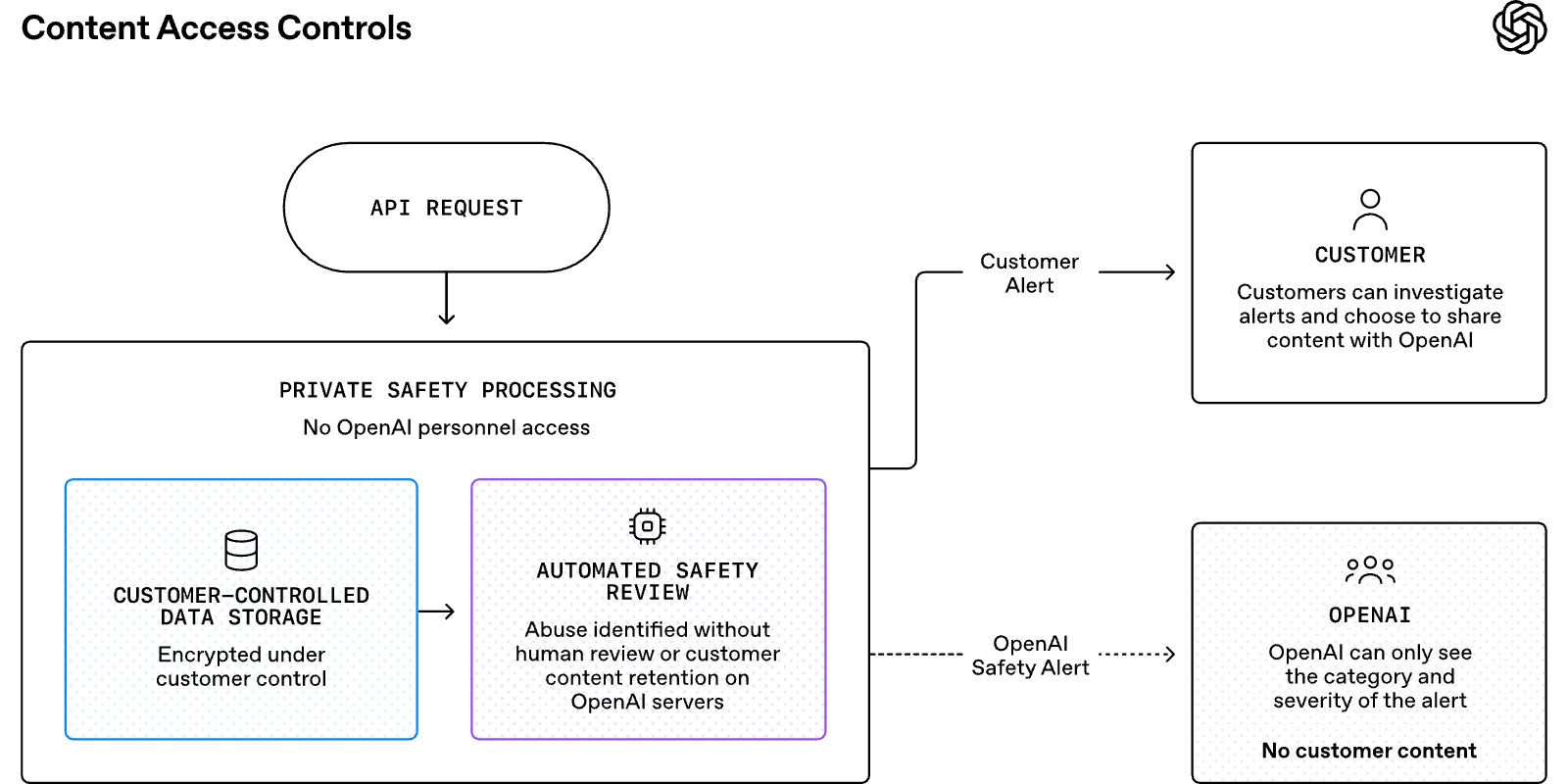
The solution OpenAI is previewing today is called Private Safety Processing, and its essence is separating "seeing the pattern" from "seeing the content." According to the official post, the system works across two storage modes:
- Mode one — customer-controlled infrastructure: customer content stays on servers the customer owns and controls (the standard posture for ZDR deployments).
- Mode two — OpenAI storage with customer keys: an option in development where content is stored on OpenAI infrastructure but encrypted with keys held by the customer alone; OpenAI personnel do not have a copy of those keys, so they cannot access the underlying content at all.
In both modes, automated systems — not humans — examine patterns across related interactions and identify potential misuse indicators. When a risk is flagged, OpenAI receives only a narrowly defined signal describing the type of activity and the severity, with no access to the underlying content even when it is flagged. The customer can investigate alerts and enforcement decisions from within their own systems, and the choice to share details with OpenAI — for an appeal, to clarify legitimate activity, or to support an investigation into verified abuse — belongs to the customer alone.
What Does This Mean for You?
- For Gulf startups on the OpenAI API: ZDR hands you a ready compliance argument under Saudi and UAE personal data protection laws; you can tell your customers and auditors that prompts and responses are not stored by the provider after processing, without wading through complex technical contracts.
- For financial and healthcare institutions: mode two (customer-held encryption keys on OpenAI infrastructure) was designed precisely for your case; the data stays unreadable even for safety purposes, and only the signals cross over.
- For individual developers: no pricing or model changes today; this news is policy-and-architecture rather than consumer-facing, but it sets a new bar competitors will race to match.
- For AI agent builders: Private Safety Processing directly addresses the "agent that will not stop" problem, signaling that next-generation safety systems will monitor task sequences rather than isolated sentences.
Quick Comparison: OpenAI's Data Modes Today
| Criterion | Standard API posture | Zero Data Retention | With Private Safety Processing |
|---|---|---|---|
| Retention of prompts/responses | Per standard policies | No retention after processing | No retention required of the customer |
| Provider personnel access | Under limited controls | Unavailable | Unavailable even for flagged content |
| Training on your data | No for enterprises without explicit opt-in | No without explicit opt-in | No without explicit opt-in |
| Cross-interaction safety monitoring | Usually via retention | Each interaction evaluated alone | Patterns across interactions via signals only |
| Storage location | Provider infrastructure | Customer-controlled infrastructure | Customer infrastructure, or provider infrastructure encrypted with customer keys |
For more on how we navigate the OpenAI toolchain and its peers, see our guide to paid versus free AI subscriptions and our coverage of ChatGPT ads in Europe and the privacy questions around them, or explore the AI tools tested by Truescho.
Honest Limitations and Caveats
In the interest of transparency: first, the option targets "eligible" API customers — full eligibility details are not spelled out in the post, and final qualification runs through enterprise account channels. Second, Private Safety Processing is a preview being tested with early customers, not a generally available feature; do not build production dependencies on it today. Third, ZDR does not mean the model "forgets" during processing — processing itself requires reading the request; what is eliminated is retention afterwards. Fourth, narrowly defined signals (activity type and severity) mean enforcement decisions may occasionally happen without full context, which is what the appeal mechanism with optional content sharing addresses.
Frequently Asked Questions
What is the difference between Zero Data Retention and not training on my data?
No-training means your conversations never enter model training data, but they may still be stored for a period for monitoring purposes? ZDR, by contrast, means prompts and responses are not retained at all once the request has been processed?
Is Zero Data Retention available to all ChatGPT users?
No; the announcement concerns eligible API customers, and eligibility details are determined through enterprise account channels?
How can OpenAI monitor misuse if it cannot see the content?
Through Private Safety Processing: automated systems recognize patterns across related interactions and send a narrow signal describing the activity type and severity without accessing the content?
Can I use these features in my commercial product in the Gulf today?
ZDR is available to eligible API customers under OpenAI's terms, while Private Safety Processing remains a preview under testing with early customers? So review your enterprise account before depending on it.
Does this announcement change OpenAI API pricing?
No; the announcement concerns data and safety policy, not pricing, and no price change was mentioned in the official post?
Sources
- OpenAI's official post: Offering Zero Data Retention for frontier models — August 19, 2026
- Related Truescho coverage: ChatGPT ads across Europe and 31 markets and the ChatGPT Plus subscription guide