
If you run a research lab or lead a graduate team at an American university, OpenAI just announced something worth your evening: the Rosalind Academic Plan, unveiled October 15, 2026, grants qualifying academic labs up to 30 Business Standard seats at no cost for up to 12 months, plus access to GPT-Rosalind — the company's dedicated life sciences model — following trusted-access approval. The plan is currently limited to US universities, but the announcement's language points to a broader effort that international researchers should be watching closely.
Source: OpenAI's official announcement
What exactly does the plan include?
According to the official announcement page, an approved lab receives:
- Up to 30 Business Standard seats at $0 per user per month, for up to 12 months.
- Access to all commercially available frontier OpenAI models, subject to plan usage limits.
- Access to GPT-Rosalind, the specialized life sciences model, after passing the trusted-access process.
- A research privacy guarantee: research data shared through the plan is not used to train OpenAI's models by default.
One important boundary: API access is not included at this time. The plan works through OpenAI's enterprise product interfaces, not direct programmatic integration.
What is GPT-Rosalind in the first place?
GPT-Rosalind is OpenAI's dedicated life sciences model, combining frontier reasoning with the Rosalind Workbench — a platform for orchestrating specialized tools across medicinal chemistry, genomics, wet-lab assistance, and other scientific applications. The research areas OpenAI highlights include drug and protein design (candidate drugs, therapeutic proteins, peptides, and enzymes, including optimizing molecular interactions, selectivity, and stability), genetic and RNA therapies, and adjacent disciplines.
To illustrate the difference between a specialized and a general model, OpenAI published an official assessment comparing GPT-Rosalind with its mainline Astra model on an antiviral therapeutics design task: Rosalind delivered a full candidate comparison matrix, a modeling plan, and paired study plans with controls and interpretation guidance. Astra withheld the actionable portions of the request — specific candidate designs and implementation-level experimental plans — offering only high-level context instead. The message is blunt: in the life sciences, specialization changes the quality of what you actually get.
Who qualifies, and how do you apply?
The official 2026 terms:
- Academic labs at US universities only, in this first phase.
- The applicant must be the lab's Principal Investigator (PI) or lab lead, applying on behalf of the lab.
- Universities with an existing OpenAI Enterprise agreement apply through their university's internal access process; universities without one apply directly through the trusted-access route.
The official application steps:
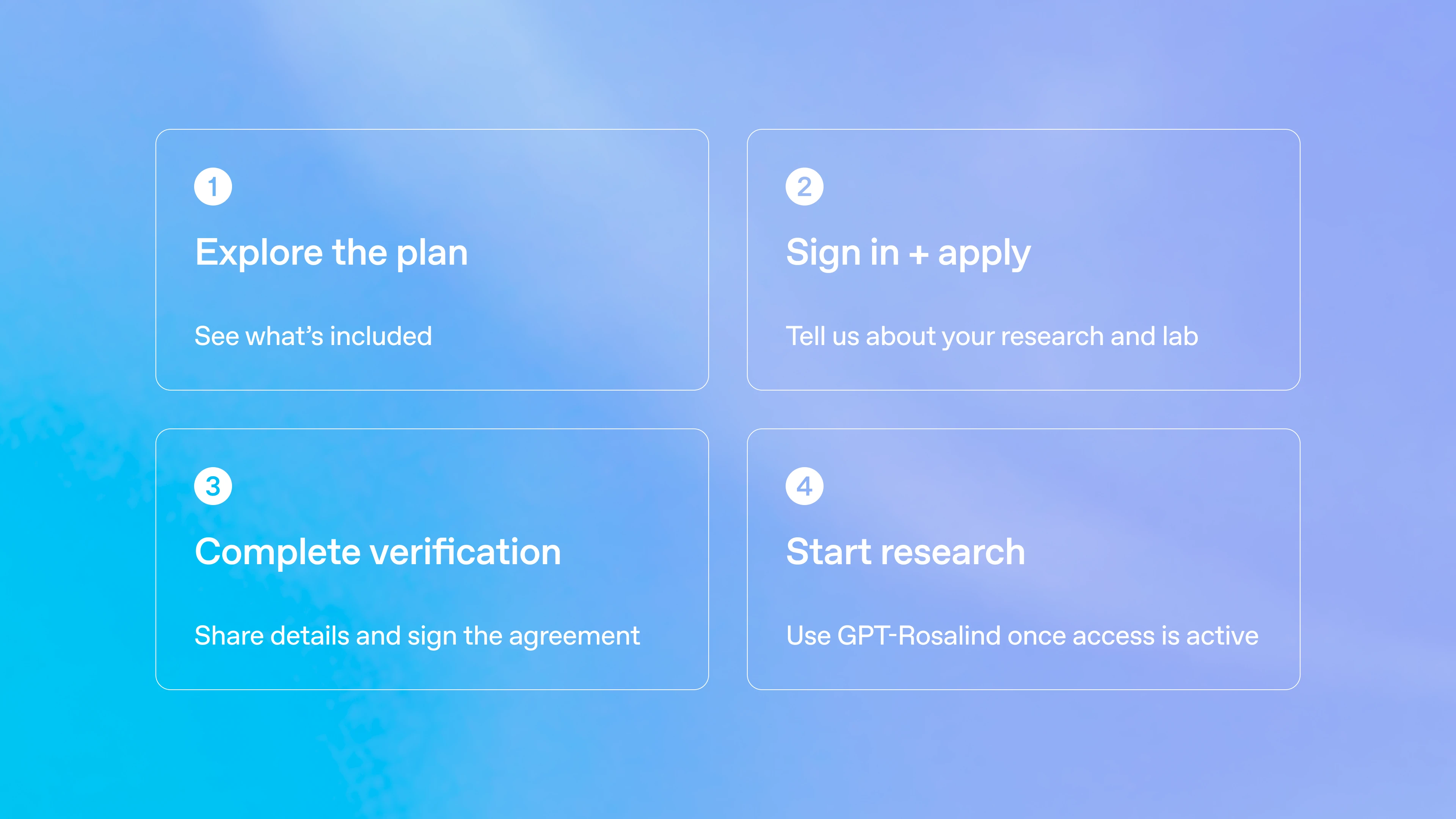
Source: official steps graphic published on OpenAI's page
- Review the plan details and the official help center guide.
- Sign in and submit an application on behalf of your lab through the official application page.
- Complete institutional and identity verification.
- Once access is active, start research and onboard up to 30 named lab members.
Before activation, OpenAI verifies the institution's legitimacy, the PI's identity, professional background, institutional appointment, and authority over lab access, and assesses the lab's affiliation, research activities, and intended use — including designating an institutional safety contact. After activation, monitoring and enforcement continue, and the company may follow up with researchers to clarify sensitive work in the context of approved research.
What this means for you
- Researchers at US universities: this is currently the cheapest route anywhere to a specialized life sciences model — 30 free seats for a year is worth thousands of dollars at market subscription rates. If your lab qualifies, do not sit on the window.
- Graduate students in the US: flag this to your supervisors. Seats are activated by the PI, not by individual students — but your lab's approval covers you.
- Gulf and international university labs: you are not covered yet. But the announcement's framing — "We're starting with academic labs as part of a broader effort to put useful AI tools in the hands of more scientists" — reads like a rollout, not a wall. Institutions that prepare usage cases and institutional documentation now will be ahead of the queue if and when eligibility widens. Meanwhile, regional options exist: Jais 3 from the UAE is a serious Arabic-native alternative for language-heavy research work.
- Anyone tracking OpenAI's trajectory: the plan completes a striking week for the company, which is simultaneously fighting a lawsuit from 8 US states over ChatGPT child safety. Widening academic access on one front while battling regulators on another is a deliberate two-front strategy.
Quick comparison: what if you don't qualify?
| Option | For whom? | Cost | Notes |
|---|---|---|---|
| Rosalind Academic Plan | US university labs | $0 × 12 months | Includes specialized GPT-Rosalind |
| Regular ChatGPT Business | Small teams anywhere | Listed per-seat price | No GPT-Rosalind access |
| Open-weight models like Muse Spark Open | Technical researchers | Free to download | Requires ops skills and hardware |
| Truescho's free tools | Everyone | $0 | Try the AI tools directory before paying anyone |
Why are AI companies competing for academia right now?
The Rosalind Academic Plan is not an isolated gesture. It is a new chapter in an openly contested race for university loyalty. Weeks earlier, Anthropic announced the Claude Frontier Academy — a $100 million program to train 10,000 engineers — and expanded its university partnerships in Asia through a new Singapore office. Google distributes research credits through its academic programs, and Gulf institutes are racing to build the same partnerships.
The commercial logic is straightforward: the academic researcher who builds today's work on one company's tools becomes, in a few years, a department chair signing institutional contracts, an industry consultant recommending the platform they know, and a founder building a product on the same API. Giving 30 free seats to a lab today costs little compared to the value of an enterprise relationship two years from now — which is why these programs are more likely to multiply than to stop.
The message for international institutions is equally clear: the window for building relationships with these companies is open now, and the labs that move early are the ones counted in official programs and invited to the next ones.
Tips for a stronger application
Based on the published criteria, reviewers verify three things: the institution's legitimacy, the PI's identity and authority, and the nature of the research and intended use. Preparing each item shortens review time and improves acceptance odds:
- Have your institutional lab page ready: an official university page showing your name in a lead role (PI or Lab Lead) and your research scope — it is the first thing checked under "institution legitimacy."
- Write a clear life-sciences use case: instead of "we want to try AI," specify the task — therapeutic protein design, genomic analysis, wet-lab experiment planning. The model is purpose-built for these domains, and the review explicitly asks about intended use.
- Designate an institutional safety contact: the terms require one; arrange it inside the university before applying, not after.
- Plan seat management for all 30 members: prepare the list of lab members who will genuinely use the seats, since administration is centralized through the PI and seats are name-limited.
- For labs outside the US: do not apply through the US track — watch the help center for updates, and have your institutional file ready the moment international enrollment opens.
Honest limitations
- US universities only in this phase — no official timeline for international expansion.
- No API access — the plan runs through enterprise product interfaces.
- Trusted-access approval for GPT-Rosalind specifically is a separate gate, not automatic with plan acceptance.
- Usage limits apply across included models; this is not an uncapped pass.
- Ongoing oversight: registered high-sensitivity use cases remain subject to safety checks and follow-ups after activation.
Frequently asked questions
Can graduate students apply individually?
No. Applications are submitted by the lab's PI or lab lead on the lab's behalf. Once approved, the PI activates seats for up to 30 named members.
Is lab research data used for training?
Not by default — the announcement states explicitly that research data shared through the plan is not used to train OpenAI's models.
How long does the plan last?
Up to 12 months from activation, with up to 30 free seats. Renewal pricing beyond the period has not been announced.
Does the plan cover universities outside the United States?
Not in the initial launch. Eligibility is explicitly limited to academic labs at US universities, with the company describing this as the start of a broader effort.
How is GPT-Rosalind different from regular ChatGPT?
Rosalind is a life-sciences-specialized model with a research workbench for medicinal chemistry, genomics, and wet-lab assistance — and in OpenAI's official assessment it produced actionable, detailed deliverables that the general model withheld.
The bottom line
The Rosalind Academic Plan is the clearest signal yet that frontier AI companies are competing to win the loyalty of academic scientists — the shortest path to institutional adoption that is hard to reverse. For those who qualify, it is a genuine free lunch: specialized tools that were corporate-only weeks ago. For those who don't, the next wave of open and regional models means the waiting room is no longer empty.