
Article 3 ===
On September 8, 2026, OpenAI published a claim with few precedents in the history of computing: an internal AI system, one the company says is significantly more capable than its commercial flagship GPT-6 Astra, has produced a mathematical proof for the Navier–Stokes existence and smoothness problem — one of the seven Clay Millennium Prize Problems, each carrying a one-million-dollar prize, and one that has stood open for roughly ninety years. The proof, accompanied by a machine-verified Lean version, argues that three-dimensional fluid equations can genuinely develop a singularity in finite time.
The announcement is already tangled in a scientific priority dispute with two outside researchers, and OpenAI explicitly says it will not claim the prize. This explainer walks through what was actually claimed, how a swarm of roughly ten thousand agents got there in 88 hours, why the controversy exists, and what any of it means for people who will never read a differential equation.
Source: OpenAI's official post
The problem, in plain English
The Navier–Stokes equations, written down by Claude-Louis Navier and George Gabriel Stokes in the nineteenth century, describe how fluids move — water, air, blood — by treating the fluid as a continuous substance rather than tracking individual molecules. Today they underpin aircraft design, weather forecasting, and blood-flow modeling.
The open question sounds almost innocent: can these equations "blow up"? Start a fluid from a perfectly smooth, calm state — can its velocities grow without bound in finite time, despite viscosity's constant damping? Jean Leray proved in 1934 that generalized solutions exist, but whether smooth solutions persist remained open, and the Clay Mathematics Institute named it a Millennium Problem in 2000. Of the seven, only Poincaré has been settled — by Grigori Perelman in 2003, who declined the prize.
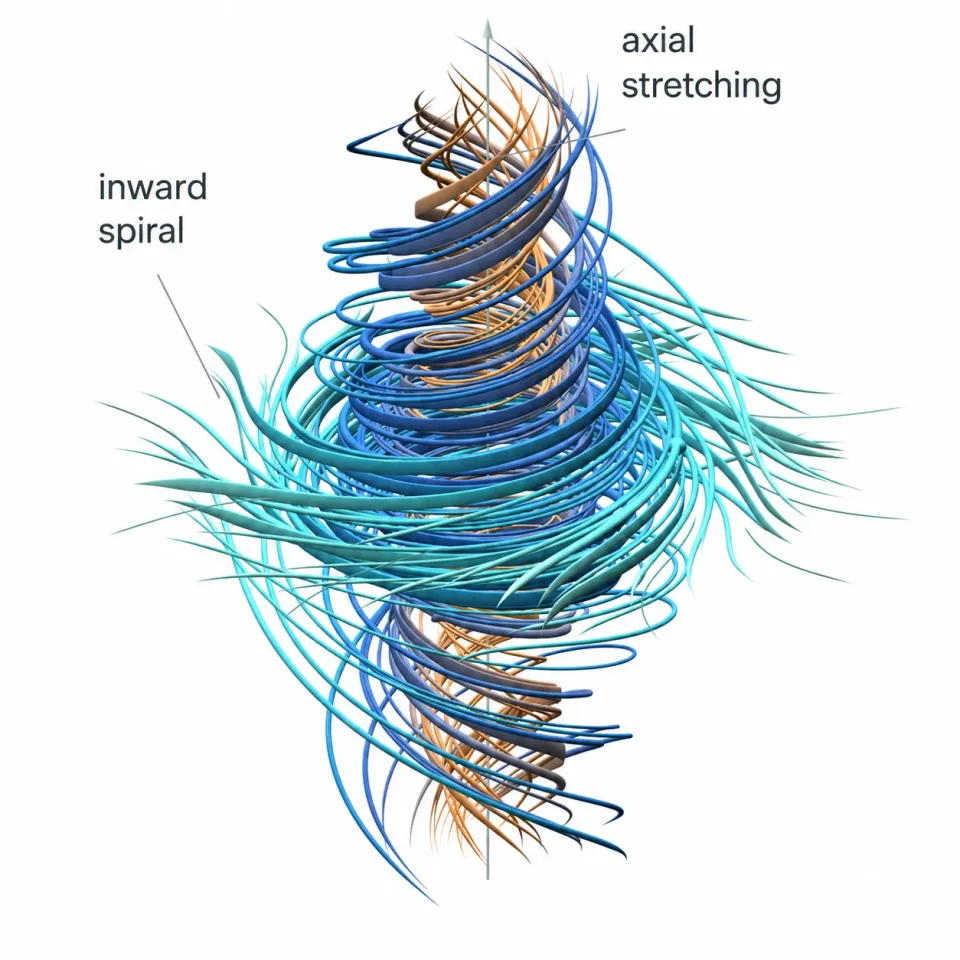
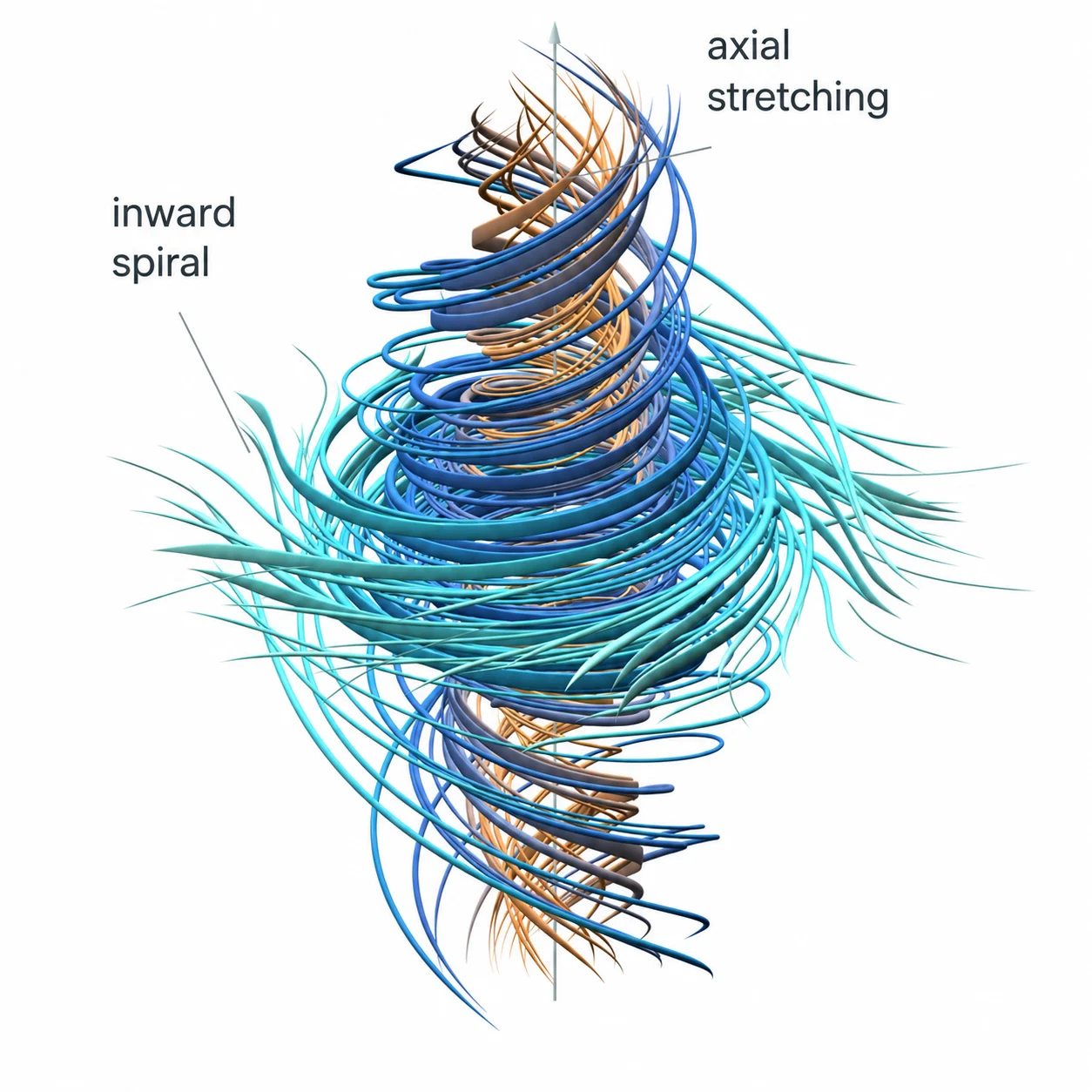
The new proof answers in the blow-up direction: yes, a singularity can form. The solution the system found is a vortex that curls inward and elongates — in OpenAI's own kitchen imagery, like spaghetti winding around a fork — shrinking and accelerating in a way that keeps its total energy finite, as physics requires.
The 88-hour story
The timeline OpenAI published reads like a heist movie. On August 28, 2026, the company began training a new internal model it describes as noticeably stronger than GPT-6 Astra, with performance still improving as training continued. On Tuesday, September 1, rumors arrived that two Millennium Problems had been solved; OpenAI responded by launching an evaluation of its model across the open Millennium Problems and beyond.
The system deployed was a coordinated swarm: agent groups of varying sizes communicating internally, some reading a cached copy of the internet, some executing code, all sandboxed under the same security controls applied to its frontier-model evaluations. For each problem, different formulations went to different groups — some instructed to seek existence proofs, others disproof — so the outcome could not be steered by framing.
Then came the surprise. In a side training task on a neighboring problem, agents solved the regularity problem for the Euler equations (Navier–Stokes without viscosity, unforced formulation) using about a hundred agents over fifty hours. OpenAI redirected everything toward Navier–Stokes, and the winning group landed the proof on Saturday, September 5 — roughly 88 hours after the first agents started. Refining and verifying the proof in Lean took another 17 hours through GPT-6 Astra, completing September 6.
The scale numbers deserve their own paragraph: the Navier–Stokes group alone exchanged 2.7 million messages and consumed roughly 130 billion output tokens. Across all problems attempted: 4.9 million messages and about 300 billion tokens.

Source: OpenAI's official post
The priority dispute: Alpöge, Buckmaster, and "fought dirty"
Those September 1 rumors, it later emerged, concerned two researchers: Levent Alpöge, affiliated with Anthropic, and Tristan Buckmaster, a mathematics professor at NYU. The two had reached a solution for the forced version of the Euler equations — a closely related but distinct result.
After completing its own project and the Lean verification on September 6, OpenAI contacted the pair to propose a joint announcement recognizing their priority. What followed was public conflict: Buckmaster published a statement documenting his objections to how OpenAI handled his and his colleague's achievement, a statement that shot to the top of Hacker News and produced headlines like "OpenAI fought dirty on a career-making math problem." Observers noted the timing — OpenAI's announcement landed two days after the researchers reached their result.
OpenAI's response, in its own post, is a flat denial on the central charge: its researchers and agents never saw either researcher's work before public release, and no access to any specific user's data occurred. But the company concedes it "cannot rule out" that anonymized data from the pair's use of OpenAI products contributed to model improvements — a sentence that distills the entire data-governance debate of this era into a footnote. OpenAI also notes the proofs differ fundamentally, including in the precise Euler result: forced for the researchers, unforced for its agents.
The lesson for anyone watching this industry: in an era of systems running billions of reasoning steps, questions of scientific priority and professional ethics become more fragile, not less. Our earlier coverage of the agent swarm incident on German Wikipedia covered the same theme from a different angle.
Why the Lean verification may matter more than the proof
Most capability claims in AI rest on short benchmarks a model can be prepared for. Mathematical proofs tolerate no gaming: every step either holds or it does not. Lean is a formal proof assistant that converts mathematics into logical rules a computer checks step by step. If Lean accepts the proof, there is no room for the human slip in line one-million that plagues traditional journal review, where exhausted volunteer referees spend months on a single paper.
That is the deeper story here: a commercial system has produced a research-grade document at Millennium-problem level that any university in the world can now verify mechanically at near-zero cost. The question stops being "do you trust OpenAI" and becomes "open the Lean file and check for yourself." DeepMind used a similar approach on International Mathematical Olympiad problems, but those are competition exercises; this is a century-old open problem. What remains for humans — and it is happening now across mathematics departments — is judging the novelty and significance of the method, the part no computer settles.
What a singularity actually means, without equations
Picture pulling the plug in a bathtub: the water picks up rotation as it approaches the drain, spinning faster the closer it gets. Navier–Stokes asks whether that acceleration can run away entirely — whether a smooth, quiet fluid can reach effectively infinite velocity somewhere in finite time. The new proof says yes: there exist perfectly smooth initial conditions where a vortex curls inward relentlessly, its core speed climbing without ceiling, while the total energy stays finite because the fast-spinning region keeps shrinking.
The philosophical punchline is that the equations used to design aircraft and forecast weather carry the seeds of their own breakdown. Physically, no real fluid reaches infinite speed — molecular physics intervenes long before — but the result marks the exact boundary where the "fluid as a continuous substance" description stops representing reality and a molecular-level description becomes mandatory. Knowing where a model breaks is itself an engineering result: it tells you when to trust a simulation and when to reach for a finer theory.
Why no million-dollar prize
The Clay Institute's rules are strict: publication in a refereed journal, a two-year waiting period after publication, and acceptance by the global mathematics community. More decisively, OpenAI states plainly in its post that it does not intend to claim the Millennium Prize for this result; the stated purpose of publishing is "to inform the world of the pace of progress" — a snapshot in time, not a coronation. So the accurate headline is not "company wins a million dollars" but "an AI system produced a Millennium-grade proof, and mathematicians will spend years checking what it means."

Source: OpenAI's official post
Where this sits among AI's landmark moments
| Achievement | Year | Who | Nature | Peer review |
|---|---|---|---|---|
| AlphaFold predicts protein structure | 2020 | DeepMind | Applied science breakthrough | Published; Nobel 2024 |
| GPT-6 Astra launches | 2026 | OpenAI | Commercial model leap | Internal benchmarks |
| Autonomous research agent runs for days | 2026 | OpenAI | Capability demonstration | Internal report |
| Navier–Stokes proof in Lean | 2026 | OpenAI internal model | Theoretical mathematics at Millennium level | Verification under way — Lean public, community examining |
Reading the numbers honestly
Two point seven million messages for one problem. The fair comparison is not to a single researcher but to an entire research lab: a professional mathematician might write a thousand pages over a whole project; here, the equivalent of tens of thousands of books was consumed in 88 hours on a single problem. The technical message is that the bottleneck for hard problems is no longer intelligence alone but orchestration — how do you stop ten thousand agents from repeating and contradicting each other? OpenAI's answer was distributing different formulations to different groups and selecting what survives, a structure that mirrors research labs themselves at machine speed.
The other side of that coin: every hour of this computation costs real energy and money, and nobody outside the company can audit the internal efficiency claims. The real test arrives when these capabilities reach an open product — only then does "stronger than Astra" graduate from marketing to measurement.
What this means for you
- If you are an engineer or researcher: materially stronger models than anything commercially available already exist inside labs, and the gap between "announced" and "internal" is widening. Plan your skills accordingly — the AI and programming tracks on Truescho are a practical starting point.
- If you are a student of math or science: the system's method — decomposing a problem into competing formulations, exploring in parallel, then merging insights — is imitable by humans in coursework and research, at vastly smaller scale.
- If you are a casual observer: the message is that the pace of capability has entered a new phase. OpenAI said it literally: "we are now in the next period of AI progress." The same company launched GPT-6 Astra days earlier, disclosed its day-long autonomous research agent in its Path to Astra report, and is now testing a model beyond all of them.
- If this worries you: the same post commits the company to deliberately slowing down where alignment and accountability require it — and declining the prize is at least a gesture in that direction. The test, as always, is in the doing.
Caveats before the awe
The proof was published by its producer and has not passed journal refereeing. The claim that the internal model beats Astra is unverifiable until release. The priority dispute raised ethics questions that remain open. And the admission that anonymized data contributions "cannot be ruled out" summarizes an industry-wide problem, not a solved one. None of this cancels the achievement; it just means the honest sentence is: a promising, machine-verified proof, awaiting the world mathematics community's verdict.
Frequently asked questions
Did OpenAI actually solve the Navier–Stokes problem?
OpenAI announced it produced a proof — with a research write-up and a machine-checkable Lean version — that three-dimensional Navier–Stokes equations can develop a singularity in finite time, corresponding to statements C and D in the Clay formulation. The official prize requires refereed publication, a two-year wait, and community acceptance, none of which has occurred.
What are the seven Millennium Prize Problems?
Seven major open problems designated by the Clay Mathematics Institute in Paris in 2000, each with a one-million-dollar prize: P versus NP, the Hodge conjecture, the Poincaré conjecture (solved by Perelman in 2003, who declined the money), the Riemann hypothesis, Navier–Stokes existence and smoothness, Yang–Mills theory, and the Birch and Swinnerton-Dyer conjecture.
What does a singularity mean in fluid dynamics?
It means fluid velocities grow without bound in finite time: a vortex curls in and accelerates toward effectively infinite speed. Since no real fluid moves infinitely fast, a singularity marks the point where the continuous-fluid equations stop describing reality and a particle-level model becomes necessary.
Why won't OpenAI win the million-dollar prize?
Because it explicitly says it will not claim it, and because Clay's rules require refereed journal publication, a two-year waiting period, and acceptance by the mathematics community. The company's stated goal is documenting the pace of its systems' progress, not collecting the prize.
Who are the Anthropic researcher and the NYU professor in this story?
Levent Alpöge of Anthropic and Tristan Buckmaster of NYU had solved the forced Euler equations problem in parallel; rumors of their result preceded OpenAI's project. After completing its proof, OpenAI proposed a joint announcement recognizing their priority, but a public dispute erupted over the handling of scientific credit, which OpenAI denies in its post.
Sources
- OpenAI's official post: On the Navier–Stokes Millennium Prize Problem — primary source for the proof and all figures
- Clay Mathematics Institute: Millennium Problems — official prize rules
- The Verge: controversy around the math breakthrough — press coverage of the dispute
- TechCrunch: NYU mathematician says OpenAI fought dirty — Buckmaster's statement and context
What we are watching next
Mathematicians will debate this proof for months, but the faster signal is commercial: when the internal model that produced it gets released, and what it can do. Between those two events, today's real winner is the demonstration that coordinated agent swarms can now produce original scientific work — not just a technical milestone but a challenge to how research itself gets done. Strengthen your own readiness for what follows; the next quarter is not going to be slower.