
Last updated: September 2026. On September 22, 2026, OpenAI launched GPT-6 Sol and Luna, two new AI models that cost roughly half as much as the previous generation on the API and, by OpenAI's own internal testing, make about half as many factual mistakes. Sol is built for complex coding and agent workflows, while Luna handles fast, high-volume text tasks. Both models are rolling out across ChatGPT plans now, and Luna is even reaching free users.
The launch is the second move in OpenAI's sixth model generation. It began earlier in September with GPT-6 Astra, the flagship reasoning model that started the whole generation. Sol and Luna are the follow-up: same family, very different jobs. One is a workhorse for developers, the other is a budget engine for volume.
In its announcement, OpenAI put it simply: "GPT-6 Astra introduced a new generation of intelligence; these models extend its benefits by making that intelligence more efficient and accessible." Translation: Astra was the demo of what the generation can do. Sol and Luna are the versions designed to run all day without draining your budget.
Sol vs Luna: What Each Model Actually Does
The two new models are not small and large versions of the same thing. They are deliberately different tools, and picking the wrong one is the easiest way to waste money.
GPT-6 Sol is the serious one. OpenAI positions it for complex tasks: hard coding problems, agent workflows that chain many steps together, long-context analysis, and reliable tool use. If you are building an AI agent that browses, calls APIs, and writes code, Sol is the model aimed at you.
GPT-6 Luna is the fast, cheap one. It is smaller and quicker, and it is meant for routine written work with a clear goal. Think summarizing a pile of documents, extracting structured information from text, or answering simple questions at high volume. Luna is the model for tasks where speed and cost matter more than deep reasoning.
| Model | Best for | Typical workloads | Profile |
|---|---|---|---|
| GPT-6 Sol | Complex reasoning, coding, agents | Long-context analysis, tool use, production agent pipelines | Larger, more capable, still cheap |
| GPT-6 Luna | High-volume routine text | Document summarization, information extraction, quick Q&A | Smaller and faster, lowest cost |
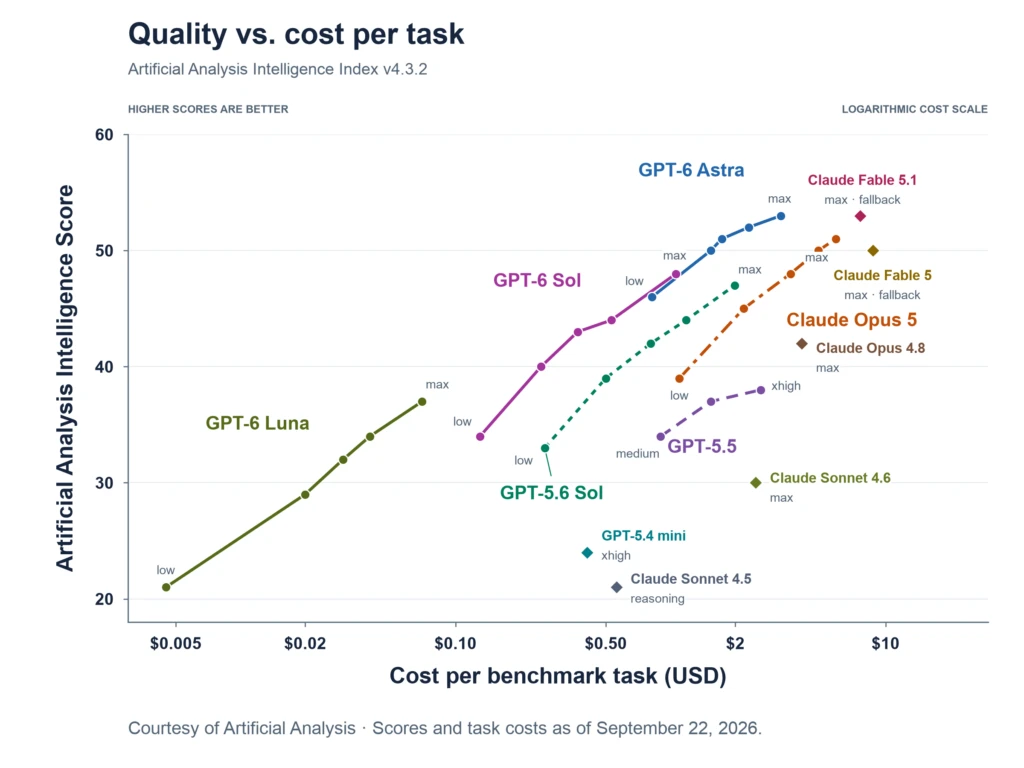
Microsoft, which made both models generally available on Azure on the same day, published an official chart comparing quality against cost per benchmark task across the GPT-6 family. It shows the trade-off clearly: Astra sits at the top on quality, Sol lands close behind at a lower cost per task, and Luna covers the high-volume floor.
Source: Microsoft Azure official blog
Half the API Price, and Why It Dropped
The pricing news is the headline for developers. OpenAI says the sixth generation costs about half of what the equivalent Sol and Luna models in the GPT-5.6 generation cost on the API. For teams running millions of tokens a day, that is not a rounding error. It is a line item cut in two.
According to OpenAI, the drop comes from two engineering sources: improvements in caching and improvements in inference efficiency. In other words, the models got cheaper to serve, and OpenAI is passing most of that saving to API customers. We covered the earlier speed-focused chapter of this story in our report on the ultrafast GPT-5.6 Sol on Cerebras hardware, and this launch extends the same pattern: every generation gets faster and cheaper at once.
The accuracy claim is just as aggressive. OpenAI says that on an internal factuality evaluation built from real conversations, where users had flagged model mistakes, GPT-6 Sol makes about half as many mistakes as its predecessor. The company's own words: it reaches "Astra-level reliability at much lower cost." That is a company claim, not an independently audited number, but the direction matches what Microsoft reported in its own testing.
Availability: Which Plans Get Sol and Luna
The rollout started on announcement day and continues in stages. Here is who gets what:
- ChatGPT Work and Codex: Sol and Luna are available for most paid accounts, aimed at coding and agent work.
- ChatGPT API: both Sol and Luna are live for developers building their own applications.
- Free users and Go: Luna is included, putting a sixth-generation model in the free tier at no cost.
- Desktop app: Luna is also available there.
- ChatGPT app and website: a gradual rollout through the day, so some users may wait hours before seeing the new models.
Enterprise users get a parallel path. Microsoft announced on the same day that Sol and Luna are generally available in Microsoft Foundry, with standard deployment across 28 Azure geographies. Microsoft's guidance assigns Astra to reasoning, coding, and computer use; Sol to general-purpose work and production agents; and Luna to extraction, summarization, and request routing.
Source: Microsoft Azure official blog
One piece of Microsoft's advice deserves emphasis for anyone comparing models on a spreadsheet: measure cost per completed task, not price per token. A cheaper token rate means nothing if the model needs twice as many attempts to finish the job.
What This Means for You
If you pay an API bill, the math just changed in your favor. A workload built on GPT-5.6-era Sol or Luna models can, according to OpenAI's pricing claim, run at roughly 50% lower cost by switching generation, before you write a single line of optimization code. Teams in markets like India, Nigeria, the Philippines, and Brazil, where price sensitivity shapes product decisions, will feel this fastest.
If you build agents, Sol is the model to test first. The combination of fewer factual mistakes, cheaper inference, and better tool use hits the three biggest failure points of agent systems: hallucinated facts, runaway costs, and broken tool chains. If your product summarizes documents or answers routine questions at scale, Luna is the obvious candidate, and its arrival on the free tier means you can prototype before you commit budget.
Want to map these models against other AI options before you choose? Truescho's AI tools rounds up the current landscape in one place.
The 90-Minute Race: Sol and Luna vs Claude Opus 5.5
The timing of this launch is not an accident. Anthropic released Claude Opus 5.5 just 90 minutes before OpenAI's announcement on the same day, September 22, 2026. Two frontier labs shipped flagship-adjacent models into the same news cycle, and the industry got a same-day comparison for free. We have the full breakdown in our Claude Opus 5.5 launch report.
OpenAI claims its new models beat Anthropic's Fable and Opus families on key evaluations. Treat that framing carefully: it is a vendor comparing itself to a rival using benchmarks it selected. Anthropic's own published numbers show its models leading in several agentic coding and knowledge tests. The honest summary is that both companies are now within a narrow margin of each other, and the right choice depends on your workload, your existing stack, and your bill.
For background on the family tree, our GPT-6 Astra launch coverage explains where this generation started, and our earlier Claude Opus 5 report traces how Anthropic built up to this week.
Read the Fine Print Before You Migrate
Three caveats keep this launch in perspective.
First, the headline numbers come from the vendors. The "half as many mistakes" figure is from OpenAI's internal evaluation, and the benchmark comparisons in Microsoft's chart are Azure's own measurements. None of it is wrong, but none of it is neutral either.
Second, OpenAI's claim of superiority over Anthropic's models is exactly that: a claim by OpenAI. Independent testing will take weeks, and real-world results always lag press releases.
Third, half-price tokens do not guarantee half-price applications. Prompt design, retrieval quality, and retry logic often dominate costs. Microsoft's "cost per task" framing is the right way to run your own evaluation before migrating anything production-critical.
FAQ
What is the difference between GPT-6 Sol and Luna?
GPT-6 Sol is built for complex work: coding, agent workflows, long-context analysis, and tool use. GPT-6 Luna is smaller and faster, designed for high-volume routine tasks like summarizing documents, extracting information, and answering quick questions. Sol is the stronger model; Luna is the cheaper, quicker one.
How much cheaper is GPT-6 Sol than GPT-5.6?
OpenAI says the sixth generation costs about half of the equivalent GPT-5.6-generation Sol and Luna pricing on the API. The company credits caching and inference improvements for the drop.
Is GPT-6 Luna available on the free ChatGPT plan?
Yes. Luna is available to free users and Go subscribers, and it is also in the ChatGPT desktop app. Sol, the larger model, is aimed at paid plans and the API.
GPT-6 Sol vs Claude Opus 5.5: which is better?
There is no clean answer yet. OpenAI claims an edge over Anthropic's Opus and Fable models, while Anthropic's own benchmarks show Opus 5.5 ahead in several coding and knowledge tests. Both launched within 90 minutes of each other on September 22, 2026, and independent comparisons are still catching up. Test both on your real workload before committing.
When did OpenAI launch GPT-6 Sol and Luna?
OpenAI announced both models on September 22, 2026, at roughly 17:00 UTC. The rollout across ChatGPT plans, the API, and Microsoft Foundry began the same day.
The Bottom Line
GPT-6 Sol and Luna mark the moment this model generation stopped being a showcase and started being infrastructure. Half the API price, roughly half the factual mistakes, and a free-tier option in Luna change the economics for developers from São Paulo to Manila to Warsaw. The claims are the vendors' own for now, so verify on your workload, but the direction of travel is unmistakable: frontier capability is getting cheaper faster than anyone predicted. While you reconsider your AI stack, it is also a good moment to scan Truescho's open opportunities for programs that can fund the skills this transition rewards.
Sources
- OpenAI — Introducing GPT-6 Sol and Luna — the official announcement with pricing and accuracy claims
- Microsoft Azure blog — GPT-6 Astra, Sol, and Luna for production agents in Microsoft Foundry — general availability details, regional rollout, and the official cost-per-task chart
- TechCrunch — OpenAI launches GPT-6 Sol and Luna — launch-day reporting quoting the OpenAI announcement