
Old vs New Syrian Pound: What the 100:1 Redenomination Means for Your Money in 2026
One website says the dollar buys 13,150 Syrian pounds. A friend in Damascus says 131.50. An app on your phone says 132.00. Your first instinct is that at least two of them must be wrong. They are all correct — they are just speaking two different currencies.
That is the story of Syrian money in 2026. On 1 January 2026, new pound banknotes entered circulation with two zeros removed: 100 old pounds = 1 new pound. Old and new notes circulated side by side for a 90-day window, and on 1 April 2026 the old notes stopped being legal tender, per the Central Bank of Syria's statement carried by SANA. The value of your money did not change — but every figure written in pounds now comes in two versions that look a hundred times apart, and the internet has not finished catching up. The Truescho editorial team tracks this currency daily, and this guide is the reference we send people who ask "which number is right?"
This guide settles it: the exact conversion, the new notes and their designs, the full timeline, why foreign sources still show numbers 100x bigger than Syrian ones, and the quick mental math that makes you fluent in both.
Source: SANA
What happened, exactly: the timeline
- August 2025 — On the anniversary of the fall of the Assad government, the presidency announced the currency would be redesigned and redenominated (Enab Baladi, 23 August 2025).
- 29–30 December 2025 — The framework was detailed: two zeros removed, per Arab News; the Central Bank governor stated the change "will not affect the exchange rate," and the information minister called it a "technical step," per SANA.
- 31 December 2025 — Presidential decree issued; 1 January 2026 — new notes entered circulation.
- 3 January 2026 — Official trading of new banknotes began, per SANA.
- 1 April 2026 — After the 90-day dual-circulation window, old notes ceased to be legal tender (Central Bank statement via SANA; corroborated by Syria Times).
Two things the redenomination was not: it was not a devaluation — the pound's value was unchanged, 100 old simply became 1 new — and it was not merely a reprint. The designs broke with the past visibly: the Assad family portraits that decorated Syrian notes for decades are gone, replaced by Syrian heritage motifs, as reported by Al Jazeera, TRT and Gulf News.
The conversion, once and for all
The rule fits in one line: old to new, drop two zeros; new to old, add two zeros.
| Old SYP | New SYP | Everyday meaning |
|---|---|---|
| 100 | 1 | Smallest practical conversion |
| 500 | 5 | — |
| 1,000 | 10 | A small note's worth |
| 10,000 | 100 | Daily spending scale |
| 50,000 | 500 | Largest new banknote |
| 100,000 | 1,000 | — |
| 500,000 | 5,000 | — |
| 1,000,000 | 10,000 | "A million" the old way |
| 13,150,000 | 131,500 | ~1,000 USD at the time of writing |
And the exchange rate in both languages: at the time of writing — observed 1 September 2026 on sypnow.com/en — the parallel market quoted around 131.50 buy / 132.00 sell per US dollar in new SYP, which is the same as 13,150/13,200 in old SYP. Whenever you see the dollar quoted "around 130-something," you are reading new pounds; "around 13,000-something" is old pounds describing the identical reality. For the day-by-day movement of that rate, our team maintains a live explainer on the Syrian pound exchange rate today and a companion page on the daily dollar buy/sell rate in Syria; if you need to convert a specific amount, the walkthrough in our USD-to-SYP converter guide shows how to read the result in both scales.
Five-second drills, exactly as they happen in real life:
| You see or hear | It means | The same money in the other pound |
|---|---|---|
| "The dollar is 13,200" | Old SYP, legacy scale | 132 new SYP |
| A payout quote of 66,000 | New SYP | 6,600,000 old SYP |
| "Rent is 1,500,000 a month" | Old SYP (habit) | 15,000 new SYP ≈ 114 USD at the observed rate |
| "Dollar fell to 130.80 today" | New SYP | 13,080 old SYP |
| A menu priced in the hundreds | New SYP | the hundreds you see are what you pay |
The new notes: denominations and designs
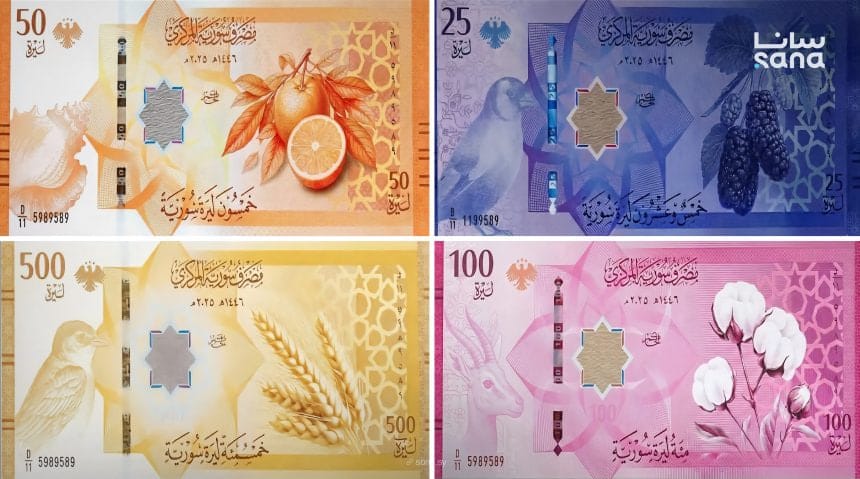
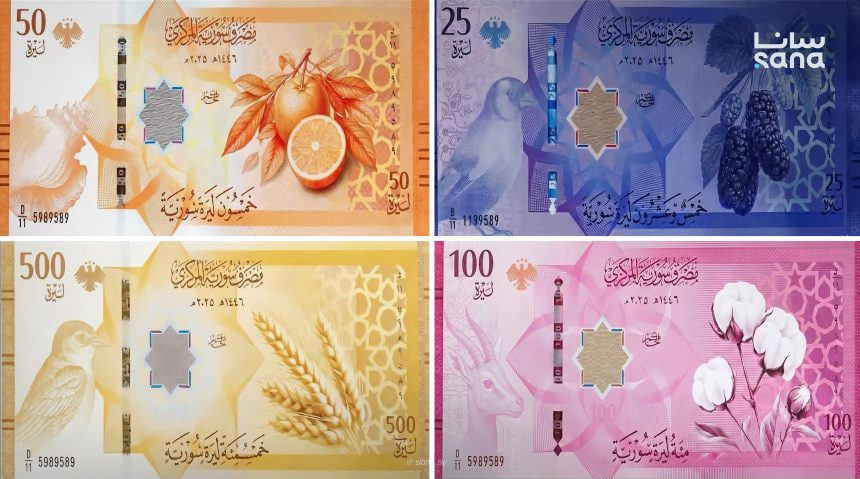
The new series circulates in 25, 50, 100, 200 and 500 new SYP notes. Gone are the presidential portraits; in their place, Syrian flora, fauna and heritage — the 200 shows olive branches and fruit, the 500 wheat, the 100 cotton and a gazelle, the 50 a fruit-bearing branch with a seashell motif, the 25 a songbird among mulberries, as displayed in the Central Bank's official release of the series.
Source: SANA
Why half the internet still shows old numbers
This is the single most valuable thing to understand, and the reason this article exists.
Most foreign sources — converters, news archives, datasets, even some banks — quoted the Syrian pound in its old scale for decades. When a country redenominates, every one of those systems must update manually. Some did it on day one. Many updated their data but not their habits. Some display a mix depending on the page you land on. The result in 2026: two honest-looking numbers, 100x apart, describing the same rate.
How to tell which one you are looking at, in five seconds:
- Dollar rate ≈ 130–140 → new SYP. This is the 2026 way.
- Dollar rate ≈ 13,000–14,000 → old SYP. Same rate, legacy scale.
- A "million-pound" price for an apartment or car → almost certainly old SYP, still spoken out of habit. That is 10,000 new SYP.
- No label at all → assume nothing; ask which pound. In Syria this question is asked constantly in 2026 — it is normal, not rude.
A related trap from spring 2026: for a few days in April, a rumor briefly produced four different quoted rates in circulation at once, as Enab Baladi reported on 23 April 2026 — a reminder that in a market mid-transition, the label on a number matters as much as the number.
How the physical swap actually went
The Central Bank moved the old currency out fast:
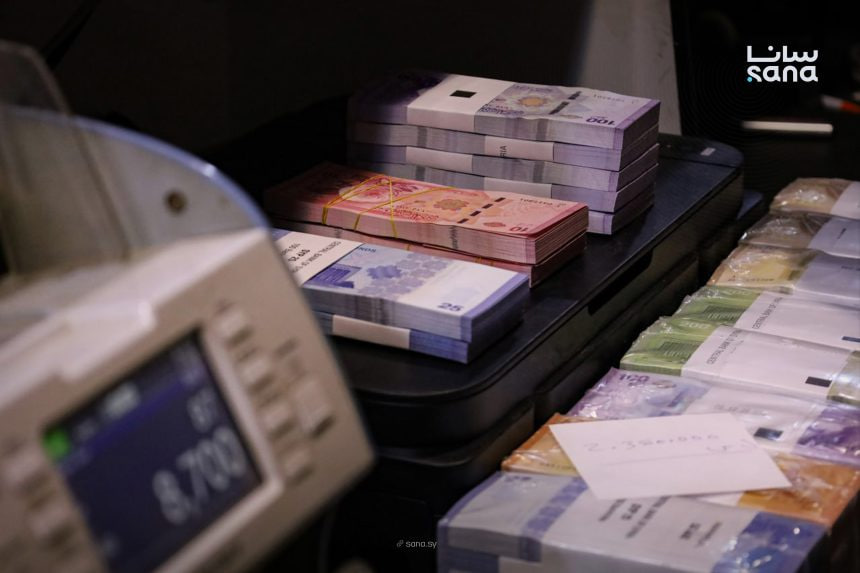
The logistics behind those numbers were substantial: the exchange ran through roughly 66 licensed exchange companies operating more than 1,000 outlets nationwide, as SANA reported when the transition framework was detailed in late December 2025 — a network built specifically so that Syrians holding savings in old notes could swap them locally rather than travel to a central bank branch. That is also why the swap progressed as fast as it did: by mid-2026, well over half the old currency by the Central Bank's own count had already been withdrawn, shredded and replaced.
- Old-note destruction began in February 2026, per SANA.
- By 4 May 2026, 56% of old currency had been replaced; by 1 June 2026, 63% — SANA reporting Central Bank figures.
- Counterfeit rumors that spread in January 2026 were publicly dismissed by the Central Bank on 15 January 2026.
For context on the wider money picture — cards returning to Syria for the first time in years, ATM reality, what visitors should carry — see our pillar guide: Money in Syria in 2026: Cash, Cards, ATMs and the New Pound. And if the redenomination matters to you because you send money into Syria, the channel-by-channel cost picture — including why quoted payouts must always be read in new SYP — is in How to Send Money to Syria in 2026.
"I still have old pounds" — what the rules say
If you are outside Syria holding old-series notes: since 1 April 2026 they are no longer legal tender. The 90-day exchange window has closed. What remains possible is governed by Central Bank of Syria procedures — check current guidance directly with the bank or its official statements via SANA before acting on anyone's summary, including ours. What you should not do is buy old notes as "cheap pounds": 100 of them are, by definition, worth 1 new pound, and as spending money they are worth nothing.
If you hold new pounds or are about to receive some, the practical habits are simple: refuse old notes in any transaction, and quote amounts to yourself in new SYP until the old habit fades.
Redenomination, devaluation, flotation — three words people confuse
The 2026 change triggers vocabulary mix-ups that cost real money, so the distinctions matter:
- Redenomination is what Syria did: relabelling the unit. 100 old SYP became 1 new SYP, same purchasing power, same value, different paper and fewer zeros. Nothing was "lost."
- Devaluation is an official cut in a currency's value against other currencies. Syria's redenomination was explicitly not this — the Central Bank governor said at announcement that the change would not affect the exchange rate, and the market rate at the time of writing (~131.50/132.00 new SYP per dollar, observed 1 September 2026) simply carries the pound's pre-existing market level forward at 1:100.
- Flotation / parallel-market movement is the pound's rate drifting with supply and demand — the thing that actually changes what your money is worth week to week. Track the rate, not the zeros.
If someone tells you "the new pound crashed" because a number got 100 times smaller, they have confused a relabelling with a collapse. The reverse confusion — insisting a site showing 13,150 is "wrong" — makes the same error in the other direction.
What it means for salaries, savings and old contracts
Inside Syria, the redenomination is now mostly a bookkeeping residue. But for anyone dealing with amounts agreed before 2026 — a lease signed in 2024, a family loan recorded "in pounds," a salary benchmark from 2023 — the practical rule is: establish which pound the old number meant (it will almost always be old SYP), convert once by dropping two zeros, and restate the figure in new SYP in writing. Where ambiguity about scale could matter, the label is the contract's most valuable word. For binding interpretations of any formal agreement, that is a question for a qualified professional in Syria — we describe practice, not issue rulings.
Abroad, the same logic applies to diaspora records: the "two million pound" wedding contribution your family remembers from 2019 is 20,000 in today's currency — worth roughly 150 USD at the observed rate — and knowing that keeps old stories and new transfers consistent with each other.
How other countries handled the same move
Syria is far from alone in cutting zeros — the pattern repeats across modern monetary history. Turkey removed six zeros from the lira in 2005; Venezuela struck three zeros in 2008 and five more in 2018 amid hyperinflation; Zimbabwe's serial redenominations became the extreme case study. The consistent lesson from all of them: the confusion window between the two scales lasts months to years, legacy quoting habits outlive the official deadline, and the people who navigate it best are simply the ones who always ask "which scale is this number in?" That question is the entire skill.
Mental math cheatsheet
- You see a price in old pounds (e.g., a menu figure like 25,000): drop two zeros → 250 new SYP.
- Someone quotes a salary "in the millions": a 3,000,000 old-SYP salary is 30,000 new SYP — roughly 227 USD at the observed rate of ~132 new SYP per dollar (1 September 2026).
- You read a foreign article claiming the dollar is "over 13,000": it is using old pounds; in new pounds that is ~131.50/132.00 at the time of writing.
- You want a tool to do it instantly: our team built a redenomination calculator into SYPNow — it shows market buy/sell in new SYP and converts old↔new both ways, on the web and in the app. Full disclosure: SYPNow is our own project, the same team behind this site, which is exactly why we are precise about which pound every number is in.
Frequently Asked Questions
Is 13,150 the same as 131.50 in Syrian pounds?
Yes. 13,150 old SYP = 131.50 new SYP. The 1 January 2026 redenomination removed two zeros (100 old = 1 new), and many foreign sources still quote the old scale out of habit or stale data. If a site shows a dollar rate in the low thousands or tens of thousands, it is speaking old pounds.
Are old Syrian pound notes still valid in 2026?
No. Old and new notes circulated together for 90 days, and old notes ceased to be legal tender on 1 April 2026, per the Central Bank of Syria. Since then, only the new series (25, 50, 100, 200, 500) is money.
Why does Google or my converter show a rate 100 times different from Syrian sources?
Because they are quoting different pounds — not different rates. Foreign platforms built their Syrian-pound data on the old scale and have updated unevenly since the redenomination. Check the magnitude: ~130s per dollar = new SYP; ~13,000s = old SYP.
Did the currency change devalue the pound?
No. A redenomination is an accounting relabelling, not a devaluation: 100 old SYP became 1 new SYP with the same purchasing power. The Central Bank governor explicitly stated at announcement that the change would not affect the exchange rate. The pound's market rate moves on its own dynamics — that is separate from the two-zeros removal.
Which pound do shops, banks and ATMs use now?
New SYP, exclusively, since 1 April 2026. Conversations may still use old-scale numbers out of habit — especially for large amounts like rents and salaries — but payment, pricing in institutions, and anything official is denominated in new pounds.
Were there problems with fake new notes?
Rumors of counterfeited new notes circulated widely in January 2026, and the Central Bank publicly dismissed them on 15 January 2026, per SANA. Standard caution with large-denomination notes remains sensible, but the panic itself was officially addressed.
Where can I quickly convert old-pound figures to new ones?
Drop two zeros, or add them going the other way — that is the whole rule. If you would rather not do it in your head every time, use our team's redenomination calculator at SYPNow, which also shows the day's market buy/sell rates in new SYP so you can sanity-check any quoted payout, price or salary figure you encounter, in either scale, in one place.
Sources
- SANA — President al-Sharaa reveals the new currency (December 2025 ceremony)
- SANA — The new banknote series: 25, 50, 100, 500
- SANA — Official trading of new banknotes begins (January 2026)
- SANA — 63% of old currency replaced (June 2026)
- SANA — Central Bank dismisses counterfeit rumors (15 January 2026)
- Arab News (29 December 2025) — two-zero redenomination framework; Enab Baladi (23 August 2025) — announcement on the anniversary; Al Jazeera, TRT, Gulf News — Assad portraits removed from new designs; Enab Baladi (23 April 2026) — the four-rates rumor episode.
- Rate context: sypnow.com/en, observed 1 September 2026 (parallel market: ~131.50 buy / 132.00 sell per USD in new SYP = 13,150/13,200 old SYP).