
Nvidia Nemotron 3.5 Lightning: 30B Open Model for AI Agents With 4x Faster Output 2026
Last updated: August 12, 2026
On August 11, 2026, Nvidia announced Nemotron 3.5 Lightning, a 30-billion-parameter Mixture-of-Experts model engineered specifically for AI agents, alongside NeMo Switchyard, an open-source routing library that automatically dispatches agent workloads across models. For any developer building autonomous AI systems that run for hours without human intervention, this release redefines the cost/performance frontier.
What Was Announced
The announcement is published on the Nvidia developer blog and includes three concrete deliverables:
- Nemotron 3.5 Lightning model — a 30B-parameter open-weights Mixture-of-Experts (MoE) model with only 3B active parameters per forward pass. The architecture accelerates inference without sacrificing output quality.
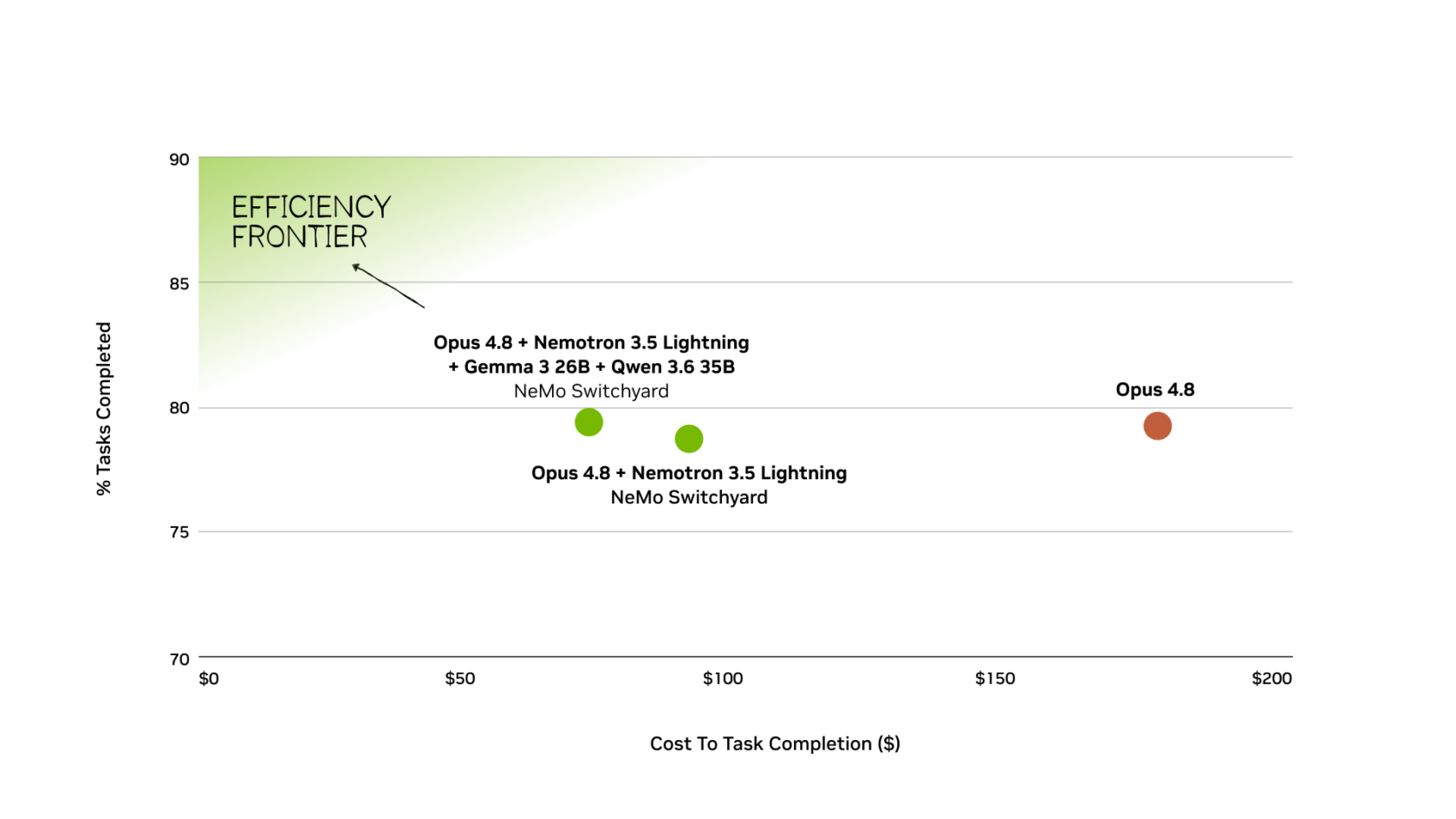
- NeMo Switchyard — an open-source routing library on GitHub that automatically dispatches each agent task to the optimal model based on quality, latency, and cost. According to Nvidia, Switchyard maintains frontier-level accuracy while reducing task completion cost to roughly one-third of using Claude Opus 4.8 alone.
- Nemotron-RL-Agentic-Terminal-Pivot dataset — an agentic reinforcement-learning dataset released on Hugging Face, enabling developers to fine-tune the model on domain-specific tasks.
According to the primary source, Nemotron 3.5 Lightning delivers up to 4x faster output speed and 30% faster agentic task completion compared with other models in its class.
Why This Matters for Developers and Enterprises
Local Inference on RTX Hardware
The defining characteristic of Nemotron 3.5 Lightning is its local-first design. It runs natively on hardware that many professional developers already own:
- Nvidia RTX consumer GPUs across multiple tiers
- The personal DGX Spark workstation
- The professional DGX Station
- The Jetson edge-computing platform for robotics and smart cameras
- RTX PRO workstations
For enterprises in jurisdictions with strict data-residency regulations — GDPR in the EU, the Personal Data Protection Law (PDPL) in Saudi Arabia, or the Dubai Data Protection law — running a 30B-parameter model on-premises eliminates the data egress risk inherent in API-based solutions.
Open-Source Integration
The model is published officially on Hugging Face, available for free trial on OpenRouter, and accessible via build.nvidia.com. The API is open, the weights are downloadable, and fine-tuning is unrestricted.
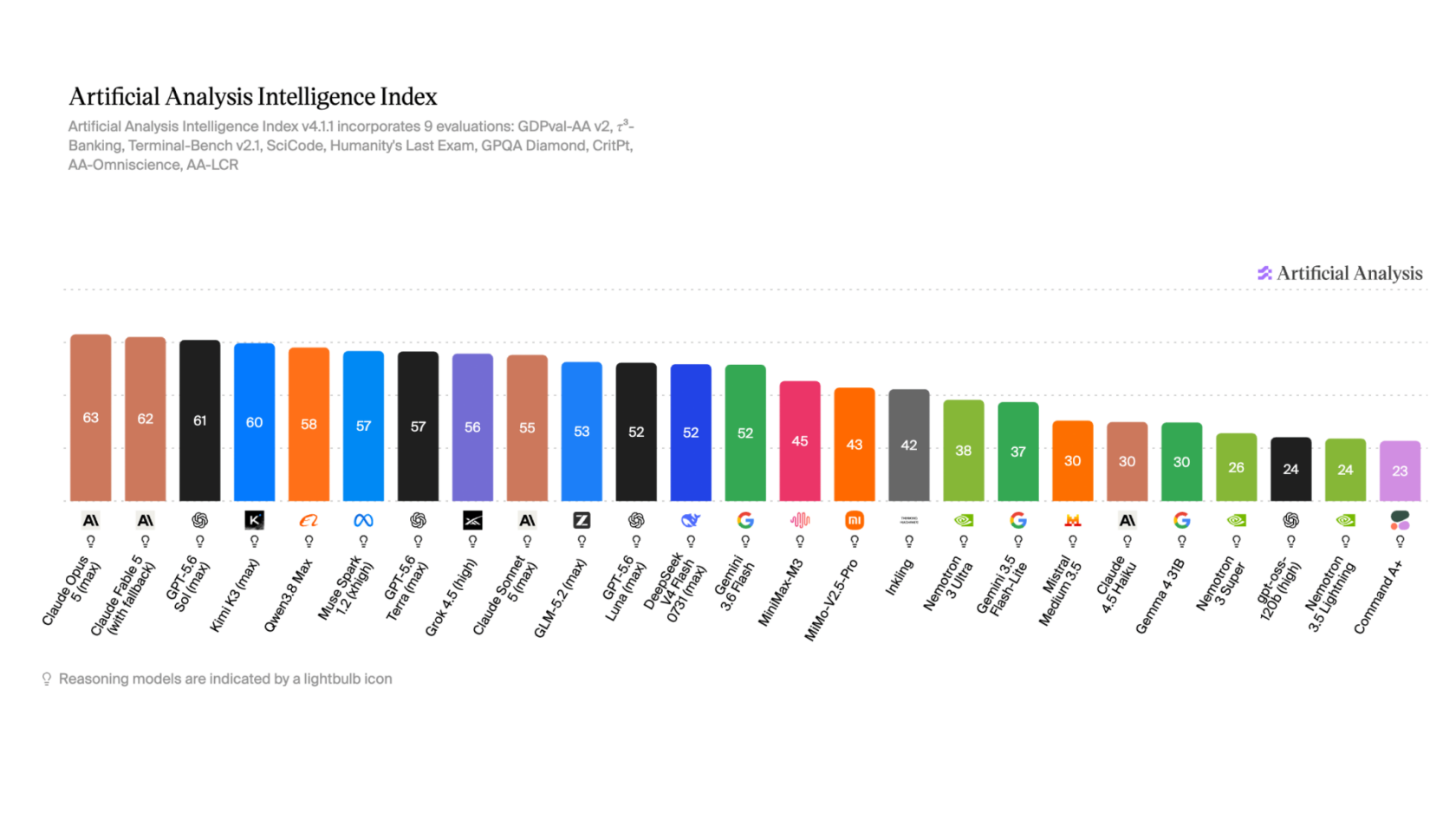
Quick Comparison: Nemotron 3.5 Lightning vs Alternatives
| Criterion | Nemotron 3.5 Lightning | Claude Haiku 4.5 | GPT-5.6 Mini | Gemini 3.6 Flash |
|---|---|---|---|---|
| Parameter count | 30B (3B active) | Undisclosed | Undisclosed | Undisclosed |
| Local inference | Yes (RTX) | No | No | No |
| Weights license | Open | Closed | Closed | Closed |
| Auto-routing (Switchyard) | Yes | No | No | No |
| Relative task cost | Lowest | Medium | Medium | Medium |
| Best for | Long-running agents | General chat | General chat | Multimodal tasks |
Nemotron 3.5 Lightning targets a specific workload class: long-horizon autonomous agents that execute multi-step task chains over minutes or hours — code review of an entire repository, legal-contract analysis, deep research, or customer-support automation for enterprise deployments.
Launch Partners
Nvidia confirmed adoption by major platforms from day one, including:
- CrowdStrike for cybersecurity operations
- Harvey for legal AI
- CodeRabbit for automated code review
- Boomi for enterprise system integration
- LangChain for agent orchestration frameworks
- Cognition for the Devin coding agent
- Siemens for industrial automation
- Ramp for enterprise spend management
LangChain's involvement matters most for developers — most agent frameworks in production today rely on LangChain or its derivatives.
What This Means for You
For individual developers
- Try the model for free on OpenRouter before committing infrastructure. Evaluate quality on a representative task sample.
- Download the weights from Hugging Face if you own an RTX GPU with at least 16GB VRAM, and use
llama.cpporvLLMto run locally. - Integrate NeMo Switchyard into existing multi-model projects. Nvidia's data shows cost reductions of up to 67% compared with single-model setups.
For startups and enterprises
- Data sovereignty: On-premises inference eliminates customer-data leakage to third parties — a non-negotiable in healthcare, financial, and government sectors.
- Lower cost: Switchyard reduces agent task cost to roughly one-third of Claude Opus 4.8 alone, according to Nvidia's published benchmarks.
- Customization: The Nemotron-RL-Agentic-Terminal-Pivot dataset enables fine-tuning on proprietary data without a commercial contract with an AI lab.
How to access from outside the US
The model has no geographic restrictions:
- Fully free on OpenRouter and build.nvidia.com
- Direct download from Hugging Face without regional blocks
- Local execution requires no internet after weights are downloaded
- No country is officially blocked, unlike some OpenAI and Anthropic services that intermittently restrict markets in the Middle East, Africa, and parts of Asia
Known Limitations
Several constraints deserve attention before deployment:
- Memory footprint: Running the full 30B model requires at least 16GB VRAM, with 24GB or higher recommended for optimal performance.
- Arabic language quality: Nvidia has not published detailed benchmarks for non-English performance. Developers building Arabic-language applications should test on their own workloads rather than assuming parity with English results.
- Operational complexity: Switchyard adds a routing layer that may slightly increase initial latency even as it reduces aggregate cost.
- Continuous updates: The model is in an early release. Performance characteristics may shift with revisions — monitor the official Hugging Face repository for updates.
How Nemotron 3.5 Lightning Differs From Nemotron 3.0
The previous Nemotron generation targeted general conversation and instruction-following. Nemotron 3.5 Lightning refocuses the model on long-horizon agentic workloads: tasks that chain 20-30+ steps, call external tools (browser, database, API), and tolerate minutes of latency before producing final output. This task class was underserved by prior open-weight releases.
Frequently Asked Questions
Do I need a paid subscription to use Nemotron 3.5 Lightning?
No. The model is open-weights and freely downloadable on Hugging Face, with free trial access on OpenRouter and build.nvidia.com. You only pay for your own infrastructure (RTX GPU or cloud server) when self-hosting.
What's the difference between Nemotron 3.5 Lightning and NeMo Switchyard?
Nemotron 3.5 Lightning is the AI model. NeMo Switchyard is the routing library that dispatches each task to whichever model is best suited — Nemotron, Claude, GPT, or any other. You can use Switchyard without Nemotron, and vice versa.
Will the model run on an RTX 3060 with 12GB VRAM?
Full FP16 inference requires more than 12GB. Use the quantized NVFP4 release published in the same Hugging Face repository to run on lower-VRAM cards, with a minor quality reduction.
Is the model suitable for Arabic-language customer-service applications?
Nemotron 3.5 Lightning is primarily trained on English and agentic tasks. For Arabic workloads, run careful evaluation on a sample of real customer queries. For critical Arabic applications, models specifically trained on Arabic — such as ALLaM or Jais — may produce better results.
How do I integrate NeMo Switchyard into my project?
The library is available on GitHub under the NVIDIA-NeMo organization. Visit the Switchyard repository, follow the install guide, and start with a simple two-model routing experiment (e.g., between Claude and Nemotron) to measure cost and quality differences.
Conclusion
Nemotron 3.5 Lightning and NeMo Switchyard establish a new baseline for building low-cost, locally-runnable AI agents — particularly relevant for developers and enterprises seeking open alternatives to closed proprietary models from Anthropic and OpenAI. The free trial on OpenRouter and official integration with frameworks like LangChain make the barrier to entry exceptionally low. Start with a small pilot on a real workload, measure cost and quality, then scale.
For more of our AI coverage, see our analysis of the Qwen 3.8-Max model from Alibaba, or our deep dive into Kimi K3, the open-source model at 2.8T parameters.