

Netflix UK Price Increase 2026: First UK Rise Since February 2025 — New Prices Per Plan and What Subscribers Should Do
Last updated: September 2026
Yes — the Netflix price increase UK subscribers have been bracing for since the American hike in March is now in force. In the first days of September 2026, Netflix raised its British prices for the first time since February 2025, lifting the ad-supported plan from £5.99 to £7.99 a month, Standard from £12.99 to £13.99, and Premium from £18.99 to £20.99. New and rejoining subscribers pay the higher prices immediately, while existing subscribers are migrated after an email notification, typically around 30 days later, on their next billing date.
That is the short version, and it is the only version you need if you want to act today. The longer version — who pays what, when the increase actually lands on your bill, whether downgrading is worth it, and how to keep streaming for less than Netflix now charges — is laid out below. Every figure here matches the reporting from Deadline, The Independent, ISPreview and the official Netflix Help Center, so you can budget against it with confidence.
What changed: every new Netflix UK price from September 2026
The Netflix price increase UK viewers face in September 2026 touches all three core plans and both extra-member options. The ad tier absorbed the sharpest rise at +33.4%, while Standard and Premium went up by +7.7% and +10.5% respectively. Extra members — the sub-accounts Netflix lets you buy for people outside your household — rose by between 17% and 20%.
| Plan | Old price | New price | Increase | Extra per year |
|---|---|---|---|---|
| Standard with adverts | £5.99 | £7.99 | +33.4% | +£24 |
| Standard (ad-free) | £12.99 | £13.99 | +7.7% | +£12 |
| Premium | £18.99 | £20.99 | +10.5% | +£24 |
| Extra member (with adverts) | £4.99 | £5.99 | +20% | +£12 |
| Extra member (ad-free) | £5.99 | £6.99 | +17% | +£12 |
On an annual basis you are now looking at £95.88 a year for the ad plan, £167.88 for Standard and £251.88 for Premium. That Premium figure is worth pausing on, because it is not just a Netflix record: as CordBusters noted in its price tracking, it makes Netflix the most expensive mainstream streaming plan in Britain, sitting above every rival's flagship tier.
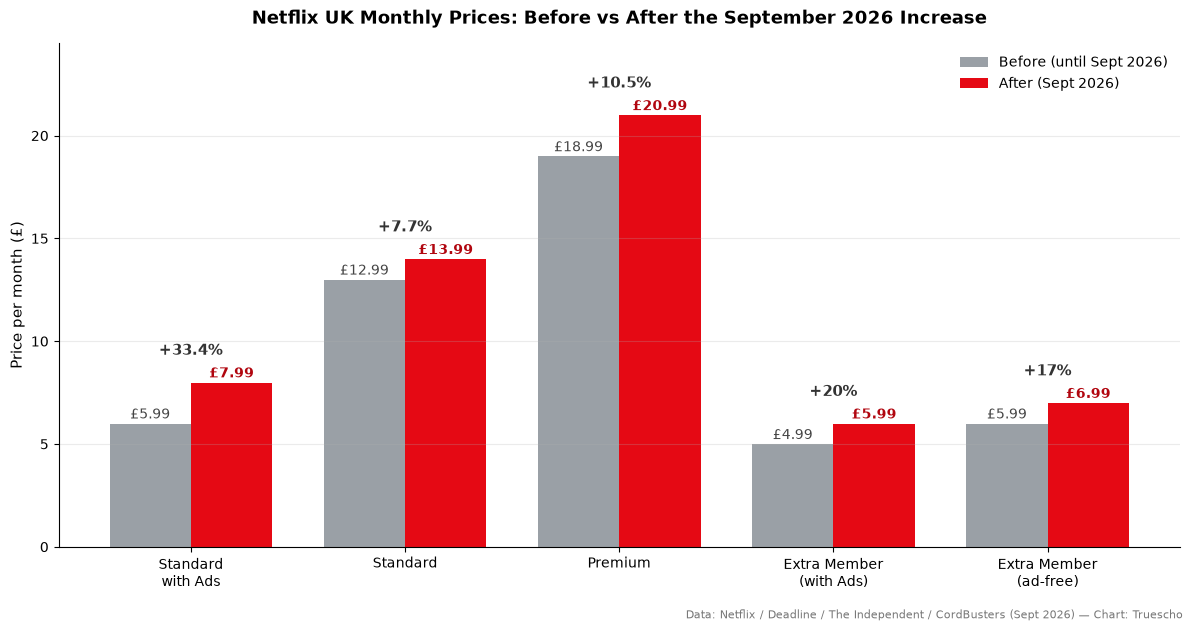
Source: Truescho, from Netflix's official UK plan pricing
Who the increase applies to — and when it hits your bill
The increase applies to everyone, but not at the same moment. New and rejoining subscribers were moved to the new prices immediately when the change went live around 3 September. Existing subscribers receive an email notice and are shifted to the new pricing on their first billing date after roughly a 30-day window, as The Independent and ISPreview both reported.
Here is how that plays out in real life. If your notification email landed on 8 September and your billing date is the 20th of each month, the payment on 20 October is your first at the new rate. If your billing date falls early in the month — say the 5th — you effectively ride the old price until early November. To find your exact date, search your inbox for the Netflix notice, then open Account, then Billing details, and read the date of your next scheduled charge.
The exit door stays unlocked throughout. UK subscribers can cancel at any time with no penalty, and access continues to the end of the month you have already paid for. That makes the 30-day notice window a genuine decision period rather than a formality — you can watch your queue down, compare alternatives and still leave before a single extra pound is collected.
The ad tier took the biggest hit: a third more in one step
The most dramatic line in the table belongs to the cheapest plan. Standard with adverts jumped by a third in a single move, from £5.99 to £7.99, which is the largest percentage increase Netflix has applied to any British plan in this cycle. When the tier launched it was positioned as the budget doorway into the catalogue; it now costs more per month than Disney+'s ad tier at £5.99 and matches the entry Now Entertainment membership at £7.99.
There is a second, subtler change worth noticing. The gap between the ad plan and ad-free Standard narrowed from £7 to £6 a month, a detail highlighted in CordBusters' coverage of the rise. That compression is deliberate pricing architecture: the ad plan's sharp rise nudges value-hunters either up to Standard — where Netflix earns more per head without ad revenue — or accepts the ad plan settling at a "normal" price point rather than a bargain one.
For viewers who watch an hour or two a week, the calculation has genuinely changed. Paying £7.99 with commercials to browse a catalogue intermittently is a harder sell than £5.99 was, and it is the single biggest reason downgrade-and-rotate strategies (covered below) have become the standard response to this rise.
How this rise fits Netflix's UK price history, 2023 to 2026
September 2026 is the first UK price increase since February 2025 and only the second in under two years. Several outlets ran headlines calling it the "second rise this year," but that phrasing is only true globally — for Britain specifically, The Independent's own reporting confirms the previous increase was in February 2025. The only 2026 hike before September was the American one in March.
| When | Market | What happened |
|---|---|---|
| January 2025 | US | Prices rise first in the United States |
| February 2025 | UK | Ads £4.99→£5.99 · Standard £10.99→£12.99 · Premium £17.99→£18.99 |
| 26 March 2026 | US | Ads $7.99→$8.99 · Standard $17.99→$19.99 · Premium $24.99→$26.99 |
| 3–4 September 2026 | UK | Ads £5.99→£7.99 · Standard £12.99→£13.99 · Premium £18.99→£20.99 |
The pattern is consistent enough to plan around: Netflix has moved prices in the US first and followed in the UK months later, then repeated. After the January 2025 US rise came the February 2025 UK rise; after the March 2026 US rise came this September's UK rise. British subscribers reading coverage of American increases should treat them as an early-warning system, not foreign news.
It also means the current figures are the result of stacking. A Premium subscriber who has held the plan since early 2025 has absorbed £3.00 of increases in under two years — from £17.99 to £20.99 — while the ad tier has gone from £4.99 to £7.99, a 60% climb since launch-era pricing. No single rise feels catastrophic; the cumulative curve is what quietly rebuilds the household budget.
A Manchester household runs the numbers: £36 a year more
Rachel Barlow, a 34-year-old ward nurse in Manchester, did what an alarming number of subscribers never get around to: she opened the email and opened a spreadsheet. Her household holds Premium for herself and her partner, plus an ad-free extra member for her sister in Salford — a setup that cost £24.98 a month, or £299.76 a year, before September.
Under the new prices the same setup costs £27.98 a month — £20.99 plus £6.99 — which is £335.76 a year. The Netflix price increase therefore costs her family £36 across twelve months, or another £3 on every monthly bill. Not life-changing, but not nothing on an NHS rota salary either, and it bought her a genuine decision.
She mapped three legitimate options. Switching her sister to the with-ads extra member at £5.99 would trim £12 a year. Downgrading the household to Standard at £13.99 — keeping the sister's extra member — would cut the total to £20.98 a month, saving £84 a year, at the cost of Premium's top video quality and extra simultaneous streams. Splitting Standard between just the two of them at £7.00 each would be cheaper still, but her sister would need her own route in.
Her call: hold Premium through the winter, calendar a review for March, and let the 30-day notice window on any future rise do the negotiating. That is the realistic playbook for most UK households — measure the actual annual delta, decide once, then stop re-reading the outrage headlines.
What the UK rise means if you pay Netflix in another currency
Netflix bills you in the currency of your account's country, so the September change only re-prices accounts billed as UK. For context — and for internationally mobile readers comparing deals — the same plans elsewhere now sit at very different levels. In the United States, after the March 2026 rise, the ad plan is $8.99, Standard $19.99 and Premium $26.99. Across euro-zone markets in 2026, Netflix pricing spans roughly €6.99–8.99 for the ad plan, €13.99–15.99 for Standard and €17.99–25.99 for Premium depending on the country.
Two observations follow. First, the UK's Premium at £251.88 a year is among the priciest ways to subscribe anywhere — subscriptionland's cross-market comparison places UK Premium second only to Ireland at the top of the table. Second, the percentage pain is uneven by design: Britain's ad tier took +33.4%, far above what most markets experienced this cycle, which is why the UK rise generated disproportionate coverage.
For expats and frequent movers there is a practical footnote. Netflix expects your account country — and therefore your currency — to match where you actually live, and changing it re-prices your plan to that market, as the Netflix Help Center's billing guidance explains. The UK rise is a good prompt to check which country is on file; a British account still billing pounds while you live in Madrid means you are paying the second-most-expensive Premium rate in the Western pricing table for no reason.
Your 60-second decision: the cheapest legitimate setup by household
The right response to the rise depends almost entirely on how many people you are supporting and whether they share your roof. The sharing mathematics popularised by MoneySavingExpert still holds under the new prices, and in most configurations the per-person cost lands at or below the old ad-plan price. Work through the row that matches your situation before touching anything else.
| Your situation | Best-value setup | Cost per person |
|---|---|---|
| Solo viewer | Standard with adverts | £7.99 |
| Two people, one home | Standard split two ways | £7.00 |
| Three people, one home | Premium split three ways | £7.00 |
| Four people, one home | Premium split four ways | £5.25 |
| You plus a friend in separate homes | Standard + one extra member, split | £10.49 |
Two of these rows deserve a sentence of explanation. The couple and family rows rely on everyone living at the same address, which is Netflix's household rule — the same principle behind the family-plan requirements YouTube Premium applies, which we cover in our YouTube Premium price increase guide. The final row is the extra-member route: Standard at £13.99 plus one ad-free extra member at £6.99 totals £20.98, or £10.49 each for two people who live apart.
If none of those rows fits — say you are a solo viewer who hates adverts — the honest answer is that Netflix Standard at £13.99 is now a considered purchase rather than a reflex. That is the tier where cancel-and-rotate behaviour starts to make sense: pay for the months a show you care about is airing, pause in between, and treat the catalogue as a library you visit rather than a utility you rent.
Cheaper alternatives if you would rather walk
The rise lands in a UK market where the competition has not matched it this cycle. Disney+ Standard with Ads is £5.99 a month — exactly what Netflix's ad tier used to cost before September. Now Entertainment runs at £7.99, or £4.99 if you accept a six-month price lock, and Prime Video includes ads at £8.99. None of them is Netflix, but as gap-fillers while you rotate, they hold the line on cost. For the wider picture — every service that did raise prices this year, in one comparison table — our 2026 streaming price hikes tracker has it covered.
The free tier of British viewing is also deeper than most subscribers use. The public-service catch-up services carry a surprising share of the national conversation, from prestige drama to sport-adjacent documentaries, at no charge. A realistic post-rise stack for a light viewer might be one paid service plus catch-up, rotating the paid slot every couple of months — a structure that caps annual streaming spend near £100 instead of Netflix Premium's £251.88.
And if the platform your household actually leans on is YouTube rather than Netflix, the Truescho shop lists a YouTube Premium family plan at €2.50 a month — a fraction of Netflix's new £13.99 Standard price — alongside Shahid, ChatGPT Plus and Gemini subscriptions. The shop does not sell Netflix itself, so this is not a like-for-like swap, but for families whose real habit is ad-free YouTube it undercuts every UK list price in this article. Our comparison of YouTube Premium versus Premium Lite versus Music Premium is worth a read before choosing a tier.
Frequently asked questions about the Netflix UK price rise
Is Netflix going up again in 2026?
Yes, twice depending on where you live. The US rise landed on 26 March 2026 (ads $8.99, Standard $19.99, Premium $26.99), and the UK rise followed around 3 September 2026 (ads £7.99, Standard £13.99, Premium £20.99). No further increases have been announced in either market.
How much is Netflix UK per month after the September 2026 rise?
The three plans now cost £7.99 with adverts, £13.99 Standard and £20.99 Premium per month. Extra member sub-accounts cost £5.99 with adverts or £6.99 ad-free. Annually that is £95.88, £167.88 and £251.88 respectively. The ad tier's +33.4% jump is the sharpest of the three, and Premium has crossed the £20 line for the first time in Britain.
When will the price increase hit my bill?
Existing subscribers are moved to the new pricing on their first billing date after roughly 30 days from the email notification. If your notice arrived on 8 September and you bill on the 20th, your 20 October payment is the first at the new rate. New subscribers already pay the new prices.
What is the cheapest Netflix plan in the UK?
Standard with adverts at £7.99 a month, or £95.88 a year. It was £5.99 before September 2026, making its 33.4% rise the steepest of any UK plan this cycle. It remains the only Netflix tier that shows advertising during playback.
How much is an extra member on Netflix UK?
An extra member sub-account for someone outside your household now costs £5.99 a month with adverts or £6.99 without, up from £4.99 and £5.99. Each extra member gets their own profile and login, and the account owner pays for it on their own bill.
How often does Netflix raise prices?
In Britain, roughly once every 18–20 months of late: February 2025 and September 2026 are the only two UK rises in that window. The US cadence is faster — January 2025 and March 2026 — and the UK has consistently followed American increases within months.
Why does Netflix keep raising prices?
Netflix says the new prices "reflect improvements to our wide range of entertainment and the quality of our service," as a spokesperson told The Independent. The company is guiding to $50.7–51.7 billion of 2026 revenue, spends around $20 billion a year on content and is absorbing the $2.8 billion fee tied to its Warner Bros. Discovery arrangement.
Is it worth downgrading from Premium to Standard?
Purely on price, dropping from £20.99 to £13.99 saves £84 a year. You give up Premium's highest video quality and the extra simultaneous streams, so the swap suits households that rarely watch in top quality or never stream in parallel. Heavy 4K households will feel the difference within a week.
Why Netflix says it costs more — and what your money funds
The company's public reasoning has not changed much over the years, but the numbers behind it have. Beyond the spokesperson's statement about entertainment and service quality, Netflix enters this rise from a position of strength: more than 325 million subscribers worldwide at the end of 2025, revenue guidance of $50.7–51.7 billion for 2026 (up 12–14%), and a target operating margin of about 31.5%. When a business this size raises UK ad-tier prices by a third, it is strategy, not survival.
The spending side explains some of it. Content investment runs at roughly $20 billion a year, and the $2.8 billion termination fee Netflix agreed to pay in its Warner Bros. Discovery dealings is the kind of balance-sheet line that eventually reaches subscriber invoices. Live sport rights, games and the push into weekly-event television all compete for the same content budget your subscription funds.
Source: Netflix on YouTube
What subscribers get for the increase is, as ever, a judgement call. The autumn slate is arriving — series such as Nobody Wants This returning on 22 October, alongside the film pipeline Netflix promotes on its channel — and viewers who watch several originals a month will rationalise the rise easily. Viewers who binge one series a quarter are the ones doing the rotation arithmetic.
Source: Netflix on YouTube
The decision framework, then: confirm your billing date, count the people your subscription actually serves, price the sharing or downgrade route from the table above, and give yourself permission to cancel without ceremony if the maths fails. Netflix made the first UK move in twenty months; the next move, for once, belongs to you — and if YouTube is what your family really watches, a family plan at €2.50 a month through the Truescho shop is the one corner of this market where prices moved in your favour.
Sources
Additional price tracking and timing reporting: ISPreview and CordBusters.