
Meta has released the weights of Muse Spark Open, calling it the most capable US open-weight model to date — and, in a first for its class, a frontier model you can run on a desktop at home using two Apple M5 Ultra Mac Studios. Announced October 15, 2026, the model packs 816 billion total parameters with 42 billion active per token, a 1-million-token context window, and a focus on coding, agentic work, and long-horizon reasoning. For developers worldwide, the headline is simpler: the weights are free to download under the Muse Model License, and hosted access on OpenRouter starts at $1.25 per million input tokens and $4.25 per million output tokens — pricing we verified live at publication time.
Source: Meta AI Research official blog
What exactly is Muse Spark Open?
Muse Spark Open is the newest member of Meta's Muse family — the open-weight sibling released just two days after the closed Muse Wonder model. Instead of renting access through a locked API, developers can now download the model's weights and run them wherever they choose, including their own machines.
The official specifications from Meta's announcement:
- 816B total parameters, 42B active per token — a Mixture-of-Experts architecture that keeps per-token compute manageable.
- A 1M-token context window — enough to reason over an entire code repository or hundreds of pages in a single request.
- Natively multimodal: it accepts text, images, audio, and video as input and produces text output.
- Built for coding and agentic work: complex software engineering, multi-step reasoning, and long-horizon tasks.
The launch caps a densely contested October in the frontier race, arriving days after Google's Gemini 4 Argon — a reminder that open and closed frontier labs are now shipping on nearly the same cadence.
The bigger story: a frontier model on your desk
The most consequential line in the announcement is not a benchmark. It is this: Muse Spark Open is the first model in its class to run on a desktop, using two Mac Studio machines with Apple M5 Ultra chips and the MLX framework.
The engineering behind that claim is straightforward once you unpack it. Modern Macs use unified memory, and each M5 Ultra machine can address up to 512 GB shared between CPU and GPU. Two machines together behave, in Meta's words, like one supercomputer with a terabyte of unified memory. Each chip's 1.2 TB/s of memory bandwidth is fast enough to read the small slice of parameters every token needs without becoming the bottleneck.
If you don't own that setup, the community documentation published on Hugging Face's official blog records real numbers for quantized builds on a single 512 GB Mac: a 2-bit llama.cpp build runs at 18 tokens/second using 304 GB of memory, while a 3-bit MLX build generates at 21 tokens/second with 225 tokens/second prefill. The full unquantized checkpoint is roughly 1.5 TB.
To prove the setup is practical rather than promotional, Meta showed its Muse Code agent shipping real iOS changes to Ice Cubes, an open-source Mastodon client — bug fixes, new features, and a full build — and driving DaVinci Resolve end to end, reviewing footage frame by frame to find the strongest moments and crop them vertically.
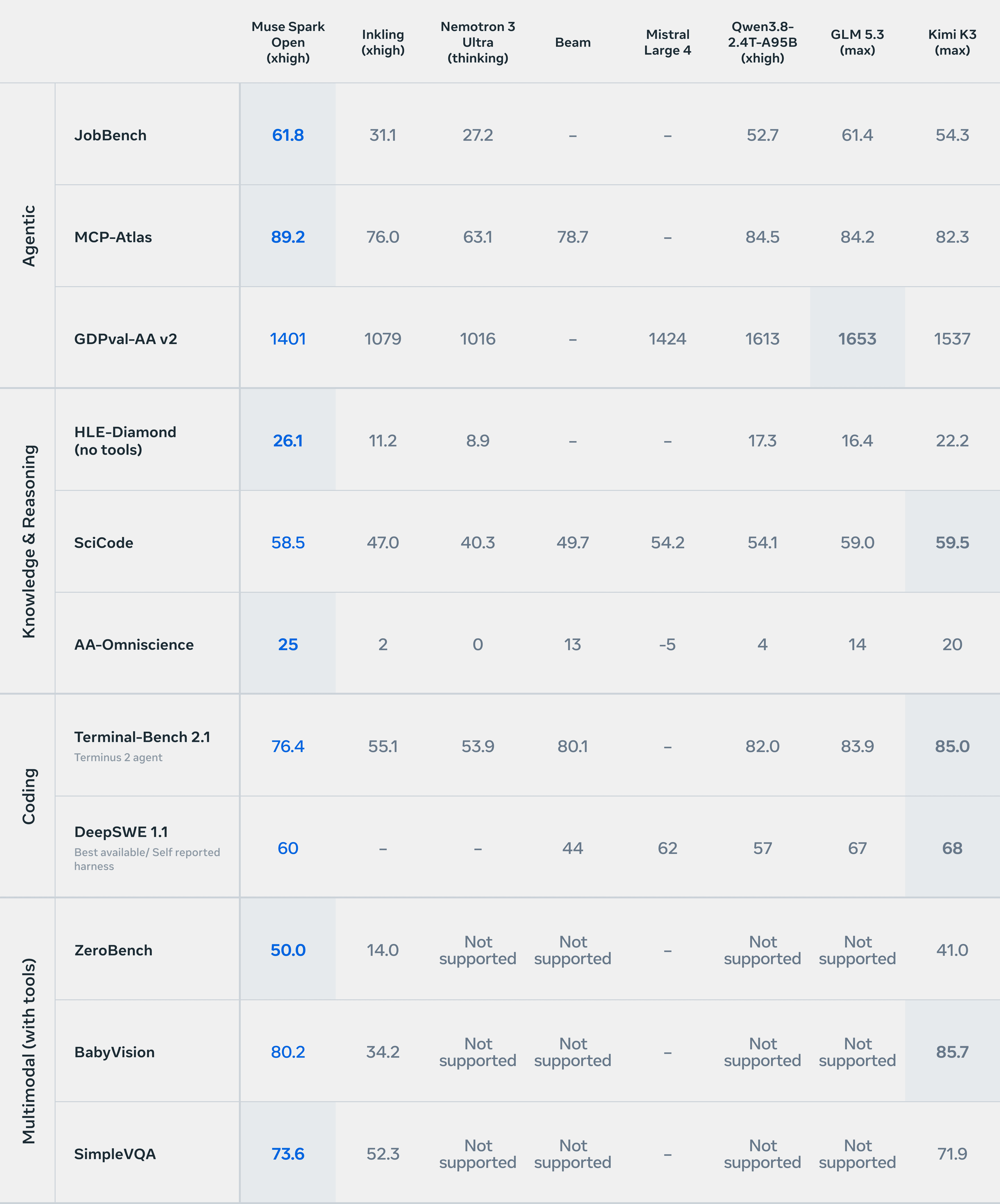
Source: Meta AI Research official scorecard
Download, license, and pricing
- Direct weight downloads: Hugging Face, Amazon SageMaker AI, Google Cloud Model Garden, and Microsoft Foundry Models.
- License: the Muse Model License ships with limited commercial terms, which Meta says allow many developers to use the model for free. Read the terms before building a large-scale commercial product on it.
- Hosted inference: available immediately through Baseten, Fireworks AI, Groq, Modal, Nebius, OpenRouter, and Together AI. At publication time, OpenRouter listed the model at $1.25 per million input tokens and $4.25 per million output tokens — competitive with far less capable closed models.
- Inference engines: SGLang, vLLM, TensorRT-LLM, Hugging Face Transformers, Apple MLX, llama.cpp, and Unsloth, with optimizations for AMD, Apple, Intel, and NVIDIA silicon.
- Cloud performance: the open-weight release ships with custom auto-tunable Helion GPU kernels in SGLang, delivering 1.03-3.95x kernel-level speedups on NVIDIA and AMD GPUs and a 3% end-to-end speedup on AMD MI350.
What this means for you
- Developers everywhere: for the first time, a top-tier US open-weight model can run locally with no subscription and no data leaving your machine. Even without a 512 GB Mac, cheap hosted access puts frontier capability within reach of any budget.
- Startups with data-residency concerns: running the model locally or inside your own cloud tenancy means your code and documents never leave your infrastructure — decisive for regulated finance, health, and government work.
- Researchers: full weight availability opens the door to studying and fine-tuning the model for specialized purposes instead of probing a black box.
- Everyday AI users: before committing to any subscription, compare what you actually need — our free AI tools directory is a good starting point.
Quick comparison: Muse Spark Open vs the alternatives
| Criterion | Muse Spark Open (Meta) | Gemini 4 Argon (Google) | DeepSeek V4 (China) |
|---|---|---|---|
| Weights | Open, free to download | Closed, API only | Open for selected builds |
| Approx. input price | $1.25/M tokens via OpenRouter | Higher, per Google's launch pricing | Among the cheapest on the market |
| Local execution | Yes — even on Macs | No | Partially |
| Context window | 1M tokens | Plan-dependent | Build-dependent |
| Multimodal | Text, audio, image, video input | Yes | Build-dependent |
The table reflects the launch state as of October 16, 2026; our deeper coverage of Gemini 4 Argon, DeepSeek V4, and the open Qwen3.8-27B has the details.
Honest limitations before you get excited
- The hardware bar is high: running the full-quality model locally officially takes two M5 Ultra Mac Studios — an investment in the tens of thousands of dollars — and even quantized builds need at least 512 GB of unified memory.
- Text-only output: the model understands audio, images, and video but does not generate them.
- Reasoning is always on: community documentation confirms the thinking layer cannot be disabled, consuming extra tokens on every request.
- Not fully open license terms: limited commercial conditions mean some broad commercial uses may require special arrangements — read the license text first.
- Post-training safety stack: the weights carry additional safety post-training under Meta's Superintelligence Scaling Framework, with a detailed model card on Hugging Face behind terms acceptance.
Frequently asked questions
Is downloading Muse Spark Open really free?
Yes. The weights are free to download on Hugging Face and all four major cloud platforms, and the Muse Model License permits free use for many developers, with limited commercial terms for broad commercial deployments.
Will it run on any Mac?
No. The full model officially requires two M5 Ultra Mac Studios via MLX, while documented quantized builds run on a single Mac with 512 GB of unified memory. Machines with less memory cannot hold this particular model.
How much does cloud access cost?
At launch, OpenRouter lists Muse Spark Open at $1.25 per million input tokens and $4.25 per million output tokens — among the lowest prices for a frontier-class model.
How is it different from Muse Wonder announced two days earlier?
Muse Wonder is a closed model served through Meta's subscriptions and APIs, while Muse Spark Open is an open-weight model you can download and run locally — our previous article covers the former in depth.
Does it support languages other than English?
The model is multilingual by design, but Meta has not published per-language evaluation cards at launch, so non-English quality is not yet officially characterized. We will update this article if an official evaluation is released.
The bottom line
With Muse Spark Open, Meta breaks the trade-off that defined 2026: either a subscription-locked frontier model or a weaker open one. For the first time, the strongest US open-weight model is also cheap to rent and genuinely runnable on hardware you own. For developers and companies far from Silicon Valley, that combination — frontier capability at $1.25 per million tokens, with a path to full local ownership — is the real news.