
Last updated: October 2026
On September 29, 2026, Morocco's Ministry of Digital Transition and Administration Reform released the first two open-source AI tools for Moroccan Darija — a dialect identification classifier and a speech-to-text model built on Mistral's Voxtral architecture. The announcement, made through the official channels of the Maroc Digital 2030 program, marks the first concrete output of a government-industry partnership signed with France's Mistral AI in September 2025. It also marks something rarer: a national government publishing usable AI tooling for a spoken dialect that global platforms have consistently ignored. For anyone working on speech technology, low-resource languages, or sovereign AI strategy, the details below — verified against official announcements and international press coverage — explain what shipped, why dialects break mainstream models, and what the Moroccan approach demonstrates for every multilingual market from South Asia to West Africa.
Source: Mistral — official Voxtral announcement page
The global problem this solves: speech AI is built for "clean" languages
Most frontier speech models are trained on written corpora that skew heavily toward standardized, formal language. For Arabic, that means Modern Standard Arabic (MSA) — the language of news broadcasts and formal writing — rather than the dozens of mutually divergent dialects people actually speak at home, at work, and on customer calls. The result is a persistent quality gap: a model that performs admirably on a news anchor's scripted Arabic can stumble badly on a casual sentence from Casablanca or Cairo or Riyadh.
Moroccan Darija is the extreme end of that gap. It is not, as outsiders sometimes assume, "broken Arabic." It is a living linguistic system with its own phonology, morphology, syntax, and vocabulary — heavily influenced by Amazigh (Berber) substrates, extensive French and Spanish borrowing, and now English tech vocabulary. A speaker who says one sentence may cross three languages without noticing. Linguists call this code-switching, and it is the single hardest problem in real-world automatic speech recognition (ASR).
This is not a Moroccan curiosity. It is the default condition of most of the world's speech:
- Hinglish (Hindi-English mixing) dominates urban Indian conversation — a market of hundreds of millions.
- Nigerian Pidgin and mixed Yoruba-English speech are daily reality across West Africa.
- Taglish (Tagalog-English) is the working language of Philippine customer service.
- Singlish, Chinglish workplace speech, and Arabizi (Arabic written in Latin script with numerals) all break monolingual assumptions.
Any organization building voice interfaces, call-center analytics, or transcription services for these markets hits the same wall Morocco just addressed deliberately. That is why a small country's tooling release deserves global attention: it is a working template, not just a local news item.
What exactly was announced
According to the ministry's official announcement and subsequent international coverage, two tools were released as open source:
| Tool | Function | Technical basis | Status |
|---|---|---|---|
| Dialect identification classifier | Distinguishes Moroccan Darija from other Arabic dialects and languages | Language classifier | Open source |
| Speech recognition (ASR) model | Transcribes spoken Darija into written text | Built on Mistral's Voxtral | Open source |
The stated target use cases span public services, education, media, customer support, document digitization, and multilingual data processing. The tools complement a broader internal AI suite the ministry has been developing to power a government-facing "AI marketplace" serving public administrations — part of the kingdom's wider Maroc Digital 2030 strategy.
Why Voxtral specifically was an engineering decision
The choice of foundation matters more than it might appear. Voxtral is Mistral's audio understanding family, and its architecture is designed from the start for multilingual speech — including handling language switching inside a single utterance, which is precisely the Darija failure mode. A model trained on "pure" language data collapses at the first mid-sentence transition; an architecture built for mixed speech does not.
Consider what a routine sentence sounds like in Moroccan service contexts: a phrase that opens in Darija, drops a French financial term in the middle, and closes with an English tech word. Every global ASR system evaluated on such audio faces three simultaneous failure risks — the dialect itself, the transition, and the borrowed vocabulary. Building the national tool on a code-switching-capable base, rather than retrofitting one, is the difference between a demo and a deployable system. For institutions elsewhere, this is the transferable lesson: match the architecture to how your population actually speaks, not to how textbooks say the language works.
The full story: from a 2025 memorandum to shipped tooling in 12 months
| Date | Event |
|---|---|
| September 2025 | Minister Amal El Fallah Seghrouchni and Mistral CEO Arthur Mensch sign a memorandum of understanding covering education, applied research, and knowledge exchange, with explicit emphasis on ethical, inclusive use and data protection |
| 2025–2026 | The ministry builds internal AI solutions for public administrations under its AI Made in Morocco roadmap |
| September 29, 2026 | Announcement of the first two open-source tools — the partnership's first tangible output |
| October 2026 | International coverage accumulates; the ministry confirms additional models and use cases in development (generative, language processing, speech recognition, digital services) |
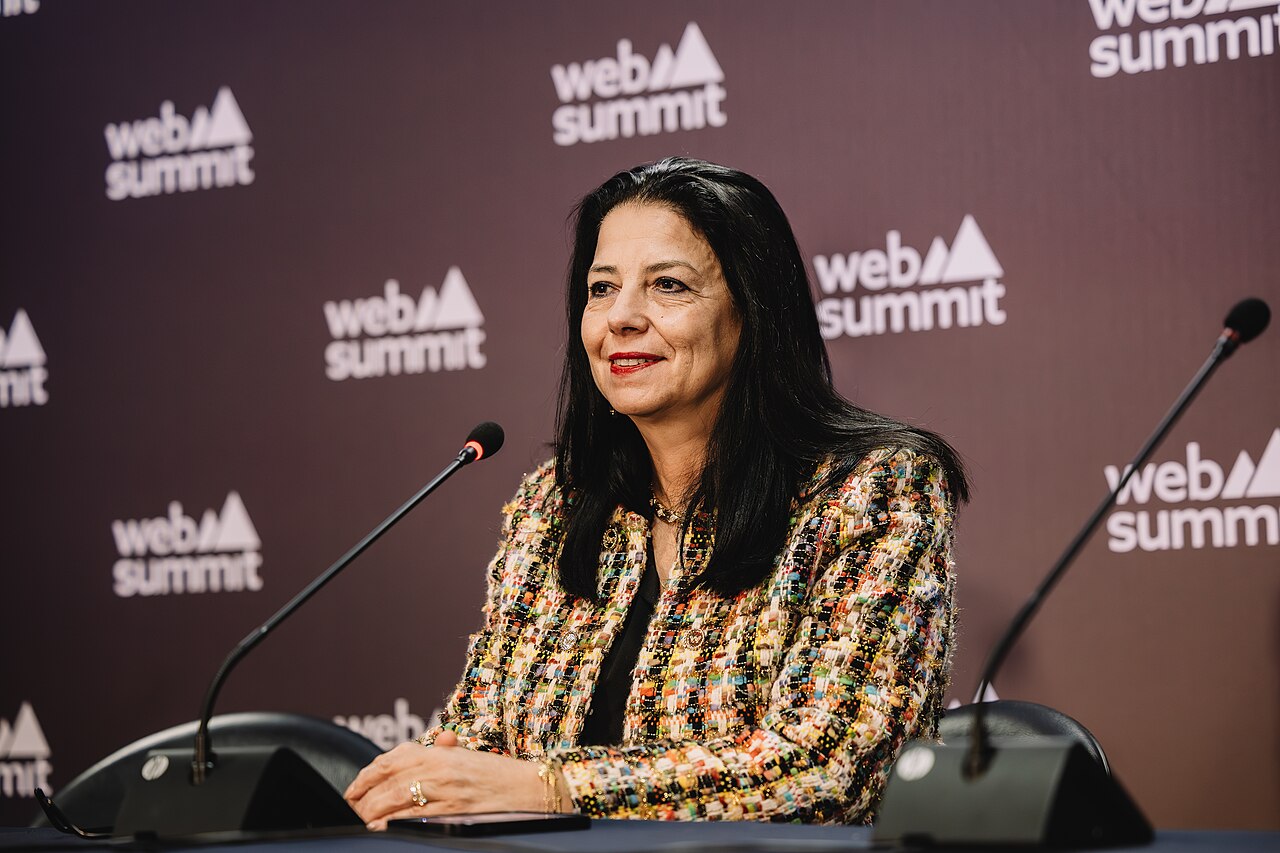
Source: Wikimedia Commons — the minister at Web Summit 2024

One detail deserves emphasis in an era of ceremonial MOUs: this partnership produced a public technical artifact within twelve months of signing. That is the yardstick against which similar government-lab agreements — including many announced with great fanfare in emerging markets — should be measured.
Three lessons for any country or team watching from abroad
Lesson one: solve the local problem, not the model race. Morocco did not attempt to build a frontier-scale general model competing with the largest labs — a race that consumes billions with no guaranteed podium. It identified a specific, unserved gap (spoken Moroccan Darija) and built focused, high-quality tooling for exactly that, with a stated path to expand into generative and additional NLP capabilities on the same foundation. Surgical, then scalable.
Lesson two: a European partner is a practical alternative to closed US platforms. The choice of Mistral was not neutral. It is a frontier-capable European lab willing to have its technology (Voxtral) underpin tools that are released openly — in contrast to closed-API-only relationships that leave governments permanently renting their own linguistic infrastructure. Notably, Mistral is simultaneously pursuing large-scale Arabic sovereign AI in the Gulf through its HUMAIN partnership in Saudi Arabia, meaning the same vendor now serves both a giant-state and a small-state model of language sovereignty.
Lesson three: open-sourcing multiplies impact at near-zero marginal cost. When a ministry releases its tools openly, every developer, startup, and university — Moroccan, Maghrebi, or otherwise — becomes a potential distribution channel: students evaluating the models, companies building products on top, researchers improving them. The alternative, a closed internal tool, would have trapped the entire benefit inside ministry walls. The pending license details matter (see limitations below), but the direction is unambiguous.
How this fits the 2026 Arabic AI landscape
The Arabic AI ecosystem has accelerated sharply through 2026, and the Moroccan approach contrasts instructively with its neighbors:
- Saudi Arabia is pursuing frontier-scale sovereign models: HUMAIN launched the ambitious humain-m3 Arabic model trained on a trillion native-Arabic tokens, with open weights promised.
- Morocco's approach is smaller but philosophically distinct: specialized tools for one dialect and one task, released for the community immediately.
- Global platforms advance steadily on "Arabic" broadly — for example, Google's Gemini 3.8 Live adding voice conversations across 97 languages including Arabic — but platform "Arabic" typically means MSA plus the most common dialects, which is exactly where specialized Darija tooling retains its value.
| Criterion | Morocco's Darija tools | Saudi humain-m3 | Global platform models |
|---|---|---|---|
| Type | Two focused open tools | Frontier-scale general model | Closed models via API |
| Focus | Moroccan Darija + code-switching | MSA + general tasks | General languages |
| Openness | Open source (license details pending) | Open weights promised | Closed |
| Who builds on it | Any developer or institution | Partners and developers when available | Via paid API |
The two strategies are complements, not rivals: one builds general Arabic infrastructure, the other fills the dialect layer that general infrastructure consistently misses. Any serious regional AI plan needs both.
What it means for you, practically
- For speech engineers everywhere: the Moroccan recipe — dialect classifier plus specialized ASR on an open multilingual base — is directly transferable to Hinglish, Pidgin, Taglish, or your own mixed-speech market. The binding constraints are training data and institutional will, not architecture.
- For product teams in multilingual markets: customer support transcription, voice interfaces, and media captioning for dialect-speaking users have just become more tractable in one more market. Audit your own audio pipelines for how they handle mixed speech — most fail silently.
- For policy watchers: this is a live demonstration that "AI sovereignty" does not require a billion-dollar frontier program. A focused ministry, a willing vendor, and an open release can move a whole language community forward.
- For researchers: an open evaluation gap now exists — benchmarking these tools against Whisper-family and other systems on real Darija audio, and building public reference datasets, is high-value, publishable work.
How to start building on this today
An honest caveat first: no public download link for the two tools had been published as of this article's date, and the ministry has not yet released license text or accuracy benchmarks. That does not block practical work:
- Master the base first. The Voxtral family is officially available on Hugging Face under the mistralai organization (including Voxtral-Small-24B and the real-time Voxtral-Mini). Test it on your own dialect recordings and characterize its strengths and weaknesses yourself.
- Build your own dialect classifier. Existing dialect identification tools cover major Arabic varieties; if yours is underserved, the Moroccan pattern shows the classifier is a tractable first project with modest data requirements.
- Watch the official channels. The Maroc Digital 2030 program's official accounts are the primary announcement venue; availability links, if published, will surface there.
- Pair audio with document AI. For full ingestion pipelines over written material, OCR and document understanding layers — such as Mistral's OCR 4 release — complement ASR for organizations digitizing mixed-language archives.
Honest limitations, stated plainly
The press coverage itself — including a detailed October 3 report on iAfrica — flagged gaps the announcement has not answered: no published accuracy metrics (what is the word error rate on Darija, measured against what baseline?), no details on training data size or provenance — a sensitive point given the partnership's stated privacy commitments — no clear license text despite the "open source" label, which spans everything from research-only to fully commercial permissions, and no verified download link. Additionally, the ministry's official website was returning a technical error page when we attempted to verify it during preparation of this article, so this report relies on the official program announcement and multiple independent press accounts. Any final quality judgment on the tools is impossible until these details are published, and this article will be updated when they are.
Why a government open-sourcing its AI is a bigger deal than it sounds
When a private company open-sources a tool, that is a business decision. When a ministry does it, that is a commitment to digital sovereignty in its practical sense: knowledge that is not merely imported and consumed, but built and shared. The biggest loser in this arrangement is the assumption that "low-resource" languages must wait for the mercy of global model roadmaps. The biggest winners are small teams worldwide who can now start from the shoulder of a government experiment instead of from zero.
Are Morocco's Darija AI tools available for download now?
The official announcement describes them as open source, but no public download link or detailed license text had been published as of this article's date. Practical follow-up means monitoring the official Maroc Digital 2030 program channels until availability links appear.
What is the relationship between Mistral's Voxtral and the Moroccan tools?
Morocco's speech-to-text model is built on Voxtral, Mistral's multilingual audio model family, whose architecture is designed to handle language switching within a single utterance — the core requirement for real Moroccan speech. Several Voxtral releases are available openly on Hugging Face for direct experimentation.
Why do global models struggle with dialects like Darija?
Because most written Arabic training data is Modern Standard Arabic, while dialects are primarily spoken and diverge in phonology, morphology, syntax, and vocabulary. Code-switching between Arabic, French, and English within single sentences adds a second layer of difficulty that monolingual architectures were never designed to handle.
Can the Moroccan approach be replicated for other languages?
Yes, methodologically. The recipe is a dialect identification classifier plus a specialized ASR model built on an open multilingual base. The binding constraints are high-quality spoken training data for the target variety and institutional funding to collect it, curate it, and maintain the result.
How does this differ from Saudi Arabia's humain-m3 model?
Morocco's tools are narrow, dialect-focused, and released for the community immediately; humain-m3 is a frontier-scale general model for Modern Standard Arabic and broad tasks, with open weights promised later. One is a surgical solution, the other is general infrastructure — regional AI strategy increasingly needs both.
Sources
- Morocco's Ministry of Digital Transition announcement via official Maroc Digital 2030 channels
- Morocco World News — Morocco, Mistral AI Release First Open-Source Darija AI Tools
- iAfrica — Morocco Releases First Open-Source Darija AI Tools From Mistral Partnership
- Mistral — official Voxtral announcement page
Dialect AI stopped being a waiting game the moment a government decided its citizens' actual speech deserved tooling — and published it. The question for every other multilingual market is no longer whether this can be done, but who does it next. If you are building skills in this space, start with structured learning paths and research and study opportunities that keep you at the front of the queue.