

Mistral Studio 2026: Version Control and Audit Logs for Prompts and Skills
On July 9, 2026, Mistral announced prompt and skill management in Studio. This is a dated explainer for an important product update that did not yet have a dedicated Truescho article, not a breaking-news rewrite.
Source: Mistral Developers on X

Source: Mistral AI
The Problem: Prompts Became Business Logic
Prompts began as experiments. A person wrote an instruction, tested it, copied it into an app and adjusted it when the output felt wrong. In production AI systems, that instruction can become customer-support policy, brand voice, escalation logic, document interpretation and agent boundaries.
Many teams still manage those assets like loose notes. One version lives in a code repository, another in a shared document, another inside a no-code builder, and another in a chat thread. When production behavior changes, the team has to answer hard questions: which version ran, who changed it, why did it change, and how do we revert?
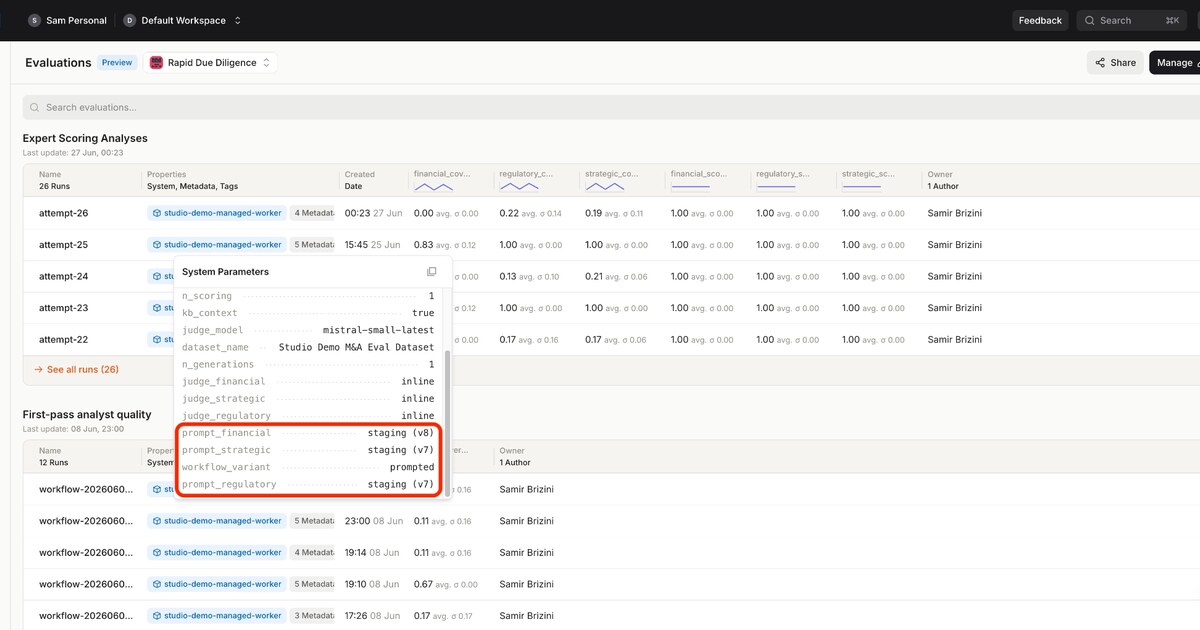
Mistral's answer is to treat prompts and skills as production assets. Studio gives them owners, immutable versions, labels, rollback, audit logs and observability that can connect a production output back to the asset version behind it. That is a governance move, not just a convenience feature.
Why Governance Matters
For teams deploying AI agents, the model is only one part of the product. The instructions around the model often determine whether the system behaves correctly. A support agent that follows the wrong escalation rule can create operational risk even if the underlying model is strong.
Versioning matters because a production prompt should not change silently. Ownership matters because someone has to approve and maintain behavior. Labels matter because staging and production should not be confused. Audit logs matter because incidents require evidence, not memory. Observability matters because a bad answer is easier to investigate when the exact asset version is known.
For related Mistral coverage, see Truescho's analysis of Mistral Robostral Navigate, and compare practical products in the AI tools hub.
Governance Options
| Approach | Strength | Weakness |
|---|---|---|
| Prompt in a document | Easy for anyone to edit | Weak ownership and weak deployment control |
| Prompt in code | Strong review path for engineers | Slower for domain experts |
| Standalone prompt catalog | Better discovery | May not know what actually ran in production |
| Mistral Studio system of record | Versioned, owned and observable | Useful only if teams adopt it as source of truth |
What Skills Add
Prompts define instructions. Skills define repeatable procedures. A skill may describe when it should be used, what steps it should follow, which tools it may call and what output format is acceptable. In agentic systems, that distinction matters.
If every team copies the same skill and edits it locally, behavior fragments. A governed skill can be improved, versioned and reused across a workspace. That reduces copy-paste risk and helps teams standardize high-value workflows such as invoice review, policy lookup, lead qualification, document summarization or incident triage.
Source: Mistral AI
A Practical Adoption Checklist
Start by listing the 20 prompts and skills that most affect production behavior. For each one, record the owner, where it currently lives, which agents use it, which version is trusted, and what damage a bad change could cause.
Then split assets into three groups: sensitive production assets, lower-risk production assets and experiments. Sensitive assets should move through approved versions only. Lower-risk assets can move faster, but still need logging. Experiments should remain fast, but they must not become production by accident.
The goal is not bureaucracy. The goal is to let teams experiment quickly while keeping production behavior explainable.
Where the Platform Is Not Enough
A system of record does not make a prompt correct. It can preserve a bad instruction just as reliably as a good one. Teams still need evaluations, test cases, approval rules, monitoring thresholds and incident processes.
Adoption is the second limitation. If some teams keep running copied prompts outside Studio, the record becomes partial. A system of record is useful only when production systems actually use it as the source of truth.
Speed is the third risk. If governance slows every small edit, teams will route around it. The healthy pattern is fast experimentation plus controlled promotion to production.
Operational Questions
What did Mistral announce?
Mistral announced prompt and skill management in Studio, giving production AI teams a system of record with owners, immutable versions, rollback, audit logs and observability.
Why do prompts need version control?
Prompts can encode product behavior and business rules. Version control helps teams know what changed, who changed it and how to revert when behavior breaks.
What is the difference between a prompt and a skill?
A prompt defines instructions and boundaries. A skill defines a reusable procedure or capability that an agent can call as part of a workflow.
Does this replace Git?
Not necessarily. It complements software version control by giving prompt and skill assets a product-native workflow that domain experts can use.
Who benefits most?
Teams running production agents in support, operations, document processing, internal policy workflows and regulated environments benefit most from traceable AI behavior.
Common Prompt-Governance Mistakes
The first mistake is naming versions final, final2 or approved-new. Those labels do not help production teams. A useful version should have a date, owner, change reason and test result. The second mistake is allowing direct edits to a production prompt. Even small changes should move through a new version or a clearly labeled promotion flow.
The third mistake is ignoring skills. Many teams govern the opening prompt but leave reusable procedures poorly documented. In modern agents, a failure may come from a skill that retrieves an old policy or calls the right tool at the wrong time, not only from the main instruction.
How To Measure Value
The value of Mistral Studio is not the number of prompts stored. It is the reduction in investigation time when behavior breaks. If a team used to spend hours finding the source of a bad answer and can now identify the asset version, owner and change log in minutes, governance is paying off.
Useful starting metrics include: how many production prompts exist, how many have owners, how many can be traced to real outputs, and how often the team rolls back to a trusted version. Those numbers show whether governance is operational or only cosmetic.
Operating Decision
This kind of update will not create as much hype as a new model, but it is central to enterprise agent reliability. Models change quickly, yet prompts and skills are where daily institutional behavior often lives. If a company uses AI in support, documents or operations, prompt governance is not a luxury.
Start small. Do not migrate everything at once. Pick the customer-facing prompt with the highest impact and the internal skill that calls the most important tool. Put both through a clear versioning path. After a month, compare incident count and investigation time before and after. If the difference is visible, expand the system.
What To Watch After Adoption
After moving prompts and skills into a central record, watch whether team behavior actually changes. Do people request the production version instead of copying an old text? Does the product owner know who owns each sensitive prompt? Can support explain a wrong answer in minutes? If those behaviors do not change, the platform exists but governance has not started.
Also watch the connection between Studio and external evaluation. If the team runs periodic quality tests, connect results to prompt versions. Then a performance drop is not just a metric problem; it becomes a traceable change. That is when prompt management becomes operational rather than archival.
A Production-Incident Example
Imagine a customer-support agent answering refund-policy questions. Someone edits the prompt to make it sound more flexible, but the new wording allows commitments outside policy. A day later, support tickets rise because customers received promises the company cannot honor. In an unmanaged system, the team searches through docs and messages to discover what changed. In a system of record, the version, owner, change time and affected outputs are visible.
That is why audit logs sound boring but matter. Production AI does not always fail through a technical outage. Sometimes it fails because one sentence in an instruction became too broad. Version history does not prevent every mistake, but it makes recovery faster.
Where To Set Editing Boundaries
Not every prompt needs the same level of control. A marketing-draft prompt can move quickly. A customer-facing policy prompt needs stronger review. A skill that reads from an internal system or calls a tool should require both operational and technical approval.
A practical split is: low-risk assets for fast experimentation, medium-risk assets for lightweight review and high-risk assets for controlled promotion. That keeps experimentation alive without leaving sensitive behavior unmanaged.