

On August 4, 2026, Mistral AI unveiled Shieldstral — a 3-billion parameter, open-weights, multimodal safety classifier designed for content moderation across both text and images. The announcement came as the inaugural release from the "Open Secure AI Alliance" with NVIDIA and other organizations, marking a strategic shift in how the AI industry approaches content safety.

What Is Shieldstral?
Shieldstral is a policy-adaptive classifier that redefines content moderation as a binary question-answering task, rather than relying on a fixed taxonomy of harm categories baked into model weights. This means users define the policies they want enforced at inference time — without needing to retrain the model.
The model is fully open-source under the Apache 2.0 license and available on HuggingFace. Its weights are freely downloadable, and it runs on a single 16GB NVIDIA GPU, making it accessible to development teams of all sizes.
How It Works: The Revolutionary Approach
Shieldstral reframes content moderation through three core components in every moderation request:
1. Instruction <Instruct>
Provides evaluation context, strictness level, and optional definitions of unsafe content. For example: "You are moderating a youth mental health support platform. Consider any reference to self-harm as high-risk content."
2. Query <Query>
A single yes/no question. For example: "Does this content contain an invitation to self-harm?"
3. Document <Document>
The content being evaluated: it can be a prompt, a response, a prompt-response pair, or an image with optional text.
At inference time, the model reads only the "yes" and "no" logits, then softmax-normalizes them into a continuous safety score ranging from 0 to 1. This simple yet elegant approach unifies four different tasks into one framework:
- Prompt classification
- Response moderation
- Refusal detection
- Toxicity detection
Performance: A Small Model Outperforming 7x Larger Competitors
The Mistral team evaluated Shieldstral across four key axes:
- Text Safety: Measuring the model's ability to detect harmful text content
- Refusal Detection: Determining whether a model appropriately refuses to answer
- Policy Adaptability: How well the model applies different policies without retraining
- Multimodal Safety: Evaluating content that combines text and images
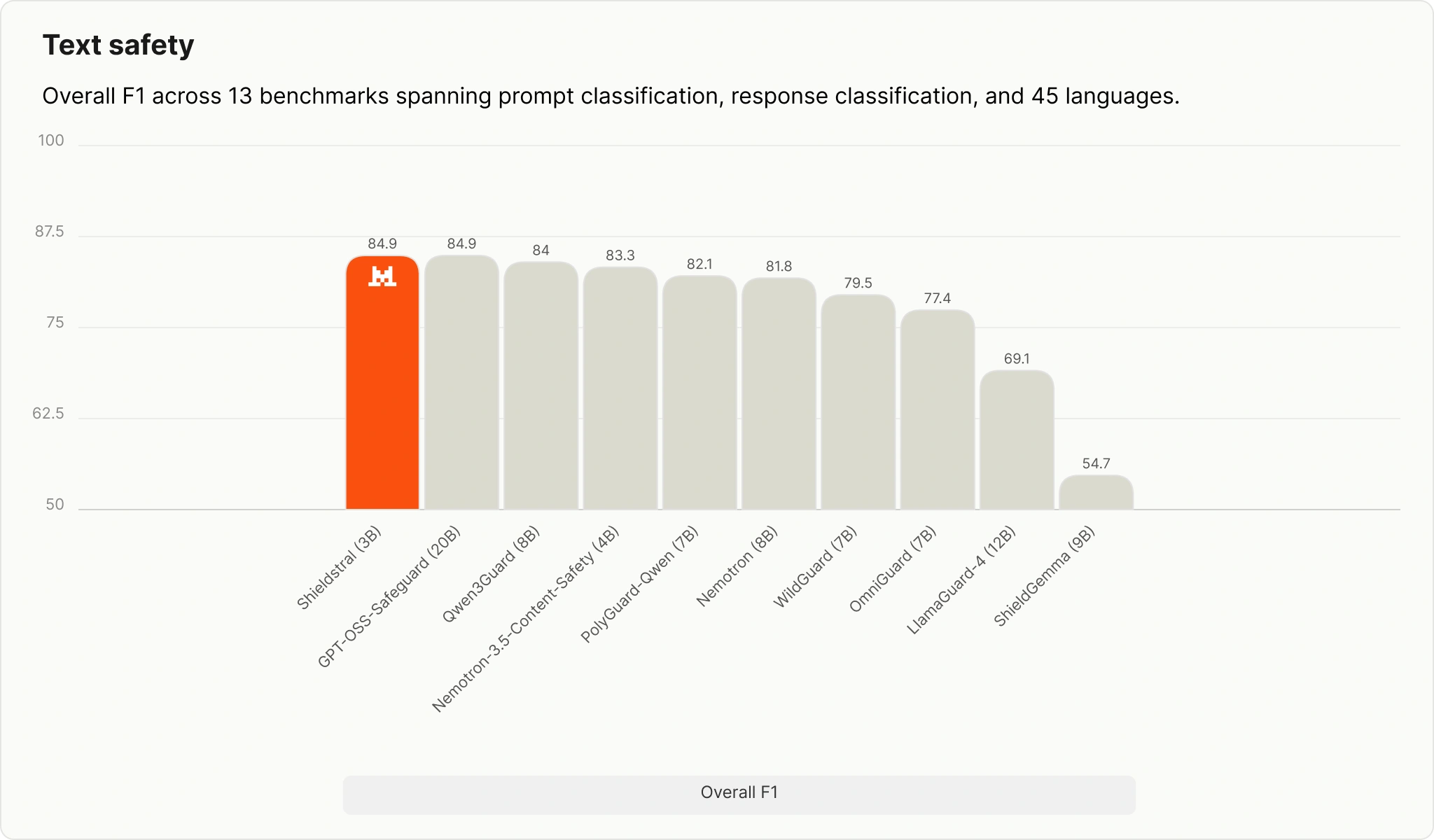
The results are striking: Shieldstral at 3 billion parameters matches or outperforms open guard models up to 7x its size across all four axes. All evaluation samples were confirmed to be held out from training data.

How Was Shieldstral Built? Technical Challenges
The team faced four key data challenges and solved them with innovative approaches:
Unifying Heterogeneous Data
The team converted diverse public safety datasets — with different taxonomies, labels, and annotation conventions — into the unified instruction-query-document format. This meant transforming every sample from every dataset into a standardized format suitable for processing.
Teaching Discrimination Over Memorization
The team built deliberately similar, confusable text pairs (contrastive text pairs) with similar but distinct policies, so the model learns to distinguish between specific policy violations rather than memorizing patterns. This prevents the model from developing a "generic toxicity detector" and pushes it to understand the specific policy context.
Grounding Safety in Images
Given the scarcity of image moderation datasets, the team supplemented with general-purpose images as negatives, then filtered them through a vision-language reranker to ensure quality.
Combining Checkpoints
The team used LoRA fine-tuning and SLERP merging across multiple checkpoints to achieve stable and consistent performance.
What Does This Mean for You?
For Companies and Startups
Traditional content moderation faces three challenges: high cost, limited Arabic support, and inflexibility in customizing rules. Shieldstral addresses all three:
- Cost: Free and open-source (Apache 2.0), runs on a single GPU
- Customization: Write your policies in any language at inference time — no retraining needed
- Full control: You hold the model weights, your data never leaves your servers
For Regional Platforms
Platforms across the Middle East — chatbots, social apps, e-learning platforms — can now build content moderation systems customized to their cultural and religious contexts without relying on external APIs that may not understand local nuances.
For Individual Developers
If you're a developer building LLM-powered applications, you can integrate Shieldstral as a guardrail layer over your models to prevent harmful content from reaching users — all on your own infrastructure.
Quick Comparison: Shieldstral vs. Alternatives
| Criterion | Shieldstral | OpenAI Moderation API | Llama Guard 2 | Azure Content Safety |
|---|---|---|---|---|
| Open source | Yes (Apache 2.0) | No | Yes | No |
| Model size | 3B | Closed | 8B | Closed |
| Multimodal | Yes (text + image) | Text only | Text only | Text + image |
| Policy adaptation | At inference time | Fixed | Limited | Fixed |
| GPU required | One 16GB | None (API) | 16GB | None (API) |
| Data privacy | Complete | No | Complete | No |
| Cost | Free | Per-request | Free | Per-request |
Integration with Mistral Products
Shieldstral was built end-to-end on Mistral's Forge platform — its internal platform for training, aligning, and evaluating custom models. Forge handled the infrastructure, data/model sharding, metrics, and logging.
This means Shieldstral is not just a research model — it's the product of a real production infrastructure. It can be integrated into Mistral's broader toolchain including their production APIs.
Limitations and Considerations
Despite its promising capabilities, consider the following:
- Multilingual coverage: Mistral noted that work continues on improving multilingual coverage. Current performance may be stronger in English than in Arabic or other languages.
- Long documents: Robustness with long documents is still being improved. For accurate evaluation of very long texts, you may need to split content into chunks.
- Evaluate in your environment: The model was trained on public datasets. Before relying on it in production, test it on your own data with your specific policies.
- Not a replacement for human review: Shieldstral is a powerful tool for automated moderation, but sensitive content always requires human review.
The Future of Open AI Safety
Launching Shieldstral as part of the "Open Secure AI Alliance" with NVIDIA sends a strong message: the future of AI safety is not exclusive to large closed companies. Open models can outperform closed alternatives, and transparency builds trust.
This is especially important for emerging markets where companies may not afford per-request moderation APIs. An open model means independence and complete control.
The Open Secure AI Alliance: A Strategic Signal
Launching Shieldstral as the inaugural product of the "Open Secure AI Alliance" with NVIDIA is not coincidental. This alliance represents a unified stance from some of technology's largest players: that AI safety should be open and auditable, not closed off behind paid APIs.
This approach explicitly contrasts with the closed-company model of OpenAI and Google, where internal moderation systems are trade secrets. The philosophy from Mistral and NVIDIA here is that transparency builds trust, and that the research community can improve safety systems faster when they're open to inspection.
This is particularly relevant given the ongoing debate about AI regulation. As governments worldwide consider mandatory safety testing (see Anthropic's open-weights position), open models like Shieldstral demonstrate that safety can be achieved through transparency rather than gatekeeping.
Case Study: How to Use Shieldstral in Practice
Imagine you manage an e-learning platform that uses AI models to generate educational content for students. You need to ensure that:
1. Generated content doesn't contain harmful misinformation
2. Student exercise answers aren't subject to bullying
3. Profile images don't contain inappropriate content
With Shieldstral, you can write three separate policies:
Policy 1 (Educational content):
<Instruct> High school educational platform, high strictness level
<Query> Does this text contain misleading educational information that could harm the student?
<Document> [Generated text]
Policy 2 (Bullying):
<Instruct> Interactive student platform, consider any personal insult as rejected content
<Query> Does this text contain bullying or personal insults?
<Document> [Student answer]
Policy 3 (Images):
<Instruct> Educational platform, no violent or inappropriate content
<Query> Does this image contain violent or inappropriate content?
<Document> [Image]
In each case, Shieldstral returns a score between 0 and 1. You can adjust the threshold to your needs — for example, rejecting any content with a score above 0.7.
This approach means the same model (Shieldstral 3B) can enforce completely different policies without any retraining — just by changing the instructions. This is impossible with traditional models that hardcode harm categories into their weights.
The Technical Challenge: Why 3 Billion Parameters Is Enough
One might wonder: how can a 3-billion parameter model outperform models 7x its size? The answer lies in the architectural approach:
- Focus on a single task: The model doesn't try to understand language in general — it only answers binary questions (yes/no) about content safety. This enormously simplifies the task.
- Using logits only: Instead of generating full text, the model reads only the "yes" and "no" logits. This eliminates the need for autoregressive decoding, making inference much faster.
- Contrastive training: Training the model on similar-but-different pairs taught it fine-grained discrimination rather than memorizing general patterns.
- Multi-checkpoint merging: SLERP merging across multiple checkpoints produced a more stable and robust model than any individual checkpoint.
These combined advantages mean Shieldstral achieves performance exceeding much larger models, with lower computational requirements — a critical feature for deployment in resource-constrained environments.
The Research Paper: Additional Technical Details
The accompanying research paper (arXiv:2607.25857) reveals additional technical insights:
- Handling data contradictions: The team faced a problem where the same content might be classified as "safe" in one dataset and "unsafe" in another, depending on context. They solved this by converting each sample into explicit instructions that specify context before judgment.
- Evaluation on unseen data: The team confirmed that all evaluation samples were held out — meaning they were not part of the training data. This is important because it rules out data leakage that could inflate results.
- Image performance: To overcome the scarcity of image moderation data, the team used an innovative approach: they added general-purpose images as negatives, then used a vision-language model to rerank and filter these images, creating a balanced training set.
This level of methodological rigor is noteworthy for an open-weights release, and it suggests that Shieldstral's benchmark performance is reliable rather than cherry-picked.
What This Means for Emerging Markets
Emerging markets — including the Arab world — face a significant gap in AI safety infrastructure. Most small and medium-sized companies cannot afford:
- Paid per-request moderation APIs
- Building custom moderation systems from scratch
- Employing specialized AI safety engineering teams
Shieldstral addresses this gap in three ways:
1. Completely free — no per-request costs
2. Easy to run — single 16GB GPU
3. Flexible — policies written as plain text at runtime
This means a startup in Riyadh, Cairo, or Dubai can build a high-quality content moderation system on a limited budget, while retaining full control over data and decisions.
The Broader Implications for AI Safety as a Field
Shieldstral's release raises an important question for the AI safety community: does openness help or hurt safety? The traditional argument from closed-model companies is that open safety systems help bad actors understand and bypass guardrails. Mistral's implicit counterargument is that open safety systems enable rapid community-driven improvement, and that the net effect is positive.
The evidence from Shieldstral's benchmarks — outperforming closed models 7x its size — suggests that openness can drive quality. If this model continues to be cited and improved by the community, it could become a reference implementation for content moderation, much as BERT became a reference for NLP tasks.
Frequently Asked Questions
Is Shieldstral free for commercial use?
Yes, Shieldstral is open-source under the Apache 2.0 license, allowing commercial use, modification, and distribution. Weights are freely available on HuggingFace.
Does Shieldstral support Arabic?
Mistral indicated that work is ongoing to improve multilingual coverage. Performance in English may be stronger currently, but the inference-time instruction approach allows writing policies in any language.
What are the technical requirements to run Shieldstral?
The model requires a single NVIDIA GPU with at least 16GB of VRAM. This means it runs on cards like the T4, V100, or any modern GPU with 16GB or more.
How does Shieldstral differ from Llama Guard?
Shieldstral is smaller (3B vs. 8B), supports images in addition to text, and allows changing policies at inference time without retraining. Llama Guard is more limited in flexibility and larger in size.
Can Shieldstral be used with non-Mistral models?
Absolutely. Shieldstral is an independent classifier that works as a safety layer over any LLM — whether from OpenAI, Google, Anthropic, or any other provider. It examines inputs and outputs independently of the underlying model.
Sources: Mistral AI Blog — Shieldstral (August 4, 2026), arXiv Technical Report.