

Meta Muse Glimmer: A 30B Open-Weights Model for Agentic Coding and Local AI — Runs on Your Machine
Source: Meta Superintelligence Labs — Announced August 10, 2026
On August 10, 2026, Meta Superintelligence Labs released Muse Glimmer — a 30-billion-parameter open-weights AI model designed specifically to run locally on consumer hardware without internet access or cloud servers. The model is available under the Apache 2.0 license, allowing full free commercial use, and can operate on a graphics card with just 24 GB of VRAM after K-Quant compression.
This release is not just another language model — it is Meta's first model built from the ground up for agentic workflows: the ability to autonomously execute multi-step tasks, use tools, recover from failures, and write code, all on your personal machine.
What Is Muse Glimmer?
Muse Glimmer is a dense causal transformer with 30 billion parameters, distilled from the larger Muse Spark model using logit distillation. It combines multiple capabilities into a single package:
- Multimodal understanding — processes text and images (screenshots, charts, documents) via a dedicated perception encoder (~1.8B parameter ViT-G/14)
- Multi-step reasoning — tackles complex problems through long chains of logical steps
- Reliable tool use — supports function calling with precise, reliable schemas
- Failure recovery — when a tool or code fails, it diagnoses the issue and retries instead of halting
- Local coding — writes, executes, and debugs code directly on your device
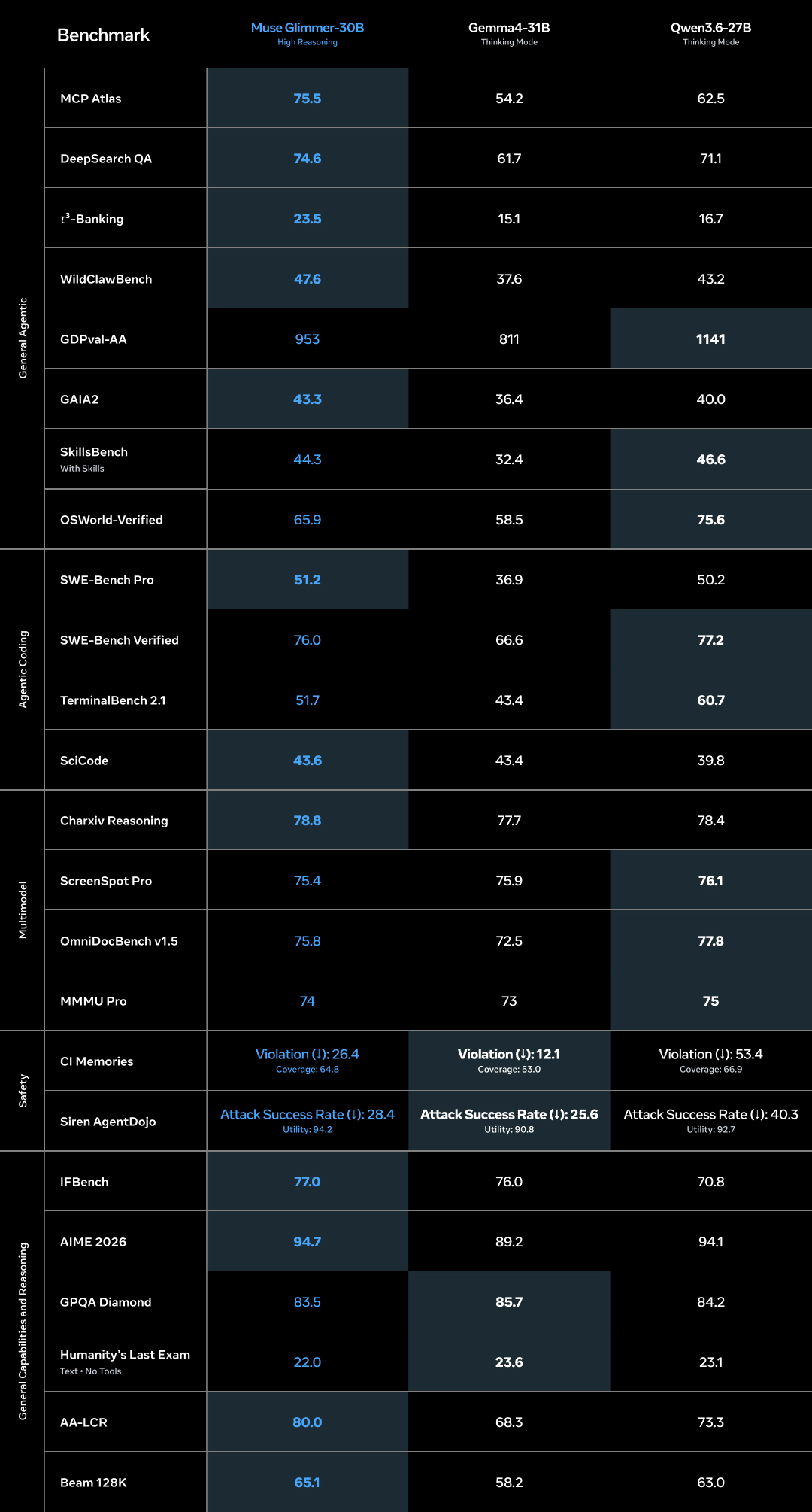
Image: Official benchmarks from Meta — Muse Glimmer vs Gemma4-31B and Qwen3.6-27B
How Was It Trained?
Muse Glimmer went through three major training phases:
1. Pre-Training: Distilled from Muse Spark using a similar data mixture, trained on data spanning more than 100 languages.
2. Mid-Training: Focused on longer-context, more agent-heavy data with richer reasoning traces to develop robust multi-step problem-solving abilities.
3. Post-Training: Combined supervised fine-tuning with on-policy distillation and reinforcement learning across general reasoning, coding, and agentic domains.
What Does This Mean for Developers and Users Worldwide?
This release matters for several reasons that go beyond raw benchmarks:
1. No VPN or foreign API needed: The model runs entirely on your machine. You do not need to create an OpenAI or Anthropic account, or pay with an international credit card. This is especially valuable in regions where access to cloud-based AI services is limited or expensive.
2. Complete privacy: Your data never leaves your device. For government agencies and companies handling sensitive data in the Gulf, Middle East, or anywhere with strict data sovereignty requirements, this means deploying powerful AI without privacy concerns.
3. Free for commercial use: The Apache 2.0 license allows full commercial use at no cost. Startups can build paid products on top of this model without licensing fees or revenue restrictions.
4. Multilingual support: The model is trained on data from over 100 languages, meaning solid understanding of Arabic, French, Spanish, Hindi, and many others — though it may not match specialized cloud models for every language.
Hardware Requirements: Do You Need a Supercomputer?
The short answer: no. This is Muse Glimmer's biggest achievement.
| Configuration | Memory Required | Suitable Hardware |
|---|---|---|
| Full Precision | ~55 GB | Multi-GPU workstations |
| K-Quant-Dynamic (4-bit) | Under 20 GB | RTX 4090 / RTX 5090 |
| K-Quant-17GB | ~17 GB | RTX 3090 / 24GB cards |
Additionally, the model ships with DFlash speculative decoding technology, which uses a lightweight drafter model to accelerate generation significantly:
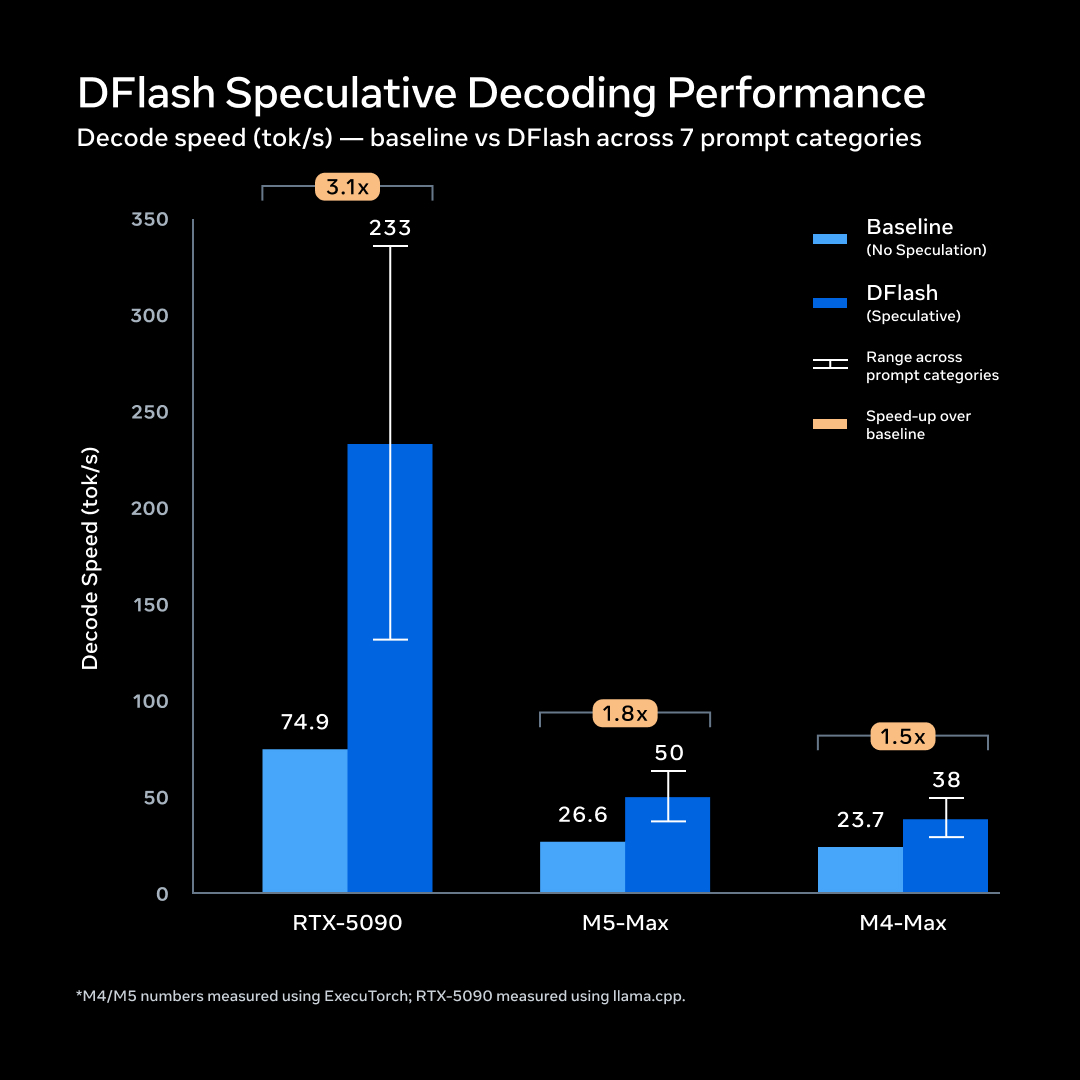
Image: DFlash speculative decoding acceleration across hardware — from Meta
- RTX 5090: 3.1x speedup
- M5 Max (Apple): 1.8x speedup
- M4 Max (Apple): 1.5x speedup
Meta describes the model as "fast enough for fluid conversation and real-time agent interaction" entirely on-device.
How to Get It and Use It
Direct Download
The model is available for free download on Hugging Face as meta-models/Muse-Glimmer-30B.
Local Runtime Tools
| Tool | Status | Best For |
|---|---|---|
| Ollama | Coming soon | Quick and easy setup |
| LM Studio | Coming soon | GUI for beginners |
| llama.cpp | Available | Lightweight CPU/GPU inference |
| MLX | Available | Apple Silicon devices |
| ExecuTorch | Available | Mobile devices |
Cloud Inference (Optional)
If you prefer not to run it locally, the model is available through several providers:
- Together AI — competitive API pricing
- Fireworks AI — fast inference
- OpenRouter — unified API for multiple models
Quick Comparison: Muse Glimmer vs Alternatives
| Feature | Muse Glimmer 30B | Gemma4-31B | Qwen3.6-27B |
|---|---|---|---|
| License | Apache 2.0 (free commercial) | Gemini restricted | Apache 2.0 |
| Size | 30B | 31B | 27B |
| Multimodal | Yes (text + images) | Yes | Limited |
| Runs on 24GB VRAM | Yes (with K-Quant) | Difficult (needs 32GB+) | Yes |
| Agentic | Purpose-built | Partial | Partial |
| Languages | 100+ | Multiple | Multiple |
Muse Glimmer's advantage is not being the most powerful at everything — it is the only purpose-built agentic model in its class designed for local deployment with full tool use and autonomous failure recovery.
Honest Limitations
It is important to be transparent about what the model cannot do:
- 30B size has limits: The model is not as capable as GPT-5.6 Sol or Claude Opus 5 on highly complex tasks. It is designed for practical agentic workloads, not advanced research problems.
- Text generation only: While it can understand images, it cannot generate images or video.
- Long context: The model supports long-context memory, but Meta has not disclosed the exact maximum context window in tokens.
- Weaker hardware: If you do not have a GPU with at least 24 GB of VRAM, you will need more aggressive quantization that may reduce quality.
- Updates: Open-weights models do not auto-update like cloud services. You will need to manually download new versions.
Why This Matters: The Shift Toward Local AI
Muse Glimmer represents a broader industry shift that affects every developer and business:
The end of the cloud AI monopoly. Until now, the most capable AI models lived behind proprietary APIs controlled by a handful of companies. Muse Glimmer proves that a model capable of autonomous agentic work — tool use, multi-step reasoning, failure recovery, multimodal understanding — can fit on a consumer GPU and run at conversational speed.
Cost elimination for high-volume use cases. If you are building a coding assistant, a customer service agent, or a data analysis tool that processes thousands of requests per day, running a free local model instead of paying per-token API fees can save thousands of dollars monthly.
Data sovereignty becomes practical. Organizations that could never send sensitive data to foreign cloud APIs can now deploy capable AI entirely within their own infrastructure. This is transformative for healthcare, legal, financial, and government sectors worldwide.
Frequently Asked Questions
Can I use Muse Glimmer in a paid commercial product?
Yes, the Apache 2.0 license allows full commercial use including selling products built on the model, with no fees or revenue restrictions.
How much memory do I need?
Using K-Quant-Dynamic compression, the model fits in under 20 GB, meaning a GPU with 24 GB VRAM (such as RTX 4090 or RTX 5090) is sufficient.
Does it support non-English languages well?
The model is trained on data from over 100 languages. Quality is good for general and coding tasks in most major languages, though it may not match specialized cloud models for advanced literary or domain-specific tasks.
What is the difference between Muse Glimmer and Muse Spark?
Muse Spark is the larger, more powerful model in the family, while Muse Glimmer is distilled from it and optimized for local deployment on consumer hardware. Muse Glimmer trades some raw capability for the ability to run on your personal machine.
Does it replace ChatGPT or Claude?
No, not in that sense. Large cloud models still outperform it on highly complex tasks. But Muse Glimmer wins on privacy, cost (free), and independence from internet connectivity — which are decisive factors for many users and organizations.