
Meta Brain2Qwerty v2 2026: Non-Invasive Brain Signals to Text, Explained
On June 29, 2026, Meta AI shared Brain2Qwerty v2, a research system for decoding typed sentences from non-invasive brain recordings. This is a dated explainer for an important recent AI research event that Truescho had not covered with a dedicated article. It is not a consumer mind-reading product.
Source: Meta AI on X
Source: Meta AI
The Key Number: 61% Word Accuracy
Meta reports that Brain2Qwerty v2 reached 61% average word accuracy, with 78% for the best participant, when decoding natural sentences from MEG recordings during typing. That is significant for non-invasive brain-to-text research. It is not enough for reliable daily communication without correction.
The distinction matters. Invasive brain-computer interfaces can access cleaner signals, but they require surgery and carry medical risks. Non-invasive systems are safer in principle, but the signals are weaker and noisier. Brain2Qwerty v2 suggests that more data, better neural models and language context can extract more usable signal from external recordings than older approaches.
What Meta Built
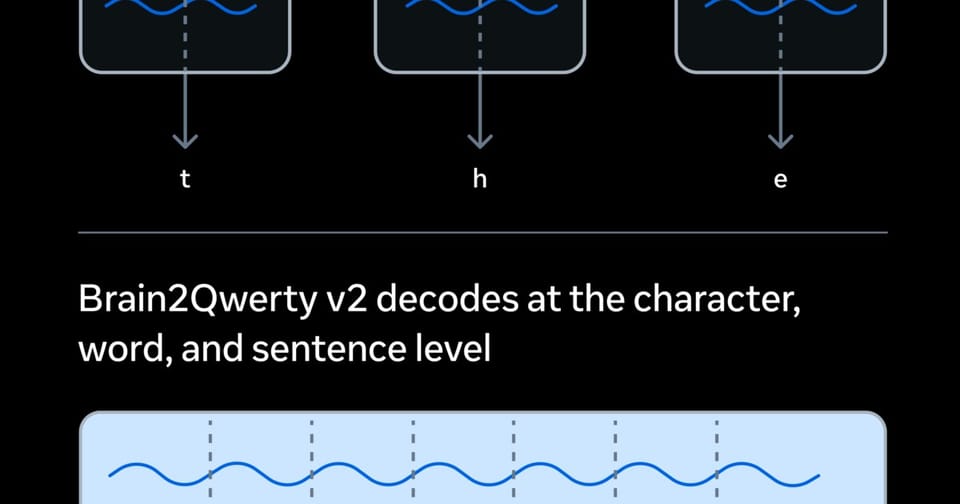
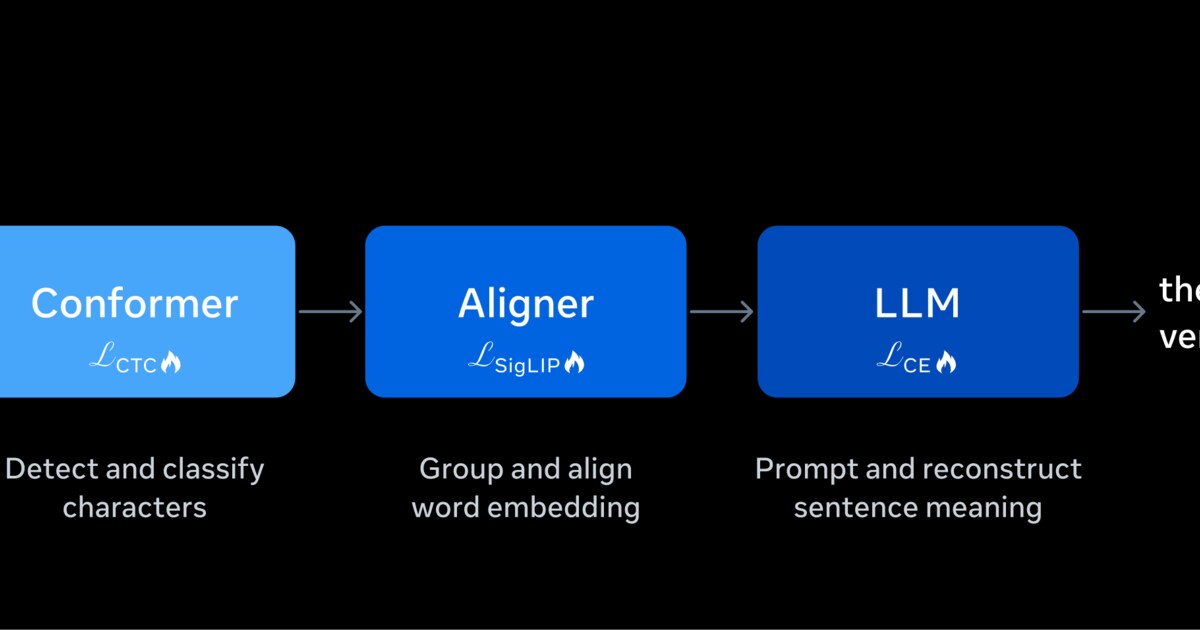
Meta says v2 was trained on about 22,000 sentences from nine volunteers. Each participant was recorded for 10 hours while wearing an MEG device and typing on a keyboard. The system decodes from raw brain signals in an end-to-end pipeline rather than relying on a hand-built sequence of signal events.
Language context is part of the story. A language model can help turn noisy neural evidence into coherent text, but that does not mean the system reads free thought. The task is constrained: a person is typing while the brain activity is recorded in a lab setting.
Why Researchers Care
For AI professionals, the lesson is that language models are moving deeper into biological and time-series signals. Brain2Qwerty v2 sits at the intersection of neural decoding, multimodal modeling, assistive communication and research infrastructure.
The long-term hope is communication support for people who cannot speak or move easily. The current reality is much narrower. MEG systems are large research instruments, the dataset is small, and accuracy is not yet sufficient for clinical communication.
This is also a privacy story. Brain data is not like ordinary web text. Even when handled for research, it requires consent, governance and careful limits on reuse.
Where This Fits
| Path | Signal type | Strength | Limitation |
|---|---|---|---|
| Brain2Qwerty v2 | Non-invasive MEG during typing | Stronger non-invasive sentence decoding | Lab equipment and constrained task |
| Invasive BCI | Implanted electrodes | Cleaner signals | Surgery and medical risk |
| EEG-based non-invasive systems | Easier sensors | More practical hardware | Usually weaker signal |
| Consumer wearables | Lightweight sensors | Convenient and cheaper | Not comparable to MEG lab recordings |
Source: Meta AI Research
Open Research and Data
Meta says it released training code for Brain2Qwerty v1 and v2, and BCBL released the v1 dataset. Meta also connects the work to the 5 million dollar Digital Brain Project fund for open brain datasets. That matters because brain research is limited by data scarcity, hardware differences and reproducibility challenges.
Open release does not remove ethical risk. Brain recordings are sensitive. Any future dataset work needs informed consent, narrow purpose, access control and clear rules for reuse.
What the Research Does Not Prove
The first limitation is hardware. MEG is not a consumer headset. It is a specialized lab instrument that requires controlled conditions.
The second limitation is the task. Participants typed sentences during recording. That is very different from decoding spontaneous inner speech or helping a person with severe paralysis communicate in daily life.
The third limitation is scale. Nine volunteers and 10 hours each are meaningful for research, but not enough to generalize across patients, languages, ages or neurological conditions.
The fourth limitation is accuracy. A 61% word-accuracy result is promising, but real communication needs high reliability, correction mechanisms and careful handling of meaning.
Careful Questions
Is Brain2Qwerty v2 mind reading?
No. It decodes typed sentences from MEG recordings during a controlled task. It does not read arbitrary thoughts.
Is it invasive?
No. Meta describes the system as non-invasive because it uses MEG recordings rather than implanted electrodes.
What accuracy did Meta report?
Meta reports 61% average word accuracy and 78% for the best participant in the v2 setup.
Is the code available?
Yes. Meta says it released training code for Brain2Qwerty v1 and v2.
Is it ready for patients?
No. It is a research milestone, but clinical use would require better accuracy, different studies, patient validation and practical hardware.
Why Headlines Need Restraint
Brain-computer interface stories attract dramatic headlines, but exaggeration is harmful here. Saying that the system reads minds misleads readers and damages trust in research. The accurate description is narrower: it decodes sentences associated with typing in a lab environment using MEG. That framing is less sensational, but it is more useful for researchers, clinicians and patients.
Ethical precision matters because this field touches people looking for medical hope. A research milestone should not be turned into a treatment promise. Moving from a lab result to an assistive product for people who cannot speak requires safety studies, broader samples, practical hardware and clinical validation.
What Researchers Will Watch Next
Researchers will watch four questions. Does accuracy continue improving with more data? Does the system work across other languages and input patterns? Can the hardware burden be reduced or replaced by easier signals? And can the approach move beyond typing-related activity toward broader communication intent? Those answers will determine whether Brain2Qwerty remains a narrow research result or becomes part of a real assistive-communication path.
How To Read the Result
Brain2Qwerty v2 is worth following because it pushes the boundary of non-invasive decoding, but it does not change everyday user life now. Its value is in open research and the questions it raises about neural data, not in a ready product. It should be read as a scientific step, not a commercial launch.
For researchers, the opportunity is not to copy the experiment blindly. It is to ask what responsible datasets would require for other languages, input patterns and clinical contexts. Work in this area needs neuroscience labs, language experts, research ethics and machine-learning engineering together.
How This Differs From Everyday AI Tools
Most AI tools people use every day operate on text, images or ordinary audio. Brain2Qwerty touches a more sensitive layer: brain signals linked to human behavior. That means performance, price and availability are not enough as evaluation criteria. Researchers also need consent, secondary-use limits, re-identification safeguards, data ownership and result ownership.
That is why the story matters beyond specialists. As models become better at interpreting deeper human signals, governance needs to arrive before products, not after them. The same path could enable valuable assistive tools or harmful misuse depending on rules and incentives.
What Open Code Means Here
Open code helps researchers verify and build on the work, but it does not mean everything should be open. In brain research, data may be more sensitive than the algorithm. A healthy model can combine open code, controlled data access and clear ethics review protocols.
Example: Research Milestone vs Product
For a person who cannot speak, a brain-to-text headline may sound close to a direct solution. Brain2Qwerty v2 is not that yet. The experiment involves participants actively typing while inside an MEG setup. That differs greatly from a person with paralysis trying to communicate through internal speech or intended movement. The signal, training setup and clinical goal are all different.
That does not reduce the value of the research. It clarifies it. The work improves a specific non-invasive decoding path and gives researchers a better starting point. It does not justify treatment promises. The correct reading is progress in foundational components, not a ready medical communication system.
Neural Data Risk
As models move closer to brain signals, data sensitivity rises. Neural recordings may reveal information about attention, fatigue or health conditions. Consent rules need to be stricter than in ordinary data projects. Participants should know what is collected, why it is collected, who can access it and when it is deleted.
This matters globally. Any university or hospital project in this area should begin with research ethics and governance, not technical excitement alone.