
LinkedIn's AI Slop Button: 1 Million Clicks and 40% Fewer Junk AI Posts
Last updated: August 2026
The number that tells the whole story: more than 1,000,000 people have clicked LinkedIn's "seems like AI slop" button in just two weeks since launch — and the platform now reports 40% fewer views on what it classifies as low-quality AI content. The source is not a leak but an official post from Hari Srinivasan, LinkedIn's chief product officer, published Thursday, August 20, 2026, as a follow-up to the feature the platform launched on July 30. If you are a professional who publishes on LinkedIn — or a marketer producing content for a company page — the rules of distribution on the platform just changed in a way you can measure in your own analytics.
Source: Hari Srinivasan's official LinkedIn post
Where the button came from: a documented timeline
The story starts before the button existed. The AI detector Pangram estimated that 41% of LinkedIn's longform posts were fully AI-generated — a figure reported by 404 Media that landed uncomfortably for a platform selling itself as a network of real professionals. The response unfolded in three documented stages:
- July 30, 2026: LinkedIn launches the "seems like AI slop" button in the three-dots menu of every post and comment, introduces new and improved classifiers to identify AI content, and removes its own AI-powered "enhance your post" feature — a quiet admission that the platform had been contributing to the problem it was now fighting.
- August 20, 2026: Srinivasan publishes the numbers in his official post: a million clicks in two weeks, and a 40% drop in views on classified low-quality AI content compared with a few weeks earlier.
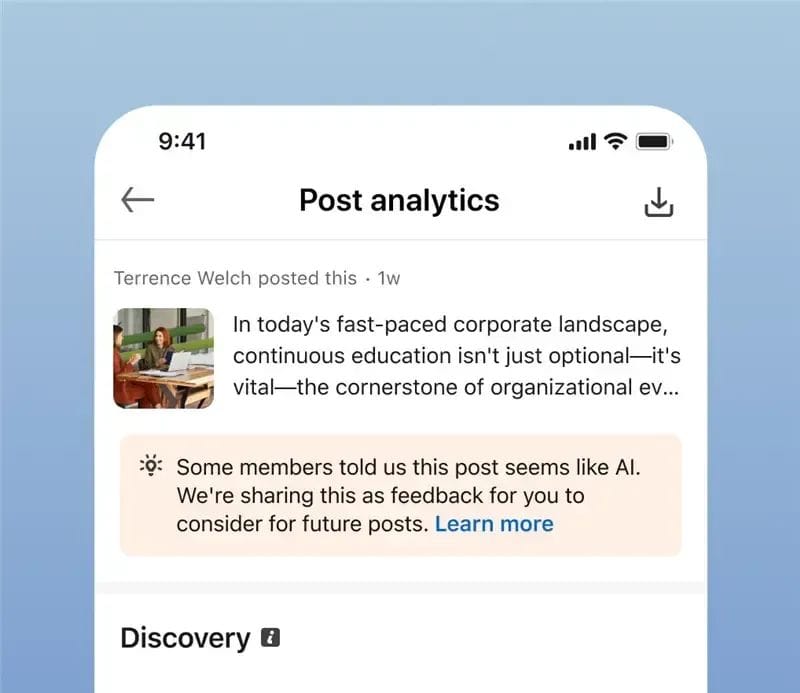
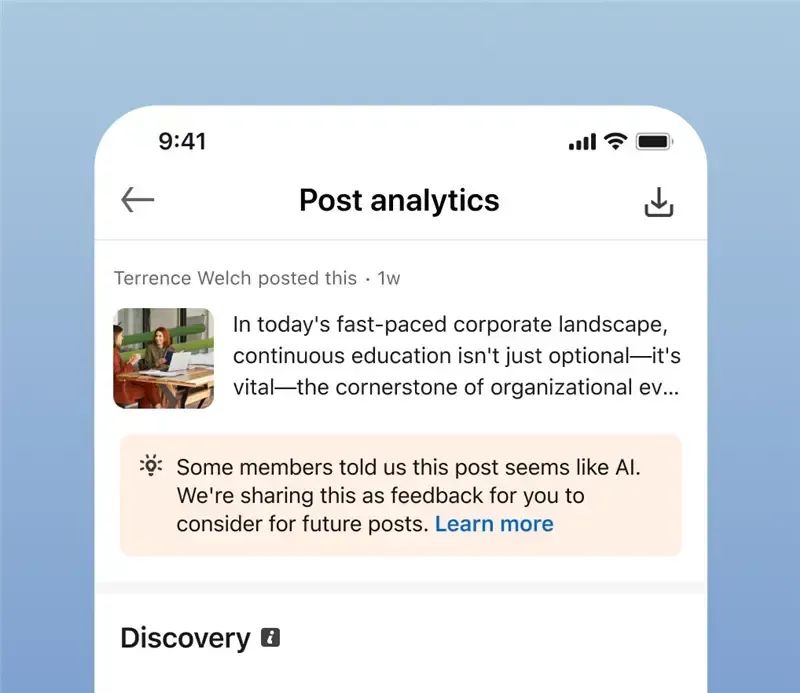
- The same week: a new message begins appearing in Post Analytics for authors whose posts attract enough community feedback, reading close to: "Some members told us this post seems like AI."
Earlier in the year, the platform had already announced a crackdown on comments produced at scale "with little or no human involvement." The context is unambiguous: an open war on manufactured content.
How the button actually works
The mechanism is simpler than you would expect: open the three-dots menu (⋮) on any post or comment, select "seems like AI slop," and you are done. No report form, no reason codes — a single click registers a signal.

Source: Unsplash
The sensitive part — which the CPO took care to state explicitly — is that "no single piece of feedback determines how content is distributed." The platform combines many signals and has built safeguards to prevent individual feedback from being used to unfairly target other members. Translation for the worried: a jealous competitor cannot take you down with a coordinated click.
What happens after the click: the signal's journey
To grasp the change, follow what happens after that single click, as described in the official post and the July announcement:
- The signal is recorded without visible identity to the author — the poster never sees who reported or exactly how many reports arrived.
- Community signals are aggregated with the platform's classifiers — the new detection systems announced at launch work alongside user clicks, so no decision rests on any single input.
- When a threshold is crossed, the author sees a private note inside Post Analytics — no public flag, no announced penalty, just a message reading close to: "Some members told us this post seems like AI."
- Distribution tapers gradually — content classified as low quality loses part of its reach, consistent with the reported 40% figure, but nothing is deleted and no account is banned.
This graduated design carries a practical implication: you will not wake up to a punished account. You would first see a warning note in your analytics, and before that, a quiet decline in engagement metrics. Anyone reviewing their numbers weekly always has time to correct course — only the publish-and-forget type gets surprised.
If you hire or run a team: reading the change as an employer
If you screen candidates or manage a company page, the button changes your equation on two fronts:
- In candidate screening: manufactured posting volume is now a potential negative signal, not a positive one. A profile with three documented experiences and real certificates outranks one with two hundred generic posts — not because posting is inherently bad, but because the platform's own algorithm now suppresses manufactured-looking presence, letting it wither on its own.
- In company content: if your team or agency produces posts from uniform AI templates, you are paying for content with declining reach. Audit the last twenty posts with one simple test: could any other company publish this exact text unchanged? If yes, the post is a classification candidate.
And the deeper point for anyone recruiting on the platform: trust is now a declared competitive asset. A network whose entire value rests on "real professionals" will not hesitate to throttle whatever threatens that foundation — and advertisers, the ultimate beneficiaries of a clean feed, gain the most from this campaign even though they never asked for it.
Three practical scenarios: what to do today
Scenario one — a student hunting an internship: you notice declining post views and a new message in your analytics. Do not delete the post or stop publishing; change the pattern instead. One short post about a real university project, with a concrete number or result, rebuilds credibility within weeks.
Scenario two — an agency managing client pages: add a mandatory human-review step anchored in the client's own voice: a ten-minute interview from which you extract one genuine quote per post. That quote is the single element competitors cannot generate.
Scenario three — a professional new to AI tools: do not stop using them; move them inside your workflow. Let the model summarize, classify, and draft headings — then write the final text yourself. The tool at the start of the line produces slop; in the middle of the line, it produces extra hours for you.
What the 40% figure really means
Here the distinction between what was said and what it means matters:
- What the executive said: members are "overall now experiencing 40% less views on what we classify as AI slop from just a few weeks ago" — phrased with visible caution ("I hesitate to give numbers, as everyone has a different network and feed").
- What it does not mean: that all AI-assisted content is being suppressed, or that using language models is banned. The declared target is "slop" — manufactured, generic, experience-free filler — not intelligent tool use.
- The figure's limits: it is a self-reported measurement by the platform itself, not an independent audit, and the classification criteria are not published.
The practical rule: use AI to organize your thinking and draft, then add your own expertise, opinion, and story. The person pasting raw model output is who this update targets.
What this means for you as a professional
- If you are a reader: you now hold a real cleanup tool — use the button on the manufactured "inspiration" posts flooding your feed, because community signals are now officially an input to distribution decisions.
- If you create content or freelance: check Post Analytics regularly; the new message appears there for the author, and it may be your first warning that your writing has started sounding automated.
- If you market a business: beware uniform ChatGPT templates on the company page — the algorithm now rewards distinctly human voices. The direction matches what other platforms have signaled, like Instagram head Mosseri's stance on AI content, and even detection-at-the-device approaches such as WhatsApp's on-device scam alerts: the industry is converging on distinguishing the manufactured from the real.
- If you are job hunting: a profile showing genuine evidence — like adding your certificates to LinkedIn the right way — now outranks a manufactured posting presence. Profile substance beats posting volume.
- The system resists gaming: one malicious report does nothing by itself; aggregation across many signals is the design.
As you build your professional presence, remember that a profile documented with real certificates and experience speaks louder than a hundred manufactured posts — and Truescho helps you organize that profile from your first opportunity onward.
How to write without an AI fingerprint: six quick checks
- Read it aloud. Long, perfectly balanced machine sentences expose themselves when spoken.
- Insert your own number. Your years of experience, your project's result, a real price — models do not know your figures.
- Break the structure. Three equal paragraphs with three bullet lessons is a near-certain generated template.
- Delete the preamble. "In today's fast-changing world" — remove it from every post you write.
- Take a position. A clear opinion that disagrees with someone is more credible than a neutral summary.
- Let the tool draft, then rewrite. Ask for structure, then rewrite in your own words.
A shorter post with one genuine idea now beats a long polished post with no stance — that is the essence of the platform's new message.
Quick comparison: how platforms handle AI content
| Platform | Tool | Mechanism | Status |
|---|---|---|---|
| "Seems like AI slop" button + classifiers | Community signals feed distribution decisions | 1M clicks in two weeks | |
| Instagram/Meta | Policy stances | Preference for original content in recommendations | Declared direction since 2025 |
| Google Search | Preferred sources | Users choose favored sources in results | Rolling out gradually |
The common thread: judgment now lands on the quality of contribution, not on the origin of the tool — and whoever adds human value on top benefits.
Honest limitations before judging
- The 40% figure is the platform measuring itself, with no published methodology and no external audit.
- "Slop" is not publicly defined — nobody outside LinkedIn knows exactly where the classification boundary sits.
- The anti-targeting safeguards are an official verbal commitment; their internal mechanics are undisclosed.
- The "enhance your post" removal came a year after the platform promoted generation features — institutional memory matters.
Frequently asked questions
What is LinkedIn's "seems like AI slop" button?
A feature launched on July 30, 2026 that lets any user flag a post or comment that appears AI-generated, via the three-dots menu. Signals are combined with others to reduce the reach of low-quality manufactured content. Over one million people used it within two weeks of launch.
How do I report AI-generated posts on LinkedIn?
Open the post or comment, click the three dots in its corner, choose the "seems like AI slop" option, and confirm. It is a single click with no form, and the author is never told who reported the content.
Does LinkedIn downrank AI-generated content?
The chief product officer announced that views on content the platform classifies as low-quality AI material dropped 40% within weeks. The target is manufactured filler without human value, not every use of AI as an assistance tool.
What does the "some members told us this post seems like AI" message mean?
It is a new notice inside Post Analytics shown to the author when community feedback on a post crosses a threshold. Its purpose is helping you understand how your audience receives your content. No single report triggers it, and no single report determines distribution.
Is using ChatGPT on LinkedIn banned?
No. There is no ban on tools; the declared target is low-quality content mass-generated without human contribution. Using a model as a draft assistant and then writing your expertise and opinion in your own words remains a sound, safe approach.
Sources
- Hari Srinivasan's official LinkedIn post — August 20, 2026 — the primary source for all figures
- Over 1 million people have clicked LinkedIn's AI slop button — The Verge — corroborating coverage and timeline
- LinkedIn Newsroom — the platform's official news hub
The Verdict for Publishers
A million clicks in two weeks means LinkedIn's own audience voted against manufactured content — and the platform handed them a daily voting tool. Winning the 2026 feed is no longer about posting volume; it is about the one sentence a model cannot write for you: your experience, your number, your position. Write shorter, truer, and more specific — and let the button work for you instead of against you.
Explore Truescho's free tools →